THE RUMOR FLOATED AT THE FRINGES OF THE JESUIT REPORTS TO OFFICIALS IN Quebec, stories of a river bigger than the St. Lawrence flowing south from the Great Lakes into the unknown. The French authorities hoped it might prove to be the long-sought passage to the Pacific, but, whatever its course, they needed to fill in the blank spot on the map. So, in 1672, they asked Louis Jolliet, a native of New France and an experienced coureur de bois, to find the river the Ottawa called Missi Sipi and follow wherever it led. The Jesuits insisted on sending a priest with the expedition to bring the word of God to the heathen, and Jacques Marquette, an experienced backcountry cleric was chosen for the trip. Jolliet launched his canoes from Sault Ste. Marie in the spring of 1673, stopped at Michilimackinac in May to pick up Marquette, then continued down the north shore of what is now known as Lake Michigan, into Green Bay, up the Fox River, and off the edge of the French map.
They found the river and headed south into a landscape like nothing a European had ever seen, an immense country of grass and wildflowers, head high in the summer breeze, stretching to the western horizon. They called it “prairie,” a reference to the grassy openings they had known in France, but this was something far different. As Jolliet commented on his return:
“At first, when we were told of these treeless lands, I imagined that it was a country ravaged by fire, where the soil was so poor that it could produce nothing. But we have certainly observed the contrary; and no better soil can be found, either for corn, or vines, or for any fruit whatever. . . . There are prairies three, six, ten, twenty leagues in length and three in width, surrounded by forest of the same extent; beyond these, the prairies begin again, so that there is as much of one sort of land as of the other. Sometimes we saw grass very short, and, at other times, five or six feet high; hemp, which grows naturally here, reaches a height of eight feet.”[i]
Jolliet had spent a lifetime hunting in the untrammeled forests of New France, but he was still impressed by the abundance of game.
“The prairies and forests share this country, which provides beautiful pasturage for a large number of animals with which it is filled. The oxen [bison] never flee. The Father [Marquette] has told of as many as 400 of them in a single band. The deer and the hinds [elk], the roe deer [probably whitetails] are almost everywhere; the cocks [prairie chickens?] chase each other on all sides; the peroquets [Carolina parakeets] fly in bands of ten or twelve, and the quails are in the meadows at all times.”[ii]
One hundred and fifty years later, the Indian agent Joseph Street crossed the Mississippi into the prairie uplands and timbered bottoms in what is now northeastern Iowa.
“I had never rode through a country so full of game,” he wrote in 1833. “The hunter who accompanied me, though living most of his time in the woods, expressed his astonishment at the abundance of all kinds of game.”[iii]
In 1839, geologist David Dale Owen came to the region, charged by the Secretary of the Treasury to complete the nation’s first survey of the minerals and soils in Iowa, Wisconsin, and northern Illinois. The report he filed was long on scientific detail, but, at one point, he paused to consider the esthetics of the country he surveyed:
“At the Mississippi,” he wrote in 1840, “the prairie for the most part extends to the water’s edge, and renders the scenery truly beautiful. Imagine a stream a mile in width, whose waters are as transparent as those of a mountain spring, flowing over beds of rock and gravel— fancy the prairie commencing at the water’s edge, a natural meadow of deep green grass and beautiful flowers, rising with a gentle slope for miles so that, in the vast panorama, thousands of acres are exposed to the eye. Sometimes the woodland extends along this river for miles . .. and sometimes in vast groves of several miles in extent, standing alone, like islands in this wilderness of grass and flowers.”[iv]
This was the New World’s tallgrass prairie as the first Europeans found it.
And, as soon as John Deere and his successors designed plows up to the challenge of breaking the thick prairie sod, this was the wilderness of grass and flowers we proceeded to take apart. Estimates vary, but there’s general agreement that less than five percent of that original grassland remains, making it one of the rarest ecosystems in North America.
A couple of years back, I was contemplating that grim statistic as I stood on the edge of a prairie restoration in northern Illinois, a jurisdiction that proudly, if more than a little ironically, calls itself “the prairie state,” though less than one-tenth of one percent of the state’s original tallgrass has survived into the present.
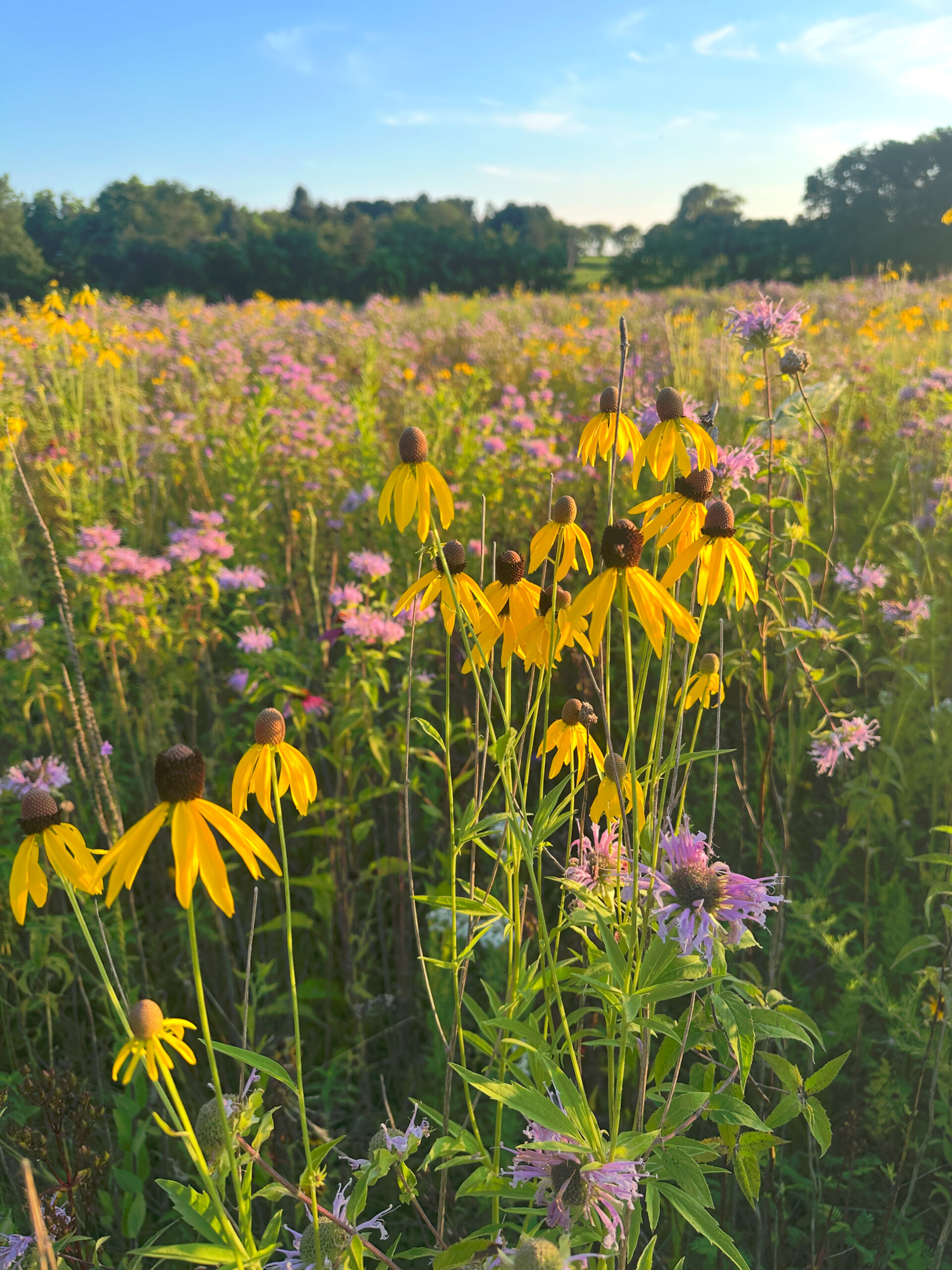
It was the middle of July, and this little patch of natives was well into a display that lasts from June to late September, a procession of wildflowers that rivals the best efforts of modern landscapers and injects a vibrant patchwork of color into the monotone of the surrounding corn. The field literally hummed with bees, most of them native to this place; butterflies floated from one blossom to another, and a vast collection of smaller lace-winged insects hovered over the vegetation.
I’ve seen the carpets of spring beauties on the slopes of Arkansas’ Boston Mountains in the first days of spring, the stands of trillium in the maple forest of Wisconsin, the vast swaths of balsamroot on the summer hillsides along the Snake River in Wyoming— all of them exquisite evocations of the wild places that nurture them, breathtakingly beautiful. But I have to say they pale in comparison to the fireworks of a thriving stand of tallgrass in the middle of July.
As I contemplated the exuberance of that patch of prairie, my ecological training began whispering in my ear. This is a system that has been shaping itself since the last glacier retreated. It’s the reason there were four or five feet of ink-black topsoil here when the first plow broke the sod, the reason the fertility of this ground remains the envy of the world.
If an ecologist were to measure the productivity of this system in its natural state, I wondered, what would those numbers show? The primary production of the prairie vegetation itself added to the herds of bison, elk, and deer; the flocks of prairie chickens; the clouds of waterfowl— from a strictly quantitative point of view, how much could this landscape produce in its pristine condition?
It would have been staggering, certainly not as much as it produces now, I conceded to myself, but then, we inject an immense amount of energy into the system— the fertilizer and diesel fuel, the herbicides that focus all the output into the crops we’ve introduced; the pesticides that eliminate all the competition for those crops. Subtract those massive inputs, and what’s left? Does our version of this place produce more than the original?
And there is the question of sustainability, I thought. What we’ve done with the prairie requires constant maintenance. It degrades the water and pollutes the air. And, if beauty matters at all in our lives, our approach to husbanding this place gives us none. We set out to create a garden here and built a factory instead.
I don’t know whether we could have found a way to live in the tallgrass that didn’t destroy at least some of it, but, at the very least, we might have tried to find a way to live alongside it. The ecologist E.O. Wilson has argued for a world split evenly between human demands and ecosystem integrity, half for people, half for the rest of life on the planet.[v] What would the heartland of America be like if half of it were devoted to the culture of the crops we need while the other half remained “a wilderness of grass and flowers”? Not as productive of profit, perhaps, but certainly a more beautiful, more livable home.
Restraint is not one of our virtues. All too often, when we set our minds on a course of action, we take it to the most destructive extreme, generally without much further thought. If something is worth doing, it’s worth overdoing. It’s a poor way to strike a balance in our affairs, an even poorer way to find happiness. As I stood on the edge of that tiny patch of prairie, it occurred to me that it was a reminder of what we stand to lose when our only yardstick for success is a bank account. The tattered scraps of tallgrass that remain are a reminder of a wilderness we erased, a monument to a mistake. Like most of the serious mistakes in life, this one can’t be undone. All we can do is regret it . . . and, if we have any sense at all, learn from the loss.
[i] Madson, John, 1983. Where the sky began. Houghton Mifflin. pp.5-6.
[ii] Danlanglez, Jean, 1944. The 1674 account of the discovery of the Mississippi. Mid-America; An historical review, 26(4): 319.
https://archive.org/details/sim_mid-america-an-historical-review_1944-10_26_4/page/318/mode/2up. Accessed July 4, 2026.
[iii] Dinsmore, James, 1994. A country so full of game: The story of wildlife in Iowa. University of Iowa Press, Iowa City, IA.
[iv] Madson, op cit, 1983. P.11.
[v] Wilson, Edward O., 2017. A biologist’s manifesto for preserving life on Earth: An eminent scientists offers a bold vision for preserving Earth’s biodiversity. Sierra, Dec. 12, 2016.
https://www.sierraclub.org/sierra/2017-1-january-february/feature/biologists-manifesto-for-preserving-life-earth. Accessed July 11, 2026.
Leave a Reply
You must be logged in to post a comment.