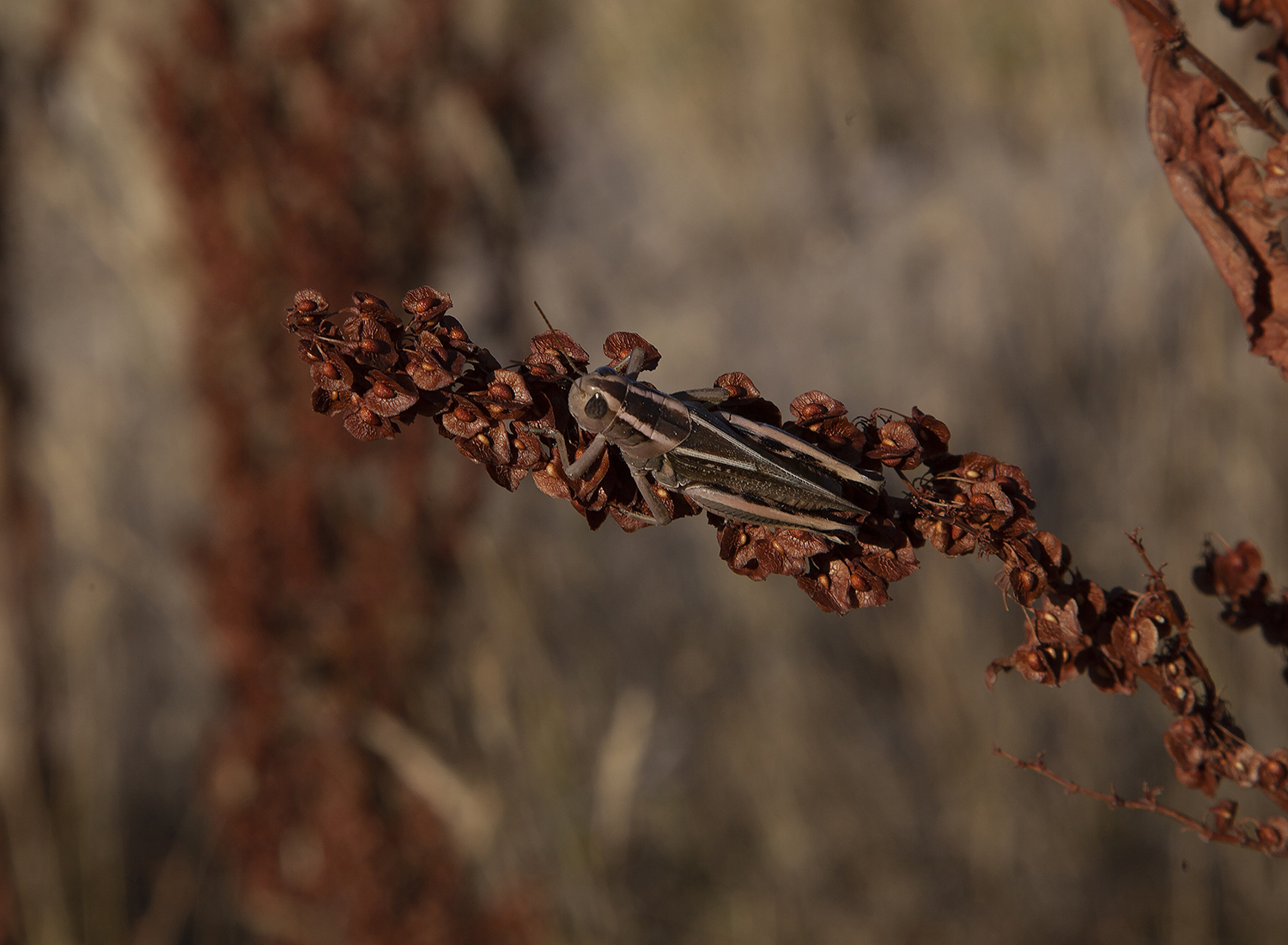
 Grasshopper on curly dock, Chris Madson
IT MAY BE THE FIRST SOUND I REMEMBER, AFTER MY MOTHER’S VOICE: THE TWO insistent notes at the beginning, then the jumble of song, sweet as strawberry preserves on fresh homemade bread. A meadowlark, in the first dew-soaked cool of a summer morning, the anthem of Iowa corn country.
As I reach back, it comes to me against a background hum of bees on clover in the hayfield behind the house, the clatter of grasshopper wings in the wildflowers along the white gravel road, the chorus of crickets in the damp shadows, fading with the rising sun. And, out on the edge of the shelterbelt, a rooster pheasant crowing in the first light. The sounds of childhood.
As I grew and eventually moved to other parts of the Midwest, the sounds faded, bit by bit, so slowly I hardly noticed. Between 1966, the first year national surveys of birds were run, and 1985, populations of the eastern meadowlark had declined by nearly sixty percent, nationwide.[i] Bobwhite quail had declined by nearly two-thirds.[ii] Pheasant numbers had dropped by a third.[iii] In Iowa, the pheasant harvest slipped from 1.4 million to 600,000. The Nebraska harvest went from 1.2 million to 470,000.
The pheasant managers had a simple explanation for the decline— a lack of cover. The weedy roadsides, pastures, and neglected corners that had supported wildlife were disappearing as farmers gained the horsepower and chemicals to bring them into production. At the same time, federal farm policy was changing. From 1956 to 1964, the U.S. Department of Agriculture had paid farmers to retire cropland for under provisions of the Soil Bank program. At the height of the program in 1960, 28.7 million acres were supporting some kind of cover. The last of the contracts expired in 1973,[iv] and the cover went under the plow with predictable effects on upland game birds and a host of other Midwestern wildlife.
The solution seemed straightforward enough. Wildlife in the farming heartland needed cover. After more than a decade of lobbying from a coalition of conservation interests, the Department of Agriculture rolled out its 1985 farm bill, which an ambitious program to establish cover on marginal cropland—[v] the Conservation Reserve Program [CRP]. The bill set a target of 40-45 million acres of CRP cover, and, by 1990, there were 33.9 million acres under contract.[vi] Hunters, serious birdwatchers, and a host of other conservationists celebrated the unprecedented establishment of wildlife cover on working land and sat back to wait for good news from wildlife surveys in the field.
The news was underwhelming. Numbers of eastern meadowlarks continued to decline, although the rate of loss had slowed a little. The same for other grassland specialists like the bobolink, eastern kingbird, and grasshopper sparrow. The catastrophic trend in numbers of the northern bobwhite actually turned slightly upward for two or three years before continuing its heartbreaking decline. And pheasants? The nationwide survey of pheasants stabilized,[vii] and harvest in the core of pheasant country rose substantially, although it didn’t return to the glory days of late 1950s.
Pheasant managers and other avian biologists were puzzled. There was more federally subsidized cover on the ground than there had been in at the peak of Soil Bank— why weren’t there more birds?
Scott Taylor, formerly a biologist and upland bird manager for the Nebraska Game and Parks Department and now coordinator for the National Wild Pheasant Conservation Plan, was just finishing his Ph.D. in upland bird research as the question arose. The first hint of an answer, he said, came from an unlikely place: Great Britain.
“The idea that chick survival, specifically, was something that needed greater attention was the publication of Dick Potts’ book on gray partridge. I think that was ’86. That’s when the tide turned here in North America.”
The book was The Partridge: Pesticides, Predation and Conservation. The author was G. Richard Potts, an English farmer’s son who earned his Ph.D. with his research on seabirds but quickly became fascinated by the worldwide decline of the gray partridge. The book was the culmination of eighteen years of work on the gray partridge in the southeastern British county of Sussex, which followed twenty-two years of earlier investigations supported by well-heeled sportsmen in the area.
Not even five years into his study, Potts had already found that “food insects might be at least as important to chick survival as the weather.” His subsequent decades of work only supported that view. After careful examination of the effects of weather, predators of eggs and adults, and loss to human hunters, he concluded that, “taken overall, partridge populations appear as if they are on a down escalator. . . . The only way to move back up the escalator or stop going down is to improve the supply of insects to the chicks.”[viii]
Potts documented the effect insecticides had on food supply, but he was also among the first ecologists to recognize that herbicides could have the same effect by killing the broad-leafed plants that supported insects.
Research in Germany, Hungary, and Britain during the 1950s and 1960s supported his own findings, “that herbicides had a dramatic effect on the insect and other arthropod fauna, reducing overall densities by 50%.”[ix]
Potts’ research squared with what American wildlife biologists were beginning to see in CRP habitat— a monoculture of tall, thick grass wasn’t the best habitat for many grassland birds, including pheasants and bobwhite quail.[x][xi] That was when Pheasants Forever got involved.
Peter Berthelsen was a biologist with PF, beginning in the early 1990s. He’d done the research for his master’s degree on grassland songbirds and pheasants in CRP. In the early years of CRP, he says, the typical cover crops were “brome and alfalfa. When a state wildlife agency or the Fish and Wildlife Service would say, ‘USDA— maybe we could look at planting some different mixtures,’ USDA said, ‘Hey, this is our program; we got it.’”
It took years to convince the authorities to get a wider variety of plants into CRP habitat and to manage the vegetation to encourage more broad-leafed plants, the vegetation that supported insects for a spectrum of grassland birds, game and nongame. As the Department of Agriculture began to see the advantages of more diverse stands of cover plants, native prairie grasses and wildflowers found their way into seed mixes, and in 2002, Pheasants Forever and a coalition of other conservation groups convinced Congress to make an important addition to the conservation title of the farm bill— mid-contract management. The new provision required participants in the program to break up stands of cover halfway through the federal contract. The disturbance could be fire, a light disking with a tractor, a herbicide, or interseeding broad-leafed plants— anything to open up thriving stands of grass that would otherwise overpower broad-leafed plants.
While this change in approach was debated and finally implemented, another alarming ecological trend began to emerge. Beekeepers found themselves struggling to maintain their bees. As it turned out, the arrival of the exotic Varroa mite in 1987 was part of the problem along with the subsequent appearance of the mysterious colony collapse disorder[xii], and the approval of a new generation of insecticides, the neonicotinoids, certainly didn’t help.[xiii] But much of the problem stemmed from a fundamental change on the American farm landscape— a lack of flowers. Without a succession of nectar- and pollen-producing plants through the growing season, honeybees were struggling to survive.
At first glance, a loss of honey bees would seem to be of little concern, except to a few people with a sweet tooth, but bees are responsible for pollinating a variety of crops, from almonds and apples to citrus fruit and cherries, that are crucial to American food supply. It’s been estimated that pollinators are responsible for one in every three bites of food in the United States. Their activities support $15 billion in agricultural income.[xiv] With those stakes on the table, the Department of Agriculture and even the White House began to take notice.
As the trouble with bees began to emerge, an even more popular icon on the American landscape was also showing signs of distress. Sometime in the early to mid-1990s, numbers of monarch butterflies started a long slide.[xv][xvi] The cause of the decline appeared to be the steady loss of nectar-producing wildflowers on the American landscape and, particularly, the loss of several species of milkweed, the only plants monarchs use for egg-laying and the sole source of food for their larvae.
And so, at the dawn of the twenty-first century, the interests of an unprecedented spectrum of conservationists converged on the need for wildflowers and insects across the farmscapes of America. Pheasants Forever had already been at work on the problem for more than a decade, thinking in terms of forage for birds, but this surge in public interest presented a new opportunity.
Pete Berthelsen remembers the discussions that led the organization to an even broader view of wildlife habitat. When the idea of providing habitat for pollinators arose, there was some initial concern among the leaders of the group that the members weren’t interested in bees and butterflies, but the staff quickly recognized that “pollinator habitat is pheasant habitat is grassland songbird habitat, duck habitat. It didn’t take long,” he recalls, for the organization to make the commitment to that broader mission.
“And the members,” he says, with a smile, “never skipped a beat. They got it immediately— that it was all the same thing.” The Pheasants Forever effort on behalf of pollinators and other insects reached from the grassroots to Washington. Dave Nomsen, PF’s tireless champion for conservation in the farm bill, built alliances with other groups that led to a significant change in the 2008 farm bill, a provision that emphasized the creation of habitat for bees, butterflies, and other pollinators.[xvii] Two years later,[xviii] that provision crystallized into Conservation Practice 42— Pollinator Habitat Establishment— that required a minimum of nine species of wildflowers to be planted, three blooming in the spring, three during the summer, and three in the fall.
Jason Beich, one of PF’s conservation specialists in the seed program, says Pheasants Forever and Quail Forever saw the CP42 program as a great opportunity.
“We knew those mixes for CP42 and pollinator habitat were the exact same mixes we want to see on the ground for pheasants and quail. So we jumped on that before anybody else did and ran with it. We started doing landowner workshops, partner trainings, habitat tours, everything that we could to absolutely promote the tar out of CP42 throughout that farm bill.”
By 2019, there were more than 507,000 acres of CP42 pollinator habitat across the country— 220,000 acres in Iowa alone, 106,000 in Illinois.[xix]
Jason convinced his granddad to plant some of the pollinator habitat on his farm in central Illinois. Back in the 1950s, this landscape had been stiff with pheasants, but over the next fifty years, roosters were thin on the ground. Last fall, the birds were back on the family farm.
“Me and my dad and some of our buddies— I think we killed around 120 wild birds. That might not be much for South Dakota, but for east-central Illinois, we had a heck of a year.”
With thirty-nine habitat specialists and 155 farm bill biologists scattered across pheasant country, Pheasants Forever was in a unique position to “promote the tar” out of programs that support pollinators . . . and insect forage for game birds. In addition to the organization’s long-standing cooperation with state wildlife agencies and the U.S. Fish and Wildlife Service, Pheasants Forever sought out state highway departments to help establish pollinator habitat on roadsides and median strips along with state departments of agriculture and soil and water conservation districts to open conversations about pollinator habitat with farmers. PF reached out to beekeepers through organizations like the Minnesota Honey Bee Producers Association and the Bee and Butterfly Habitat Fund.
It also found an ally in the Xerces Society for Invertebrate Conservation, based in Portland, Oregon. Xerces began its work in the early 1970s as a champion of butterflies but quickly broadened its focus to include all invertebrates. Today, in the Lincoln, Nebraska, office of the U.S. Department of Agriculture, Xerces biologist and pollinator conservation planner Rae Powers works with the ag agencies and Pheasants Forever farm bill biologists on a common goal: building habitat to support insects and the wildlife that depends on those insects. She’s one of ten Xerces biologists who work with the USDA across the region.
Rae is enthusiastic about her connection with the Pheasants Forever specialists.
“It’s been awesome,” she says of her work with Pheasants Forever. “Honestly, I’ve been really impressed with the depth of knowledge on the Pheasants Forever staff here in Nebraska. I feel like they’re called ‘Pheasants Forever,’ but really they’re thinking about all kinds of wildlife, and I love that. They’ve been knowledgeable about pollinators and what pollinators need. Obviously, that team had been having a lot of conversations about pollinators and monarchs. I’m consistently impressed with their thoughtfulness.”
Pheasants Forever’s commitment to the pollinator effort reaches even further, right down to the ground itself. In the early years of the farm bill, many CRP fields were planted with one or two species of grass because it was hard to find seed for anything else. Recognizing the need for a greater variety of plants on the land, Pheasants Forever got into the business of finding sources of seeds, for food plots and for diversified planting of native grasses and flowers.
These days, they offer seed mixes with up to forty-five species of plants, far and above the nine species required in CP42 plantings. Their mixes are tailored to region, climate, slope, and moisture, and they’re happy to create custom mixes tailored to individual needs. They provide seed and planting advice to state wildlife agencies, highway departments, farmers, and, in small quantities, to city folk who are interested in helping monarchs and other charismatic insects in their backyards.
Pheasants Forever president and CEO, Howard Vincent, saw the growing concern over pollinators as an opportunity to show a wider public that the organization was doing more than trying to produce pheasants.
“The tools that we’re using like buffers, native prairie, deep-rooted forbs,” he says, “are the single best tools to benefit a wide spectrum of wildlife, including pollinators, monarchs, pheasants, quail, deer, neotrops, the list goes on and on.”
The question the organization faced, a generation ago, was how to get more people involved in the effort to maintain diverse, productive habitat in farm country: “How could we be more relevant to a broader constituency, not just hunters of pheasants and quail— who else would benefit by this?”
And the pollinator effort proved to offer a powerful way of doing just that. Vincent remembers a story Pete Berthelsen brought back from a speaking engagement in California.
“There was an older woman who was at an almond growers and Xerces conference,” he says. “She stood up after Pete Berthelsen had made a presentation to these five, six hundred people. Stood up and said, ‘Pheasants Forever is a hunting organization and I’m anti-hunting. I don’t believe in that. I sent my membership in this morning because nobody does more for pollinators than Pheasants Forever.’ And she sat down.
“That’s it, right there, in a nutshell.”
So it is.
The pollinator effort is not, in itself, a panacea. Even with the improvements our new-found concern for insects has wrought, CRP and the rest of the conservation title of the farm bill have not turned the tide for grasshopper sparrows and field sparrows and bobwhite quail.[xx] According to the long-term surveys, the declines in the populations of these species continues, although at a much slower rate. What we’ve done to build habitat on the working landscape, so far, isn’t enough. But the alliances that are forming on behalf of butterflies, bees, and game birds hold hope for the future.
Well over a century ago, John Muir found poetry in a basic ecological truth. “When we try to pick out anything by itself,” he wrote, “we find it hitched to everything else in the Universe.”[xxi] That goes for my meadowlarks and monarchs, for aphids and pheasant chicks, for beetles and bobwhite. It’s just as true for birdwatchers and beekeepers, hunters and hikers, farmers and city dwellers, lovers of wildflowers and consumers of clean water. Pheasants are the miner’s canaries of American farmland, unimaginably tough, remarkably resilient, but ultimately dependent on the health of the land that supports them. Their future is ours.
For all the political and ecological complexities the Pheasants Forever pollinator effort entails, its bottom-line message is simple and compelling: We’re all in this together.
————————
[i] Breeding Bird Survey, U.S. Geological Survey. https://www.mbr-pwrc.usgs.gov/. Accessed March 10, 2020.
[iv] Helms, J. Douglas, 1985. Brief History of the USDA Soil Bank Program. Historical Insights Number 1, United States Department of Agriculture, Natural Resources Conservation Service. https://www.nrcs.usda.gov/Internet/FSE_DOCUMENTS/stelprdb1045666.pdf.
[v] O’Brien, Doug, nd. Summary and Evolution of the U.S. Farm Bill Conservation Titles. The National Agricultural Law Center.
[vi] Osborn, C. Tim, Felix Llacuna, and Michael Linsenbigler, nd. The Conservation Reserve Program: Enrollment Statistics for Signup Periods 1-12 and Fiscal Years 1986-93. Natural Resources and Environment Division, Economic Research Service, U.S. Department of Agriculture. Statistical Bulletin No. 925. https://www.ers.usda.gov/webdocs/publications/47094/32455_sb925.pdf?v=0.
[viii] p. 192. Potts, G.R., 1986. The Partridge: Pesticides, Predation and Conservation. Collins Professional and Technical Books, London, UK.
[x] Patterson, Matthew P. and L.B. Best, 1996. Bird adundance and nesting success in Iowa CRP fields: The importance of vegetation structure and composition. The American Midland Naturalist 135 (!): 153-167. https://www.jstor.org/stable/pdf/2426881.pdf?refreqid=excelsior%3Acf003524f550ba51ff36991159b9fe5c.
[xi] Millenbah, Kelly F., et al., 1996. Effects of Conservation Reserve Program field age on avian relative abundance, diversity, and productivity. Wilson Bulletin 108(4): 760-770. https://www.jstor.org/stable/pdf/4163755.pdf?ab_segments=0%252Fbasic_SYC-5055%252Fcontrol&refreqid=excelsior%3A80a595028a5684a90eacffcade934e7a.
[xii] Anon, nd. ARS honey bee health and colony collapse disorder. Agricultural Research Service, U.S. Department of Agriculture. https://www.ars.usda.gov/oc/br/ccd/index/.
[xiii] Hopwood, Jennifer, et al., 2016. How neonicotinoids can kill bees: The science behind the role these insecticides play in harming bees. Xerces Society for Invertebrate Conservation, Portland, OR. http://xerces.org/sites/default/files/2018-05/16-022_01_XercesSoc_How-Neonicotinoids-Can-Kill-Bees_web.pdf.
[xiv] Pollinator Health Task Force, 2015. National strategy to promote the health of honey bees and other pollinators. The White House. https://obamawhitehouse.archives.gov/sites/default/files/microsites/ostp/Pollinator%20Health%20Strategy%202015.pdf.
[xv] Pelton, Emma, et al., 2016. State of monarch butterfly overwintering sites in California. Xerces Society for Invertebrate Conservation, Portland, OR. https://xerces.org/publications/scientific-reports/state-of-monarch-butterfly-overwintering-sites-in-california.
[xvi] Petition to protect the monarch butterfly (Danaus plexippus plexippus) under the Endangered Species Act. August 26, 2014. https://www.biologicaldiversity.org/species/invertebrates/pdfs/Monarch_ESA_Petition.pdf
[xvii] Anon, 2009. USDA bill addresses FWS conservation initiatives. Fish and Wildlife News, Summer 2009, U.S. Fish and Wildlife Service, Washington, D.C. p.8. https://books.google.com/books?id=BzJmQu6W_zkC&pg=PT200&lpg=PT200&dq=%22pheasants+forever%22+%222008+farm+bill%22+pollinator&source=bl&ots=pw6KnzAlNj&sig=ACfU3U3l86BZnGkFRALJ6Um4_4_kz3nUlA&hl=en&ppis=_e&sa=X&ved=2ahUKEwiI8_XigJboAhUcHzQIHQuoDxAQ6AEwBnoECAoQAQ#v=onepage&q=%22pheasants%20forever%22%20%222008%20farm%20bill%22%20pollinator&f=false
[xviii] p.124. Gemmil-Herren, Barbara, ed., 2016. Pollination Services to Agriculture. Routledge, New York, NY. https://books.google.com/books?id=0Xf7CwAAQBAJ&pg=PA124&lpg=PA124&dq=Conservation+Practice+42+new&source=bl&ots=8vKOhgOdEL&sig=ACfU3U34f-3voP3uEvTt8dbrQigWsaCYEQ&hl=en&ppis=_e&sa=X&ved=2ahUKEwimnP_Zi5boAhWpHzQIHcahBLsQ6AEwBXoECAsQAQ#v=onepage&q=Conservation%20Practice%2042%20new&f=false
[xix] Ross, Jackie, et al., 2019. National Agricultural Statistics Service Agricultural Statistics 2019. U.S. Government Printing Office, Washington, D.C. https://www.nass.usda.gov/Publications/Ag_Statistics/2019/chapter12.pdf
[xx] BBS, op cit. https://www.mbr-pwrc.usgs.gov/
[xxi] Muir, John, 1911. My First Summer in the Sierra. Entry for July 27. p.245 in John Muir: Nature Writings. Library of America, Literary Classics of the United States, New York, NY.
Leave a Reply
You must be logged in to post a comment.