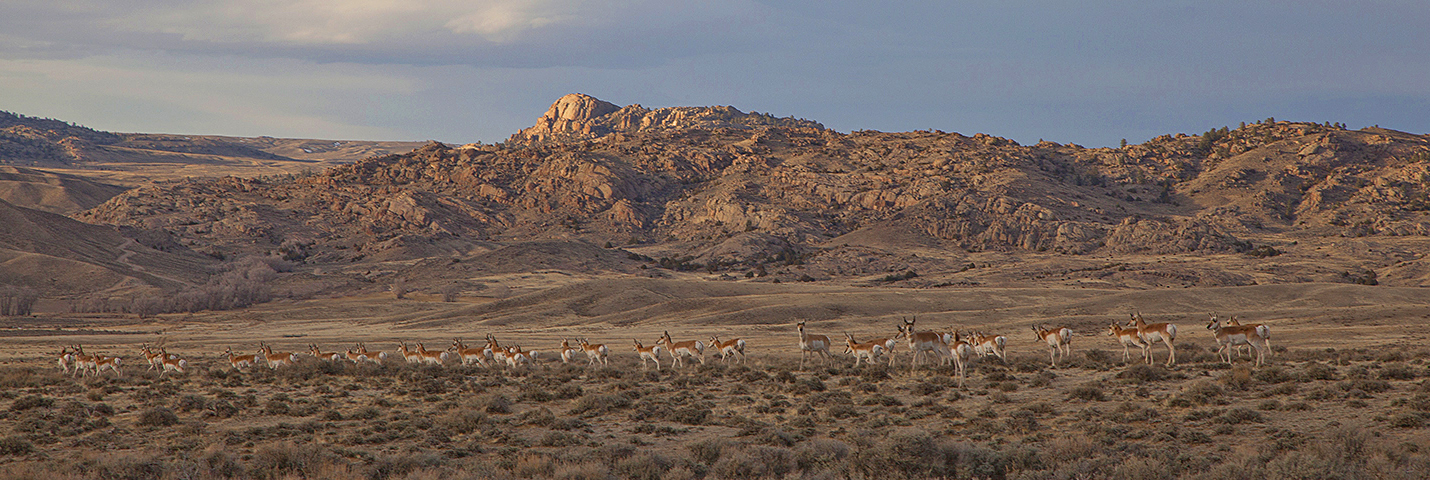
Pronghorn herd on the move, Sweetwater valley. (Photo by Chris Madson)
IN THE AUGUST 2025 EDITION OF WYOMING WILDLIFE MAGAZINE, ANGI BRUCE, DIRECTOR of the Wyoming Game and Fish Department, outlined her interpretation of the Game and Fish mission. In that essay, she made several statements that should concern anyone with an interest in the wildlife heritage of the state.
First— and most alarming— was her contention that the Game and Fish Department should not “advocate or speak for wildlife.” She argued that the department’s real business was serving people, which makes me wonder whether she’s confused Game and Fish with the Public Service Commission. Clearly, every agency in state government was created to render a service to the public. However, in every case, that service is to advocate something the public has decided it wants.
The Wyoming Department of Agriculture’s stated mission is “the promotion and enhancement of Wyoming’s agriculture, natural resources and contribution to Wyoming quality of life.”
The Department of Transportation’s stated mission is to “provide a safe and effective transportation system.”
The Department of Environmental Quality’s mission is “protecting, conserving and enhancing Wyoming’s land, air and water for the benefit of current and future generations.”
The Department of Education strives “to significantly increase the percentage of Wyoming students that are college, career, and military ready.”
Family Services is dedicated to keeping people “safe at home, giving families opportunities for success, and supporting people who support the families.”
The Health Department aims “to promote, protect and enhance the health of all Wyoming citizens.”
The Office of Tourism works to “promote and facilitate travel to and within the state of Wyoming.”
The Wyoming Wildlife and Natural Resources Trust exists to “enhance and conserve wildlife habitat and natural resource values throughout the state.”
And the statutory mission of the Wyoming Game and Fish Department, first adopted into law in 1937, is “to provide an adequate and flexible system for control, propagation, management, protection and regulation of all Wyoming wildlife.”
These missions all have a common theme— they call on a specialized group of state employees to advance a specific set of values and outcomes the public supports. The agencies exist to advocate.
Game and Fish’s statutory mission is unusual in this list because it arose out of a public conference in the depths of the Great Depression. The conference itself represented a groundswell of public demand for a more effective, professional approach to wildlife conservation, sheltered from the political infighting in the state legislature and funded independently by income from the sale of hunting and fishing licenses. Few state agencies can claim to represent the will of the general public more directly.
Ms. Bruce is mistaken when she says that the Game and Fish Department should not advocate or speak for wildlife. That is precisely what the people who established the modern agency nearly a century ago intended, what the generations of Wyomingites who have supported it ever since expect. In fact, it’s what they demand.
Ms. Bruce goes on to argue that Game and Fish should always try “to understand the social inputs to our work— conversations with our public partners are vital in making effective management decisions.” And she is right about that, of course. She encourages anyone who is interested to email, write letters, attend public meetings, or stop in at a Game and Fish office for a chat.
As a long-time employee of the department myself, I can testify that the agency holds a staggering number of public meetings, the vast majority of which are sparsely attended. The scattering of people in the audience nearly always have personal interests in the topic under discussion, quite often financial. Those are the public meetings. There are others, the ones that take place behind closed doors and involve individuals or companies with a “special interest,” which generally means they have exceptional political, legislative, and/or fiscal leverage.
Neither one of these formats results in a clear understanding of what the public, writ large, wants. And so, when Director Bruce emphasizes the agency’s responsibility to “serve people,” many of us have to wonder just which people are being served.
Ms. Bruce hired on as habitat protection supervisor with Game and Fish in 2017 after a career with the Iowa Department of Natural Resources, stepped up to deputy director for external affairs in 2019, and was appointed director in July of 2024. As I look back over her tenure in the agency’s head office, I recall several high-profile situations that involved Game and Fish decisions and wonder whether those decisions served a majority of Wyoming’s people or just a conveniently small minority.
In 2023, the department hired contractors to kill 129 elk wintering on a ranch in southeastern Wyoming. It’s hard to say whether the shooting solved the problem of hungry elk or just moved it to another ranch. This much is certain— there are hundreds, possibly thousands, of resident big-game hunters who live within forty miles of that ranch. It would be interesting to know how those hunters and others across the state feel about the hired slaughter of their elk on a ranch practically in their backyards. Game and Fish never asked.
In February of 2024, a snowmobiler in the Pinedale country caught a lone wolf in the open and ran over it, injuring the animal so severely that it could be bound with duct tape and taken to town. A video of the subsequent bragging session over the crippled animal in a Daniel bar found its way onto the internet, where it stimulated an outpouring of rage across the nation and around the world. Initially, Game and Fish contended that predators are exempt from animal cruelty statutes— the department eventually cited him for illegal possession of warm-blooded wildlife, and he was fined $250. A grand jury later indicted him for felony animal cruelty at the behest of the county prosecutor. I’m not aware of any public comment from Ms. Bruce or the department about the legal or ethical issues involved in this case. I suspect a majority of the Wyoming public was revolted by this gratuitous torture, but Game and Fish has expressed no views on the matter, at least in public, nor does it seem that the agency exercised its full enforcement authority until the incident generated public outcry.
Two months after Ms. Bruce took over as director of the department, the agency was finishing a detailed analysis of several big-game migration corridors, including the now-famous Sublette antelope migration corridor, the “Path of the Pronghorn,” which meanders through the heart of the oil and gas fields on the Pinedale Anticline. The department’s technical analysis, based on extensive radio telemetry over many years, provided a clear picture of key routes, stop-overs, wintering areas, and summer range. Strangely, when the department approached the Game and Fish Commission for approval last fall, it didn’t recommend protection of the entire route. Instead, the proposal lopped off a chunk at the southern end, apparently believing that, since that piece was on BLM land, it was somehow secure. Luckily for the herd, the commissioners thought differently and adopted the entire route instead. I think most Wyomingites support the broader protection, but there’s no way of knowing for certain— Game and Fish hasn’t taken steps to find out.
Then there is the case of the mule deer migration corridor up above Dubois. The initial map of the corridor stopped abruptly at the eastern edge of the Teton National Forest because the winter range was on the Wind River Indian Reservation and controlled by the tribes there. The bulk of the corridor was on the national forest itself, and, because of that, the department decided to stop short of an official designation of the corridor, which would have mandated protection against inimical land use changes. It was simply “identified” instead. The biologist who defended the ultimate decision argued that, if something bad happened in the corridor, “we can always redo this threat evaluation.” Trying to undo a change in land use is always harder than preventing it in the first place, but the department seems confident that there is no problem, even though the mule deer herd using the corridor is sixty percent below the target population the department has set for it. It would be interesting to know how the Wyoming public feels about this decision— not just the people who attended the public meetings and submitted written comments, but the public in its entirety. Game and Fish has never asked.
And sage grouse. I honestly don’t know how much elbow room Game and Fish has in the arena of sage grouse conservation or even comment. There are gubernatorial executive orders, ESA petitions, court proceedings and decisions, independent advisory groups that seem to have quasi-legal authority, federal resource management plans, and species management strategies. I suppose I should grant Ms. Bruce and the agency some latitude when it comes to their general silence on sage grouse. For example, it may be too much to expect that the department would object publicly to the recent gutting of the BLM sage grouse management plan. There was a time when Game and Fish would have made objected strenuously to proposals like this that threaten the state’s wildlife, but, in the case of sage grouse, I guess those times are long gone.
The on-the-ground management of sage grouse is controlled by a remarkably narrow set of “special interests.” The best scientific analysis shows a staggering long-term decline in population, and recent analysis suggests that, contrary to the political rhetoric, the Wyoming “core-area” approach may not be sufficient to maintain the species, here in Wyoming or elsewhere. The Game and Fish response to that analysis has been to deny outside scientists and agencies like the U.S. Geological Survey access to some of the data the department is collecting during lek surveys. Ms. Bruce is fond of saying that the first requirement of good wildlife management is science, but, with sage grouse, she seems inclined to support what she likes and ignore— or even undermine— the rest.
There are ways to find out what the public is thinking— reliable, statistically significant ways. A barrage of public meetings by itself is simply not reliable; in fact, I think it often serves as a smoke screen to give the appearance of seeking public consensus without bothering to do it. Same with a call for “public comment.” If, as Ms. Bruce claims at every opportunity, she wants to use the public’s views to shape wildlife management in the state, she could invest in far more sophisticated techniques. They don’t come for free, but they would be cheap compared to the cost of the wildlife surveys the department has used for decades to inform its habitat management and harvest regimes. I suspect she’d find such public survey data inconvenient. It all comes down to how many people she really wants to serve.
I spent more than 40 years in professional wildlife work, 36 of them with two state wildlife agencies. I believe I understand the pressures that are brought to bear on wildlife managers, particularly in a state like Wyoming where wildlife shares the front page with politics and economics. Still, I expect the representatives of the Wyoming Game and Fish Department to speak truth to power . . . and to me. The department is indeed an advocate in the legal as well as the general sense of the term. The department makes a case for wildlife in the court of public opinion. It is not responsible for the final decision, especially when that decision is ultimately controlled by majority vote of the legislature, the governor’s fiat, or a directive from Washington, D.C. However, it is responsible for presenting the facts as they affect the well-being of the public’s wildlife. My wildlife.
That information should be readily available, not only to decision-makers, but to researchers and the general public. Game and Fish should go out of its way to tell us what’s happening to the wildlife and wild places in our state, and we should have the benefit of its best technical recommendations on how to proceed. That’s why we have a competent staff of wildlife professionals. They aren’t paid to decide how to stimulate the state’s economy, encourage industry, keep more young people in the state, or placate special interests. They’re paid by the public— you and me— to be advocates for wildlife.
A number of years back, Game and Fish invented a terse little aphorism to describe its mission. The agency claims it is “conserving wildlife; serving people.” If I had it in my power, I’d make one small change to that credo: “Conserving wildlife; serving the public.” Wyoming’s wildlife belongs to us all; we should all have a say in its future. Before you grease the squeaky wheel, Ms. Bruce, it would be a good idea to find out what’s going on with the rest of the wagon.
Leave a Reply
You must be logged in to post a comment.