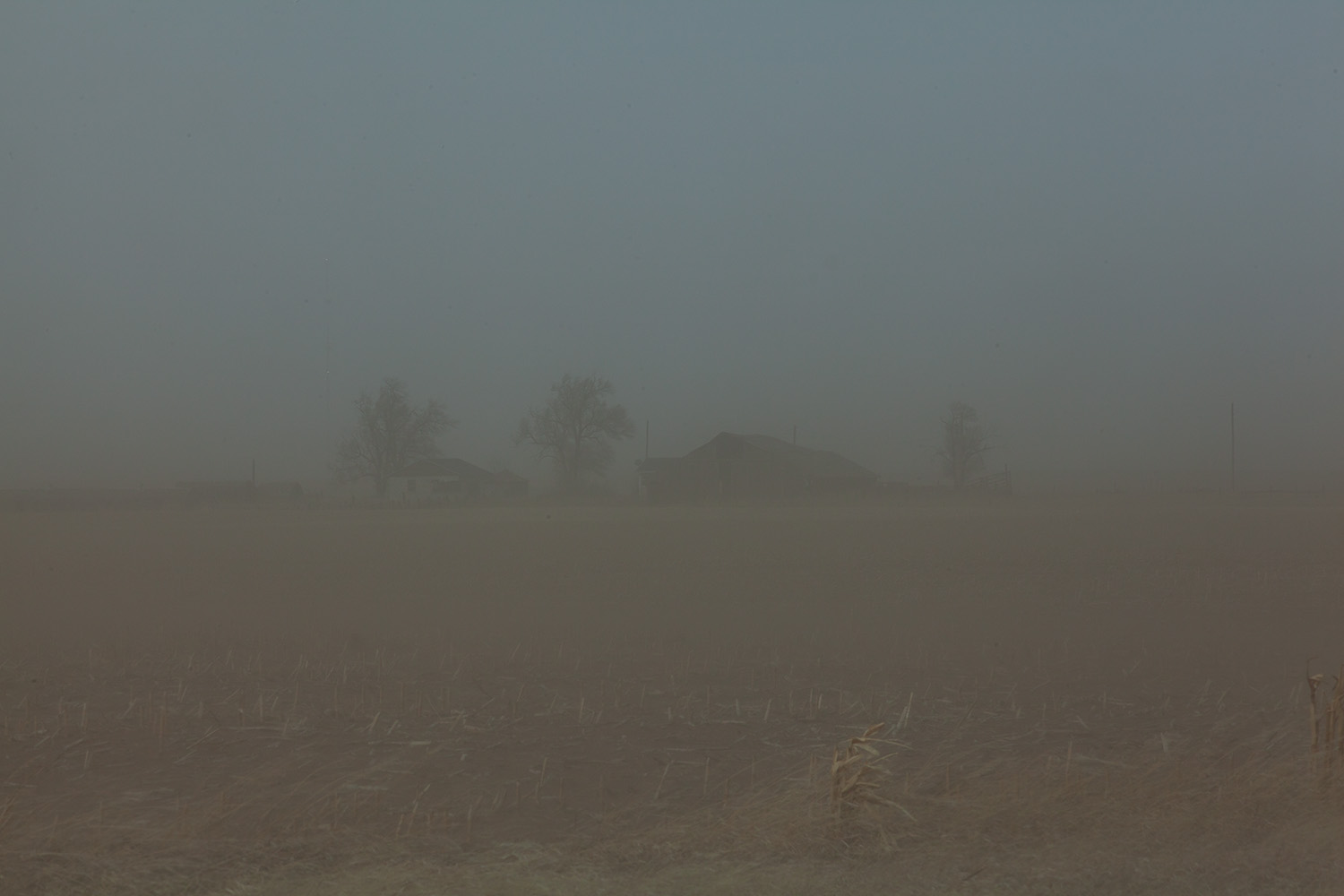
Dust storm in southeastern Wyoming, March 12, 2026
I’M LIKE MOST OLD GEEZERS, I GUESS. I GET UP IN THE MORNING A LITTLE STIFF IN THE joints but ready to grapple with the day. I trundle my twenty-year old psyche into the bathroom to shave only to see a seventy-year-old face staring out at me from the mirror. Most days, I just lather up and continue the morning ablutions, but, now and then, I stop to study the reflection for a few seconds and wonder what the hell happened.
Change. How we deal with it depends not only on its scale but its rate. Few species are better at dealing with the unexpected catastrophe as long as it hits us hard enough— and fast enough— to get our attention. A flood, a hurricane, a tornado, a typhoon, a blizzard, a wildfire, or an earthquake summons up the best in us. We rush to our neighbors’ aid, feed them, shelter them, help them rebuild. More often than not, we undertake expensive public works to keep them safe from the threat of future calamities, subsidize their insurance, and join them in shaking a challenging fist at the elements. “Move out? There’s no way we’re moving out. No friggin’ [fill in the appropriate offending event] is going to scare us off!”
But there’s one natural phenomenon that manages to slip under our communal radar. It doesn’t happen all at once. It sneaks up on us one cloudless day at a time, like old age. The weeks and months and years go by, and everything seems the same until, one morning, we look more closely and see its withered, sun-scalded face.
Drought.
The vast majority of us live in town where precipitation of any kind, liquid or frozen, is an inconvenience. Our food appears miraculously on the shelves of the supermarket, and our water comes miraculously out of the tap. Every sunny day is a good day in town. Until it isn’t.
As I write this, the snowpack in my corner of the South Platte River drainage in southeastern Wyoming is two percent of normal.[i] Two percent. Across the state of Wyoming, the snowpack is 57 percent of normal.[ii] To the south and west, things are even worse— some of the drainages in southern Utah, southwestern Colorado, and northern Arizona report zero percent snow water equivalent, and, even in the northern Rockies, the snowpack is below average.[iii]
It was dry winter. And a dry fall before that. And a dry summer before that. In fact, the U.S. drought monitor shows that the interior West and much of the Great Plains have been in moderate to severe drought for the last 26 years.[iv] Before that, there was the six-year drought in the late 1980s and early 1990s, the two-year drought in the 1970s, and the extended 16-year drought in the 1950s and 1960s.[v] One analysis of the dry spell in the American Southwest calls it a “megadrought,” the worst since the late 1500s and possibly the worst in the last 1,500 years,[vi] which is why Lake Powell on the Colorado River is only 25 percent full.[vii]
I’m not a farmer or rancher, so I’m not in a position to assess the trouble this drought has caused, and continues to cause, in the agricultural sector. I’m an ecologist by training, a hunter, angler, and ridge runner by inclination, and I can say that hardly a day goes by when I’m not reminded of the problems drought causes in the wild.
In Wyoming, the failure of populations of mule deer, pronghorns, and sage grouse to recover to the numbers a few old hands recall from the 1960s and 1970s can be explained by drought. On the high plains of western Nebraska and Kansas, the drought has played a significant role in the ongoing declines in numbers of pheasants and a host of nongame birds. I know marshes in southeastern Wyoming, wetlands that once attracted thousands of ducks and geese, that have been dry so long they don’t even support a crop of weeds. Without enough snowmelt, our streams are anemic and too warm for trout, and our reservoirs shrink until the boat ramps are high and dry and the fish are stranded on mudflats. I don’t have to be a farmer to mourn the pernicious effects of drought.
There is a school of thought that believes this drought is just the most recent in an infinite series of dry spells that stretches back through the millennia to the last glaciers and before. The purveyors of this view suggest we hunker down and wait it out— there’s nothing else to be done.
Nearly fifty years of increasingly rigorous scientific analysis has proved that is not the case. We’ve helped deepen and extend these droughts,[viii] and we have a pivotal role to play in softening them.
Drought is a slow-motion catastrophe like the climate change that intensifies it. Are we up to the special challenge this kind of insidious trouble presents? I guess we’ll see. Meanwhile, the 90 mile-per-hour wind howls at my windows and buffets the side of the house. The thermometer rises past 80 degrees in afternoon;[ix] highways are littered with upset semis,[x] and 600,000-acre wildfires rage out on the prairie.[xi] In March.
As the topsoil lifts off the fields and the sky turns brown, images from another era on the plains float like ghosts in the dust, conjuring memories of that awful time when a generation learned hard lessons about the land and their place on it. Back then, the fundamental problem was how and where we farmed. These days, we’ve added another dimension: our addiction to fossil fuel. We can’t prevent drought, but we don’t have to feed it. Those of us who intend to stay in the arid West would be wise to remember the lessons of the past— this isn’t going to get better until we change our ways.
—————-
[i] Wyoming State Climate Office, 2026. Snow water equivalent percent of median (1991-2020) 26 Mar 2026.
https://www.wrds.uwyo.edu/wrds/nrcs/snowmap/snowmap.html. Accessed March 26, 2026.
[ii] Coyle, Jeff, 2026. Wyoming— Report #15: NRCS weekly snow report, March 23, 2026.
https://www.wrds.uwyo.edu/wrds/nrcs/snowrept/snowrept.html. Accessed March 25, 2026.
[iii] Anon, 2026. Western United States Snow Water Content. ThorntonWeather.com.
https://www.thorntonweather.com/snow-basins.php
and
National Weather Service, 2026. National Snow analyses. March 25, 2026.
[iv] National Integrated Drought Information System, nd. Historical data and conditions.
https://www.drought.gov/historical-information?dataset=0&selectedDateUSDM=20260317. Accessed March 25, 2026.
[v] U.S. Geological Survey, nd. Five droughts that changed history.
https://labs.waterdata.usgs.gov/visualizations/drought-timeline/index.html#/. Accessed March 25, 2026.
[vi] Williams, A. Park, et al., 2022. Rapid intensification of the emerging southwestern North American megadrought in 2020-2021. Nature Climate Change 12: 232-234.
https://www.nature.com/articles/s41558-022-01290-z. Accessed March 25, 2026.
[vii] Central Arizona Project, 2026. Current Colorado River conditions: March 1, 2026.
https://www.cap-az.com/colorado-river-conditions-dashboard/. Accessed March 26, 2026.
[viii] Ibid, Williams et al.
and
Hidalgo, H.G., et al., 2009. Detection and attribution of streamflow timing changes to climate change in the western United States. Journal of Climate 22: 3838-3855.
https://journals.ametsoc.org/view/journals/clim/22/13/2009jcli2470.1.xml?tab_body=pdf. Accessed March 25, 2026.
and
Guan, Yansong, et al., 2025. Anthropogenic enhancement of subsurface soil moisture droughts. Nature Climate Change 15: 1355-1362.
https://www.nature.com/articles/s41558-025-02458-z?fromPaywallRec=false. Accessed March 25, 2026.
[ix] National Weather Service, nd. Climate: NOW data.
https://www.weather.gov/wrh/climate?wfo=cys. Accessed March 25, 2026.
[x] Pope, Weston, 2026. Deadly 100 mph wind event leaves widespread damage in Wyoming. Laramie Boomerang, March 18, 2026.
https://www.wyomingnews.com/laramieboomerang/news/deadly-100-mph-wind-event-leaves-widespread-damage-in-wyoming/article_89072057-3068-408e-89e9-a6020771e043.html. Accessed March 25, 2026.
[xi] Koperski, Scott, 2026. Largest wildfire in Nebraska history is now nearly 100% contained. Nebraska Public Media, March 20, 2026.
https://nebraskapublicmedia.org/en/news/news-articles/largest-wildfire-in-nebraska-history-now-nearly-100-contained/. Accessed March 25, 2026.
Leave a Reply
You must be logged in to post a comment.