ON SUNDAY, FEBRUARY 15, 2015, CHRISTOPHER SOLOMON published an essay in the New York Times titled “Leaving Only Footsteps in the Woods?: Think Again.” The premise of Solomon’s piece was that every human being that enters a wild area has an effect on the wildlife living there.
It’s an important observation, one that gets surprisingly little attention in an era when many outdoors folk desperately want to believe that their activities are “nonconsumptive” and not a bit like the depredations of bloodthirsty hunters and anglers who go out with the express purpose of committing mayhem against defenseless wild things.
Of course, there’s no such thing as “nonconsumptive use” in the outdoors. The research literature is replete with studies that demonstrate that cars and trucks, ATVs, hikers, and horseback riders all have deleterious effects on many wild animals, sometimes killing or maiming them or, more often, displacing them temporarily or permanently, often with short- or long-term effects on their well-being.
It’s worth remembering that, while human presence itself has an undeniable effect on wildlife and wild places, that direct damage is dwarfed by the effect of our demand for resources. The SUV used to drive to that primeval forest, the gasoline burned on the trip, the wool in the sweater, the petrochemical in the shoes, the lunchmeat in the sandwiches multiplied by 320 million constitute a threat orders of magnitude greater than any form of recreation we pursue. And this damage is inflicted by every person in America, not just backpackers and off-road aficionados.
I do want to raise one objection to Solomon’s piece. He carries things too far when he argues that a person on foot has more impact than a person on a snowmobile or ATV. He cites a study in Alaska by Grant Harris and colleagues that gathered data on the effect of snowmobiles on wintering moose in the Kenai. These researchers also reviewed the scientific literature to find studies of other winter activities, particularly Nordic skiing. A couple of these studies suggested that a moose’s response to a person on skis might be greater than its response to a snowmobile. Solomon concluded that there was “more evidence of impacts by hikers, backcountry skiers and their like than by the gas-powered crowd.”
Not really. Harris and his co-authors gave a more accurate assessment when they wrote that “nonmotorized recreation causes fewer, stronger disturbance effects in relatively smaller areas while motorized recreation generates more, weaker disturbances across larger areas.” I would add that motorized disturbance involves MUCH larger areas and often inflicts more severe long-term ecological damage as well.
Extensive research on elk at the Starkey Experimental Forest and Range in northeastern Oregon has concluded that ATVs and mountain bikes generally cause greater disturbance for elk than hikers and horseback riders, results that are supported by many other studies from other parts of the country assessing disturbance of other wild animals. Add to that body of information the lasting ecological effects of backcountry roads and the unauthorized trails that ramify over public lands across the country and you have a scale of damage that pedestrians could never match.
Kudos to Solomon for reminding us that “we’re all complicit” in the ongoing deterioration of wild places. But I would add that, if you find the muse calling you to the wild country and you’re looking for a way to reduce your impact, park the vehicle, tighten the laces on your boots, and walk. You’ll see more and hurt less.
THE GOOD OLD DAYS. I’M OLD ENOUGH TO REMEMBER THE SIXTIES (AND EVEN A PIECE OF THE FIFTIES) WITH SOME FONDNESS, BUT THERE ARE A LOT OF THINGS ABOUT THAT ERA I’d just as soon forget, especially in the environmental arena— massive fish kills, rivers catching fire, and not least, a federally funded campaign to destroy wetlands. Between the 1950s and the 1970s, nine million acres of wetlands in the contiguous forty-eight states were drained, filled, plowed, destroyed— an average of 458,000 acres a year.
Efforts to respond to this casual abuse culminated in 1972 with the Clean Water Act. The first paragraph of the act set out a clearcut objective: “to restore and maintain the chemical, physical, and biological integrity of the Nation’s waters.” Among other goals, the authors wanted to achieve “water quality which provides for the protection and propagation of fish, shellfish, and wildlife and provides for recreation in and on the water.”
Authority for enforcing the provisions of the act was split between the Army Corps of Engineers and the nascent Environmental Protection Agency, and over the next thirty years, treatment of domestic sewage improved markedly, even as the nation’s population increased, and pollution from point sources like industrial plants decreased, even as the economy grew. Overall, the Clean Water Act has significantly improved water quality in many urban areas, while rural areas have seen less improvement, mainly because of heavy use of fertilizers and pesticides.
Another benefit of the act was undeniable: By 2000, headwater streams had been afforded some measure of protection against toxic run-off from mines and silt from overzealous timbering and road-building and the drainage of freshwater wetlands had been almost halted. Part of that shift was the result of ongoing efforts of the U.S. Fish and Wildlife Service and private-sector conservation groups like Ducks Unlimited, but much of it rose from the protection the Clean Water Act offered against unregulated drainage, filling, or pollution. Wetlands are the most productive, diverse natural systems on the continent. They’re a mainstay for North America’s waterfowl, but they support hundreds of other species of birds, mammals, reptiles, amphibians, and invertebrates as well. And headwater streams, especially in the mountainous West, are crucial nurseries for trout and salmon as well as refuges for a variety of rare fish species.
Which explains why hunters, anglers, and other conservationists were so distressed when, in 2001, the U.S. Supreme Court gutted the Clean Water Act’s authority to protect “isolated” wetlands. Five of the justices challenged the scientific understanding that nearly all water is connected, either directly when water runs from one drainage into another or indirectly through the movement of groundwater or migratory birds that travel from one wetland to another. Their majority ruling immediately exposed wetlands like the prairie potholes in the northcentral United States to the dredging and filling operations that had previously been regulated by Section 404 of the Clean Water Act and called into question the act’s protection of headwater streams far from the continent’s major river systems.
Ever since the Supreme Court decisions in SWANCC v. Corps of Engineers and Rapanos v. United States, the Corps of Engineers and the EPA have been struggling to redefine a key concept in the Clean Water Act: the phrase “waters of the United States.” After a decade of discussion and public input, the two agencies proposed a new definition last April.
Complicated? I guess. The proposed rulemaking filled eighty-six pages in the Federal Register. In recognition of the limits placed on their authority by the court, the two agencies reiterated and clarified many of the exemptions they had granted in their earlier permitting and enforcement. Farmers were granted all the exemptions they had enjoyed before the Supreme Court decisions, including exemptions for irrigation that continue to cause serious water quality problems. Water-filled depressions created during construction were given a pass along with gullies, artificial ponds created on dry land as ornaments or for stock watering, irrigation, or rice culture. Groundwater was exempted; the state authority over water rights was recognized.
And the concept of an “isolated” wetland is clarified. In order to be protected under the Clean Water Act, a wetland would have to “significantly affect the chemical, physical, or biological integrity” of a larger body of water, considered to be a “water of the United States.” In the case of a system of isolated wetlands like the prairie potholes, the entire system would have to “significantly affect” one of those major waters.
The proposed rule is a huge compromise for conservationists, but it provides more protection for headwater streams and isolated wetlands than the current situation in which the corps or EPA has to decide case by case whether a creek or marsh is covered by the Clean Water Act. It’s better than nothing.
The new proposal has its opponents, of course. There are many economic interests that would just as soon be free to degrade or destroy watercourses and wetlands. They would be more than happy to return to an arrangement that left the public with poisoned water, dead fish, and burning rivers. And, inevitably, these interests have friends in Congress.
On September 9, the U.S. House of Representatives passed a bill called the “Waters of the United States Regulatory Overreach Protection Act of 2014,” 262 votes in favor to 152 opposed. If enacted, the bill would block the proposed rule and order the corps and EPA to reach consensus with all fifty states before proceeding. Bear in mind that the state-by-state approach to water quality before 1972 is what left us with fires on the Cuyahoga River, millions of dead fish on the Mississippi, and poisoned salmon runs on the West Coast.
The bill has little chance of passing the Senate and no chance of being signed into law. Still, the action by the House is appalling. The majority seems more than willing to sacrifice clean water and wildlife in order to please their corporate contributors.
Perhaps the most distressing part of this is the lip service these Congressmen pay to “the sportsman.” Of the 262 who voted and/or cosponsored this bill, 198 are members of the Congressional Sportsmen’s Caucus. That’s the group that claims “to protect and advance the interests of sportsmen and women through policies that address sportsmen’s conservation issues such as hunting, recreational angling and shooting and trapping.”
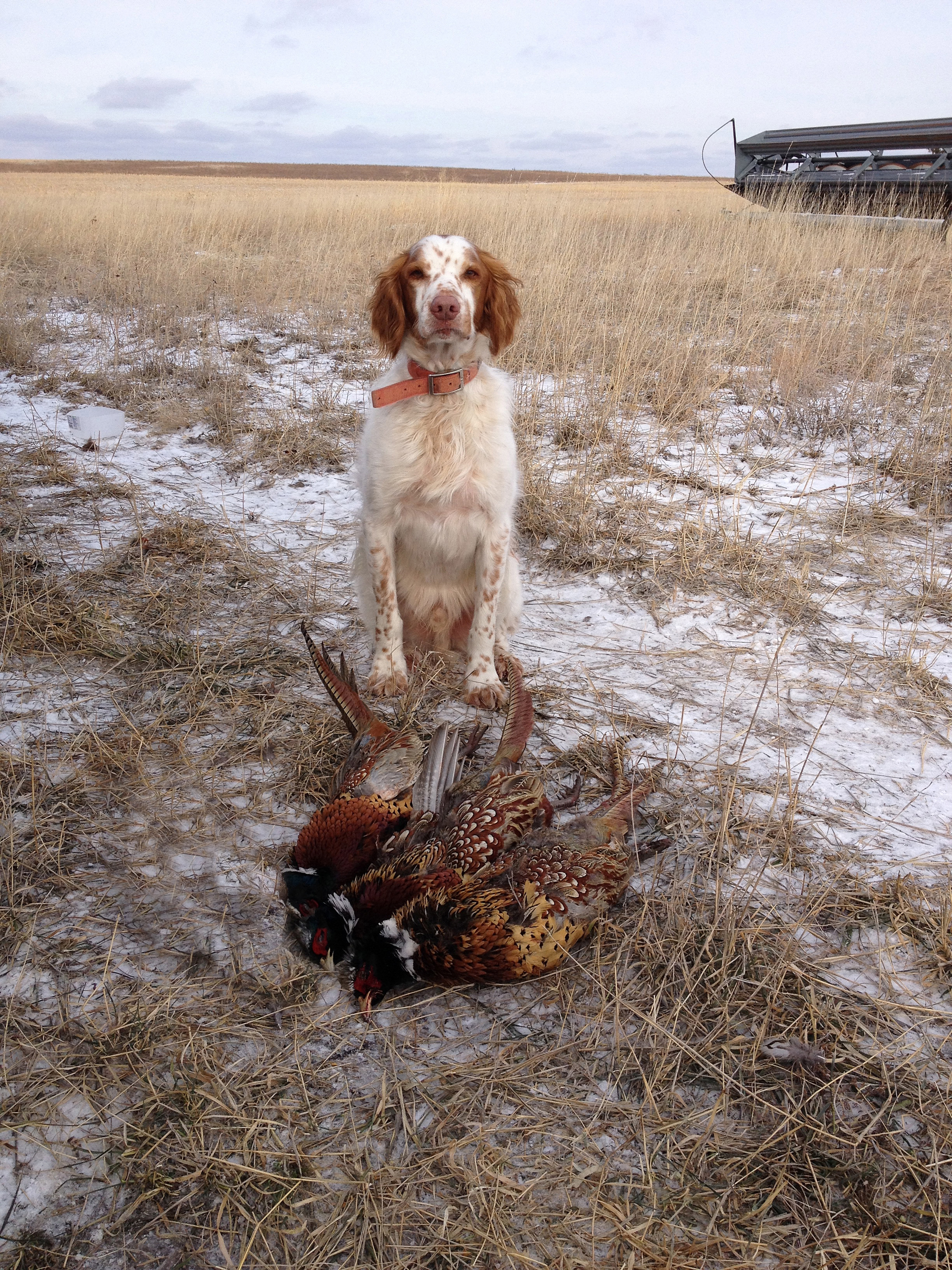
I’m an avid waterfowler, so the future of the prairie potholes concerns me. I’m an avid pheasant hunter, so the winter cover those potholes provide is a matter of some interest to me as well. I like to fish for trout in the high country, which means I’m a supporter of good water quality in the West. One of these days, I hope to get over toward the coast and wet a fly for steelhead, so I like to think those rivers will be clear and full of fish when I get there. In short, I’m a sportsman, so I care about clean water. Nor do I think I’m alone in this concern— tens of millions of other hunters and anglers recognize that we can’t have wildlife without water. It’s an ecological fact that even the members of the Congressional Sportsmen’s Caucus ought to be able to understand.
We’ve tried cleaning up our streams and protecting our wetlands state by state— it doesn’t work. The quality of our water affects us all; it’s a national issue and it requires a national solution.
If you happen to live in Connecticut, Delaware, Hawaii, Maine, or Vermont, your representative didn’t vote for the “Waters of the United States Regulatory Overreach Act.” If you live anywhere else, there’s a chance he or she did. If you live in Texas, Georgia, Louisiana, Michigan, North Carolina, Oklahoma, the chances are pretty good, and if you live in Utah, Wyoming, North or South Dakota, it’s a certainty.
The next time that glad-handing politician slaps you on the back and tells you what a dyed-in-the-wool nimrod he is, how many mallards he shot last year, how many bass he caught, ask him how he voted on this one.
It takes more than a gun or a fishing pole to make a sportsman.
I WANT TO EXPRESS MY THANKS TO JIM DAWSON FOR THE INVITATION TO BE HERE THIS EVENING, AND FOR TAKING THE TIME TO MEMORIZE THE INTRODUCTION I worked so hard to invent and deliver it with such sincerity. Isn’t it remarkable how good you can make a guy sound when you’re not constrained by the facts? It’s a pleasure to get together with such an august group, especially when the subject at hand is teaching the next generation about the discipline of hunting.
The discipline of hunting.
I’m a writer and an editor by profession, so I’ll freely admit that that I can get a little persnickety about words and their meaning. This probably explains why I’ve always been uncomfortable with the description of hunting as a “sport,” which, for a lot of people, means “playtime.” For me, and I’m sure for you, hunting doesn’t bear much resemblance to badminton or golf or slow-pitch softball or even to skeet and trapshooting. The most obvious difference is that something is probably going to die during a hunt,— at least we hope it will— which right away makes it much more serious business than a football game.
The ethical ramifications of that elemental fact are sobering, but the gravity of hunting extends beyond the likelihood that an animal or animals may be killed. The serious hunter makes a commitment. He— and I use the word “he” in its generic sense, not to exclude women— he commits to the idea of sustainable harvest and conservation. He upholds the principles of fair chase. He hones his ability as a marksman; he studies the animals he pursues; he stays in shape, maintains his equipment, trains his dogs, all for those weeks in the fall or spring when he will match himself against a quarry that has developed the skills of escape to a high art.
A commitment of this magnitude reaches beyond “sport.” It’s more like a lifeway, a martial art. So I’ve dropped the phrase “sport hunting” from my vocabulary. For me, hunting is a discipline, a calling, and I think an argument can be made that, for many humans, it ‘s been that way for a very, very long time.
Late on the afternoon of December 18, 1994, three cave buffs found a hole in a limestone bluff overlooking the Ardeche River in southern France. It wasn’t much of an opening— thirty inches by ten— but there was a draft coming out of it that intrigued the spelunkers. They spent over an hour clearing rubble out of the hole, then wiggled through into a large cavern. The floor of the room was strewn with the bones of cave bears, a species that has been extinct in Europe for 25,000 years. As they walked deeper into the passage, admiring the stalactites and calcite curtains, they began seeing marks on the walls— first, there were lines of large red dots, then . . . art.
Chauvet Cavern turned out to have hundreds of paintings and engravings, nearly all of them depicting animals that have not been known in Europe for millennia— mammoths, wooly rhinos, aurochs, lions, and reindeer in addition to cave bears. Radiocarbon dating has found that some of the pigments on the walls are more than 30,000 years old, by far the most ancient ever found.
One of the most fascinating elements of Chauvet is the floor of the cave. In nearly every other Paleolithic cavern that has ever been discovered, the first visitors, whether they were cave explorers or anthropologists, trampled the dirt and mud, obliterating any signs that might have been left there.
The discoverers of Chauvet took great pains to protect the floor from disturbance. The bones of the cave bears, their tracks, the beds they dug for hibernation are all still visible. And in that ancient clutter, the scientists who have been studying the cave found two unusual sets of prints. On set belonged to a human, about four feet tall, judging by the size of the tracks and the length of stride.
The other set is clearly canine. It’s impossible to determine whether the two came into the cave together, although I find it a little far-fetched to believe that a wolf would venture hundreds of feet into the stygian darkness of a cave that has been inhabited by cave bears unless he was following someone. Was this creature a dog or a “socialized wolf”? Opinions vary, but I like to think the two went into the cave together, the kid holding the torch and convincing the canine to come along.
The two trails beg the question: Why was the youngster so far back in the grotto? It seems likely that he was there to see the paintings, although we don’t know for certain why. Over the years, anthropologists have offered several explanations of the function of cave art. One thing seems clear— it wasn’t just an exhibit of the artist’s skill, considerable as that often was. The fact that these paintings were stuck far back in a cave suggests some mystic significance. The artists may have been making magic against their prey; they may have been worshipping the animals or engaging in some sort of shamanistic cult.
Whatever the details, the activity in these painted caves seems bound to the hunt. If that’s the case, it’s easy to imagine young initiates being led into the darkness of the cave as part of a coming-of-age ritual with the art serving as some sort of catechism. For these ice-age people, hunting was a central element of religion, and the ceremonies in the back of the cave were, in all likelihood, an important part of hunter education. And you thought you were breaking new ground . . .
There’s no way of knowing how those ancient hunters approached the chase, but if the example of modern subsistence hunters is any guide, they may have lived by a remarkably stern ethical code. In 1936, the eminent wildlife biologist, C.H.D. Clarke, went to the Arctic to study muskoxen and spent many years among the Inuit of northern Canada at a time when most of these people still hunted to live. Clarke told my dad that he knew an old man in one of the Inuit villages who had been blind most of his life. It was said in the village that, when the man was young, his fellow hunters had put out his eyes because he had failed to show proper respect to a caribou he had killed.
These are the echoes of belief and commitment in hunting that come down to us from prehistory.
The training of young hunters may be the oldest form of human education, an exercise that predates mankind itself and was already unimaginably ancient when people settled down to farm and build cities. The oldest hunter education text I know was written by a Greek named Xenophon, born in Athens more than 430 years before the birth of Christ. As a young man, he threw in with Cyrus the Younger when the prince tried, unsuccessfully, to claim the Persian throne.
Among several other important works, Xenophon wrote Cynegeticus— On Hunting. It was a practical guide to hunting technique: weaving and setting nets; choosing good dogs and training them— “There is a good deal to be said for taking your hounds frequently into the mountains,” he wrote. “It is there they will become sound of foot, and in general the benefit to their physique in working over such ground will amply repay you”— the variability of scent; the best clothes for hunting; techniques for hunting lions, bears, wild boar, deer, and the lowly hare.
Does the hunt have any value for civilized men?
Xenophon thought so. “To the gods themselves is due the discovery,” he wrote, “to Apollo and Artemis, patrons of the chase and protectors of the hound. As a reward they bestowed it upon Cheiron, by reason of his uprightness, and he took it and was glad, and turned the gift to good account. At his feet sat many a disciple, to whom he taught the mystery of hunting and of chivalry. . . . Thanks to the careful heed they paid to dogs and things pertaining to the chase, thanks also to the other training of their boyhood, all these greatly excelled, and on the score of virtue were admired.
“For my part, then, my advice to the young is, do not despise hunting or the other training of your boyhood, if you desire to grow up to be good men, good not only in war but in all else of which the issue is perfection in thought, word, and deed.”
Xenophon’s view of hunting in 400 B.C.
In matters of philosophy and culture, the Romans were staunch followers of the Greeks, so it’s no surprise to find guides to hunting in Latin prose and poetry. The ones that have come down to us emphasize the breeding, care, and training of hunting dogs for various tasks, as in this passage from a resident of Carthage, Marcus Aurelius Olympius Nemesianus:
“At the outset your diligent care for your dogs must start from the beginning of the year. . . . At that season you must choose a bitch obedient to speed forward, obedient to come to heel, native to either the Spartan or the Molossian country-side, and of good pedigree.” Nemesianus goes on to describe how to breed for the best dogs, how to pick the best pup out of a litter (a knack I wish I had), even how to change feeding regime to make sure the dogs are ready for the fall. And, like any hunter, he’s anxious for the season to open:
“Already my heart is tideswept by the frenzy the Muses send: Helicon bids me fare through widespread lands. . . . We search the glades, the green tracts, the open plains, swiftly coursing here and there o’er all the fields, eager to catch varied quarries with docile hound.”
Sounds familiar.
With the disintegration of the Roman Empire, Europe shattered into a mass of contending dominions, constantly at war with each other and with outside forces like the Mongols and Muslims. It’s not called the Dark Ages for nothing, nearly a thousand years during which art and literacy gave way to near anarchy. Hunting was a central part of medieval life in that time, but there were few men who had the training or inclination to put the laws and customs down on parchment.
One of these was Gaston, Third Count of the fief of Foix in France, known as Phoebus because of his blond hair. “All my life,” Phoebus wrote, “ I have taken special delight in three things: arms, love, and hunting.” He went on to say that he claimed no expertise in the first two areas but had no doubts about his mastery of the third.
Sometime around 1387, Phoebus wrote The Book of the Chase, an encyclopedic look at hunting techniques and equipment of the time and place. Mixed with his extensive and generally rock-solid advice on the details of the chase, Phoebus took time to recognize the less tangible benefits a day afield:
“When the hunter riseth in the morning, he sees a sweet and fair morrow, and the clear weather and bright, and heareth the song of the small fowl, the which sing sweetly with great melody and full of love, each in his language in the best way that he may . . . and when the sun is arise, he shall see the fresh dew upon the small twigs and grass, and the sun which by its virtue shall make them shine, and that is great liking and joy to the hunter’s heart.
“And when he hath well et and well drunk, then he shall go lie in his bed and shall sleep well and steadfastly all the night without any evil thought of any sin, wherefore I say that hunters go into Paradise when they die, and live in this world most joyful of any other men.
“. . . And therefore be ye all hunters, and ye shall do as wise men.”
Phoebus’s book provided the foundation for the first English book on hunting, The Master of Game, written or, more accurately, translated by Edward, Duke of York, The Master of Game provided the foundation for the Book of Hawkyng, Huntyng &c. by Dame Juliana Berners, first published in 1486. In her introduction, Dame Berners offered this motive for writing her book for “gentlemen having delight therein. This book showeth to such gentle persons the manner of Hunting for all manner of beasts, whether they be beast of Venery, or of Chase, or Rascal. And it also showeth all the terms convenient as well to the hounds as to the beasts aforesaid.” A fifteenth-century hunter education manual.
This was the hunting tradition that came to the New World, customs and attitudes shaped by noblemen on a continent that was quickly running out of game and the wild places that supported it. In the tiny settlements on the east coast of America, hunting quickly became a matter of getting food or making a profit, but in spite of the utilitarian approach taken by the first waves of immigrants, the more refined attitudes of the European aristocracy gained an early foothold.
Thomas Morton, a down-at-the-heels lawyer from Devonshire, England, came to Massachusetts colony in 1624. Unlike many of the Puritans in the area, he found the wilderness at the edge of town irresistible:
“Fowls in abundance,” he wrote, “fish in multitude, millions of turtledoves on the green boughs, which made the land to me seem paradise. In mine eye, t’was Nature’s Masterpiece.” His subsequent description of trees, game birds, and big game was a hunter’s ode to wildlife and wild places— it was probably America’s first hunter education manual.
As the decades passed, a steady trickle of publications provided hunters with first-hand information on the landscapes and game to be found in North America. Most were natural histories written by men who combined a love of hunting with a scientific interest in flora and fauna, a combination that has probably been common among hunters since mankind made the first stone tools.
In 1783, an anonymous army officer in New York published The Sportsman’s Companion: or An Essay on Shooting, generally regarded as the first book to focus on hunting technique in America. Scattered through the practical advice, the author offers an occasional comment on conservation, as in this passage:
“They are Partridge to be sure— I seem them gather, Sir. We may kill many, but— what the deuce!— four brace [that’s eight birds]? That’s too many. I think it’s time to return home for tea.”
Forty years later, Jesse Kester of Philadelphia published The American Shooter’s Manual, a book intended “to diffuse throughout the community a taste for genteel and sportsman-like shooting, and to abolish that abominable poaching, game destroying, habit of ground shooting, trapping, and snaring, which prevails throughout our country in the neighborhood of all cities and large towns.”
Kester’s book was on the leading edge of a rapidly growing hunting literature. The first American magazine to emphasize hunting and fishing started in 1829, and one of the most influential writers on these subjects, Henry William Herbert, better known as Frank Forester, began a twenty-year career in the spring of 1839.
“There is, perhaps, no country in the world which presents to the sportsman so long a catalog of the choicest game, whether of fur, fin, or feather as the United States,” he wrote in his Field Sports of the United States in 1848. “None in which the wide-spread passion for the chase can be indulged, under so few restrictions, and at expense so trifling.” Unfortunately, he added there is also no place in which the habits of game animals “are so little known and their seasons so little regarded, none in which the gentle craft of Venerie is so often degraded into mere pot-hunting. The game that swarmed of yore in all the fields and forests, in all the lakes, rivers, bays, and creeks of its vast territory are in peril of becoming speedily extinct.”
In 1887, the ethics championed by Forester and others crystallized into an organization of hunters dedicated to fair chase and wildlife conservation: the Boone and Crockett Club. In 1893, the founders of the club, Teddy Roosevelt and George Bird Grinnell, wrote this about their intentions: “The Club hopes to bring about the preservation of our big game by discouraging among sportsmen themselves all unsportsmanlike proceedings and all needless slaughter. Hunting big game in the wilderness is, above all things, a sport for a vigorous and masterful people. The rifle-bearing hunter, whether he goes on foot or on horseback, whether he voyages in a canoe or travels with a dog-sled, must be sound of body and firm of mind, and must possess energy, resolution, manliness, self-reliance, and capacity for hardy self-help. These are the very qualities which it is the purpose of this Club, so far as may be, to develop and foster.”
The effort to educate hunters ripened in the early years of the twentieth century with the establishment of organizations like the Boy Scouts of America and the Campfire Club and with marvelous books like Ernest Thompson Seton’s Two Little Savages and George Bird Grinnell’s Jack Tales. The first state-sanctioned hunter education program started in 1946 when Kentucky included hunter safety in its statewide youth camp. New York was the first state to require hunter safety in 1949.
And that was about the time the writer Robert Ruark began publishing the essays that became the best single hunter education text I’ve ever read: The Old Man and the Boy. There have been many books on hunter safety and ethics, but I can’t think of one that presented better information in more readable style. Considering the company this evening, I’d like to offer Ruark’s definition of a top-drawer hunter education instructor:
“The Old Man knows pretty near close to everything. And mostly he ain’t painful with it. What I mean is that he went to Africa once when he was a kid, and he shot a tiger or two out in India, or so he says, and he was in a whole mess of wars here and yonder. But he can still tell you why quail sleep at night in a tight circle or why the turkeys always fly uphill. “The Old Man ain’t much to look at on the hoof. He’s got big ears that flap out and a scrubby mustache with light yellow tobacco stains on it. He smokes a crook-stem pipe and he shoots an old pump gun that looks about as battered as he does. His pants wrinkle and he spits pretty straight in the way people used to spit when most grown men chewed Apple tobacco.
“The thing I like best about the Old Man is that he’s willing to talk about what he knows, and he never talks down to a kid, which is me, who wants to know things. When you are as old as the Old Man, you know a lot of things that you forgot you ever knew, because they’ve been a part of you so long. You forget that a young’un hasn’t had as hard a start in the world as you did, and you don’t bother to spread information around. You forget that other people might be curious about what you already knew and forgot.”
I’d like to thank all of you here in this room for being willing to share what you already knew and forgot, whether you’re a real Old Man, like me, or just practicing to be one sometime down the trail. There are a lot kids out there who want to know things about hunting and wild places and don’t have anyone else to tell them. They need you.
The discipline of hunting was already ancient when the elders first held class in the torch-lit recesses of Chauvet Caverns 30,000 years ago, but I believe it holds as much for us today as it did for the people of that far-off time and place. It is, after all, what made us human. You are the last in that long line of teachers, stretching back to our beginnings as a species. Thank you for passing the lesson on.
In 2001, the U.S. Supreme Court dealt a crippling blow to the protection of America’s wetlands and the wildlife these wetlands support. The court’s decision in the case SWANCC v. Army Corp of Engineers, followed a year later by similar decisions in the Carabel and Rapanos cases, ended the Corps of Engineers’ authority to protect isolated wetlands and the headwaters of streams.
On April 21, the Corps and the Environmental Protection Agency proposed a new set of rules to define “the waters of the United States.” These new rules would return some measure of protection to smaller bodies of water and watercourses, many of which are crucial to waterfowl and a wide variety of fish. The new rules use language from the Supreme Court’s SWANCC decision to limit federal authority— they would apply only to those wetlands that significantly affect the chemical, physical, and biological integrity of navigable waters.
Conservation groups were satisfied with this significant compromise and had hoped that the rules would be adopted, allowing the nation to continue its effort to protect important marshlands like the prairie potholes and the upper reaches of trout and salmon streams in the Appalachians, the upper Midwest, the Rockies, and the Pacific coast. The EPA and Corps of Engineers have asked for comments from concerned citizens and organizations.
But opponents of the rules aren’t waiting for the final rulemaking proposal. Organizations like the Farm Bureau Federation and the National Association of Homebuilders have brought pressure to bear on Congress to block any funding for “jurisdiction under the Clean Water Act.” The House of Representatives has already passed an appropriations bill that would deny the Corps of Engineers funding to protect the wetlands in question, and the Senate is considering a similar proposal.
This issue has been swathed in a fog of judicial hairsplitting and legislative paralysis for more than a decade, and as Congress has temporized, losses of the most productive wetland types have continued. Between 2001 and 2011, the Dakotas have lost 154,000 acres of prairie potholes. According the U.S. Fish and Wildlife Service, “emergent wetland area also declined in other Midwestern States, including Nebraska, Kansas, Missouri, Indiana, and Michigan. Losses were observed in the Lower Mississippi Alluvial Plain States of Arkansas, Mississippi, and Louisiana and the southeastern States of North Carolina, South Carolina, Georgia, Florida, and Alabama.”
The ongoing loss of wetlands in the Midwest, combined with the loss of upland cover maintained under the farm bill, will decimate wildlife in America’s heartland. Waterfowl, resident upland birds, and deer will take a huge hit, and the long-term decline of nongame grassland birds will resume.
If you care about these wild things, if you care about clean water and air, if you care about protecting fertile topsoil, please contact your Congressional representatives in both houses. Tell them you support protection of isolated wetlands under the Clean Water Act and that they should, too.
In recent statements and writing, Peter Kareiva, chief scientist with The Nature Conservancy, distorts history, ignores the successes of modern conservation, and undermines the moral and philosophical foundations of the movement. Do his views reflect the views of his employer?
PETER KAREIVA, CHIEF SCIENTIST WITH THE NATURE CONSERVANCY, RECENTLY DECIDED THAT IT WAS time to deliver a new message about conservation. He began late in 2011 with an article in the Breakthrough Journal. Since then, he has taken other opportunities to publicly restate the fundamental thesis of this article: that “by its own measures, conservation is
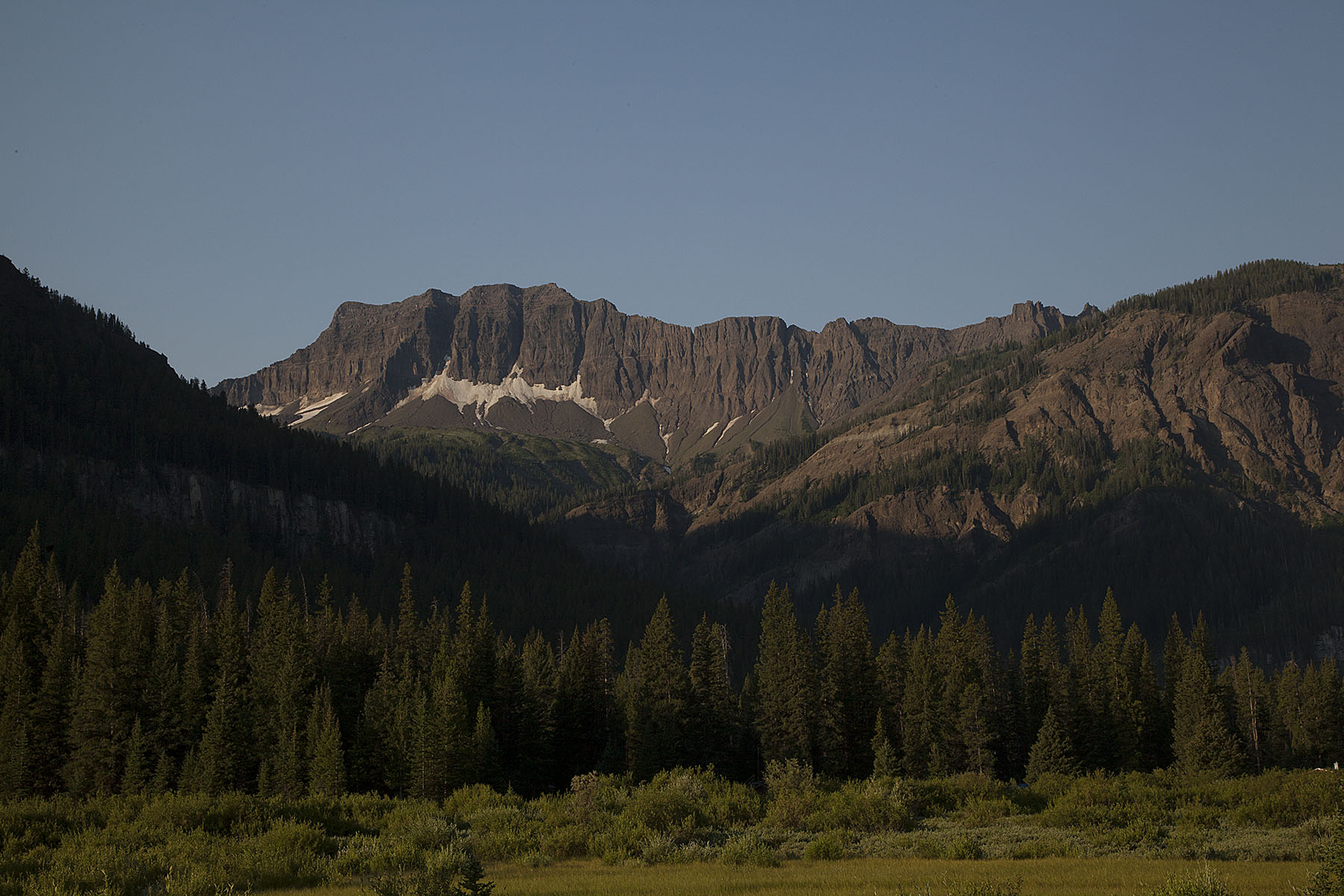
The edge of the Absaroka wilderness, Wyoming
failing.” He and his co-authors argue that the only way conservation can succeed is “to embrace marginalized and demonized groups and to embrace a priority that has been anathema to us for more than a hundred years: economic development for all.”
Kareiva’s argument in support of these observations isn’t entirely without merit, but much of it misrepresents history, ecological fact, and political reality. If his views were to serve as the sole basis for conservation in the next century, they could result in a staggering loss of biodiversity as well as significant long-term damage to our prosperity and well-being. For that reason, I think it’s important to examine his argument in detail.
First, an issue of definition: What does Kareiva mean by the term “conservation”? In the first paragraph of his Breakthrough essay, he writes that “biodiversity on Earth continues its rapid decline.” In the second paragraph, he adds that “conservation is losing the war to protect nature despite winning one of its hardest fought battles— the fight to create parks, game preserves, and wilderness areas.” Later on in his essay, he offers this definition: “Conservation is widely viewed as the innocent and uncontroversial practice of purchasing special places threatened by development.” Since he makes no effort to broaden this definition, I have to conclude that he accepts it.
The lack of historical perspective and ignorance of recent conservation efforts reflected in this definition are breathtaking. It’s certainly true that American conservationists have long been concerned about the loss of species, the rich variety of living things modern ecologists refer to with the faintly clinical term, “biodiversity,” but the earliest and most effective efforts to maintain species of wildlife were not, as Kareiva suggests, based on establishment of parks or other “very limited ecological systems.” They were legal and ethical restrictions on overharvest of game animals that were first adopted in the early seventeenth century and covered entire jurisdictions, colonies, and eventually states. These legal steps were soon followed by the work of natural historians to find and classify wild animals and plants— men like John Lawson, Mark Catesby, the Bartrams, and other pioneer scientists traveled thousands of miles through the American wilderness to record the unique flora and fauna it contained. Even in the eighteenth century, the conservation movement was extensive in its focus, not intensive as Kareiva suggests.
By the mid-1830s, George Perkins Marsh was espousing the importance of preserving timber and other kinds of ground cover to avoid the loss of topsoil. Published in 1861, his volume, Man and Nature, laid out the practical reasons for restraint in the exploitation of renewable resources. In 1872, Arbor Day was established, launching a nationwide effort to plant trees to improve habitat for people as well as wildlife. In 1885, Congress created the Division of Economic Ornithology and Mammalogy, which quickly launched a successful effort to convince Americans of the value of nongame birds in the control of insects.
By the time Gifford Pinchot (or his friend Overton Price) defined the term “conservation” as the sustained-yield use of natural resources in 1907, Americans had been talking about the idea and implementing it for at least a century and, in some cases, much longer. While John Muir championed a more preservationist view of the natural world in the late nineteenth century, Pinchot and Teddy Roosevelt were advancing a very anthropocentric vision that managed the natural world around human activities for the benefit of man.
Of course, the American concept of the national park also arose in the nineteenth century, but it’s important to recognize that the enabling act for Yellowstone, the world’s first national park, defined the area first as “a public park or pleasuring-ground for the people.” While “the people” clearly did not include the native Americans who lived in
Druid Peak, Yellowstone National Park
Yellowstone or the settlers, market hunters, and loggers in the vicinity who wanted to exploit the land inside the park, the politicians who created the reserve were fully aware of the need to define some benefit the park would have for the average citizen. Kareiva’s essay implies that conservationists have somehow neglected the practical politics of parks and reserves, which is ridiculous on its face— Yellowstone and the rest of America’s parks would not exist if the political ramifications of their creation hadn’t been carefully balanced.
It’s also worth noting that the park would probably never have been established if it hadn’t been for the support of Jay Cooke, the president of the nascent Northern Pacific Railroad. Cooke recognized that the park would be a valuable tourist attraction along the route he planned between Minneapolis and Seattle, and he brought significant money and political pressure to bear in the effort to sell Congress on Yellowstone. The nation’s first park was more an exercise in economic development and recreation than it was an effort to preserve a wild landscape.
The national wildlife refuge system began with the establishment of Afognak Forest and Fish Culture Reserve in 1891, thanks to the efforts of conservationists. Today, the refuge system has grown to 150 million acres with another 677,000 acres of wetlands to support ducks, geese, other waterbirds, and hundreds of other species of wildlife. The compromises that were required to create this system of wildlife habitat included significant provisions for a spectrum of human uses,
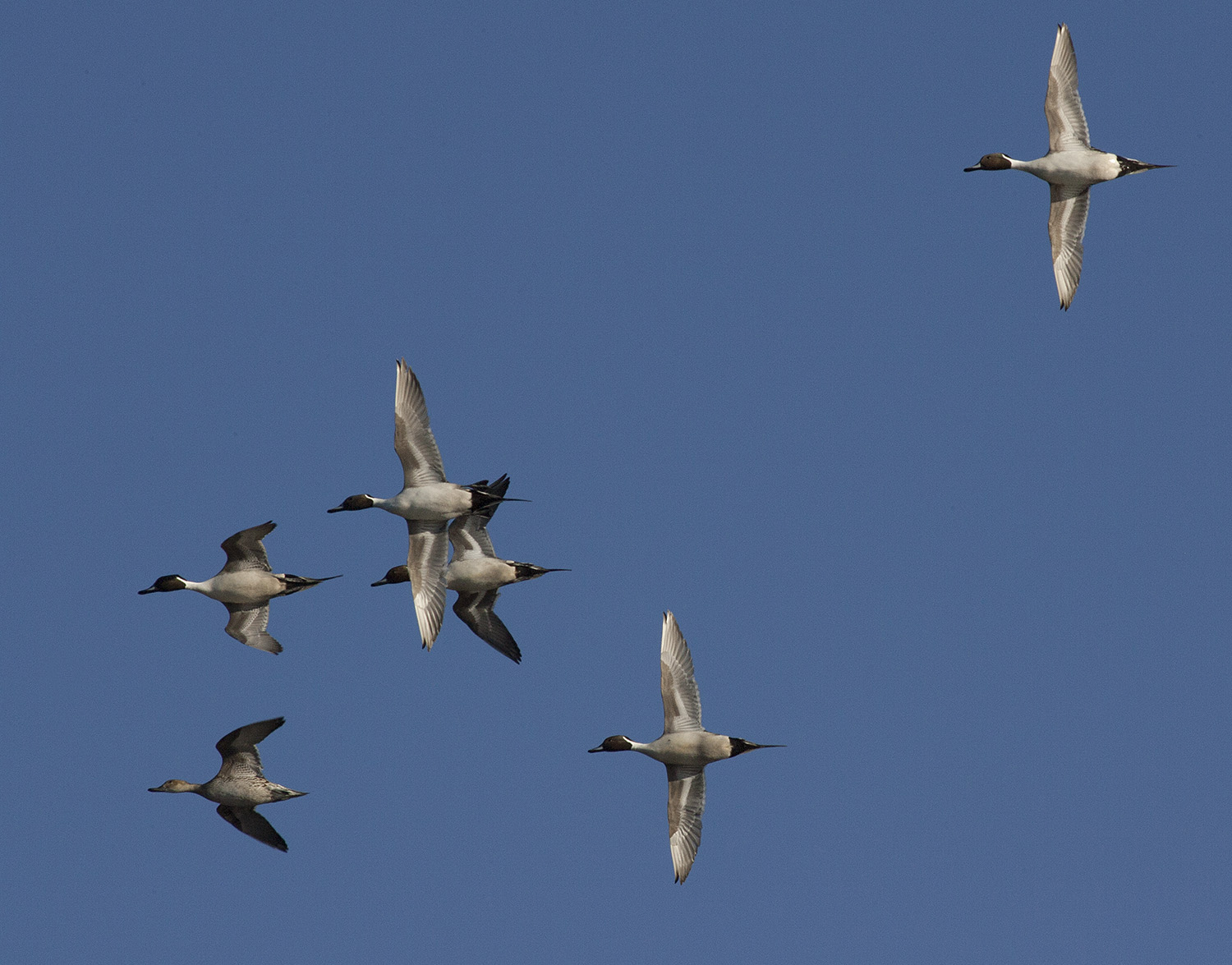
Pintail courtship over a federal waterfowl production area, Nebraska
and the negotiations over the activities that are allowed on refuge lands continue to this day. Oil and gas drilling, grazing, and farming are allowed on refuges where these activities are deemed to be consistent with the mission of the refuge, and the refuge system supports a variety of recreational pursuits that are important to local economies. While these areas are fairly small in comparison to the size of the nation as a whole, they are immensely productive— without them, populations of many North American birds would be a fraction of their current size— and they clearly consider human economic interests as well as the goals of wildlife conservation.
The Migratory Bird Treaty Act was adopted by Congress and signed into law in 1918, an unmistakable sign that its supporters had accurately gauged the political climate and that a large body of Americans supported the sweeping protections it mandated. The legality of the act was subsequently challenged in federal court, and the Supreme Court upheld its constitutionality. Politically and legally, the act passed muster with Americans, who seemed to recognize both the intrinsic worth and the economic and recreational value of the birds it protected.
Then there is the conservation title of the American Farm Bill. This group of programs traces its roots back to the work of Hugh Bennett and the infant Soil Conservation Service in the 1930s. It compensates landowners for taking a variety of actions that help conserve soil, improve water quality, and provide habitat for a host of wildlife species, particularly grassland birds, a group that has come on hard times in the last sixty years. These are voluntary programs that draw huge support from local communities as well as landowners and conservationists. It would be hard to imagine a more cooperative, human-centered effort on behalf of wildlife and the environment.
This is just a sampling of the salient nationwide conservation efforts that have supported wildlife in the United States for a century or more. There are many other smaller-scale efforts as well, carried out by states and communities with the full participation of affected people. Suggesting that any of these efforts could even begin without public support and involvement is ludicrous.
The long history of American conservation does not bear out Kareiva’s notion that the movement’s main focus has been the establishment of parks and preserves that are more or less off-limits to people. I can only conclude that Kareiva was speaking to a small sliver of modern environmental activists when he drafted his essay and that he was focusing on conservation work outside of North America.
While I share some of his concerns about some of the proposals environmental activists make, I can’t share his apparent conviction that they represent the will or primary focus of the entire conservation movement. His use of the broad brush utterly ignores the accomplishments of past conservationists and unfairly impugns the motives and actions of their modern counterparts. With his comments on American parks, he invites me to consider the history of the conservation movement in the United States— why, then, does he ignore the main currents of that history?
Fragile nature
Kareiva has another bone to pick with modern conservationists. “Ecologists and conservationists have grossly overstated the fragility of nature, frequently arguing that once an ecosystem is altered, it is gone forever,” he writes. Not so, argues Kareiva. “Nature is so resilient that it can recover rapidly from even the most powerful human disturbances.”
Well, of course it can and nearly always does. When an existing equilibrium is disturbed, a new equilibrium eventually establishes itself, even if there is nothing left but bacteria to begin the process. However, Kareiva began his essay on this plaintive note: “Biodiversity on Earth continues its rapid decline. We continue to lose forests in Africa, Asia, and Latin America. There are so few wild tigers and apes that they will be lost forever if current trends continue. Simply put, we are losing many more special places and species than we’re saving.”
Which of these assertions am I to believe? If the living systems on earth can absorb any damage mankind can dish out, then there really is no reason for concern. In fact, The Nature Conservancy and other conservation groups can simply adopt Kareiva’s view of ecological invulnerability, declare victory, and take up other work.
Most ecologists would argue that the drastic loss of “special places and species” Kareiva mentions is dangerous to natural systems and to mankind. Most would also say that this decline is a result of our own intemperate behavior.
That’s why the term “Anthropocene” was coined: to recognize that our presence is changing the planet at a geologic scale. Elsewhere in his essay, Kareiva casually suggests that the reason the people of Easter Island disappeared was due, at least in part, to the depredations of the nonnative rats they brought to the island with them. Did the rats destroy the entire Easter Island ecosystem? Of course not. They simply destroyed the capacity of the island to support people. This microcosm should give any thinking person pause.
Over the millennia, humans have exploited many landscapes and have often found, to their sorrow, that deterioration in natural systems leads to problems for man as well as wildlife. The ancient history of the Fertile Crescent and the
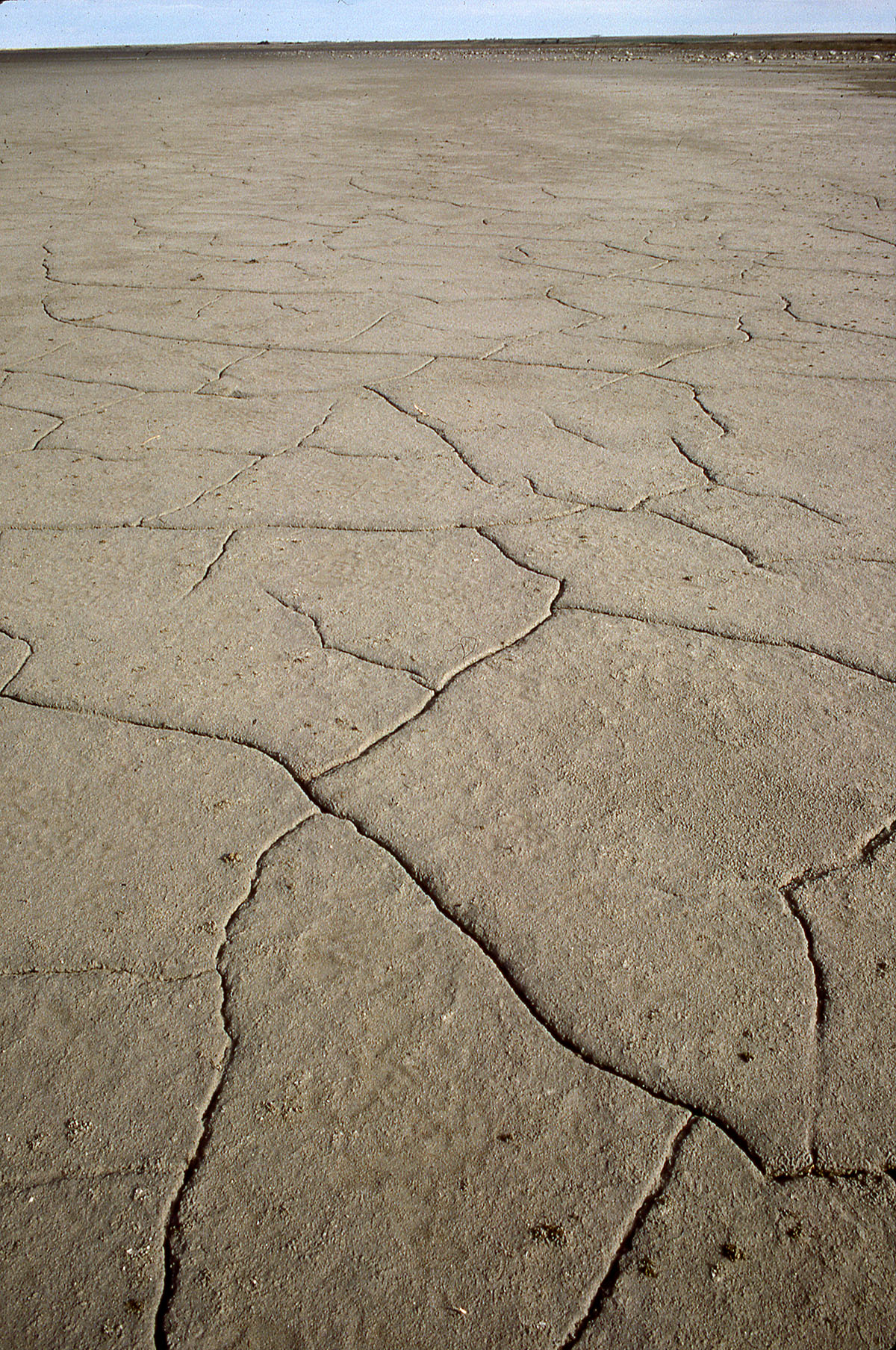
Drought on a federal marsh in the Dakotas
Mediterranean rim is studded with examples. The Cedars of Lebanon were cut and exported; the Anatolian hills above the Tigris and Euphrates were plowed and overgrazed; the rich fields and foothills of Carthage were exposed to the erosive power of wind and rain. Native populations of wildlife like the Arabian oryx and Eurasian lion declined or disappeared, a sign that diversity and productivity in the region’s natural systems had been reduced. Eventually, the same forces that affected wild animals began to touch people.
It’s been estimated that the population of ancient Mesopotamia, the place we now know as Iraq, may have reached five million around 300 B.C. before a combination of invasion, internecine struggles, and the deterioration of the region’s soils brought about a collapse. The area would not see that many people again for 2,000 years when the growing income from recently discovered oil generated economic development the land itself could still not support.
Similar examples of collapse can be found in the archaeological record of the New World. The Mayan civilization flowered and fell in the jungles of Central America, the victim of wars that may have had many proximate causes but were driven ultimately by a shortage of food. The Mayans kept no species lists documenting the biodiversity around their city-states, but it’s not outlandish to guess that it declined as agricultural pressure intensified.
The great Mississippian culture of eastern America’s woodlands was already in decline before Columbus arrived in the New World. Analysis of the physical condition of the people in the great native city of Cahokia shows that the quality of diet had deteriorated over several centuries. At the end, people were smaller in stature and suffered from a variety of diseases caused by dietary deficiencies. Local populations of deer, waterfowl, and fish had been overexploited, and so generations of people suffered.
Kareiva argues that the loss of the passenger pigeon and the American chestnut had no lasting effect on the great forests of eastern North America. I reply that, as an ecologist, he knows better than that. He knows that the loss of five billion passenger pigeons and the elimination of the most important mast-bearing tree in that forest must have had huge effects on the organization of the system. The trophic cascades would have reached into every nook and cranny of that forest— if there had been any old-growth forest left. In fact, the mature deciduous forest of the East had essentially been eliminated by the beginning of the twentieth century. Our failure to see the effects of the passenger pigeon’s extinction and the loss of the chestnut has more to do with the shortcomings of the science of the time than it does with ecological reality.
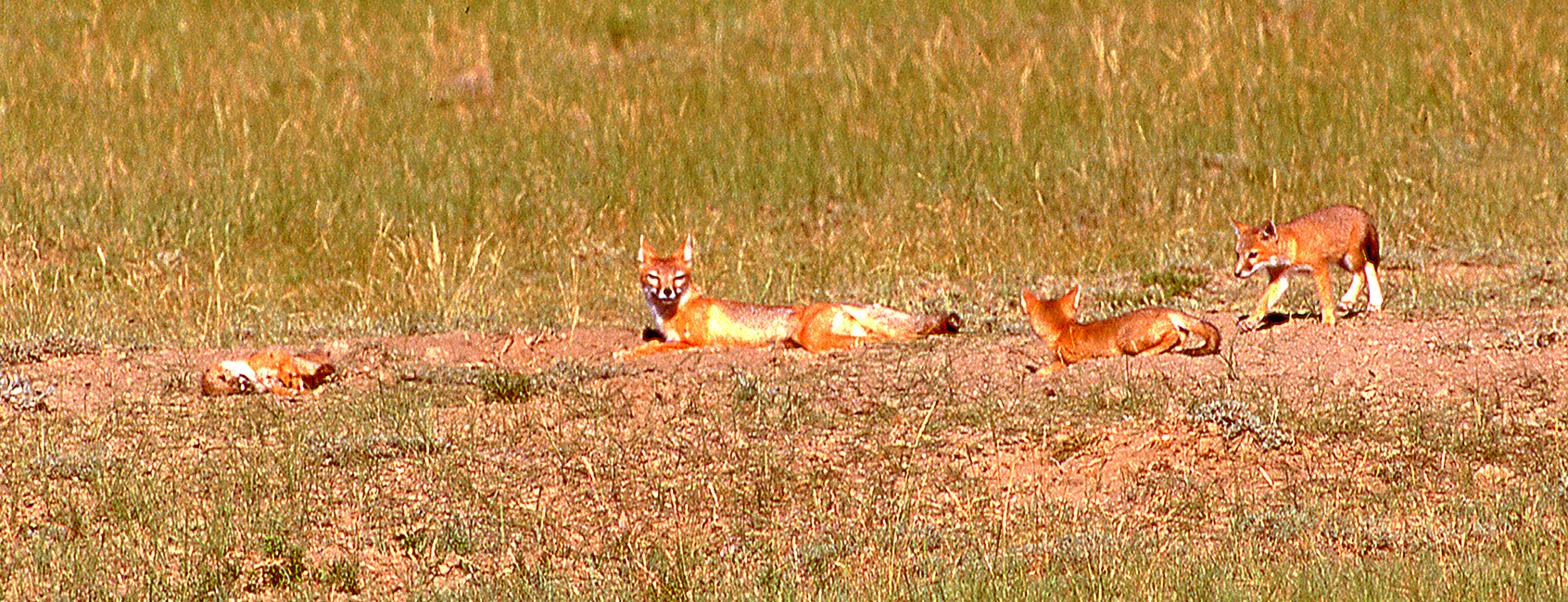
North America is filled with more recent examples of damage caused by the removal— or addition— of just one species. The loss of ninety-eight percent of the black-tailed prairie dogs on the continent has strained several other wildlife
Swift fox family on federal land, Wyoming
species: black-footed ferrets, northern swift foxes, ferruginous hawks, mountain plovers, and others.
The introduction of cheatgrass to the West’s sagebrush basins has shifted the fire regime and plant composition on entire landscapes, causing drastic decreases in sage grouse, Columbian sharp-tailed grouse, Brewer’s sparrows, sage thrashers, and pygmy rabbits as well as declines in populations of mule deer and pronghorns.
The effective removal of the canebrake, America’s native bamboo system, has brought the Bachman’s warbler and the eastern panther to the brink of extinction and has caused declines in other wildlife species as well.
Some of these ecological shifts have had little apparent effect on human activities; others have had an immediate and lasting impact. Unfortunately, our technical analysis isn’t sophisticated enough to predict what ecological damage might touch our economic interests and what damage does not. That’s why Aldo Leopold’s counsel on conversion of ecosystems still has force: “To keep every cog and wheel is the first precaution of intelligent tinkering.”
The most succinct definition of conservation is the wise use of natural resources. That means sustainable use of renewable resources and particular care with those resources that are finite and nonrenewable. Buried in Kareiva’s rhetoric, I sense a commitment to that idea, but when he casually advocates “economic development for all” without any qualification or caveat, I worry that many people will interpret his statement as license to take all they can, as fast as they can.
Earth simply cannot support nine billion people whose demands on natural resources are anything like the demands a typical American makes. There are those who believe that technological breakthroughs will free us from the bioenergetic bonds that threaten to confine us, but those breakthroughs haven’t yet emerged, and even if they do, our history as a species suggests that we will continue to grow until restrained by the shortage of some other key resource. If a new ultra-clean energy source removes the limits we currently face, we’ll explode until the next limit comes to bear. Justis von Liebig saw the hard reality of that nearly 200 years ago.
The metaphor of the miner’s canary is apt. When we exploit natural systems to the point that many wildlife populations are declining and some are in danger of extinction, we may well be on a path that threatens our own well-being. In his essay, Kareiva points out that, in the future, conservationists will have to find ways to manage “working landscapes” for some kind of “conservation value.” He offers this as a startling insight when, in fact, a host of conservationists has been working to do just that for more than 150 years. What he fails to mention is the importance of a more enlightened view of the value of a whole range of conservation options, from inviolate reserves to small pockets of easily accessible urban wildscape.
Wilderness and its spokesmen
In a lecture given for the Distinctive Voices @ the Beckman Center in November of 2011, Kareiva expanded on many of the ideas he presented in his Breakthrough essay. Early in the talk, he took up the concept of wilderness and wilderness preservation. He picked out a couple of “environmental writers” to attack their idea that people really value the wilderness experience. The first was Ed Abbey.
He mocked Abbey for writing about the stars over the desert: “Instead of loneliness, I feel loveliness,” he quoted from Desert Solitaire. He then went on to read a passage from Abbey’s journal, written at the same time, in which Abbey complained about how much he missed his wife. Kareiva is struck by the irony of Abbey juxtaposing these two sentiments.
Ed Abbey had some good things to say about the desert Southwest, a landscape that commands little respect, but passing him off as a leader in defining the concept of wilderness is ludicrous. Consistency in reasoning or emotion, nuance in perception, were things Abbey never troubled himself to find. There are dozens of writers and thinkers who deserve notice for their philosophical analysis of man’s place in nature before Abbey. However, Ed does serve as a convenient straw man for Kareiva to push over.
Following his sally on Abbey’s journal entry, Kareiva goes on to add a couple of other names to his list of eco-communicators: “Emerson and Hawthorne, [two] of our great naturalist writers.”
I guess it’s been a while since Kareiva has read the works of either writer. While it’s true that Ralph Emerson wrote an essay he called “Nature,” I think it’s fair to say that he was happy to contemplate the natural world through a stout pane of glass. For Emerson, nature was just another metaphor in the service of broader philosophical discourse.
Hawthorne, one of America’s first novelists, never bothered himself with the concept of the environment in his major works, except as a stage for the inquiries into human morality and behavior that were his central theme. Hardly an eco-philosopher.
Then Kareiva mentions Thoreau. Here, finally, he has found a man who thought deeply about humans and their relationship with the land.
“I bet a lot of you had to read Walden Pond,” Kareiva remarked in his speech. “‘In wilderness is the preservation of the world,’ and he wrote about his cabin and his pond and all that. Yeah, right! His mom came and did his laundry every
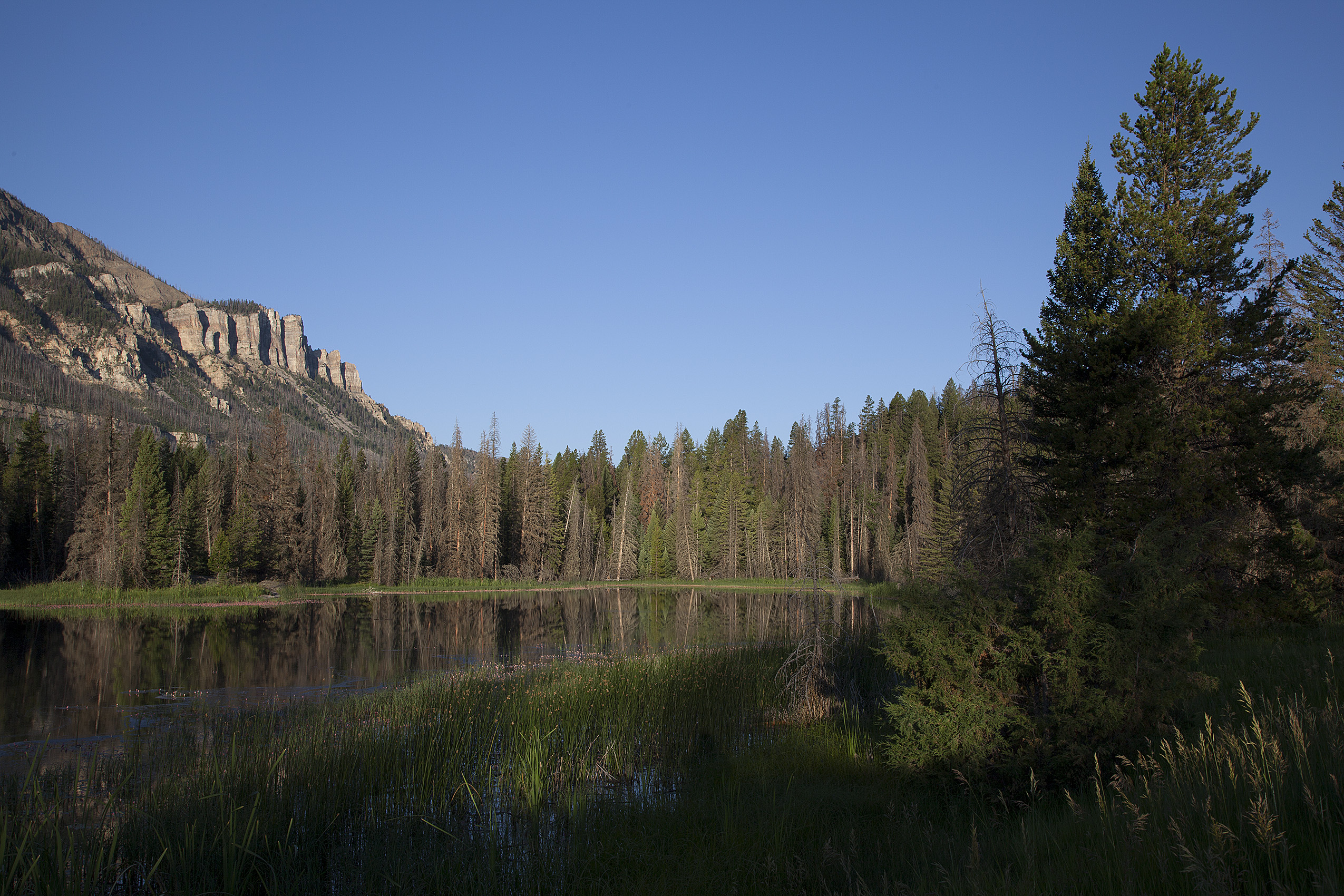
Wetlands under Cathedral Cliffs, Shoshone National Forest, Wyoming
weekend. Yet he painted this picture.” The picture of Thoreau Kareiva seems to have in his own mind is a man who abandoned civilization for the life of a hermit communing with the trackless wilderness.
It’s hard to believe anyone could pack so much misinformation into such a small package. Let’s start with the smallest items first: The name of Thoreau’s best-known book is Walden, Or Life in the Woods, not Walden Pond. Unlike Emerson, Thoreau was qualified to write about a “life in the woods”— he actually spent quite a bit of time outside, most of it walking or working as a surveyor in the country around Concord, Massachusetts, but some of it in what was then bona fide wilderness in Maine.
Contrary to Kareiva’s implication, Walden was never intended to be a defense of wilderness. In the first paragraph of the book, Thoreau laid out the setting: “When I wrote the following pages, or rather the bulk of them, I lived alone, in the woods, a mile from any neighbor, in a house which I had built myself, on the shore of Walden Pond, in Concord, Massachusetts, and earned my living by the labor of my hands only. I lived there two years and two months.” So much for man communing with wilderness.
His purpose in this experiment? “I went to the woods because I wished to live deliberately, to front only the essential facts of life, and see if I could learn what it had to teach, and not, when I came to die, discover that I had not lived.” Such were Thoreau’s motives in retreating to Walden Pond.
All this is somewhat beside the point, however, because the quote Kareiva cites does not appear in Walden; in fact, it’s not precisely a Thoreau quote at all. The passage Kareiva has in mind is actually part of different essay: “Walking.” And Kareiva gets the quote badly wrong. Thoreau actually wrote: “What I have been preparing to say is that in wildness is the preservation of the world.”
The difference between Kareiva’s “wilderness” and Thoreau’s “wildness” is immense. The concept of wilderness is a matter of intense debate among conservationists and ecologists in America and around the world. It’s a debate worth having, a debate Kareiva seems anxious to join. He would have served himself and his audience far better if he had been careful to confine himself to that issue and left Thoreau out of the discussion.
Americans have a long history of valuing wildness, even as they settled the wilderness, and over the last century, that value has been confirmed by philosophers and scientists alike. In his Breakthrough essay, Kareiva implies that he’s quite concerned about maintaining as much of the earth’s biodiversity as possible. No serious ecologist or conservationist would disagree. And Thoreau’s famous line is as lucid a statement of that concern as I’ve ever read; in fact, it could serve as the mission statement for Kareiva’s current employer. Why, then, does Kareiva misquote and impugn it?
It’s particularly ironic that Thoreau’s first purpose in “Walking” is to encourage people to take time every day to get out of the house and office for a walk in the woods. I assume this is an activity Kareiva would also advocate. Thoreau, as a man of his time, paid homage to the West, that symbol of freedom and potential in nineteenth-century America, but he
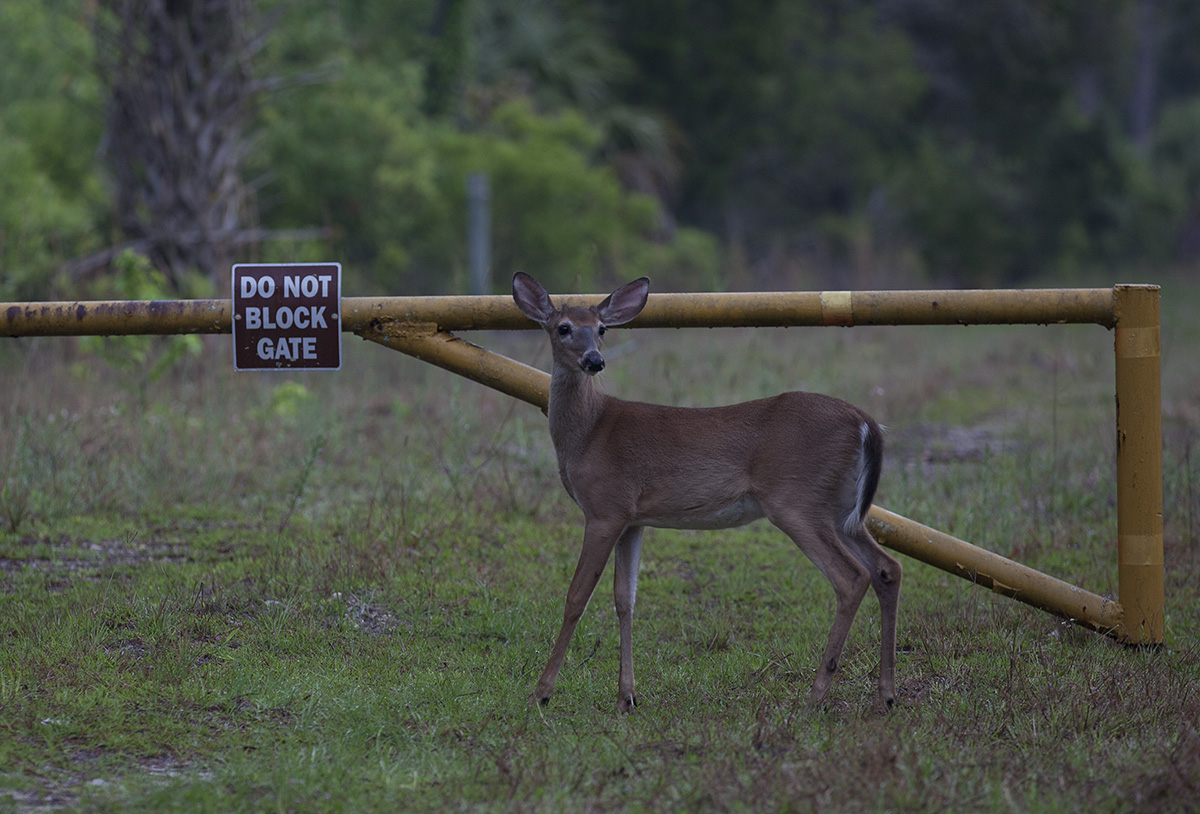
White-tailed deer on the Lower Suwannee National Wildlife Refuge, Florida
began and ended in the bucolic surroundings of Massachusetts: “From many a hill I can see civilization and the abodes of men afar,” he wrote. Like any other commodity, the wild experience becomes more valuable as the supply dwindles, a consequence of supply and demand Thoreau, on a coastal landscape that had been settled for 200 years, had already begun to see in 1840.
As human population grows, the chances to preserve large tracts of unworked land will fade away. “Quit romanticizing,” Karevia says. “The notion of untouched wilderness— it just doesn’t exist anywhere. . . . We’ve touched every corner.”
No informed conservationist would disagree. Unfortunately, Kareiva’s attack on the entire idea of preserving wilderness without any stated exception raises the question of whether we should bother to hold onto any wilderness at all, even the fragments that have already been set aside. He’s right in pointing out that no point on the earth’s surface has remained untouched by man, but I challenge his implication that this means there is no wilderness left. I can tell the difference between the North Slope of the Brooks Range and a WalMart parking lot. Both of them are extreme environments inhabited by a few tough pioneering species; both have been altered by human activity, but the North Slope offers me things the parking lot does not, even if I never find my way to the shores of the Beaufort Sea.
Kareiva raises moral objections to the idea that humans have been displaced to establish many of the world’s parks and wildlife reserves. It’s a legitimate concern that needs to be considered with care every time a new park is contemplated. Kareiva is worried about the possibility that the Amazon might be turned into a gigantic reserve, off-limits to people. At least, off-limits to everyone but the tribes native to the Amazon basin. That is a difficult moral question, indeed.
Is it better to preserve the forest and the wildlife and human lifeways the forest supports? Or is it better to sacrifice the forest and its tribes in the name of economic progress for the rest of the nation and the world? Is it better to shower the native tribesmen of the forest with the benefits— and ills— of twenty-first-century technology or leave them to make their own way in the paths of their ancestors? Do we have the right to make such choices for them? Do we have the right to even offer such choices?
As I write this, the New York Times has reported that natives of the Amazon region are being murdered by outsiders who want unlimited access to Brazil’s forests. Americans should recognize the process, since it’s the same approach we took to the issue of native inhabitants for almost 400 years. Was it right then? Is it right now? Like all the important moral debates, this one seems destined to play out in the twilight between right and wrong. Certainly not the simple choice Kareiva implies.
On a much smaller scale, consider the example of Central Park, a relatively wild reserve in the middle of one of the world’s largest cities. What is an acre of real estate in Central Park worth on today’s market? Would New Yorkers be better off without the park? Or is the value of the reserve worth the foregone income for the city and its residents?
I submit that we are far from finished with these questions. While we look for ways to incorporate wildness into the warp and weft of modern life, we would cheat ourselves if we stopped thinking about places held in common ownership where the scale of human activity is reduced and the geological and ecological character of the land is emphasized. Places where we can walk, as Thoreau suggested, through “some retired meadow” in the setting sun. Call them what you want: quiet places, wild places, even wilderness; they are important as storehouses of biodiversity and as refuges for the human spirit.
Gloom and doom
In his Beckman lecture, Kareiva raises his voice against what he calls “the doom-and-gloom thing.” According to Kareiva, this is the conservationist’s knee-jerk approach to framing any issue of land management, claiming that the world is about to collapse before our eyes unless something is done. He’s certainly right when he argues that the potential damage to the land is too often exaggerated and that stretching the truth can undermine support for conservation.
During the Beckman lecture, he remembered visiting Yellowstone National Park as a child: “I went when I was a kid with my family. There were no wolves or grizzly bears, and there weren’t many buffalo.” He goes on to report the recovery of grizzlies and bison as well as the reintroduction of wolves.
Dr. Kareiva finished his bachelor’s degree in 1973. If he started his undergraduate work straight out of high school, that means he’s a year younger than I am— chances are good that the two of us first visited Yellowstone about the same time, in the decade of the 1960s. But the two of us saw different realities.
There were, in fact, no wolves documented in the park in the 1960s, but there were grizzlies— the park estimated that there were between 200 and 250 in that period. There were also bison— between 350 and 1,000, according to park estimates. And so the bad old days Dr. Kareiva describes in Yellowstone weren’t quite as bad as he suggests, and he seems guilty of exactly the kind of eco-exaggeration he decries elsewhere.
Kareiva also mentions a trip he took as a child with his father: “Dad took me to Pittsburgh. I was about twelve, and the three rivers in Pittsburgh were so polluted you didn’t go near them. It stank. People didn’t want to live along the river. Now they have bass fishing contests in the three rivers. Real estate is at prime, and it’s a wonderful place to run.”
Clearly, the situation in Pittsburgh in the 1960s fell somewhere short of “doom,” but as Kareiva describes it, the condition of its rivers was well out on the scale of “gloom.” He offers the anecdote as an example of the kind of progress that can be made when we put our minds to the task, which is fair enough, but he fails to point out that the Clean Water Act and its precursors were controversial in their time— their adoption was the result of a lot of “doom-and-gloom” rhetoric, verbal and printed, that motivated Americans to make a change.
As upset as Kareiva claims to be with the “doom-and-gloom” claims of rabid environmentalists, these excerpts show that he’s not above engaging in a little doom and gloom himself when he feels the circumstances call for it. Nor should he be.
Doom-and-gloom rhetoric has been responsible for the passage of many of our most important conservation and environmental laws: the Migratory Bird Treaty Act, the Bald Eagle Protection Act, the Endangered Species Act, Federal
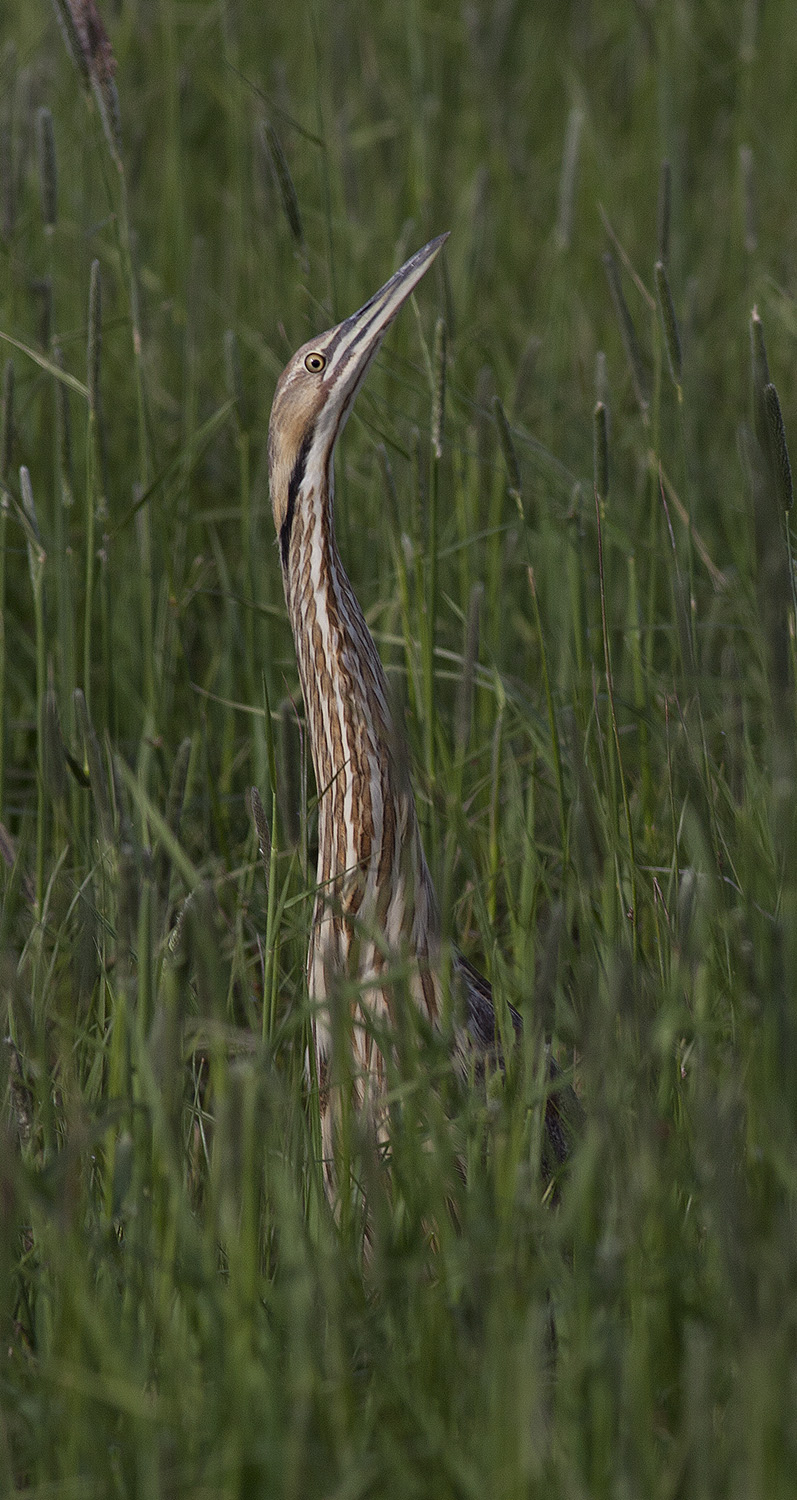
Bittern on Cokeville Meadow National Wildlife Refuge, Wyoming
Land Policy and Management Act, the Surface Mining Control and Reclamation Act, the Clean Air Act, the Clean Water Act, the National Environmental Policy Act, and many others, federal and state.
In his lecture, Kareiva argues that the dams on the Snake and Columbia rivers in the Pacific Northwest aren’t a major obstacle for wild salmon on those rivers: “The federal dams have been so well engineered, they’re really not that much of a problem for the salmon. The private dams are a huge problem. Massive federal investments have made the federal dams not such a problem.”
The modifications that have been made in dam design in the Columbia River drainage have helped salmon, although there are experts who would argue that the dams still constitute a profound threat to wild salmon stocks, especially on the upper Snake, but there would have been no massive investment in these modifications if it hadn’t been for the “doom-and-gloom” rhetoric of two generations of conservationists. The same can be said of other modifications in structures and industrial processes that government and corporations have adopted— if these entities aren’t held accountable when they’re causing harm, they have no incentive to remedy it.
The bad news is that there is a lot of bad news on the conservation front. Kareiva is right to point out that conservationists need to showcase successes and hold out hope for the future. But in an era when a growing majority of humanity is estranged from the land, conservationists have to talk straight about damage to the planet as it occurs or people will simply not be aware of it.
I find it interesting that, after attacking many of the dire, but inaccurate, predictions of environmental doom that have been made over the last generation, Dr. Kareiva freely says, “Climate change predictions are NOT deeply flawed.” I think he’s right, but if there’s a more daunting body of information than the emerging analysis of climate change, I haven’t seen it. If the predictions are right, we’re irrevocably committed to a century or more of climatic shifts that will generally cause intense difficulty for most people and a spectrum of wildlife and wild places as well. And, if we don’t act soon to reduce our emissions, that prediction of doom and gloom could well extend for a millennium or more.
I think it’s vital that people become aware of this threat to the future. Dr. Kareiva seems to agree, but his general opposition to the expression of “doom and gloom” raises doubts about where he stands on this and many other issues.
There is a delicate equilibrium to be struck in our discussion of the planet’s ecological health. Most Americans are largely ignorant of the environmental circumstances facing them and the consequences those conditions may have for people as well as other living things. They need to know enough to get motivated but not so much that they despair. The middle ground between the two is admittedly narrow, but we won’t even take up the task of change as long as we remain ignorant.
The upshot
The list of practical reasons for maintaining biodiversity and a certain degree of wildness on earth grows with our understanding of natural processes. It’s a long list that still hasn’t been well integrated into our thinking about the future. I hope Dr. Kareiva and I agree on the importance of remedying that. But, beyond the economic and ecological justifications for conservation, there are spiritual and moral issues that need our attention.
A wise man once told me that he thought humanity would go out, not with a bang, but a whimper.
“We are an arrogant species,” he continued. “We believe we can destroy the world. There’s no way we can do that; life on earth is unimaginably tough. But there is a far more delicate thing that is in our power to destroy. Human happiness. The question is whether we’ll have the wisdom to preserve what makes us happy.”
Our kinship with the rest of life on this planet is undeniable, stretching back over more than four billion years of change and adaptation. Such ties don’t evaporate in a few generations of city living. Even the most confirmed urbanite still wears the marks of that legacy: We keep flowers on the windowsill, fountains in the lobby. Our blood pressure drops when we stroke a pet. We feel the cycle of the sun and still fear the dark. We are bound to the land in thousands of ways, many of which we no longer recognize.
I share Kareiva’s concern over “special places and species,” not only because their loss could unravel ecosystems on which we depend— though it might— but because the world would be a grayer, sadder place to live in if we lost them. This is the spiritual argument for conservation. It doesn’t rest on a foundation of hard data and economic necessity, but
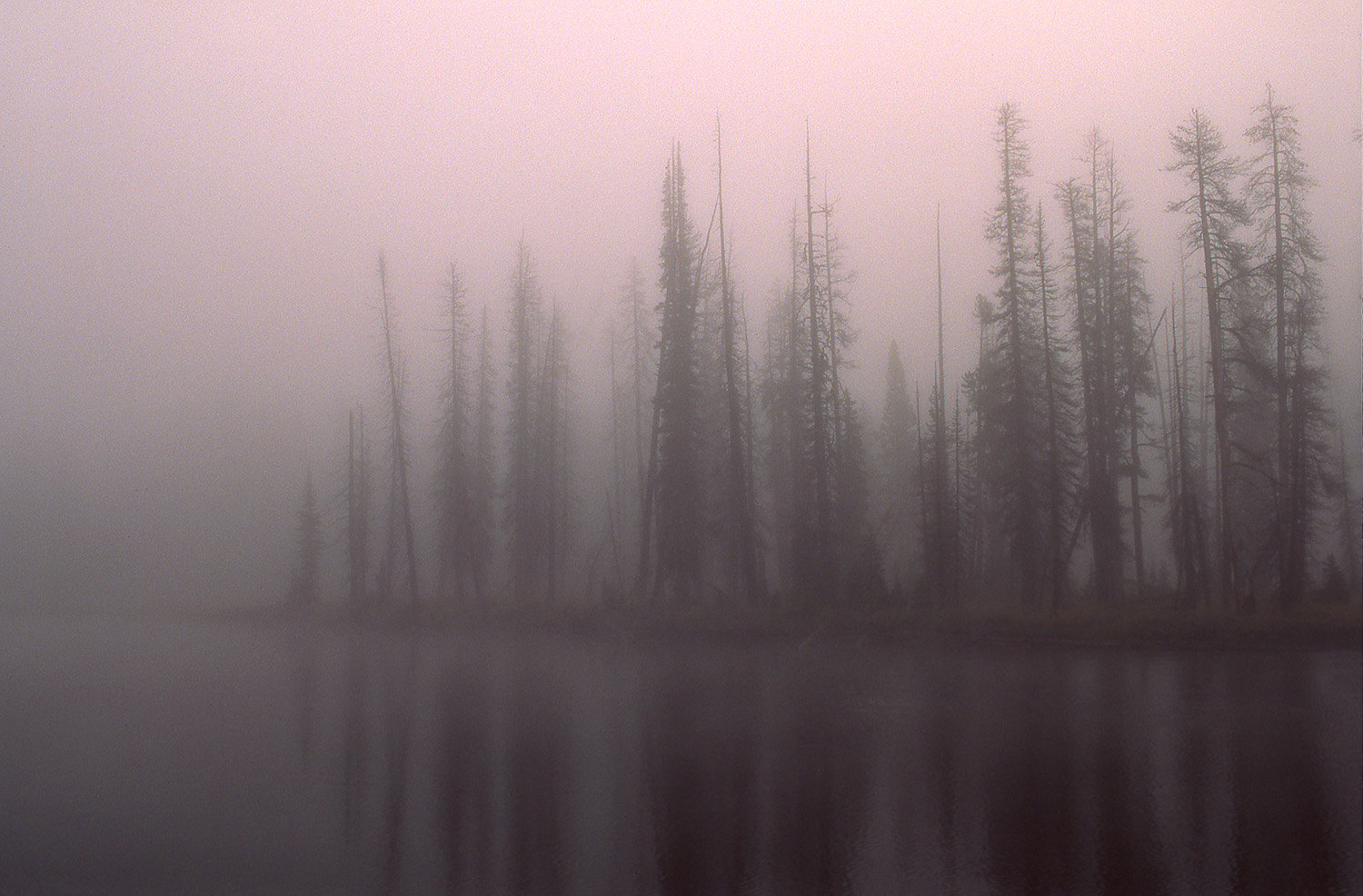
Lewis River, Wyoming
that doesn’t make it any less important. Kareiva counsels conservationists to abandon this foolish spiritualism, to quit selling the idea that occasional solitude in a wild place is a balm to the human soul. I think he’s wrong. He wants to confine the conversation to our standard of living; I think we should spend some time talking about our quality of life.
There is also an obligation to be considered. Almost seventy years ago, Aldo Leopold famously championed a new ethical relationship with the land:
“A thing is right,” he wrote, “when it tends to preserve the integrity, stability, and beauty of the biotic community. It is wrong when it tends otherwise.”
It’s certainly true that conservation is generally profitable and always prudent. It is also the right thing to do.
In his Beckman lecture, Kareiva offers these mnemonics for conservation in the twenty-first century: “Restore, reconnect, people, communities, growth and opportunity, technology for nature, green infrastructure, greening business.” They’re all laudable reminders, although not a single one of them is new to the mainstream of American conservation. But I note that there is not a single hint of moral responsibility in his list. He seems ready to abandon key moral and spiritual elements of the traditional argument for conservation. These may not be particularly useful for a group like The Nature Conservancy, but they remain crucial to the ultimate success of the larger movement and to the quality of our lives.
In a New York Times column last year, Thomas Friedman called on the Republican Party to renew its commitment to conservation issues. In that column, he quoted another official of The Nature Conservancy, Glenn Prickett, as saying, “We spent the 20th century protecting nature from people; and we will spend the 21st century protecting nature for people.” Here in North America, at least, that characterization of the past and present is simply not true. In fact, we’ve spent much of the last century searching for ways to support wildlife on tamed landscapes, to provide outdoor recreation
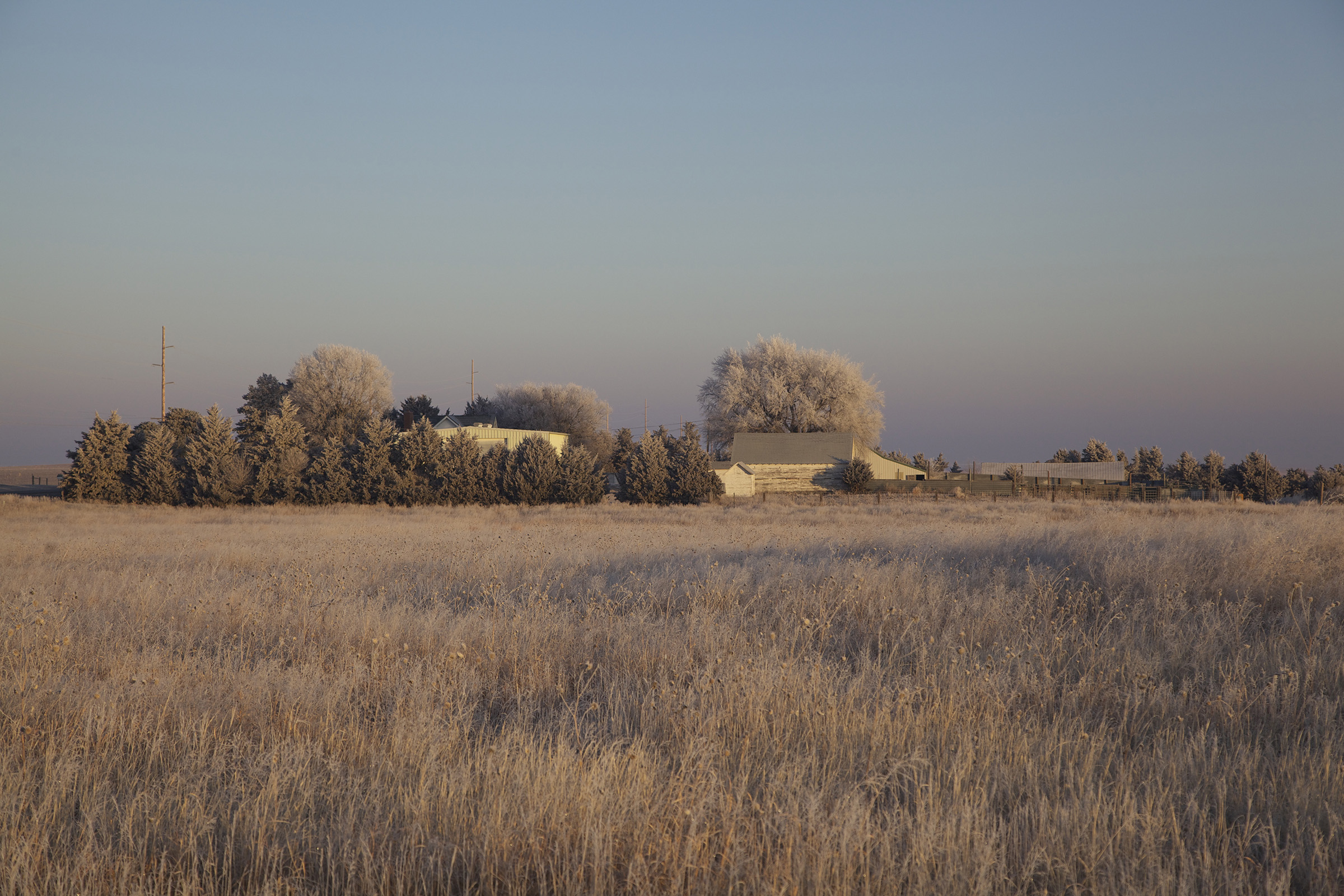
Wildlife habitat retired under federal CRP program, Nebraska
in a wide variety of settings, to hold onto vital natural resources like topsoil, clean air, and clean water. When professional conservationists like Kareiva and Prickett fail to recognize such efforts, they damage the credibility of past conservation work and undermine the future of conservation. Thomas Friedman is an influential voice in modern America— if the cracked view of conservation history Kareiva and Prickett offer is coloring Friedman’s view of the past and future, then these two spokesmen for conservation have already done significant harm.
Conservationists have learned important new lessons in the last sixty years and relearned some old ones. It’s clear that little significant conservation work can proceed without public support— we’ve learned that in several international projects and relearned it here at home. At the same time, conservation should never simply settle for convenient solutions. Coping with the really big problems— like climate change— will be decidedly inconvenient. While we will never be able to force people to conserve, we should never stop trying to convince them.
In the end, I have the feeling that Kareiva is confusing conservationists with a certain kind of environmentalist. For decades, I resisted the distinction between conservationist and environmentalist entirely, feeling that it was redundant, that all people who were interested in holding onto the variety of living systems shared a common focus and set of goals. However, vocal members of both persuasions have harangued so long and so passionately about the fundamental differences between the two groups that I’ve finally been forced to concede that they must have fundamentally different motives.
Perhaps Kareiva is addressing some of the more radical environmentalists, hoping to persuade them to include humans more often in their visions of the future. While that is a laudable end, I doubt that his argument will move many of the radicals. In any case, his mischaracterization of the conservation mainstream does a disservice to generations of dedicated people who achieved great things at great personal cost. It devalues the example their work set and neglects the many successes they had in convincing the rest of the nation, and much of the world, to embrace the concept of wise, sustainable use of natural resources. Perhaps worst of all, Kareiva distorts or ignores important discoveries and precepts in the science of ecology.
He bases his argument on the premise that “conservation is failing.” I can’t refute that assessment. To me, it seems obvious that an increase in human population and human appetite will complicate any effort to maintain significant tracts of major natural systems and the wildlife they support. In the twenty-first century, conservationists may lose more than they win. There is a movement afoot among some conservation professionals to avoid these losses by a simple expedient— don’t ask for anything you’re not sure you’ll get. That approach certainly makes the score sheet look better, but it also concedes many cases where the ultimate issue is in doubt.
Failure isn’t always a bad thing. Sometimes, it raises public awareness of an issue and changes attitudes. A classic example was the fight over Glen Canyon in the American Southwest. The Bureau of Reclamation wanted to build a dam at the mouth of the canyon and flood it; a coalition of conservationists fought the idea. In the end, the dam was built, but there’s good reason to believe that the furor over Glen Canyon headed off a proposal to build a dam across the mouth of the Grand Canyon.
Kareiva seems to be one of those conservationists who is willing to confine his efforts to “win-win” solutions. I’m a fan of “win-win,” but in the end, the problems that yield to a “win-win” approach are the easy ones. Many of the greatest conservation decisions of the past had winners and losers, and if we expect to hold onto more than a scrap of the wild heritage we share, there will more “win-lose” choices in our future. I think the people of the world need to discuss those choices fully, not concede the issues before they arise.
Kareiva seems willing to think smaller, to focus only on those situations in which conservation has a clear and immediate economic benefit for everyone involved and quick agreement is a foregone conclusion. He suggests that we bring conservation into our cities and onto our farmland, as if that hasn’t been going on for generations. And he tells us to give up our “romantic notions” about wilderness, implying that we should get comfortable with ever more far-reaching and destructive alterations of entire landscapes.
While I enthusiastically support the idea of bringing more wildness into our communities, I challenge Kareiva’s implication that we will be able to maintain the earth’s biodiversity simply by adjusting our management of “working landscapes” and providing for more urban open space. Some species are equipped to cope with the kinds of rapid change we work on the land; others are not. If we expect to hold onto species like gray wolves and grizzlies, barren ground caribou and bighorn sheep, Attwater’s prairie chickens and Gunnison’s sage grouse, then we will have to leave room for them. Human activity in such places may not always be excluded, but it will have to be constrained.
For four generations or more, there was a consensus on the need for conservation in America. It crystallized when we recognized the depth and breadth of the damage we had done to wildlife, forest, native prairie, wetlands, clean water,
Parched federal wetland in the Dakotas
and the very air we breathed, and it carried us into the 1980s. Over the last thirty years, that consensus has eroded.
It’s up to this generation of conservationists to rebuild it. The situation on the land is, in many ways, no different than it was at the turn of the last century. We face ecological challenges that rival or surpass the problems Americans faced in the era of the Roosevelts. The nature and extent of these challenges is becoming clearer with every passing year, and several of them are beginning to impinge on the lives of average people around the globe. I believe that, as more and more of us recognize the gravity of these issues, it will get easier and easier to consider serious responses, even if they entail significant cost and sacrifice. Now is not the time to abandon the discussion; now is the time to press it.
The successes conservation achieves in the twenty-first century will be built on the foundation that has been laid over almost 200 years. They will be evolutionary, not revolutionary, and I believe they will depend as much on a moral renaissance as on technical or political breakthroughs. If Kareiva is uncomfortable with that notion, he is free to pursue his own vision, of course. But I hope he will grant other people who are equally concerned and committed the freedom to choose a different path to the goals I believe we both share. And I expect him to observe the same discipline he demands of others and get his facts straight.
__________________________
If you’re interested in reviewing the original texts of Dr. Kareiva’s remarks, consult these sources:
FOR THIRTY YEARS AFTER JIM HANSEN AND HIS COLLEAGUES AT NASA FIRST WARNED US THAT WE WERE CHANGING THE EARTH’S CLIMATE, the discussion focused on ways to reverse, or at least stabilize, the process. That dialog gained volume and urgency as the relationship between rising concentrations of greenhouse gases and increasing worldwide temperature was described with greater precision over a longer and long span of time.
Over the last decade, the discussion of climate change has dilated to include a new concept: adaptation. The release of the recent report from the IPCC’s Adaptation Committee has stimulated another round in the conversation about how we should respond to the heating of the planet.
As far as I can tell, the idea first emerged as a cynical fallback position among climate change deniers, who were forced by accumulating data to admit that climate was, in fact, changing but who were unwilling to accept any proposals that would reduce human emissions of greenhouse gases. In recent years, it has been taken up by people on the far side of the spectrum in the debate, those observers who have lost hope that our species can restrain its appetite for fossil fuels in time to avert major, and essentially irreversible, shifts in climate.
I have little patience for the deniers’ view of the issue, which is so clearly driven by a combination of contempt for science and a vision of politics, economics, and ecological reality that would be comic if it weren’t so dangerous. On the other side of the debate, the people who have lost hope in our ability to stop climate change make a frighteningly plausible argument, but it has about the same effect as the case made by climate deniers: It tends to divert attention from the disease— the planet’s unprecedented capture of solar energy— and focuses on treatment of symptoms— which is to say, adaptation.
The word “adaptation” has a reassuring ring. It implies that we can cope with whatever challenges climate change may throw at us, that dealing with a global shift in climate shouldn’t be more than a footnote in human affairs over the next century. Anyone who has been paying attention realizes that we’re already adapting to the effects of climate change. While no reputable scientist in the field will argue that a specific storm or drought is the direct result of increasing concentrations of greenhouse gases, the scientific community is advising us that the probability of damaging events has already risen.
And so the restrictions on water use in drought-stricken California may well be an adaptation to climate change. These will certainly take a toll on the agricultural economy of California, and they’ll probably mean that I eat less lettuce in the next few months as well. The lingering drought on the southern and central plains has contributed to increasing grain prices, which have their effect on prices of commodities from breakfast cereal to the ethanol in our gas.
We’re in the process of spending billions of dollars to restore New Orleans in the wake of Hurricane Katrina and billions more rebuilding the central Atlantic coast after Superstorm Sandy. Apparently, we’re not ready to adapt to rising sea level and the prospect of more intense storms by moving away from these risky coasts, but we are willing to divert huge amounts of money from other public works to maintain life as usual in the face of growing risk. It’s part of the cost of adapting.
In the wake of the mudslide that killed at least thirty people in Oso, Washington, we hear that a study issued in 2000 warned of the risk of “catastrophic failure” on the slope. At the time, county officials considered buying all the property on the hillside and moving the residents. The cost was estimated at $1.6 million, more than the county wanted to spend, and the buyout probably wouldn’t have worked anyway, since it depended on convincing all the owners to sell.
Will owners in similar situations be willing to sell now? Will local governments be willing to spend the money necessary for such buyouts? Will new zoning ordinances be passed to restrict the public’s freedom to build in such high-risk areas? What is the price of this kind of “adaptation”?
Similar questions arise in the “wildland-urban” interface, where the rising risk of forest and brush fires poses an increasing threat to homes built by people who want to get away from it all. Over the last five years, the federal government, primarily through the U.S. Forest Service and Department of Interior, has spent an average of more than $3,400,000,000 (that’s billion) a year fighting wildfires.[i] That figure doesn’t count the money spent by the Federal Emergency Management Administration or state and local entities to save private property from wildfires. It also neglects the cost of wildfires in human lives. Who in the arid West will ever forget the news from Arizona last summer when nineteen members of a hotshot crew lost their lives in half an hour?
In 2010, the World Bank estimated that helping the developing world adapt to a two-degree C. rise in temperature between now and 2050 will cost humanity between $70 billion and $100 billion a year.[ii] No one has been bold enough to offer an overall estimate of what it will cost to adapt to changing climate here in the United States, but at least one economist has estimated that the cost of Hurricane Katrina alone topped $250 billion.[iii] As impressive as it is, this number fails to assess the price in human life exacted by Katrina— more than 1,800 souls, according to officials.[iv]
Judging from the relative indifference the nation shows toward climate change issues, we seem willing to accept costs of this magnitude as a form of adaptation. Some have argued that a major rebuilding effort has its own economic benefits; the gross domestic product may show little, if any, response to the effects of a major storm, simply because the damage is at least partly balanced by the expenditures made during the recovery. That may be the case, from a strictly economic perspective, but there’s no progress in the transaction, no net benefit. Instead of choosing our way forward, we allow a deepening crisis to define our priorities for us and squander our efforts and capital in a losing battle to maintain the status quo.
Whether we decide to move large populations away from major weather threats, whether we choose to build massive levees to protect them from too much water or massive dams and pipelines to protect them from not enough, whether we leave them where they are, exposed to the dangers of storm and drought, then pay the cost in dollars and lives to deal with ensuing disasters, the best analysis from climate scientists tells us that the cost will continue to climb as concentrations of greenhouse gases and world temperatures rise. Without an adequate response to the underlying cause, the trouble we face is certain to get worse.
And unless we do something about the trend in global temperature, the concept of “adaptation” will eventually require more than new public works projects, a change in zoning, or a Congressional bill for disaster relief. It could eventually lead us into the primal realm of organic evolution, where success is defined by survival. Residents of temperate regions could be exposed to tropical pathogens and insect vectors for the first time. Regional shortages of fresh water and food, extended drought or widespread flooding could leave millions of people around the globe in desperate circumstances. At some point, shifting climate could mean the difference between life and death for a large fraction of humanity.
Which is why I’m uncomfortable with a discussion about climate change that ends with adaptation. We’re adapting, and with the damage we’ve already done to the atmosphere, we’ll have no choice but to continue to adapt over the coming decades. I’m the first to recognize that we need to be smart about that process, to make sure that the steps we take are efficient and durable over the long term. But dealing with the symptoms of climate change isn’t going to protect us from its deepening effects. We need to treat the disease. No discussion of climate change is complete without a commitment to a cure. Adapting won’t be enough.
Congress continues to bleed America’s most important conservation program
WELL, AFTER MORE THAN THREE YEARS OF DEBATE AND CLOAKROOM POLITICS, WE FINALLY HAVE A NEW FEDERAL FARM BILL. The scope of the programs it authorizes is almost beyond imagining. So is the cost: around $960 billion between now and 2023.[i]
Most of the angst over the bill has focused on the Supplementary Nutrition Assistance Program (SNAP) and various subsidies to farmers, particularly direct payments to farmers who raise certain crops, whether the prices for those crops are high or low, and special treatment for commodities like milk and sugar. Largely lost in the discussion has been Title II of the 2014 farm bill, the section that defines most of the federal conservation programs that apply to farmland.
Several of the conservation groups who lobby Congress on these matters have expressed general satisfaction with the outcome of the extended negotiations over the farm bill and with good cause, I guess— the damage to the conservation title could have been much worse. Various farm interests were interested in getting rid of Sodsaver, the provision that gives grasslands some measure of protection by limiting farm subsidies for any farmer who plows native prairie. Conservation groups managed to keep Sodsaver.
A farmer who wants to take advantage of the massive subsidies in the new crop insurance program has to comply with the provisions of the conservation plan he and the Natural Resources Conservation Service design for his property. Some farm interests didn’t want that provision, but they got it anyway.
And the crown jewel of the farm bill’s conservation title— the Conservation Reserve Program (CRP)— wasn’t killed in the crossfire over food stamps between liberals and Tea Baggers. That’s something.
The conservation lobbyists who negotiated these concessions worked miracles in a Congress that would rather feud than breathe. At this point, they have little choice but to make their peace with the final outcome and get on with life.
But you’ll pardon me if I’m more than a little dismayed at the outcome. We’ve been compromising on the farm conservation programs ever since the 1985 farm bill became law. That was the bill that created CRP, a provision that paid farmers to plant permanent cover on highly erodible cropland and leave it for ten to fifteen years. In some cases, the ten-year payment was as much as the price of the land itself, but conservationists didn’t complain because the cover drastically reduced soil erosion, improved water quality, and provided habitat for a spectrum of wildlife species, many of which had been suffering long-term declines before CRP was launched.
City and country, farmer and urbanite, everybody got something out of CRP, but even in that first bill, there was a substantial compromise: With permission from the Department of Agriculture, farmers could hay or graze their CRP land during a severe drought. That reduced the protection from erosion CRP provided and nearly eliminated residual wildlife food and cover when wildlife needed them most. It was a huge compromise, but the conservation community accepted it as a necessary step in gaining important protection for farmland and wildlife.
We’ve been compromising ever since. The 1985 farm bill set a ceiling of 45 million acres for CRP.[ii] In 1996, the ceiling was reduced to 36.4 million acres.[iii] In 2008, it was reduced again, this time to 32 million acres.[iv] And the 2014 farm bill reduces the ceiling again— now, it’s 24 million acres, barely half the original target for CRP.[v]
As the ceiling has been lowered, the number of acres in CRP has declined. In 2007, we had 36.7 million acres in CRP; in 2013, we were down to 26.8 million acres.[vi] Some of this drop was the result of record high prices for corn, soybeans, and wheat— faced with a choice between CRP rental payments and the income from a corn crop at $8 a bushel, many farmers let their CRP contracts expire and got on the tractor— but there’s little doubt that the reduced CRP ceiling has played a major role in the loss of CRP acres across the farm landscape.
I suppose it could have been worse— there was at least one proposal in the House of Representatives to slash the budget for CRP, even though the program has what’s known as “mandatory funding” under the farm bill. The attempt to reduce CRP appropriations failed, but between 2003 and 2010, similar efforts cut $7.5 billion in funding for other programs in the farm bill’s conservation title. More compromises . . .
So the suits in Washington have made their deals and held their news conferences, and the conservation title of the farm bill has once again suffered the consequences. What do we in the real world stand to lose as a result?
Well, there’s the topsoil, of course. CRP began as a program to tack down highly erodible fields, and it has had marked success in achieving that goal. In 1982 before the advent of the modern farm bill, croplands were losing 7.3 tons of soil per acre every year. That was something like 3,061,000,000 tons of topsoil down the river or into the sky. Every year.[vii]
In 2007, that loss had dropped to 4.8 tons per acres, a 43-percent reduction in soil loss.[viii] Some of this reduction is undoubtedly due to new minimum-till farming techniques, but a large part is the result of cover crops planted on CRP acres.
As human population moves toward 500 million in the United States and 9 billion or more in the world, we may well find that the most important single natural resource we have in America is our topsoil. It would a good idea to hold onto as much of it as we can.
Holding soil in place also means better water and air quality. Researchers at the University of Missouri estimate that CRP cover hold 259 million tons of nitrogen, 56 million tons of phosphorus, and 23 million tons of organic carbon on the land instead of allowing them to leach into waterways.[ix] This not only improves the fertility of the land but reduces pollution and eutrophication in the water. The researchers also estimate that CRP keeps 335 million tons of dust out of the air.
These days, a growing number of people (including me) are worried about the continued build-up of greenhouse gases in the atmosphere. A significant part of the conversation about saving ourselves from being roasted alive has been the idea of somehow trapping carbon dioxide underground. The coal industry and other business interests are looking for high-tech ways of removing CO2 from the air and pumping it thousands of feet below the surface of the earth, where they hope it will stay.
There’s an easier way—just fund more CRP. Researchers in Michigan studied a field that was being returned to a corn-soybean rotation after twenty-two years in CRP. In the first year after the field had been replanted, they found that the soil released 6.4 tons of carbon dioxide and nitrogen oxide per acre. They estimated that the field would release another 21.9 tons of greenhouse gases per acre over the next several years until some sort of equilibrium was reached.[x]
It’s been estimated that, at its peak area in 2007, CRP locked up 84 million tons of carbon dioxide in a single year.[xi] If the Department of Agriculture manages to meet the ceiling in the new farm bill, we’ll see a thirty-four-percent reduction from the 2007 acreage of CRP—plowing thirteen million acres will release millions of tons of carbon into the atmosphere and cripple one of the best sequestration systems we have.
And farm wildlife will take a beating. CRP hasn’t been a boon for every wild animal on the agricultural landscape— no single approach to habitat can provide all things to all wildlife— but the net effect has been overwhelmingly positive. At least one species, the tiny Henslow’s sparrow, might very well be listed as threatened by now if it hadn’t been for the advent of CRP. Prairie ducks have prospered in the CRP era, as have prairie sharp-tailed grouse and several species of songbirds.
The coming of CRP revived the Midwest’s populations of ring-necked pheasants as well. In 1986, hunters in South Dakota, long the heart of pheasant country, had bagged just over 600,000 birds; in 1991, five years after the CRP program was launched, the harvest doubled to 1.2 million. Iowa, another mecca for pheasant hunters, reported a harvest of just over 800,000 roosters in 1986; just three years later, hunters took more than 1.4 million, thanks to a year of gentle weather and nearly 2 million acres of new CRP cover.
The decline of CRP over the last seven years has had the opposite effect across the pheasant’s current range. Here’s a quick look at the change in Midwestern pheasant harvest since 2007:
2007 2012
Iowa 600,000 158,000
Nebraska 480,000 198,000
Kansas 383,000 234,000
Minnesota 655,000 290,000
South Dakota 2,100,000 1,428,000
North Dakota 907,000 650,000
Much of this drop has been caused by stunningly bad weather over the last five years— extended drought on the central plains, a succession of horrific winters and/or spring deluges in Iowa and parts of Minnesota. Still, good habitat is a shock absorber. It can’t eliminate the effects of a bad year, but it does minimize them, and it accelerates the recovery once the weather improves. The Midwest’s prime pheasant states have lost nearly 8 million acres of CRP since 2007, which leaves pheasants and most other wildlife exposed to the full impacts of whatever cold front happens to blow through.
No one who knows anything about pheasants is surprised by the effect of this deepening habitat loss. Saddened but not surprised.
Pheasant populations are more carefully followed than the numbers of any other bird in farm country. If a bird as tough as the ringneck is struggling, it’s almost certain that sharptails, prairie chickens, and prairie ducks will follow. That’s bad news for hunters and bird enthusiasts, of course, but it’s also horrible news for local economies. In 2012, pheasant hunters spent $172 million in South Dakota alone[xii]. As recently as a decade ago, pheasants supported an industry worth half a billion dollars in the upper Midwest, an income stream that was produced almost accidentally by a conservation program designed to protect soil and bolster crop prices.
The boys in Washington are desperate to cut federal spending— I get that. And like most Americans, I support the idea of a balanced budget. But if we’re going to cut costs, it seems sensible to cut programs that don’t work very well, don’t serve many of our citizens, or both. CRP and several of the other programs in the conservation title of the farm bill deliver a spectrum of important benefits to nearly every American: They save precious topsoil, help support prices of grains and other farm commodities, clean our water and air, trap carbon dioxide and other greenhouse gases, keep rare wildlife species off the federal list of threatened and endangered species, provide recreation, and inject income into rural economies.
And they accomplish all these things at a surprisingly modest cost.
The farm bill as a whole is breathtakingly expensive, but it’s important to remember that eighty percent of that amount pays for food stamps and other nutritional programs. Another nine percent goes for subsidies on crop insurance (more on that in a minute), and another five percent for a variety of crop subsidies.
Only six percent of the farm bill budget is spent on conservation programs, most of it on CRP, and over the next ten years, the new federal farm program will cut more than $3.3 billion in CRP funding. Meanwhile, the cost of our subsidies to farmers for crop insurance will go up by $5.7 billion.[xiii]
I think it’s appropriate for us, as taxpayers, to help farmers cope with some of the risks inherent in their business. Agriculture is one of the cornerstones of the American economy, and it’s likely to become even more important in the future. But, for the life of me, I can’t understand why we should offer a farmer support by underwriting his crop insurance. Those of us who live in town reap no benefit whatsoever from the insurance program.
The farm bill’s conservation programs offer a far better conduit for support. Participating farmers receive a guaranteed income, regardless of flood, drought, or hail, and at the same time, the nation as a whole gets cleaner air and water, more productive topsoil, more wildlife, and a step toward heading off climate change. Everybody wins.
I’m tired of paying for the backroom deals while I watch compromise after compromise erode the parts of the farm bill I want most. Congress tries to pass a farm bill every five years or so, which means that, before the issue heats up again, Americans have three years to think about what we really want for the trillion dollars we’ll spend on the next farm bill.
It’s time to move the debate out of the backroom. And quit compromising.
[iii] Public Law 104-127, 1996. Federal Agriculture Improvement and Reform Act of 1996. http://www.gpo.gov/fdsys/pkg/PLAW-104publ127/pdf/PLAW-104publ127.pdf
[vii] USDA, Natural Resources Conservation Service, 2007 National Resources Inventory. National Soil Erosion Results Table. http://www.nrcs.usda.gov/wps/portal/nrcs/detail/national/technical/nra/nri/results/?cid=stelprdb1041678
[viii] ibid.
[ix] Food and Agricultural Policy Research Institute, University of Missouri, Columbia, MO, 2007. Estimating Water Quality, Air Quality, and Soil Carbon Benefits of the Conservation Reserve Program. FAPRI-UMC Report 01-07. http://swat.tamu.edu/media/1331/fapri_umc_report_01_07.pdf
[x] Gelfand, Ilya, et al., 2011. Carbon debt of Conservation Reserve Program (CRP) grasslands converted to bioenergy production. Proceedings of the National Academy of Sciences 108(3): 13864-13869. www.pnas.org/cgi/doi/10.1073/pnas.1017277108
[xi] p. 31. Food and Agricultural Policy Research Institute, University of Missouri, Columbia, MO, 2007. Estimating Water Quality, Air Quality, and Soil Carbon Benefits of the Conservation Reserve Program. FAPRI-UMC Report 01-07. http://swat.tamu.edu/media/1331/fapri_umc_report_01_07.pdf
[xiii] Congressional Budget Office, 2014. Letter the Honorable Frank D. Lucas, estimating the effects of direct spending and revenues of the conference agreement on H.R. 2642, the Agricultural Act of 2014. http://www.cbo.gov/publication/45049
SIX MONTHS AGO, I FOUND MYSELF IN A HOTEL CONFERENCE ROOM WITH THE BLINDS DRAWNS, GLASSES AND PITCHERS OF WATER ON the draped tables, a projector for Powerpoint presentations, a flip chart and magic markers in the corner: This was clearly a place that had been equipped for some deep thinking. Fifteen or twenty of us were sequestered behind closed doors, charged with plotting the future direction of a major conservation group, and we were all contemplating a draft mission statement on the screen. While the word-smithing went on, my attention was drawn to a phrase near the beginning:
“We have an opportunity to create a world in balance, a world where human needs do not come at the expense of nature.”
I lingered a while over the notion of “a world in balance,” the quaint idea that, in spite of the constant shifts in everything from incoming solar energy and the orientation of the earth’s axis to the evolution of bacteria, it might be possible to establish some sort of stasis on an entire planet. Neither physics nor biology held out much hope for a balance, but I thought I knew what the authors were trying to say, so I drifted to the second half of the sentence: “a world where human needs do not come at the expense of nature.”
Creeping around in the background of that statement, unexpressed but palpable, is one of modern man’s most enduring prejudices— that, somewhere in our rise to enlightenment, we transcended our animal lineage and became qualitatively different, and distinctly better, than the menagerie that surrounded us. In this case, the phrasing went on to imply that we could live without making any demands on ecological systems, without appetite or impact, almost like angels.
The question is one of the most central issues in human thought: Are we a part of nature or are we apart from it? It haunts our discourse on philosophy and religion, shapes our debate on practical ethical matters from our appetite for meat to our concepts of animal welfare, and colors the way we use land and the resources it provides. Not too surprisingly, it emerges in nearly every discussion of conservation and the environment
Of course, the differences that distinguish us from all other living things are unmistakable, even though it’s proven remarkably difficult to build a quick, air-tight definition of what sets us apart. When I first stepped into a college classroom, anthropologists were describing us as the tool-using animal, but in the last forty years, we’ve found many examples of other animals, from chimps to sea otters to crows, that use tools. In some cases, these animals use items that are handy without altering them, but in others, they modify an object before using it, which calls into question the revisionist claim that we are the only tool-making animal.
It can be argued that, even if we can’t make an absolute distinction in this behavior, there is certainly a difference of degree: We’re much better at making and using tools than any other species, which has turned out to be a good thing for us, since we can’t run, jump, swim, or fly nearly as well as other life forms do. We’re unique; we fill a niche in the scheme of things, and we’re one endpoint in four billion years of selection for success. The same can be said of every other living thing that shares the planet with us. Different, for certain, but not necessarily better.
No one knows for certain when the concept of human exceptionalism began, but I think it’s a relatively recent phenomenon in our existence as a species. Probably the earliest record we have of abstract human thinking was found about twenty years ago in the Chauvet Caverns of the Ardeche Valley in southern France. Some of the paintings and sculptures in that cave are more than 30,000 years old, and they suggest that those ancient men understood the earth and its teeming life in much the same way as contemporary Stone Age cultures do. It seems likely that then, as now, people whose lives depended on good hunting and foraging for their livelihood felt a close kinship with other animals, a relationship that colored religion as well as the group’s day-to-day activities. For those primitives, each species had its unique place in the world, but no species, not even man, exerted control over the whole.
It’s interesting that there are no strictly human figures among the paintings at Chauvet or the more recent cave paintings in places like Lascaux and Altamira. The occasional images that suggest humans have the heads of bison or horses. Archaeologists have speculated that these may be drawings of shamans or possibly illustrations of visions from trances. Either way, they leave the impression that the people of that time and culture felt an intimate relationship with the living things around them— they saw themselves as a part of nature.
I suspect the shift in our attitude began with the domestication of key crops and animals some 13,000 years ago. It was a slow-motion revolution that may have stretched over 4,000 years or more and left no record beyond the melted remains of a few adobe huts, fragments of discarded tools, and the altered DNA in the organisms that led us into farming.
At the beginning, our lives and fortunes were clearly shaped by the same forces that defined success and failure for all the animals and plants around us. A severe drought or winter, an outbreak of disease, a shift in the constant push and shove between predator and prey all sent immediate ripples through the populations that supported us and inevitably took their toll on each tiny group of wandering humans they touched. By the end, we had created a domain we thought we could control. The natural world beyond the fence was no longer a part of a universal brotherhood; it was a potential threat. We were estranged.
Irrigation expanded our sense of control and eventually led to the first great cities, places where specialists in various trades could divorce themselves almost entirely from the daily demands of producing food. The world’s first written epic, “Gilgamesh,” includes the wild man Enkidu, immensely powerful, drawing his strength from the wild world outside the control of the empire. Eventually, the emperor finds a way to domesticate the wild man and reduces him to the status of a slave, albeit, a valued slave, who assists the monarch in a series of adventures. The story reads remarkably like the biblical expulsion from Eden, set down in cuneiform 2,500 years before the birth of Christ.
As far as I can tell, these are the roots of the notion that the human animal stands somehow outside of nature— an idea that, in western culture at least, has complicated our thinking about our relationship with the earth ever since.
In its most extreme form, this concept has led to expressions of open hostility toward the unruly places that are seen to resist domestication. In the classic history of early colonial life in New England, Of Plimoth Plantation, the Puritan cleric William Bradford had this to say about the land he and his companions had chosen as their new home: “What could they see but a hideous & desolate wilderness, full of wild beasts & wild men? And what multitudes there might be of them, they knew not. Neither could they, as it were, go up to the top of Pisgah, to view from this wilderness a more goodly country to feed their hopes; for which way soever they turned their eyes (save upward to the heavens) they could have little solace or content in respect of any outward objects. For summer being done, all things stand upon them with a weatherbeaten face; and the whole country, full of woods & thickets, represented a wild & savage hue. If they looked behind them, there was the mighty ocean which they had passed, and was now as a main bar & gulf to separate them from all the civil parts of the world.” It was a view many Americans would take over the coming centuries.
One of the most succinct expressions of this attitude is literally cast in concrete on the University of Wyoming campus. Construction on the building that first housed the UW engineering department began in the early 1920s. In 1926, as the building neared completion, someone asked Earl D. Hay, dean of the college of engineering at the time, to compose a motto to be enshrined over the main entrance. After some thought, he came up with this: “Strive on; the control of nature is won, not given.”
I find it more than a little ironic that, in the spring of 1927, as Dr. Hay and his students were moving into the new building, the Mississippi River contested his notion that nature is susceptible to control. Always an unruly watercourse, the Mississippi had already been contained behind an extensive network of levees, but rain and snowfall across the heartland were unusually intense from August 1926 to the following April. Driven by nine months of exceptional runoff, the river ruptured the levees, flooded 127,000 square miles of bottomland, drove 700,000 people from their homes, and killed 250. And this rain-soaked winter immediately preceded the catastrophic ten-year drought of the Dust Bowl. Strive on . . .
I’d like to think we’ve learned a few things since Dr. Hay issued his challenge to engineers and the implacable opponent he identified only as “nature”— although I have to say that some of the events on the Mississippi Delta and along the Gulf coast in the last ten years shake my faith a little. However, for the sake of argument, I’ll concede that we may be beginning to think more in terms of cooperating with the land rather than dominating it.
Having said that, I still find us struggling with the fundamental question: Are we a part of nature or apart from it? The conservation and environmental communities are not immune. At one extreme is a specific group of hunters the sociologist Stephen Kellert has labeled “dominionistic” because they view wildlife and the rest of the planet as property to be disposed of as people see fit. The human species, in this view, stands clearly apart from the rest of the natural world.
But many of these hunters speak movingly of their outdoor experiences— it’s why they take the time and trouble, go to the expense, involved in hunting. They feel involved in natural processes when they’re in the field, and often, they place a high value on the meat they bring home. It gives them a sense of connection. They see themselves as apart from the natural world in the authority they have over it but very much a part of the natural processes and landscapes they enjoy.
Animal rights activists represent another extreme. They’re passionate about the kinship between people and the rest of life on earth. We are a part of nature, they argue— animals are our brothers. But they are morally repulsed by the idea that humans would participate in some of the most basic processes in the natural world, like eating meat and killing other animals to get it. They see humans as unique moral beings— a part of the natural world in our genes, but apart from the natural world in our moral responsibility.
Somewhere in the middle, there is the well-meaning phrase in that organizational mission statement: “a world where human needs do not come at the expense of nature.” It’s a mainstream sentiment, one that would fit nearly any conservation group, but it implies a sharp division between “human” and “nature.” From a strictly ecological point of view, that’s sheer fantasy. Every physical need we have is filled “at the expense of nature,” as the drafters of this language know as well as I do, but when challenged with expressing an overarching mission, they struggle to acknowledge our dependence and leave the impression that billions of people could somehow find a way to live and prosper without making any demands on the planet that supports us all.
The roots of the conservation movement reach back much further than most history books recognize. Alarmed by the disappearance of their deer, the residents of the town of Portsmouth, Rhode Island, outlawed spring deer hunting in 1647. And the notion of providing some protection for wildlife was not new in the New World. It stretches back through the game preserves of kings and nobles to the Fertile Crescent and the reign of the Assyrian emperor Ashiburnipal.
Through all those centuries down to the first effective conservation efforts in America, we approached the task much as we approached our backyard gardens. We admired some things for their beauty, some for the way they tasted. We set aside a corner out back, cultivated it, built a fence, and chose the varieties we wanted to grow.
Early in the development of wildlife management, its advocates used the metaphor of the garden to explain how they thought about the process. There were stocks of wildlife that needed our attention, and if we watered and weeded with sufficient care, we would eventually have a crop to harvest. A good gardener was careful not to overharvest his perennials so they would yield another crop next year, and with the annuals, he made sure not to eat all the seed so he had something to plant the following spring. A little thinning down the row helped production. So did a little manure.
It was a useful metaphor, as far as it went, emphasizing the renewable nature of the “resources” we managed in a way that an agrarian population could readily appreciate. But it had its limits. There was a casual chauvinism in the distinctions we made between crops and weeds that often failed to recognize the interdependence of the organisms we were managing or the processes that supported them. With a certainty bred of ignorance, we did things that seemed like a good idea at the time, only to discover years or decades later that we had failed to account for some key variables.
The collapse of the mule deer herd on Arizona’s Kaibab Plateau was among our first lessons. Massive predator control and highly restricted hunting allowed the population to grow from 4,000 animals to between 50,000 and 100,000 in a matter of eighteen years between 1906 and 1924. Conservationists celebrated until the herd finished chewing the last of its forage down to the roots and collapsed from its own too-much.
In the early years of the twentieth century, the people of Wyoming began feeding elk to keep them off private stocks of hay. Eventually, there were more elk than private citizens could afford to feed, so state and federal governments took over the program. It seemed like a durable compromise, an expensive but effective way to have elk in the mountains while avoiding conflicts with ranchers on winter range in the valleys. Until brucellosis came along. And the possibility of chronic wasting disease.
We thought common carp would be a welcome addition to the nation’s fisheries, and in spite of a hundred years of bad experience with that introduction, we subsequently decided to import grass carp. And black carp. And silver carp. We weren’t satisfied with the interior West’s native trout, the cutthroat, so we brought in brookies and rainbows and German browns and mackinaw and walleye and broadcast them over the landscape without considering the possibility that some or all of them might not coexist comfortably. We dammed nearly every river in the region without bothering to think about how a wall across a river might affect the movements of salmon, sauger, sturgeon, humpback and razorback chubs, and Colorado pikeminnows.
Sometimes, visualizing a garden isn’t the best way to think about the world.
The garden metaphor carried another message, too. Was that subtext accidental or intentional? — I can never decide. Either way, it was easy to jump to the conclusion that we owned the garden. We could decide how big it should be. If we suddenly decided that we needed another wing on the house or a new shed, we could move the beds or cut them in half, and if the crops and ornamentals were more trouble than they were worth, we could lay down some weed barrier, cover it with rocks, and give up the whole exercise. The garden, while often useful and sometimes entertaining, was something we could do without. We were apart from it.
I’m the first to concede that our willingness to provide for natural systems has grown with time— the world’s first national park and first national forest, both monuments to our changing perspective. In the last forty years, we’ve made a commitment, however uneasy, to preserve native biodiversity by protecting rare species, whether they are charismatic or not, and we’ve begun to appreciate that an organism can’t survive without the wild places that shelter it, a perception of habitat that demonstrates a growing ecological sophistication.
But we still struggle to come to grips with our place in it all. Do we exist on some higher plane, out of reach of “the thousand natural shocks that flesh is heir to”? Are we overseers, partners, or just participants, feeling our way toward survival like every other living thing on the planet? Is the impulse to protect wildlife and wild places an act of selfless charity or self-preservation?
Conservation is defined as “wise use.” There are many paths to that wisdom. Science reveals the unimaginable complexity of natural systems and helps clarify the way human actions ripple through them. If we spent more on research, we would have a better grasp of the challenges we face and the often unintended effects our decisions have.
But a technical grasp of the situation isn’t enough. We need to come to terms with the emotional and ethical ties that bind us, not only to each other, but to every other living thing.
So here’s how I see it. It’s time to return to a reality the artists in Chauvet Caverns understood and that we, in our technological hubris, have long abandoned: The human animal is a part of the natural world. Skin and bone, flesh and blood, right down to the last strand of DNA, we are creatures of the earth. We depend on it for food, water, shelter, raw materials, the very air we breathe. It shapes our conscious and unconscious, our minds and souls. It defines us.
Sixty years ago, the pioneer ecologist Aldo Leopold crystallized a lifetime of experience and thought into a slim volume of essays that was published after his death— A Sand County Almanac. He’d seen the consequences of land abuse from the delta of the Colorado River in northern Mexico to the forests of the Alps, the effects, not only on wildlife, but on people. His great contribution to human thought was the extension of the ethical concepts that color our interaction with each other to the concepts that color our interaction with the world at large.
“A thing is right,” he wrote, “ when it tends toward the integrity, stability, and beauty of the biotic community. It is wrong when it tends otherwise.”
A thing is right when it tends toward the integrity, stability, and beauty of the biotic community— Leopold’s “land ethic.” It was based on a scientist’s appreciation of the interdependence of all living things and a hunter’s grasp of the hard ecological truth that predator cannot survive without prey. He never suggested that we should aspire to living without making demands on the world around us; he recognized the ecological absurdity of that notion. He knew that the human animal depends on the processes that support all life. The key, in Leopold’s view, was to make those demands sustainably and with a keen sense of the limits of our understanding. In another essay, he offered this guide to interaction with the rest of creation: “To keep every cog and wheel is the first precaution of intelligent tinkering.”
More recently, the ecologist and philosopher E.O. Wilson has taken a somewhat different approach, proposing a new term for the environmental lexicon: “biophilia.” The roots are familiar: the Greek “bios” for living things and “philia,” which scholars define either as brotherly love or as kinship.
Take your choice: Leopold’s appeal to our sense of ethics, our higher nature, or Wilson’s evocation of our visceral connection with the rest of life on earth. They’re just different views of the same, unalterable truth: From the simplest viruses to the most complex life on earth, we’re all in this together.
I don’t know that accepting this will make our decisions concerning the land any easier, but there’s a good chance it will make them better.
As I remember, I first came across the work of Roy Chapman Andrews in the summer of my tenth year.
Andrews was one of the more remarkable men of the early twentieth century. He put himself through college doing taxidermy work, and with his fresh bachelor’s degree in hand, he went to New York, walked into the American Museum of Natural History, and asked for a job. The man at the museum told him there was nothing available.
“I’m not asking for a position,” Andrews replied. “You have to have someone to clean floors. Couldn’t I do that?”
The boss reportedly expressed doubt that a young man with a college degree would scrub floors for a living.
“Not anybody’s floors,” Andrews said. “But the Museum floors are different. I’ll clean them and love it, if you’ll let me.”
He was hired.
Over the next couple of years, he worked his way into the museum’s taxidermy department while he completed a master’s degree in mammalogy at Columbia. In 1909, he began a series of collecting expeditions in the East Indies, the Arctic, and China, and in 1920, he convinced the director of the museum to launch a series of expeditions to central Asia. Over the next decade, he and his colleagues explored the vast interior of Mongolia, collecting some of the most significant paleontological specimens ever found, while dodging bullets, brigands, invasions, revolutions.
Some people say Andrews was the inspiration behind Indiana Jones. I wouldn’t know about that. But Andrews wrote about the life of an explorer and scientist in a way no ten-year-old boy could ignore. He wasn’t given to extended descriptions, but between his stiff-upper-lip tales of high adventure, he occasionally paused to evoke the spirit of the Gobi Desert:
“We looked out over a wild chaos of ravines and canyons and gigantic chasms, yellow, red and gray,” he wrote in This Business of Exploring. “A huge obo built by the Mongols as an offering to the gods of this fantastic spot crowned a sentinel butte. Sunset shadows filled the mysterious chasms with soft purple masses. Pinnacles and spires stood in silhouette against the sky. Over this tumultuous land sea lay the exquisite calm of a desert evening.”
At another point, he offered this description of a sandstorm approaching his camp: “A breathless silence, suddenly dropping like a pall over the desert, brought me out from dinner in the mess tent the night we made camp. In the west a tawny cloud shot through with shafts of dull red boiled up out of the flaming pit into which the sun had disappeared. Already the purple line of distant mountains was blotted from the sky. A twisting, whirling skirmish line of tiny wind devils danced their way across the basin floor. Behind them the solid yellow mass advanced swiftly, ominously, engulfing the hills and canyons of the badlands like a devouring monster. Slowly we became conscious of a pulsing throb, which beat upon our eardrums in an un-earthly, soundless noise . . .”
Camped on the shore of Chagan Nor, the White Lake, looking out toward the Altai Mountains from the edge of a field of dunes, he made this journal entry:
“ Late in the afternoon, there was a little rain, and, just at sunset, a glorious rainbow stretched its fairy arch from the plain across the lake to the summit of Baga Bogdo. Below it, the sky was ablaze with ragged tongues of flame; in the west, billowy gold-margined clouds shot through with red, lay thick upon the desert. Wave after wave of light flooded the mountain across the lake— lavender, green, and deepest purple— colors which blazed and faded almost before they could be named. We exclaimed breathlessly at first and then grew silent with awe. Never might we see the like again.”
Thus wrote Roy Chapman Andrews of the Gobi Desert.
I finished my first Andrews book in late June of 1961, and as luck would have it, my family took its first vacation west in August of that same year. We went all the way to the Olympic Peninsula on the Washington coast. For my sisters and me, it was two weeks studded with firsts: Summer snow and the alpine tundra. Old Faithful and the Norris Geyser Basin. Black bears and prairie dogs. Streams so clean we could drink out of them. The impossibly huge Doug fir and Sitka spruce of the Olympic rain forest. The waves of the Pacific.
I’d never presume to designate one of those places as “the best,” not then, not now. But for me, the South Dakota badlands were something special. Maybe that was Andrews’ doing; I don’t know. What is there about those strange saw-toothed ridges of clay chiseled out of the horizontal immensity of the High Plains? I took to following the dry watercourses up into the formations where they narrowed down to shadowy slits in the ground, a hundred feet below the surface, like caves without roofs, only the sliver of prairie sky far above. And when I felt confined, I’d find a crack and scramble up to the top of one of the ridges to stand on the crumbling knife edge with a view to the horizon so far away it seemed to curve in the distance. Unlike Andrews and his men, I found no fossils, though I’m sure I passed by many without recognizing them, and the lack of old bones made no difference whatsoever. I was simply captivated by the land itself.
The word “weird” has been trivialized in modern use. These days, it’s used mainly by teenagers to express mild surprise tinged with disapproval. My Scandinavian ancestors took the word much more seriously. It was originally the name of one of the three goddesses who wove the fabric of the destinies of gods and men. The Norsemen used the word as a noun, not an adjective— the modern synonym is probably “fate,” although for the Norse, the term carried nuances of the unexpected, the supernatural, that it has long since lost for us.
When I think of my first encounter with the badlands, the word comes to mind, in its original, almost magical, sense. It was a landscape of the weird, a place where the veil between what we understand and what is hidden grows thin.
South Dakota’s badlands have drawn me back many times since that inaugural visit, first with my parents, later on my own, and I’ve also had the chance to indulge my taste for barren ground in other desert country across the West, from the saguaro expanses of Sonora to the Missouri Breaks in Montana, from the Cretaceous chalk of the Smoky Hill in western Kansas to the rainbow clay of Adobe Town.
The inclination seems as natural to me as breathing, but over the years, I’ve often been called upon to defend it, usually by some upper-class inmate of a major metropolitan area whose idea of star-gazing is attending a Broadway play on opening night. I have found the exercise . . . daunting. It’s a little like being challenged to mount a rational explanation for the way I feel about my children— there are some things in life that simply aren’t covered by logic. In fact, some of the very best things . . .
If there is any way of understanding, rather than simply feeling, the lure of the desert, it begins with an appreciation of our roots. According to the best evidence we have at hand today, Homo sapiens has been around some 200,000 years, give or take. We spent at least ninety-five percent of that immense span of time as hunter-gatherers, which is to say, entirely dependent on wild places for our sustenance and shelter.
In spite of our best efforts at domesticating ourselves, we are still largely untamed creatures living in cages of our own making, penned in with a constant, fundamental contradiction. We pride ourselves on our penetrating insight, our astonishing technological aptitude, but we’re faintly uncomfortable with our appetite for meat. We dote on our gifted children filling classrooms with newly discovered knowledge but chastise them for staring out the window on a warm spring afternoon. We make plans to visit other planets and try to forget our fear of the dark. In short, we are pleased to have the legacy of our African ancestors but embarrassed by the covenant that comes with it.
The last 8,000 years of Western culture have been characterized by our violent struggle to deny that covenant. Somewhere in the transition from hunter-gatherer to farmer, we took up the destruction of wilderness with a terrible enthusiasm. It was more than an effort to protect our flocks and fields, more than the pursuit of wealth. For many generations, it amounted to a holy war.
We had nearly finished the job before we began to recognize the potential cost. The list of practical values of wild places has mounted with our understanding of native environments. At the turn of the last century, we finally recognized what wetlands and timber meant to the protection of topsoil and clean water. In the decades since, we have found out much more: the possibility of new drugs and fibers; natural pesticides to protect our crops; new genes to make them more efficient; natural processes that soften the effects of man-made climate change and pollution. There has been sophisticated discussion of natural diversity as an investment in global stability— something even a Wall Street stockbroker can appreciate.
What we may still fail to appreciate is the place wildness occupies in the human spirit. All too often, we still assume we can excise the need for it from our character without disturbing anything else. That’s not too surprising. After all, it’s the way we’ve dealt with every other unruly facet of nature we’ve encountered. Maybe it’s time we took a lesson from our failures. All our best efforts notwithstanding, we are beginning to find that the world doesn’t run properly without some measure of wildness in it.
The same can probably be said of the human animal itself. Whether we recognize it or not, our hunt is still going on— the same restless search to the horizon that has brought us from the plains of the African Pliocene— or Eden, if you prefer— to where we are now. If we’re far enough removed from wilderness, we may not even recognize the root of the feeling, but that makes very little difference— we still can’t leave it behind. Now and then, it demands free rein in an empty place, a long run beyond the fences. Without that, it will subside at last into pacing the perimeter of our circumscribed lives, without direction or rest, looking for a way out and finding none.
This is why wild places exert such a gravitational attraction on many of us— they are our home.
But here, we’re considering a very specific wild place, the desert, which, I’ll readily admit, is not the first landscape most Americans think of when they drive out of town, looking for a refuge. That shouldn’t come as a great shock— over the millennia, the human view of desert has always been equivocal. These days, there’s a tendency to focus on what we find inconvenient or uncomfortable in these forsaken lands, but there is a long tradition of other, more positive associations.
More than 4,000 years ago, a Sumerian scribe sat down with his clay tablets and recorded a tale that had grown among the people of the Fertile Crescent, the story of Gilgamesh, a king of the ancient world. He was “supreme over other kings, lordly in appearance,” the story went, a mighty warrior consumed by ego, so arrogant he offended the gods.
One of the Sumerian goddesses decided to restore a balance in the kingdom by offering a challenge to the king, and so, the scribe recorded, “in the wildness, she created valiant Enkidu, born of silence, endowed with strength,” a being who “knew neither people nor settled living,” a child of the desert places.
He was not evil. The tablets described him as eating grasses with the gazelles and joining the animals at the watering hole. But he was powerful, “the mightiest in the land,” the tablets said; “his strength is as mighty as the meteorite of Anu!“ In the course of the story, a trapper sees Enkidu on the other side of a water hole far out in the wilds. “On seeing him, the trapper’s face went stark with fear. He was rigid with fear, though stock-still, his heart pounded and his face drained of color.”
It was the first written expression of a theme that would emerge from time to time over the centuries— the desert as the province of the supernatural, a place of power, a counterpoint to the civilized world.
The Old Testament is rooted in this same tradition. The desert is often a place of danger where believers can lose their way or a metaphorical landscape watered by divine intervention, but, at times, it is a refuge for believers and occasionally provides the backdrop for divine revelation. Consider Isaac [Genesis 21:20]: “God was with the lad; and he grew, and dwelt in the wilderness and became an archer.” Or Moses [Exodus 3: 1-2]: “Now Moses . . . led the flock to the backside of the desert, and came to the mountain of God. And the angel of the Lord appeared unto him in a flame of fire out of the midst of a bush; and he looked, and, behold, the bush burned with fire, and the bush [was] not consumed.” Or David [1st Samuel 23: 14]: “David abode in the wilderness in strong holds, and remained in the wilderness of Ziph. And Saul sought him every day, but God delivered him not into his hand.”
In the New Testament, miracles occurred in the untamed fastness of the desert. You may recall that, according to Saint Mark, Jesus fed 5,000 people with five loaves and two fishes [Mark 6: 31-42]. You may not recall that the 5,000 were without food because they had followed Him “out of all cities . . . into a desert place” far from the comings and goings of civilization. According to Mark, Jesus began the work of redemption when he heard a voice from heaven saying, “’Thou art my beloved Son, in whom I am well pleased. And immediately the Spirit driveth him into the wilderness. And he was there in the wilderness forty days, tempted of Satan; and was with the wild beasts, and the angels ministered to him.” [Mark 1: 11-13]
I’m not any kind of expert on the Gospel, but I have to offer my own view of this passage. Some have found it to be proof that Satan himself lived in the desert. I challenge that notion. The temptations Jesus faced in that lonely place seemed to be temptations he brought with him. It was clear that He needed to confront them, cast them out. I wonder if the voice sent Him to the desert because it was easier to recognize them there.
In the end, this may be the magnet that draws at least some of us to these desolate spaces: the simplicity. Certainly, from an ecological point of view, the desert is not complicated. Few living things, plant or animal, have the endurance to make a living there, so the bones of the country lie naked to the sky and the silence is seldom disturbed by anything except the wind.
And the desert isn’t burdened with humanity. There are no fences, no houses, few roads, fewer signs. Through most of the year, there are no people at all. Those few who are persistent enough— or crazy enough— to get out into the country earn the shelter of solitude . . . and a feeling of possession, not the kind that comes with a deed but the kind you get when there’s no one within forty miles to dispute it. The desert strips away distractions and quiets the hive of details that follows us all in more settled places so that we can hear ourselves think. These are gifts some of us have always cherished, and as the world fills with people, they become ever more precious.
Several years ago, I was rambling out under Joe Hay Rim on a warm, dry day in early September. I could see Continental Divide Peak off to the north, and I suddenly took it into my head to drive up that way from the south and west, an approach I’d never tried before. I took the first two-track to the north and wandered out into the Bear Creek Basin, the Martian landscape of the Honeycombs on the horizon.
No one had been on that trail that day; in fact, when I got to the first of the dry washes, I discovered that no one had been there since the last significant rain, which had probably fallen sometime in July. The runoff had cut down a couple of feet or more, right through the two-track, leaving a low vertical wall in the clay on each side.
Over my years in the backcountry, I’ve discovered a major disadvantage of four-wheel-drive— it doesn’t work when all four wheels are off the ground. With that in mind, I studied the cut for a minute and decided I wasn’t interested in getting high-centered on either edge of the wash or down at the bottom. So I broke out the shovel and “improved” the grade, which took about fifteen minutes of heavy-duty earth-moving, then made the crossing without incident.
There were four more of these washes, each one requiring an extensive and temporary modification before I could pass. It was a little more than two hours before I eased out on the alkali flat at the base of the Honeycombs.
I grabbed a camera and a canteen and hiked up into the breaks. The find of the afternoon was a clay arch twenty feet tall, the kind of temporary attraction the badlands produce and erase in a matter of days. I was taking pictures when the light suddenly dimmed. I walked out of the ravine to see a line of thunderstorms over the hills to the west. The lightning flickered silently through the curtains of rain, too far away to be heard.
I looked back at the truck. I had a little less than an hour before the squall line arrived. It was two hours back to the gravel by the way I’d come, maybe an hour and a half to a dependable road north and east. Which was to say that I couldn’t get out in time. The floor of that basin is mostly bentonite, a mineral that mixes with water to produce a colloidal substance combining the most inconvenient properties of fish slime and Elmer’s glue. If the rain came, I was going to spend the night right where I was, and possibly the next day as well.
So I sat and watched, taking the lesson in patience for what it was. The clouds darkened and rolled inexorably toward me, until, at the last minute, the waters parted. The cell to the south drifted off toward Chain Lakes Flat, and the cell to the north rumbled up over South Pass, leaving a Technicolor sunset in its wake. Now and then, I get lucky.
As I stood there in the last orange light of the day with the silence seeping back into the basin, I recalled a passage from Wallace Stegner’s Wolf Willow. He wrote of the country along the Frenchman River straddling the border between Montana and Saskatchewan, but it applies as well to the big sky country of the Red Desert.
“”Desolate? Forbidding? There was never a country that in its good moments was more beautiful. Even in drouth or dust storm or blizzard it is the reverse of monotonous, once you have submitted to it with all the senses. You don’t get out of the wind, but learn to lean and squint against it. You don’t escape sky and sun, but wear them in your eyeballs and on your back. You become acutely aware of yourself. The world is very large, the sky even larger, and you are very small. But also the world is flat, empty, nearly abstract, and in its flatness you are a challenging upright thing, as sudden as an exclamation mark, as enigmatic as a question mark.
“It is a country to breed mystical people, egocentric people, perhaps poetic people. But not humble ones. At noon the total sun pours on your single head; at sunrise or sunset you throw a shadow a hundred yards long. Puny you may feel there, and vulnerable, but not unnoticed. This is a land to mark the sparrow’s fall.”
Few visitors appreciate the desert. Most see the drive across the sage basins as the price they have to pay in order to see the Tetons and Old Faithful. I’m not sure how I feel about that. On one hand, their indifference leaves the desert to the tiny minority of people who treasure it. As many of my other favorite places are discovered, it’s good to know there is this one last refuge. On the other hand, in this modern age, no wild place can survive for long without a large and committed group of backers, people who will stand for a piece of country because they simply couldn’t live without it.
More than a century ago, one of my heroes, George Bird Grinnell, took over a publication called Forest and Stream. It covered the outdoor sports, but it also championed the emerging cause of conservation. The masthead of the magazine bore this credo: “A refined taste in natural objects.” A refined taste in natural objects— that’s what the desert requires of us. It hides its secrets in plain view, drifting on the wind, warming the evening light, changing the way we see. It is a place where the wild in us can run free. A place that sustains the spirit.
It’s the kind of industrial efficiency America admires. In 1997, Ultra Petroleum sank a gas well on the Mesa, a long, flat-topped ridge along the Green River in western Wyoming. Over the previous sixty years, other outfits had drilled in the gas-rich strata of the Pinedale Anticline under the Mesa, but the rocks turned out to be what geologists call a “tight formation” with few cracks and fissures that would allow gas some distance from the well shaft to move toward it as the gas closer to the shaft was removed.
Ultra was the first operator to loosen the anticline strata with a technique called “fracking,” in which a mixture of fluids and sediment were pumped into the well at high pressure where it opened cracks along seams in the rock, allowing the gas to move more easily so that it could be economically collected. Ultra’s first well was such a success that the company immediately drilled three more, and corporations like Shell, Questar, and BP scrambled to get a piece of the action.
The Mesa is more than a ridge with natural gas underneath. It’s also critical winter range for mule deer that summer on the west flank of the Wind River Range. As the demand for drilling permits accelerated, reaction among local wildlife biologists, hunters, and other conservationists deepened from concern to alarm. Industry representatives were sure the mule deer would learn to coexist with the intensifying activity on the gas field; the BLM needed hard evidence of impacts on the deer, and all the local biologists had was the puckered feeling that came through the seats of their jeans. While that feeling was based on decades of experience and observation, it wasn’t quantified, so in 2000, the BLM authorized 700 more wells and directed the drilling companies to pay for a long-term study of the local mule deer.
Enter Hall Sawyer and his colleagues at Western Ecosystems Technologies, Inc. (WEST). In 2000, WEST landed the contract for an extensive study of deer and their habitat on the Mesa and nearby winter ranges that weren’t being drilled— Sawyer won the dubious distinction of leading the investigation, which combines extensive vegetation sampling with radio telemetry and aerial surveys to estimate deer populations and track changes in population and patterns of use, along with satellite imaging to measure the amount of habitat that has been lost to drill pads, storage tanks, and roads that have been installed since 2000.
Last September, Sawyer and his team released their tenth annual report on the deer of the Mesa, and the hard data confirm the seat-of-the-pants assessments wildlife managers had made when the gas rush first began. About three percent of the deer habitat on the Mesa has been lost to well pads and access roads with an additional unmeasured loss to pipeline rights of way. And, even though companies have made good-faith efforts to reduce traffic on roads and minimize the dirt work on drilling pads, the deer continue to avoid the disturbance around the gas field. The nine-year weighted regression analysis of the winter deer population on the Mesa between 2001 and 2009 shows a decline of thirty-six percent. In that same span, the entire deer herd in the area, including the animals that use the Mesa, has declined by twenty-one percent, while the part of the herd wintering on nearby undisturbed range has actually increased.
Sawyer’s analysis shows that annual survival of does on the Mesa in 2009 was ten percent lower than average survival over the last ten years. Most of the mortality occurred in May. “These deer came off the winter range, made it through most of their migration, and just sort of tipped over,” Sawyer said. “We have never seen anything like this before, but it certainly raises a red flag.”
The BLM’s plan for the Mesa requires the agency to increase its mitigation efforts if the Mesa’s deer population drops more than fifteen percent in any year or cumulatively over years since 2005. (A note here: It’s interesting that BLM should use the year 2005 as a baseline, since the population estimates for that year had already dropped sixty percent from estimates made in 2001, the year Sawyer started winter survey flights.) Between 2008 and 2009, the estimates of Mesa mule deer numbers dropped by forty-five percent, which has at least triggered a discussion about the possibility that mitigation efforts should be intensified.
In the case of the Sublette mule deer herd, mitigation has consisted mainly of buying conservation easements on large ranches along the upper Green River drainage. These easements should protect the habitat on these ranches from encroachment by ranchettes, but even though efforts are being made to improve the conserved habitat, it will probably not produce enough deer to offset the losses that seem to be occurring on the Mesa. And it’s worth considering that the influx of well-paid workers as a result of the natural gas play in the area is a significant part of the increase in demand for ranchettes. In this case and in other similar situations, mitigation isn’t likely to give us back the deer we’ve lost; the best we can hope is that it will reduce subsequent losses we would otherwise suffer.
Perhaps the most discouraging part of this story is the way the decision to develop was made. The informed opinions of experienced biologists carried no weight compared to the demands industry made on BLM officials. Oil and gas companies were required to fund wildlife research, but in the end, the burden of proof concerning the impacts of development fell on wildlife managers and conservationists, even though the proposal to transform the Mesa came from industry.
Thirteen years after the first successful well, we have the proof, which comes, as it usually does, too late to affect the sale of leases or the pattern of development in the gas field on the Mesa. The estimated life of the reserve is forty to sixty years, which assumes that neither the market for natural gas nor the technology for extracting it will change much, two assumptions that are questionable at best. But, at some point in the future, the gas will finally run out, and my grandchildren or their children may get the chance to try reclaiming the winter range on the Mesa, at which point they’ll find out how much is really known about the surprisingly delicate ecology of the sagebrush grasslands.
In the meantime, the approaches to development that were applied on the Mesa have already been used on other oil and gas fields in Wyoming. These fields don’t involve much crucial winter range, but they do occupy huge tracts of cover that are important to deer, pronghorns, sage grouse, Columbian sharptails, and the weather-beaten outdoorsmen who pursue them across the high desert. The basins and foothills of the interior West are a unique landscape, rich in resources that are increasingly rare in modern America— silence, solitude, and the freedom to travel to the far horizon without asking leave of any man. They deserve better from us.
The WEST report can be found at: http://www.wy.blm.gov/jio-papo/papo/index.htm. Click on “2010 Mule Deer Monitoring Annual Report.”
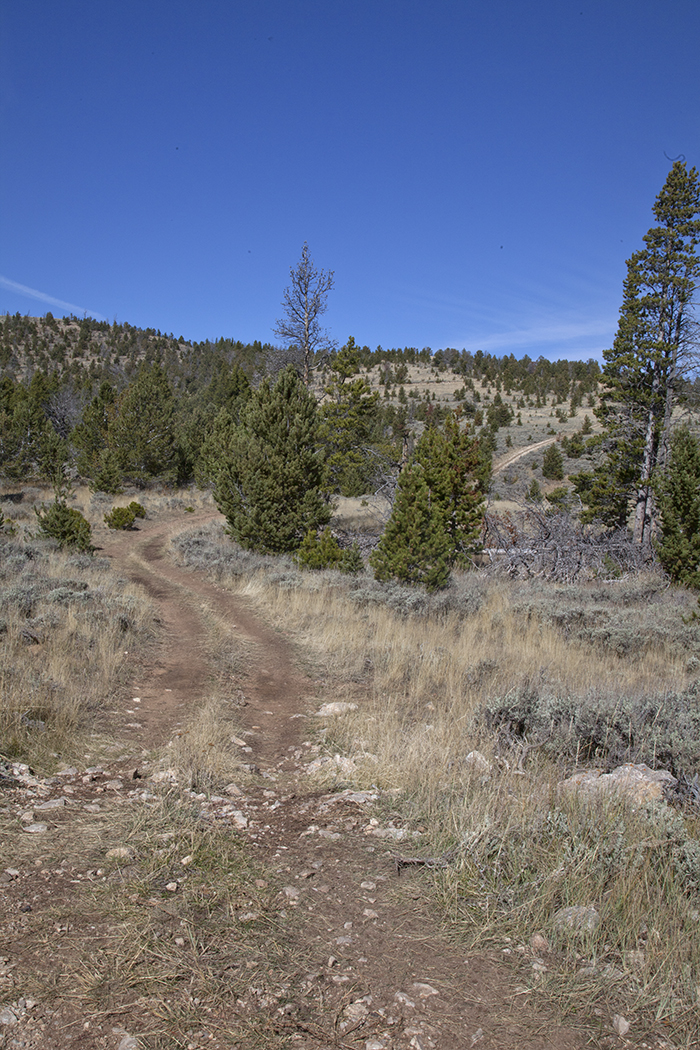 ON SUNDAY, FEBRUARY 15, 2015, CHRISTOPHER SOLOMON published an essay in the New York Times titled “Leaving Only Footsteps in the Woods?: Think Again.” The premise of Solomon’s piece was that every human being that enters a wild area has an effect on the wildlife living there.