the land ethic

toward a state of harmony between men and land by Chris Madson

  • Slow learners

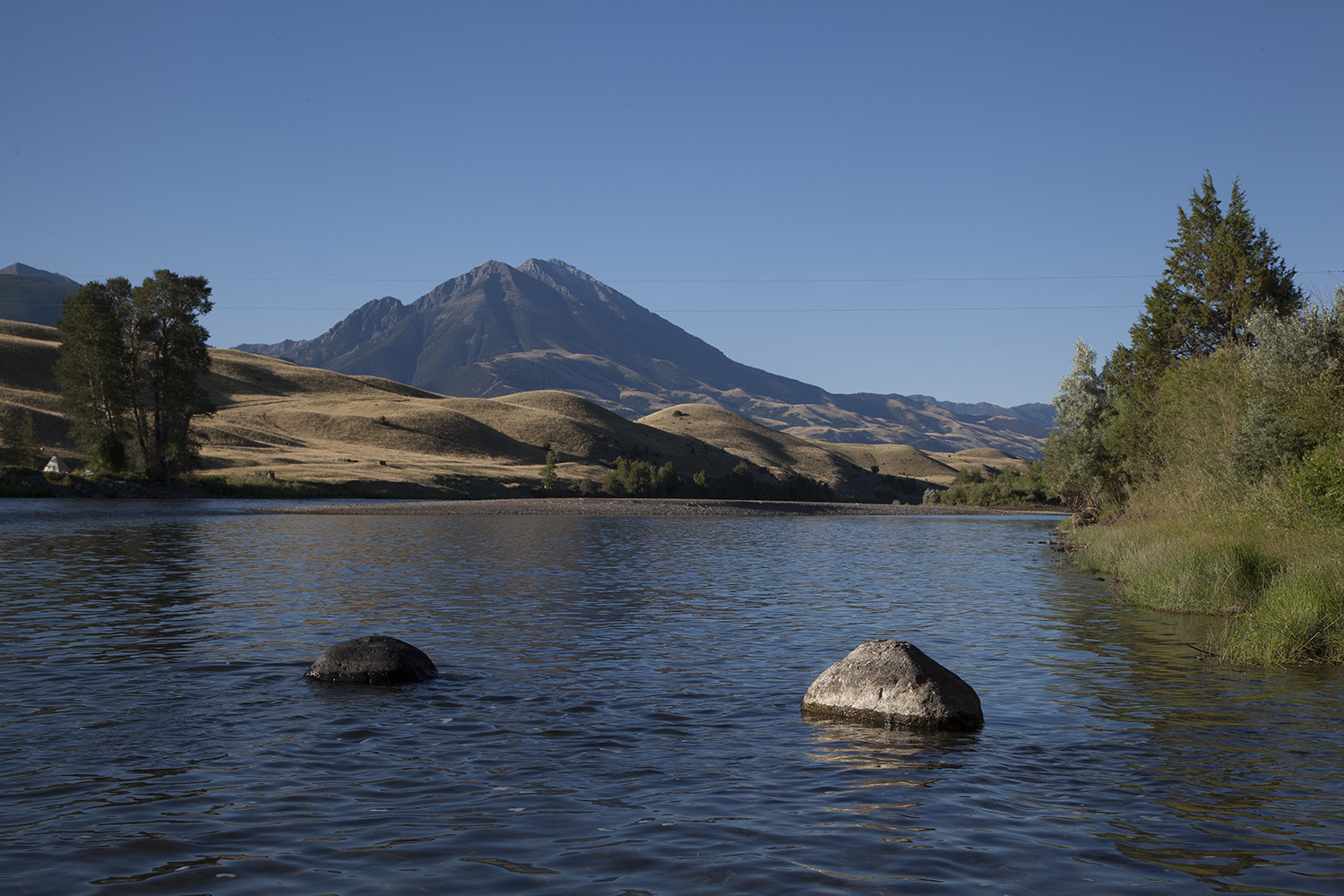
    Yellowstone and Emigrant PeakWHEN I FIRST HEARD THE NEWS, I THOUGHT IT WAS A FACEBOOK SCAM. BUT, NO: THE MONTANA DEPARTMENT OF FISH, WILDLIFE AND PARKS HAS CLOSED 183 MILES OF THE Yellowstone River to all recreation. That includes swimming, tubing, floating, wading . . . and fishing.

    The reason? An outbreak of a fatal disease called proliferative kidney disease in the river’s whitefish and trout. Managers with the department closed the river to “protect the fishery and the economy it sustains.” They added that “the closure will also limit the spread of the parasite to adjacent rivers through boats, tubes, waders and other human contact.”

    Biologists with the department estimate that tens of thousands of mountain whitefish have already died, and there is evidence that rainbow and cutthroat trout have also succumbed.

    A release from the department added that the impact of the disease was exacerbated by exceptionally low flows in the river, high water temperatures, and disturbance from recreational activities.

    The closure may well last through September, throwing a huge wrench in the local economy, but for people who care about rivers like the Yellowstone, the economic impact of the closure is only a footnote to the much larger question: What does this mean for one of the great trout streams of the Rocky Mountain West?

    Unfortunately, I suspect that critical parts of that question will never be addressed.

    How, for example, did water levels and temperatures get so low? It’s common knowledge that the last six months have been warm and dry in Yellowstone country, so the stock answer to that question will be “drought.” Which is fine, as far as it goes. We won’t bother ourselves with the trend in weather over the last thirty years or more.

    Fact is that there have been a lot of warm, dry years in the central Rockies over the last thirty years. What we’re seeing on the Yellowstone this summer is likely to be the new normal as temperatures continue to rise and snowpacks dwindle. Less water always means warmer water, so the lack of flow this year has been a double whammy for the Yellowstone’s coldwater fish. That’s what global climate change looks like along the Yellowstone. We all share responsibility for that developing environmental catastrophe, and so far, we’ve done little, if anything, to stop it.

    Of course, there’s another reason the Yellowstone is anemic this summer. In the upper Yellowstone basin of Montana, there are 383,000 acres of irrigated land, most of it producing alfalfa or other livestock forage. That’s a lot of water that isn’t in the river, a hard fact government officials and mainstream conservation groups are likely to ignore because any discussion about the environmental effects of irrigation in the West immediately turns into a no-holds-barred brawl.

    Another question worth asking is: Where did this disease come from? The pathogen is now known to be Tetrocapsula bryosalmonae, a myxosporean parasite with a complicated life cycle that seems to include other simple forms of aquatic animal life, the bryozoans. The cause of the disease was discovered about thirty years ago, and specialists are still studying the details of its natural history and various forms. However, fish with the symptoms of the disease were reported in Europe as early as 1924.

    Here in the United States, the first known cases were found in 1981 at the Hagerman State Fish Hatchery in Idaho. I doubt that anyone will ever bother to do the sleuthing and lab work to determine whether the PKD pathogen was brought to America by human agency, but the relatively recent appearance of the disease on this side of the Atlantic, especially in an inland hatchery, suggests that somebody probably brought it over.

    In the last five years, a vocal group of biologists has suggested that we should give up the effort to exclude exotic species from new environments. They argue that such invasions are so common and so difficult to head off that trying to stem the tide of exotic species is a waste of money. They go on to assert that new species can actually increase biodiversity in an area, and isn’t biodiversity a feature of the natural world we should support?

    If, as I suspect, PKD is a recent import, this closure is one more in a litany of examples that show why this laissez–faire attitude toward the introduction of new species is so dangerous. Lots of bad things can happen when an exotic species is transplanted to a new environment, most of which we won’t recognize until it’s too late.

    Over the last 150 years, recreational anglers have played a significant role in such importations, damaging the very waters they value so highly. Western fisheries managers are still trying to cope with whirling disease, Didymo infestations, and disastrous introductions like the mackinaw in Yellowstone Lake. The magnitude of the mess we’ve created is reflected in the state inspection stations for aquatic invasives that have been established across the West, in the directives that warn us to treat our waders with chlorine solution every time we fish a new drainage, in the luxurious growth of “rock snot” on the bottoms of beautiful streams. And in a two-month closure of the Yellowstone River, not only to fishing but to all recreation.

    Every time I think about it, I feel like I just backed into a concrete wall with a new car, sick to my stomach and pounding my forehead at my own stupidity. Are we ever going to check the mirrors before we throw the car in gear? Or are we just going to keep smashing into walls?

  • Season’s end

    Flick on point

    THE MONTH OF JANUARY WENT PRETTY MUCH THE WAY I’D EXPECTED— MORE AND MORE MILES FOR FEWER AND FEWER ROOSTERS. We were still seeing birds, Flick and I— fifty or sixty a day, sometimes— but as the month wound down, the average range of flushing birds steadily increased until, when Flick started working scent at my feet, I found myself watching the ridgeline for the flicker of wings. The GPS tally of the walks mounted steadily as the days passed: 12 miles, 13 miles, 14.8 miles, 15.2 miles of kochia and switchgrass and little bluestem, up and down the Nebraska hills from sunrise to sunset, hoping for one or two good chances. Hoping.

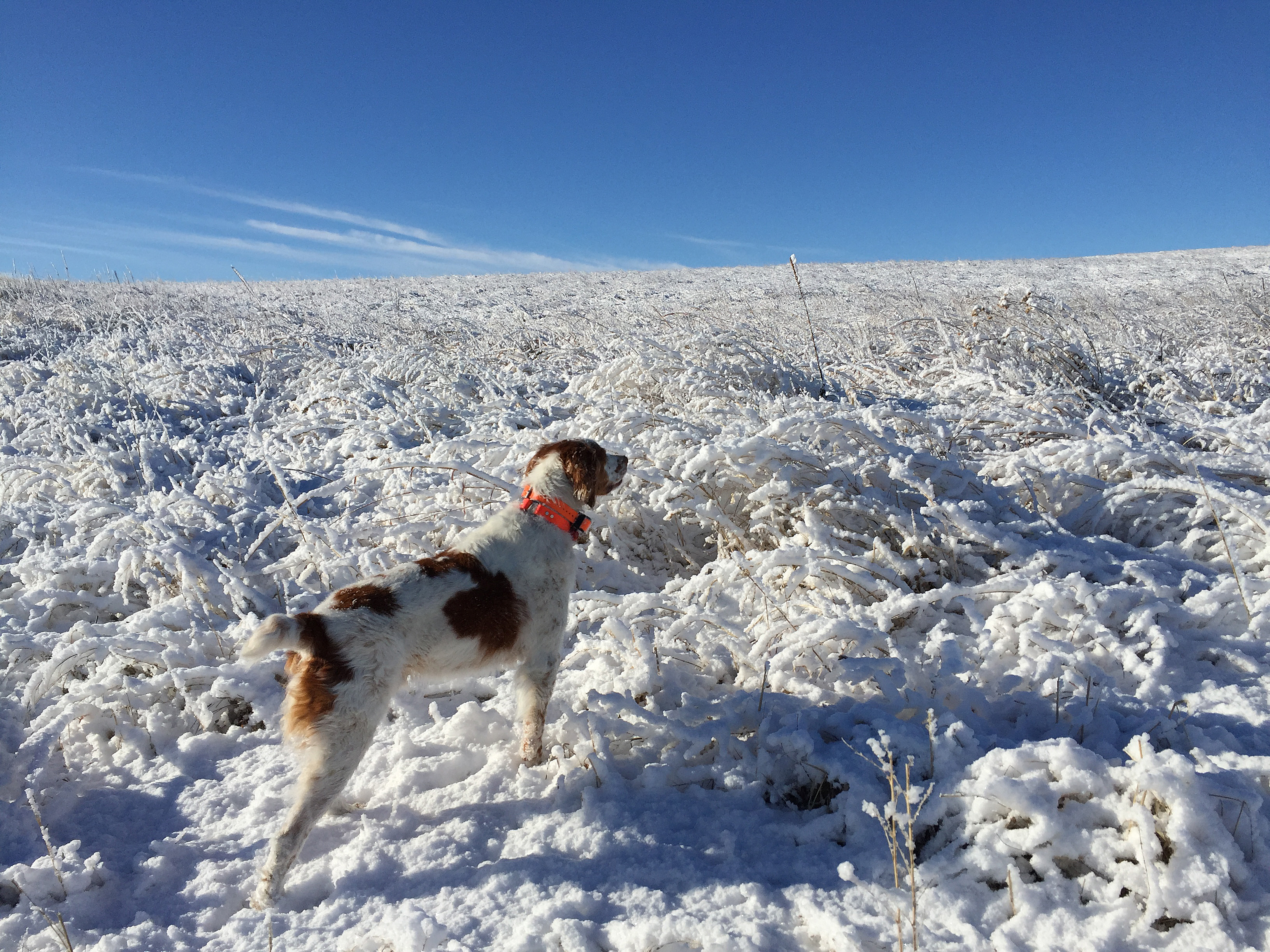
    The last of the bird seasons closed at sunset on January 31, so, of course, Flick and I were on the road at four in the morning, the dog snoozing in a tight ball on the right seat while I navigated the black ice on the interstate in order to be in the cover at first light. We arrived to find four inches of fresh powder lying gently on the prairie grass, the stems bent in delicate arches under the roof of snow, draped with crystals they had gathered during the night, each crystal flashing as the sun touched it, the light shattered momentarily into the colors of the spectrum against the blue shadows.

    It was a quarter of a mile from the road to the first patch of cover. I eased the truck door closed and started across the intervening corn stubble as quietly as I could, Flick at heel to minimize the chance of a wild flush. Ten minutes later at the northwestern corner of the grass, I released him with a wave of the hand, and he disappeared, leaving a trail of snow suspended in the air above the switchgrass as he made his first swing.

    We worked our way down the east slope of the ridge into the draw where the old International pickup body rusted slowly away in half an acre of kochia. For all our care, the birds knew we were coming. A rooster flushed wild sixty yards to my right, out of range on the far slope, followed by a second bird even farther away. Disappointment. I’d expected them, but I’d hoped the snow would convince them to hold a little longer. At the sound of the wings, Flick popped out of the grass thirty yards to my left and froze with his ears perked up and a look of disgust. I had to smile.

    And, right then, the third rooster jumped, thirty yards away instead of sixty. I’ve played the game long enough now to keep the jolt of panic from an unexpected flush under some sort of control, but the urge to hurry was nearly overwhelming, as it always is. I shifted my feet as the Model 12 came to my shoulder, swung through the bird as he hit high gear, and pulled the trigger just an instant too early. He rocked but didn’t fall. The second shot was longer but more considered. It caught him just as he rose to clear the cutbank on the other side of the cover, and he crumpled. Flick was there three seconds later to make sure he didn’t run.

    On the last day, one rooster in the bag is a major success, but it was early and, with the snow, there was reason to hope for more. We checked the patch of kochia at the corner of the field where we moved a lone hen who ran 200 yards before she flushed at the shoulder of the ridge and disappeared.

    As I turned south, I saw another set of tracks headed south through the corn stubble. Flick wasn’t on the trail— yet— but I took the gun off my shoulder and quickened the pace. As I came over the next rise, he’d come out of the cover and was trotting down the field edge when a plume of scent grabbed him by the nose, spinning him ninety degrees as he pointed. I hurried to catch up, thinking that this was another hen— on the last day, roosters never hold to points.

    But this one had. Flick was certain sure, as tight as a fiddle string, and I stepped in front of that unerring pink nose, reminding myself to relax, just as the rooster exploded out of the switchgrass in a cloud of snow, incandescent copper and green against a flawless morning sky, cackling as he went. He swung right, and just as the muzzle of the gun caught up with him, banked back left. I managed to reprogram the change in trajectory, and he went down. Flick was there in a heartbeat to make sure he didn’t run.

    We worked another kochia covert that should have been loaded with birds, pushing one rooster out at more than eighty yards and crossing the tracks ten or fifteen birds had left as they melted into the wheat stubble to the south. Then up the southern edge of the grass, a part of the field that had never produced before. Half way up the slope, Flick pointed emphatically. I walked in, kicked the cover, and turned to look at the dog. He moved three steps and locked up again. I was doubtful— roosters don’t hold this way on the last day, especially on public land. With the gun on my shoulder, I kicked half-heartedly at the tangle of grass in front of the dog . . . and a rooster flushed, headed low over the cover to my left.

    I’ve missed that shot on many occasions. But not this time. He fell through the snow-covered canopy just short of the fence, leaving a sparkling cloud of frost in the air. And Flick was there to make sure of him.

    As we walked the half-mile back to the truck, I found myself puzzling over my feelings about the morning.

    It had been almost perfect. The landscape, so often cold and colorless at this time of year, had been transformed in the middle of the night into a fairyland. With the experience of another long season under his belt, Flick had done his job about as well as it could be done, instinct and training running straight and true in an ancient channel, and after a season of out-maneuvering and out-thinking hunter and dog, the birds had yielded, at least for an hour or two. I’d even managed to do my part with the wingshooting.

    I’ve chased birds and dogs for more than fifty years now, and if there’s anything I’ve learned over that time, it is that hunting well, with grace and honest effort, respect and appreciation, is difficult, even for those of us who have done it all our lives. What brings me back is the pursuit of perfection.

    But, in spite of the marvelous morning, I was more than a little down in the mouth as I realized that this was the last day. It’ll be nine months before Flick and I have another rendezvous with the birds. A long time to wait. If the birds had all been wild; if the dog had run ahead and flushed the only rooster; if I had missed the one good chance, as I so often do; if the wind had swung into the north and pummeled us; if we had come back to the truck at sunset, footsore, chilled, and hungry with nothing to show for the effort except blisters and the questionable benefit of ten hours of hard walking— if, in short, it had been what the last day almost always is— then it might have been easier to let go.  As it was, this hour had transcended the sum of its exquisite parts.  Everything— the weather, the land, the light, the birds, the dog, even the hunter— had been close to some sort of unspoken ideal, and the combination was so fine that it brought a smile to my face and a tear to my eye.  It’s hard to let go of such days.

    As I write this, Flick is sleeping in the corner, whining now and then, his feet twitching as he follows fresh scent through the coverts of his dreams. In this, as in so many other aspects of the hunt, he gives me an example to follow.  Fall will come again.  In the meantime, I’ll take his lead and remember this day, savor it, until next November.

  • The Revenant falls short

    Laramie County sunrise 3THE TALE OF HUGH GLASS AND THE GRIZZLY IS ONE of the most treasured stories in the mythology of the mountain man. Most of the best parts understandably come down to us by word of mouth, since Glass was alone during the legendary crawl and never wrote a word about the experience.

    However, there are a few generally accepted facts that ground the story: Glass met the grizzly around August 23, 1823, on the Grand River near what is now the border between North and South Dakota. It took him a month and a half to make his way back to Fort Kiowa, an American Fur Company outpost on the Missouri River near what is now Chamberlain, South Dakota. There had been two serious fights with the Arikara earlier that summer, the first in June involving the men of the Rocky Mountain Fur Company; the second, a retaliatory strike led by Colonel Henry Leavenworth and the Sixth Infantry. There was also a skirmish with the Mandans on the Grand River.

    As Kevin Bacon said in “A Few Good Men,” “These are the facts of the case, and they are not disputed.”

    Like many aficionados of western history, I’ve always admired the Hugh Glass story, and like many fans of Hollywood, I looked forward to Alejandro Iñárritu’s film adaptation, “The Revenant.”

    Well, I’ve seen it. I have to give a nod to Leo DiCaprio, who may well deserve an Academy Award for his work in the film, for raw endurance, if nothing else. There is some exquisite photography of marvelous landscapes.

    But about those landscapes. Many of us with an affection for the West had hoped that Hollywood had finally outgrown the need to set every film with a western theme in Jackson Hole or Monument Valley. Kevin Costner showed the way in “Dances with Wolves,” a film about the High Plains actually filmed in the grassland wilderness of the High Plains.

    Iñárritu couldn’t decide where to place Hugh Glass in “The Revenant.” Anyone with the slightest grasp of western geography is likely to get whiplash as scenes jump from snowbound mountain passes to dense coniferous forests and then, for three minutes or so, onto the grasslands before returning to the mountains. Glass was mauled on the High Plains; he crawled 200 miles across the High Plains to get back to Fort Kiowa, an encampment on the Missouri River in the heart of the Great Plains. None of the forts of that time— Fort Henry, Fort Tilton, Fort Kiowa— were in the high mountains. They were all in or near major rivers like the Missouri or the mouths of the Yellowstone and Big Horn. Grassland settings.

    Iñárritu couldn’t even decide WHEN his story took place. Near the beginning of his version, Glass and his companions have already seen major snowfall— winter is coming on. Glass is mauled by a sow grizzly with two cubs that should be half the size of their mother by late fall; instead, the two youngsters are about the size they would be in May.

    It looks a lot like winter as DiCaprio’s Glass crawls out of his shallow grave and heads for Fort Kiowa with a broken leg and deep lacerations. There are no bugs, precious few berries— in short, no food for a man who is unarmed and all but immobilized. No flies to lay eggs in the festering wounds so that the maggots can clean the injuries and keep Glass from dying of infection or blood poisoning.

    I can accept certain embellishments to the traditional Hugh Glass story— giving Glass a son by a Pawnee woman, inventing an Arikara chief who is searching for his kidnapped daughter, twisting the end by allowing Glass to kill Fitzgerald— but was it really necessary to make the crawl even more difficult than it really was? I guess being abandoned without firearms or a horse 200 miles from the nearest help with a broken leg and multiple puncture wounds and lacerations wasn’t a big enough challenge. Iñárritu just had to spice it up a little.

    If Iñárritu didn’t want to take the time to research the story or visit the places where it happened, he could have hired somebody to do the digging. As it is, he turned what might have been an engaging piece of historical fiction into a fantasy of violence. “The Revenant” reminds me of “A Clockwork Orange.” It could have been something much better.

  • On the nature of gifts

    sunrise goose migration 2

    A long day of watching a sky devoid of waterfowl, staring into the endless blue until my eyes burn and the muscles at the base of my neck stab me every time I turn my head. A pair of buffleheads scoot in over the decoys at eleven. A harrier kites along the shore at noon. A magpie at one. A gull at two. The whisper of the ripples eating at the shelf of ice at the head of the bay, the hours passing until the sun drops low in the west and the light gives the illusion of warmth while the breeze finds a way through to the nape of my neck, just to remind me that it’s December. As if I needed the reminder, laid out on the sand, rock hard with the frost with nothing but a double layer of burlap under me, all this interminable day.


    Evening. Time to pick up. As cold as it is here on the ground, it’s not as cold as it will be out in the water, up to my waist, retrieving the decoys and winding the anchor lines as ice water runs down my sleeves. Still, it’s time to pick up. Stand up, and the blood that has pooled in my legs, losing its heat, comes back to the core and the shiver comes hard and fast. Put on another layer, then wade out into the water, thick and dark like molasses in the cold. Wrap a decoy and pitch it up on the bank. Blow on my hands to keep them working. Wrap another decoy, thirty-four of them until all the blocks I can reach without going over my waders are up on the beach.


    I walk down the shore and over the point to where I hid the boat, and the exercise quells the shivering. The motor— the old five-and-a-half Johnson that was my dad’s— starts on the first pull, a minor blessing, and I run back around the point, slowing to an idle, then killing the motor as I reach the first of the goose decoys, the ones on twenty-foot anchor lines so I can get them out where they can be seen by a passing flock on the main lake. Five passes to get them all in the boat and another ten minutes to get the lines wound up so they don’t tangle. Back to shore to pick up the shells. Then bag the spread, case the unused gun, load everything in the little boat until there’s barely room for my feet, push off, and haul myself in one more time.


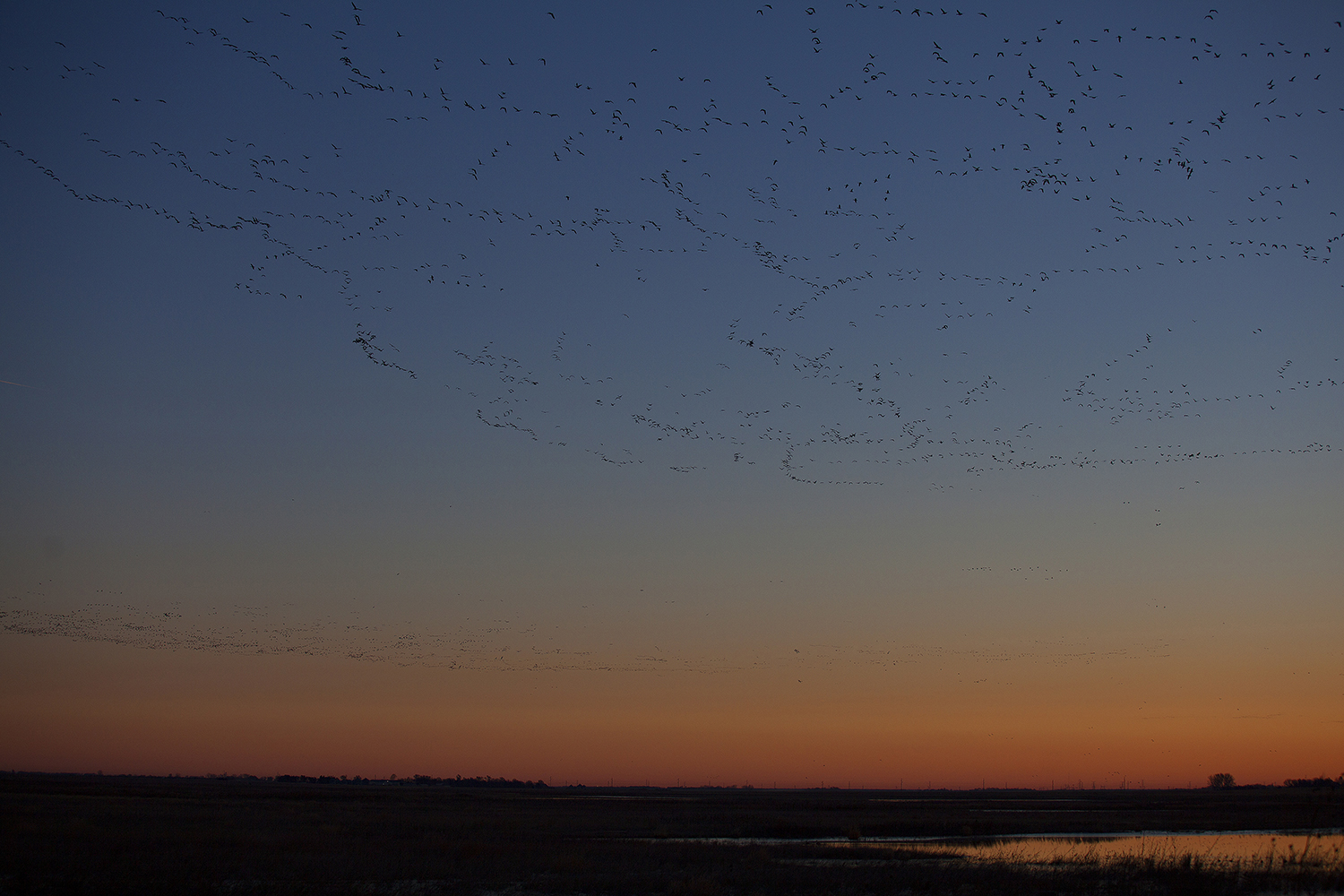
    As I point the boat east down the reservoir, my eye catches the movement I’ve watched for all day— a line of mallards, high, so high, against the deepening blue of the evening sky. And another. And another. I follow the procession back toward the horizon, and as far as I can see, the tracery of mallard flocks shivers in the wind, black lace against the indigo of space until the patterns fade in the distance. And they keep coming. For half an hour as the old Johnson pushes me toward home, the formations pass to the west.


    There was a time in my waterfowling career when I would have taken this hard. Were the old Greeks right? Do the gods make sport of men just to amuse themselves? There was a time I thought so and cussed the fates that so often make light of our best efforts, but slowly, over the years out on the water, I’ve absorbed the hard lesson, the discipline of patience. And now, on the other side of patience, there’s another lesson waiting. This was a day that had not given me what I’d come for. It had given me something else instead.


    Many years ago, my grandmother told me I shouldn’t look a gift horse in the mouth. It’s taken me this long to realize how right she was.

  • Cecil’s death shouldn’t end hunting

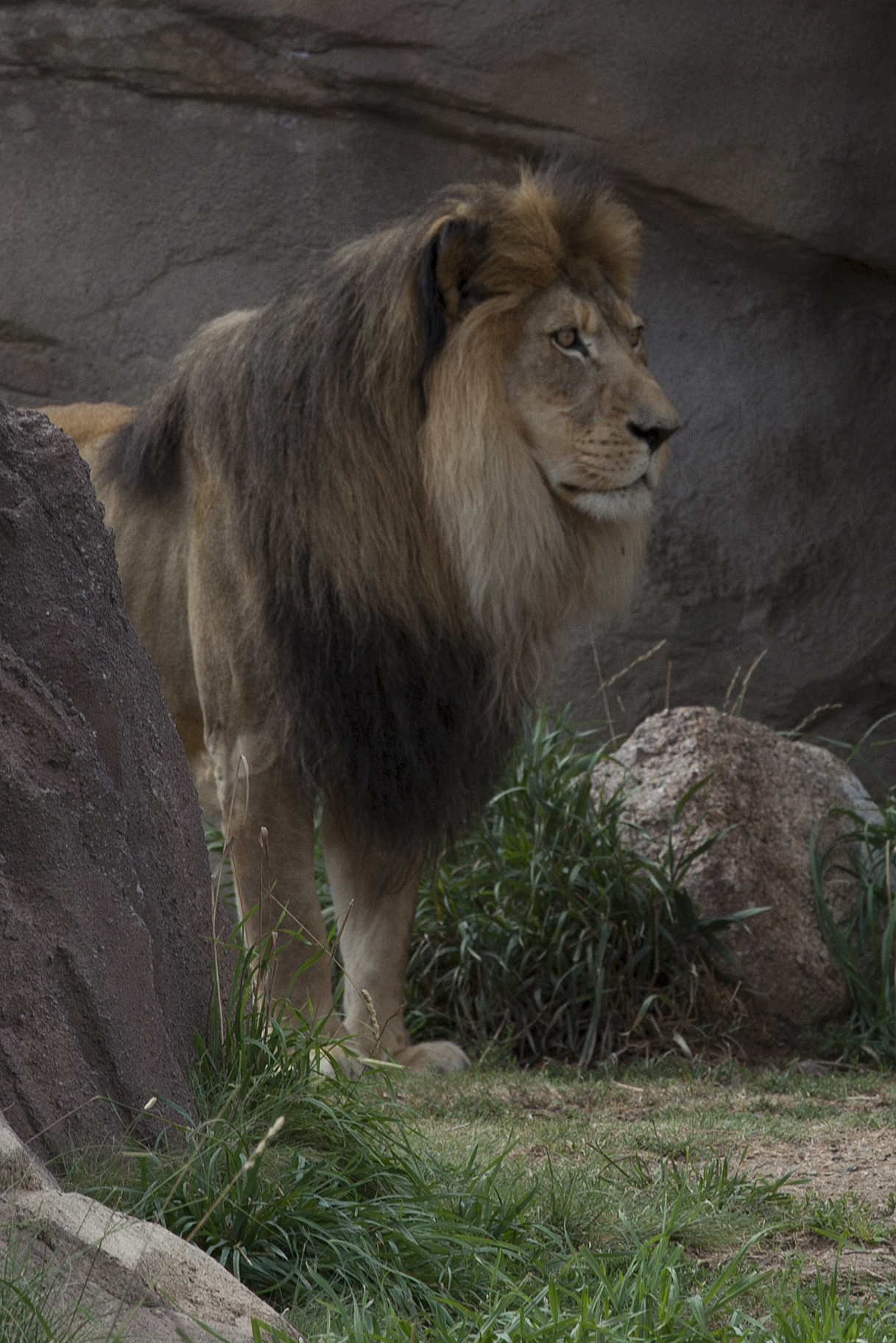
    I NEED TO STATE AT THE OUTSET THAT I AM A COMMITTED CONSERVATIONIST.  lion tightI trained in the field and have spent my entire adult life in the effort to maintain native biodiversity in the United States, and I continue to embrace that goal as one of the most important in my life.

    I am also a hunter.  I’m not a trophy hunter.  I’ve hunted big game all my life to provide healthy, organic wild meat for my family from sources close to home.  I’ve never been to Africa, and I have no desire to hunt big game there.  While I’m not familiar with all the details surrounding the shooting of “Cecil” the lion— and I submit that very few people have those details— I’m emphatically opposed to practices like baiting big game that dishonor the principles of fair chase and smear the reputations of all hunters.

    Having said that, I’m dismayed by some of the arguments against hunting that have been made in the wake of this lion’s death.  I think they threaten key elements of conservation in sub-Saharan Africa.  Here are four I find particularly dangerous:

    1) Much of the money paid by trophy hunters in Africa never finds its way either to conservation or to local impoverished communities.

    There are corrupt regimes in sub-Saharan Africa.  In these regimes, income from all kinds of sources is routinely diverted for the benefit of a ruling elite.  I don’t doubt that this happens with income from the sale of hunting licenses and associated services.  It also happens with income from the sale of oil, diamonds, timber, and any number of other natural resources.

    I fail to see how nonresident hunters are in any way responsible for such diversions.

    There are a few governments in sub-Saharan Africa that recognize the value of healthy, widely distributed game populations.  In these countries, partnership between the public and private sectors has resulted in effective conservation, which includes optimum sustained yields for trophy hunters and even for commercially sold meat.  Hunting is an important part of conservation funding in these nations and will probably remain so for many years.

    So the problem with getting money from the First World to conservation efforts and local support in the Third World is essentially political.  It nothing to do with legal hunting.  And I have to add that income from ecotourism or any other source that passes through the hands of government officials in corrupt systems is no more likely to reach the common man or conservation work than the income from hunting licenses.  And I suspect that government officials in such regimes are not likely to smile on programs that try to bypass government because such programs would cut into the graft that drives these systems.

    2) Management agencies that are funded with income from hunting licenses inflate harvest quotas to unsustainable levels to get more money.

    This accusation is frequently leveled against state wildlife agencies in the United States.  I can’t speak with authority about wildlife agencies in sub-Saharan Africa, but my distant impression is that many of them are as committed to the ideal of conservation as wildlife professionals in the First World.

    Wildlife biologists who manage hunting quotas in the U.S. understand all too well that game is a renewable resource.  Managed properly, it yields a harvestable surplus that is never exhausted.  Managed poorly, it quickly yields no surplus, and once that kind of damage has been done, the game populations may take years, even decades, to recover.  Selling too many licenses in the short term means a huge loss of income in the long term.  That sort of cynical overharvest not only violates the ethical canons of the profession, it significantly reduces the long-term funding for the wildlife agency.

    As I say, I can’t certify that national wildlife management agencies in Africa would never knowingly overharvest a game population, but the assertion that overharvest is a necessary effect of using hunting as a source of income reflects an utter lack of knowledge, at best, or, at worst, an entrenched prejudice against hunting.

    3) Ecotourism is a better approach to raising money for conservation than is well-regulated hunting. buff cropped

    In the absence of an honest government, any money that flows through the hands of officials is likely to be diverted.  This is just as true of money paid by ecotourists as it is of fees from hunting licenses and other permits required of hunters.

    Beyond that harsh reality, there is the issue of the scale of management required to provide photographic subjects for tourists as opposed to the scale needed to produce harvestable surplus of game for hunters.  The truth is that all the demands of ecotourism can be provided in a relatively small area set aside in national parks.  The cost of protecting these areas is relatively low, because of their small size, and the local politics are simplified, because large areas of relatively wild country are made available for “development.”

    As convenient as this approach is, it runs a grave risk of distorting or destroying huge components of entire natural systems.  The migration of terrestrial ungulates is an excellent example of a natural process that is hard to contain in a small, easily managed national park.  When migrations are disrupted or eliminated, predation can become a threat to confined herds, leaving park managers with the challenging puzzle of adjusting populations of various species so that they all remain in adequate numbers.

    Ethical hunting, on the other hand, requires widely distributed, abundant populations of wildlife and unlike tourism, it’s a discipline that doesn’t survive crowding.  Providing space for hunting requires that there be more space for wildlife.  This can’t be said for ecotourism— a relatively high-quality nonhunting experience can be provided in a much smaller space than hunting demands.

    The best game management takes an extensive approach to maintaining wildlife populations— managers use natural processes to encourage native forage and habitat and allow wildlife to move as it will across the landscape.  This extensive approach has its own challenges, since, on the modern landscape, it often depends on the cooperation of local landholders, herders, and other residents, but it has had significant success in many places, preserving natural processes like extensive migrations, predation, and seasonal cycles in consumption of forage.  It’s no accident that this extensive approach to management also benefits a wide array of nongame.

    There are other, more intensive management approaches to producing harvestable surpluses of game: captive breeding of animals, providing processed feed, confining wildlife in relatively small areas.  I have to say that, as a hunter, I’m not a fan of these approaches, partly because they undermine the principles of fair chase that are the foundation of ethical hunting and largely because they produce game animals without providing an adequate habitat base, which means that the animals produced are somehow less wild, and that the value of management to native nongame species is reduced.

    However, even these intensive techniques support sustainable populations of game, along with many nongame species.  While they aren’t the best approach to conservation, they’re far better than allowing wildlife to disappear or confining it in zoos.

    I’m not belittling ecotourism as a way of supporting wildlife conservation, but I think it is naïve in the extreme to think that depending solely on ecotourism as a source of funding and political support has no consequences for free-ranging wildlife.  The consequences are, in fact, profound, and at least as damaging, in their way, as well-regulated, ethical hunting.

    4) Harvest of mature males is always bad for a population.

    I recognize that killing a dominant male lion can have profound effects on the structure of the pride he controlled.  I submit, however, that his death is inevitable and that the upheaval in pride structure is bound to occur, whether he’s shot or pulled down by younger males.  Setting aside romantic illusions about the social structure among lions, I think the only practical conservation question this raises is the question that is the foundation of all conservation: What level of mortality is sustainable?  Answering that question is a challenge but not an insuperable one.  It requires research, data collection, and, if hunting is involved, a strict control of harvest.

    The argument that trophy hunting removes the fittest males from any population neglects important realities of genetics and management.  Among ungulates that grow horns, these badges of male dominance increase in size with age.  Among ungulates that grow antlers, racks may dwindle when a male is extremely old, but the biggest racks still belong to males that have been sexually active for several years.  Trophy ungulates are not just mature males; they are males that are practically at the end of their social and reproductive lives.  The overwhelming majority of their genetic contribution to the population has already occurred.

    The trophy value of large predators is judged by less obvious standards than those used to assess horned and antlered game.  Still, the predator’s trophy value is generally measured by its overall size, which also relates to the animal’s age.  There is a good chance that an exceptional trophy has left his genetic mark on the population.  It’s also worth pointing out that sheer size isn’t a guarantee of social and reproductive dominance among predators, so the notion that killing the largest mature males in a population of big cats or bears necessarily cause problems is at least open to question.

    The removal of these aging males need not have any significant effect on the genetics or social function of the population as a whole.  The key to avoiding such problems is, once again, solid research and strict control of harvest.  Neither of these is impossible to achieve.

    The upshot

    lion standingThe U.S. Fish and Wildlife Service is in the process of listing the African lion as “threatened” under the provisions of the Endangered Species Act.  If that decision stands, the species will gain a large measure of protection from what is now legal hunting.  I frankly doubt that a complete cessation of legal hunting will be enough to protect lions, since they face a host of other problems that have nothing whatsoever to do with trophy hunting, but there may be ethical justification for a moratorium on legal lion hunting, whether it helps lions or not.

    However, I believe that a categorical end to all legal hunting of big game in Africa would be a huge mistake.  Actions like Delta Airlines’ refusal to transport legally taken trophies could well prove to undermine African conservation rather than advance it.

    I recognize that many people with a genuine interest in conservation find hunting repugnant.  I think that view fails to credit the seminal role hunting has played in the development of our species and, at an even more fundamental level, neglects the influence predation has as a natural process that shapes much of what we find most beautiful in this world.

    I won’t try to make the case for that view here, but I do want to argue a more practical point: Ethical hunting has been an irreplaceable force for conservation over the last two centuries, and it continues to be critical to the success of wildlife conservation in North America and in parts of sub-Saharan Africa with stable, ethical governments.  Hunters need to police their ranks and banish people who fail to live up to the standards of the discipline.  Society at large clearly has a part to play in that effort.  But I counsel anyone who cares about the future of African wildlife to be careful about eliminating any approach that can help in the conservation effort, including well-regulated hunting.  The most profound threats to the future of that unique fauna can be found in the economics and politics of emerging nations, not in ethical hunting.  We’ll need every tool we can find to head off the loss of Africa’s free-ranging wildlife.

  • No place like home

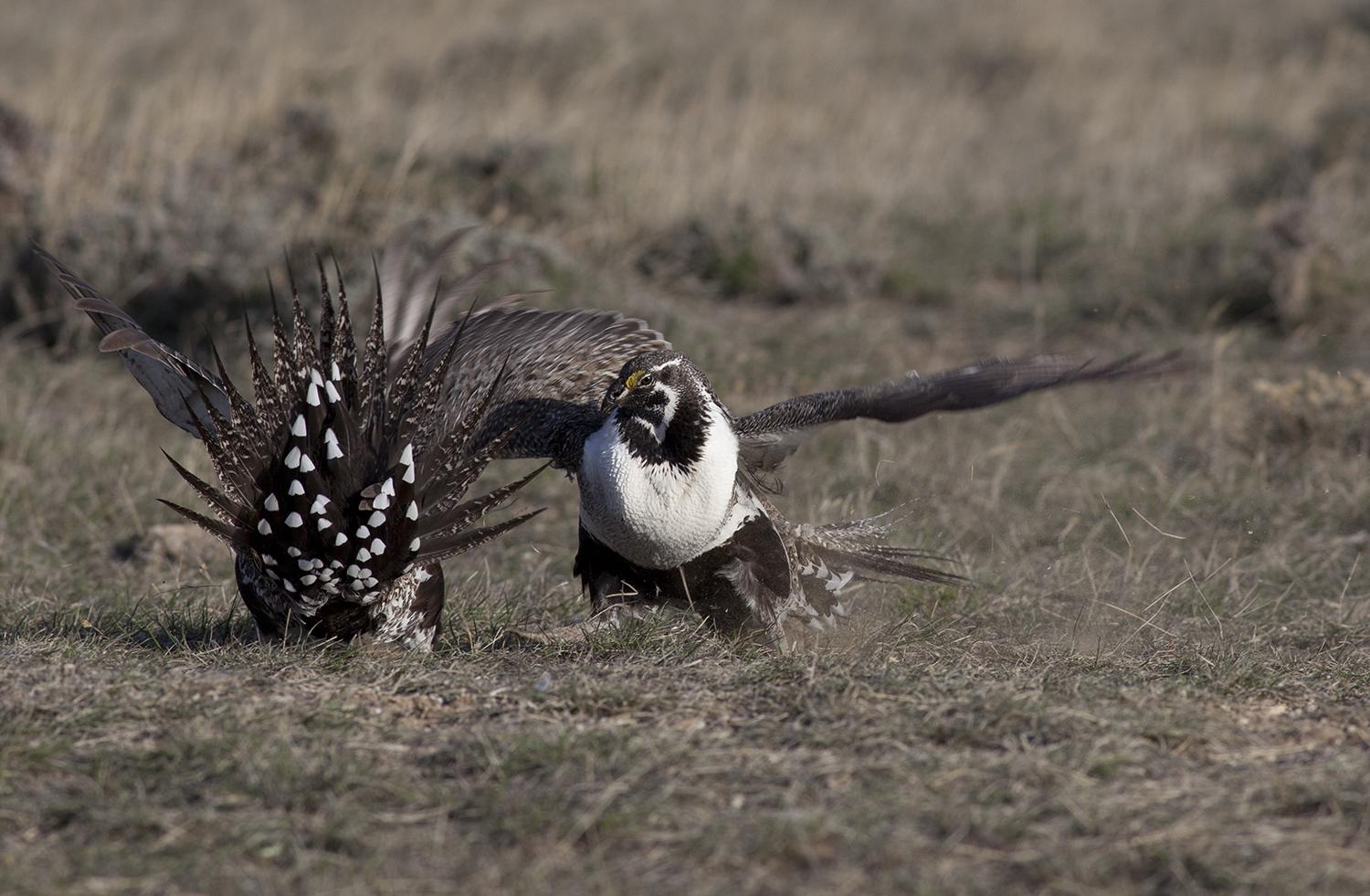
    sage grouse fighting 1-1


    IT’S ONE OF THE MOST FUNDAMENTAL rules of ecology: Each species has its niche, the unique combination of food, water, shelter, and nursery that, taken together, are home for the breed.  Without that place, the species would not exist.

    As the deadline for the federal decision on whether to list the sage grouse approaches, I’ve found myself wondering about the inverse of that idea.  If a species disappears, it seems logical to conclude that its niche has also been badly damaged or destroyed.

    A recent analysis of trends of sage grouse lek counts published by Dr. Edward Gorton and colleagues suggests that the numbers in many populations, including Wyoming’s, continue to decline, in spite of the fairly uninspired conservation efforts that have been made on their behalf over the last several years.  The bird’s decline is the most powerful possible indication that the wild sage is melting away as well.

    The bird can’t exist without the place.  And in ecological and spiritual sense, the place won’t exist without the bird.

  • We’re all users— but some more than others

    Shirley Mt ATV track 1ON SUNDAY, FEBRUARY 15, 2015, CHRISTOPHER SOLOMON published an essay in the New York Times titled “Leaving Only Footsteps in the Woods?: Think Again.”  The premise of Solomon’s piece was that every human being that enters a wild area has an effect on the wildlife living there.

    It’s an important observation, one that gets surprisingly little attention in an era when many outdoors folk desperately want to believe that their activities are “nonconsumptive” and not a bit like the depredations of bloodthirsty hunters and anglers who go out with the express purpose of committing mayhem against defenseless wild things.

    Of course, there’s no such thing as “nonconsumptive use” in the outdoors.  The research literature is replete with studies that demonstrate that cars and trucks, ATVs, hikers, and horseback riders all have deleterious effects on many wild animals, sometimes killing or maiming them or, more often, displacing them temporarily or permanently, often with short- or long-term effects on their well-being.

    It’s worth remembering that, while human presence itself has an undeniable effect on wildlife and wild places, that direct damage is dwarfed by the effect of our demand for resources.  The SUV used to drive to that primeval forest, the gasoline burned on the trip, the wool in the sweater, the petrochemical in the shoes, the lunchmeat in the sandwiches multiplied by 320 million constitute a threat orders of magnitude greater than any form of recreation we pursue.  And this damage is inflicted by every person in America, not just backpackers and off-road aficionados.

    I do want to raise one objection to Solomon’s piece.  He carries things too far when he argues that a person on foot has more impact than a person on a snowmobile or ATV.  He cites a study in Alaska by Grant Harris and colleagues that gathered data on the effect of snowmobiles on wintering moose in the Kenai.  These researchers also reviewed the scientific literature to find studies of other winter activities, particularly Nordic skiing.  A couple of these studies suggested that a moose’s response to a person on skis might be greater than its response to a snowmobile.  Solomon concluded that there was “more evidence of impacts by hikers, backcountry skiers and their like than by the gas-powered crowd.”

    Not really.  Harris and his co-authors gave a more accurate assessment when they wrote that “nonmotorized recreation causes fewer, stronger disturbance effects in relatively smaller areas while motorized recreation generates more, weaker disturbances across larger areas.”  I would add that motorized disturbance involves MUCH larger areas and often inflicts more severe long-term ecological damage as well.

    Extensive research on elk at the Starkey Experimental Forest and Range in northeastern Oregon has concluded that ATVs and mountain bikes generally cause greater disturbance for elk than hikers and horseback riders, results that are supported by many other studies from other parts of the country assessing disturbance of other wild animals.  Add to that body of information the lasting ecological effects of backcountry roads and the unauthorized trails that ramify over public lands across the country and you have a scale of damage that pedestrians could never match.

    Kudos to Solomon for reminding us that “we’re all complicit” in the ongoing deterioration of wild places.  But I would add that, if you find the muse calling you to the wild country and you’re looking for a way to reduce your impact, park the vehicle, tighten the laces on your boots, and walk.  You’ll see more and hurt less.

  • Congressmen vote against marshes and creeks

    THE GOOD OLD DAYS.  I’M OLD ENOUGH TO REMEMBER THE SIXTIES (AND EVEN A PIECE OF THE FIFTIES) WITH SOME FONDNESS, BUT THERE ARE A LOT OF THINGS ABOUT THAT ERA I’d just as soon forget, especially in the environmental arena— massive fish kills, rivers catching fire, and not least, a federally funded campaign to destroy wetlands.  Between the 1950s and the 1970s, nine million acres of wetlands in the contiguous forty-eight states were drained, filled, plowed, destroyed— an average of 458,000 acres a year.  cutthroat LaBarge Creek

    Efforts to respond to this casual abuse culminated in 1972 with the Clean Water Act.  The first paragraph of the act set out a clearcut objective: “to restore and maintain the chemical, physical, and biological integrity of the Nation’s waters.”  Among other goals, the authors wanted to achieve “water quality which provides for the protection and propagation of fish, shellfish, and wildlife and provides for recreation in and on the water.”

    Authority for enforcing the provisions of the act was split between the Army Corps of Engineers and the nascent Environmental Protection Agency, and over the next thirty years, treatment of domestic sewage improved markedly, even as the nation’s population increased, and pollution from point sources like industrial plants decreased, even as the economy grew. Overall, the Clean Water Act has significantly improved water quality in many urban areas, while rural areas have seen less improvement, mainly because of heavy use of fertilizers and pesticides.

    Another benefit of the act was undeniable: By 2000, headwater streams had been afforded some measure of protection against toxic run-off from mines and silt from overzealous timbering and road-building and the drainage of freshwater wetlands had been almost halted.  Part of that shift was the result of ongoing efforts of the U.S. Fish and Wildlife Service and private-sector conservation groups like Ducks Unlimited, but much of it rose from the protection the Clean Water Act offered against unregulated drainage, filling, or pollution.  Wetlands are the most productive, diverse natural systems on the continent.  They’re a mainstay for North America’s waterfowl, but they support hundreds of other species of birds, mammals, reptiles, amphibians, and invertebrates as well.  And headwater streams, especially in the mountainous West, are crucial nurseries for trout and salmon as well as refuges for a variety of rare fish species.

    Which explains why hunters, anglers, and other conservationists were so distressed when, in 2001, the U.S. Supreme Court gutted the Clean Water Act’s authority to protect “isolated” wetlands.  Five of the justices challenged the scientific understanding that nearly all water is connected, either directly when water runs from one drainage into another or indirectly through the movement of groundwater or migratory birds that travel from one wetland to another.  Their majority ruling immediately exposed wetlands like the prairie potholes in the northcentral United States to the dredging and filling operations that had previously been regulated by Section 404 of the Clean Water Act and called into question the act’s protection of headwater streams far from the continent’s major river systems.

    Ever since the Supreme Court decisions in SWANCC v. Corps of Engineers and Rapanos v. United States, the Corps of Engineers and the EPA have been struggling to redefine a key concept in the Clean Water Act: the phrase “waters of the United States.”  After a decade of discussion and public input, the two agencies proposed a new definition last April.

    Complicated?  I guess.  The proposed rulemaking filled eighty-six pages in the Federal Register.  In recognition of the limits placed on their authority by the court, the two agencies reiterated and clarified many of the exemptions they had granted in their earlier permitting and enforcement.  Farmers were granted all the exemptions they had enjoyed before the Supreme Court decisions, including exemptions for irrigation that continue to cause serious water quality problems.  Water-filled depressions created during construction were given a pass along with gullies, artificial ponds created on dry land as ornaments or for stock watering, irrigation, or rice culture.  Groundwater was exempted; the state authority over water rights was recognized. Laramie plains wetland

    And the concept of an “isolated” wetland is clarified.  In order to be protected under the Clean Water Act, a wetland would have to “significantly affect the chemical, physical, or biological integrity” of a larger body of water, considered to be a “water of the United States.”  In the case of a system of isolated wetlands like the prairie potholes, the entire system would have to “significantly affect” one of those major waters.

    The proposed rule is a huge compromise for conservationists, but it provides more protection for headwater streams and isolated wetlands than the current situation in which the corps or EPA has to decide case by case whether a creek or marsh is covered by the Clean Water Act.  It’s better than nothing.

    The new proposal has its opponents, of course.  There are many economic interests that would just as soon be free to degrade or destroy watercourses and wetlands.  They would be more than happy to return to an arrangement that left the public with poisoned water, dead fish, and burning rivers.  And, inevitably, these interests have friends in Congress.

    On September 9, the U.S. House of Representatives passed a bill called the “Waters of the United States Regulatory Overreach Protection Act of 2014,” 262 votes in favor to 152 opposed.  If enacted, the bill would block the proposed rule and order the corps and EPA to reach consensus with all fifty states before proceeding.  Bear in mind that the state-by-state approach to water quality before 1972 is what left us with fires on the Cuyahoga River, millions of dead fish on the Mississippi, and poisoned salmon runs on the West Coast.

    The bill has little chance of passing the Senate and no chance of being signed into law.  Still, the action by the House is appalling.  The majority seems more than willing to sacrifice clean water and wildlife in order to please their corporate contributors.

    Perhaps the most distressing part of this is the lip service these Congressmen pay to “the sportsman.” Of the 262 who voted and/or cosponsored this bill, 198 are members of the Congressional Sportsmen’s Caucus.  That’s the group that claims “to protect and advance the interests of sportsmen and women through policies that address sportsmen’s conservation issues such as hunting, recreational angling and shooting and trapping.”

    I’m an avid waterfowler, so the future of the prairie potholes concerns me.  I’m an avid pheasant hunter, so the winter cover those potholes provide is a matter of some interest to me as well.  I like to fish for trout in the high country, which means I’m a supporter of good water quality in the West.  One of these days, I hope to get over toward the coast and wet a fly for steelhead, so I like to think those rivers will be clear and full of fish when I get there.  In short, I’m a sportsman, so I care about clean water.  Nor do I think I’m alone in this concern— tens of millions of other hunters and anglers recognize that we can’t have wildlife without water.  It’s an ecological fact that even the members of the Congressional Sportsmen’s Caucus ought to be able to understand.

    We’ve tried cleaning up our streams and protecting our wetlands state by state— it doesn’t work.  The quality of our water affects us all; it’s a national issue and it requires a national solution.

    If you happen to live in Connecticut, Delaware, Hawaii, Maine, or Vermont, your representative didn’t vote for the “Waters of the United States Regulatory Overreach Act.”  If you live anywhere else, there’s a chance he or she did. If you live in Texas, Georgia, Louisiana, Michigan, North Carolina, Oklahoma, the chances are pretty good, and if you live in Utah, Wyoming, North or South Dakota, it’s a certainty.

    The next time that glad-handing politician slaps you on the back and tells you what a dyed-in-the-wool nimrod he is, how many mallards he shot last year, how many bass he caught, ask him how he voted on this one.

    It takes more than a gun or a fishing pole to make a sportsman.

  • Learning the hunt

    The lesson:

    A short look at the long history of hunter education

    Comments on the occasion of the
    2014 Wyoming Hunter Education Academy
    July 26, 2014
    © Chris Madson, 2014

    HED ACAD GROUP 2014 12014 Hunter Education Academy

              I WANT TO EXPRESS MY THANKS TO JIM DAWSON FOR THE INVITATION TO BE HERE THIS EVENING, AND FOR TAKING THE TIME TO MEMORIZE THE INTRODUCTION I worked so hard to invent and deliver it with such sincerity. Isn’t it remarkable how good you can make a guy sound when you’re not constrained by the facts? It’s a pleasure to get together with such an august group, especially when the subject at hand is teaching the next generation about the discipline of hunting.

    The discipline of hunting.

    I’m a writer and an editor by profession, so I’ll freely admit that that I can get a little persnickety about words and their meaning. This probably explains why I’ve always been uncomfortable with the description of hunting as a “sport,” which, for a lot of people, means “playtime.” For me, and I’m sure for you, hunting doesn’t bear much resemblance to badminton or golf or slow-pitch softball or even to skeet and trapshooting. The most obvious difference is that something is probably going to die during a hunt,— at least we hope it will— which right away makes it much more serious business than a football game.

    The ethical ramifications of that elemental fact are sobering, but the gravity of hunting extends beyond the likelihood that an animal or animals may be killed. The serious hunter makes a commitment. He— and I use the word “he” in its generic sense, not to exclude women— he commits to the idea of sustainable harvest and conservation. He upholds the principles of fair chase. He hones his ability as a marksman; he studies the animals he pursues; he stays in shape, maintains his equipment, trains his dogs, all for those weeks in the fall or spring when he will match himself against a quarry that has developed the skills of escape to a high art.Christiansen_Madson and Flick-lr

    A commitment of this magnitude reaches beyond “sport.” It’s more like a lifeway, a martial art. So I’ve dropped the phrase “sport hunting” from my vocabulary. For me, hunting is a discipline, a calling, and I think an argument can be made that, for many humans, it ‘s been that way for a very, very long time.

    Late on the afternoon of December 18, 1994, three cave buffs found a hole in a limestone bluff overlooking the Ardeche River in southern France. It wasn’t much of an opening— thirty inches by ten— but there was a draft coming out of it that intrigued the spelunkers. They spent over an hour clearing rubble out of the hole, then wiggled through into a large cavern. The floor of the room was strewn with the bones of cave bears, a species that has been extinct in Europe for 25,000 years. As they walked deeper into the passage, admiring the stalactites and calcite curtains, they began seeing marks on the walls— first, there were lines of large red dots, then . . . art.

    Chauvet Cavern turned out to have hundreds of paintings and engravings, nearly all of them depicting animals that have not been known in Europe for millennia— mammoths, wooly rhinos, aurochs, lions, and reindeer in addition to cave bears. Radiocarbon dating has found that some of the pigments on the walls are more than 30,000 years old, by far the most ancient ever found.

    One of the most fascinating elements of Chauvet is the floor of the cave. In nearly every other Paleolithic cavern that has ever been discovered, the first visitors, whether they were cave explorers or anthropologists, trampled the dirt and mud, obliterating any signs that might have been left there.

    The discoverers of Chauvet took great pains to protect the floor from disturbance. The bones of the cave bears, their tracks, the beds they dug for hibernation are all still visible. And in that ancient clutter, the scientists who have been studying the cave found two unusual sets of prints. On set belonged to a human, about four feet tall, judging by the size of the tracks and the length of stride.

    The other set is clearly canine. It’s impossible to determine whether the two came into the cave together, although I find it a little far-fetched to believe that a wolf would venture hundreds of feet into the stygian darkness of a cave that has been inhabited by cave bears unless he was following someone. Was this creature a dog or a “socialized wolf”? Opinions vary, but I like to think the two went into the cave together, the kid holding the torch and convincing the canine to come along.

    The two trails beg the question: Why was the youngster so far back in the grotto? It seems likely that he was there to see the paintings, although we don’t know for certain why. Over the years, anthropologists have offered several explanations of the function of cave art. One thing seems clear— it wasn’t just an exhibit of the artist’s skill, considerable as that often was. The fact that these paintings were stuck far back in a cave suggests some mystic significance. The artists may have been making magic against their prey; they may have been worshipping the animals or engaging in some sort of shamanistic cult.

    Whatever the details, the activity in these painted caves seems bound to the hunt. If that’s the case, it’s easy to imagine young initiates being led into the darkness of the cave as part of a coming-of-age ritual with the art serving as some sort of catechism. For these ice-age people, hunting was a central element of religion, and the ceremonies in the back of the cave were, in all likelihood, an important part of hunter education. And you thought you were breaking new ground . . .

    There’s no way of knowing how those ancient hunters approached the chase, but if the example of modern subsistence hunters is any guide, they may have lived by a remarkably stern ethical code. In 1936, the eminent wildlife biologist, C.H.D. Clarke, went to the Arctic to study muskoxen and spent many years among the Inuit of northern Canada at a time when most of these people still hunted to live. Clarke told my dad that he knew an old man in one of the Inuit villages who had been blind most of his life. It was said in the village that, when the man was young, his fellow hunters had put out his eyes because he had failed to show proper respect to a caribou he had killed.

    These are the echoes of belief and commitment in hunting that come down to us from prehistory.

    The training of young hunters may be the oldest form of human education, an exercise that predates mankind itself and was already unimaginably ancient when people settled down to farm and build cities. The oldest hunter education text I know was written by a Greek named Xenophon, born in Athens more than 430 years before the birth of Christ. As a young man, he threw in with Cyrus the Younger when the prince tried, unsuccessfully, to claim the Persian throne.

    Among several other important works, Xenophon wrote Cynegeticus— On Hunting. It was a practical guide to hunting technique: weaving and setting nets; choosing good dogs and training them— “There is a good deal to be said for taking your hounds frequently into the mountains,” he wrote. “It is there they will become sound of foot, and in general the benefit to their physique in working over such ground will amply repay you”— the variability of scent; the best clothes for hunting; techniques for hunting lions, bears, wild boar, deer, and the lowly hare.

    Does the hunt have any value for civilized men?

    Xenophon thought so. “To the gods themselves is due the discovery,” he wrote, “to Apollo and Artemis, patrons of the chase and protectors of the hound. As a reward they bestowed it upon Cheiron, by reason of his uprightness, and he took it and was glad, and turned the gift to good account. At his feet sat many a disciple, to whom he taught the mystery of hunting and of chivalry. . . . Thanks to the careful heed they paid to dogs and things pertaining to the chase, thanks also to the other training of their boyhood, all these greatly excelled, and on the score of virtue were admired.

    “For my part, then, my advice to the young is, do not despise hunting or the other training of your boyhood, if you desire to grow up to be good men, good not only in war but in all else of which the issue is perfection in thought, word, and deed.”

    Xenophon’s view of hunting in 400 B.C.

    In matters of philosophy and culture, the Romans were staunch followers of the Greeks, so it’s no surprise to find guides to hunting in Latin prose and poetry. The ones that have come down to us emphasize the breeding, care, and training of hunting dogs for various tasks, as in this passage from a resident of Carthage, Marcus Aurelius Olympius Nemesianus:

    “At the outset your diligent care for your dogs must start from the beginning of the year. . . . At that season you must choose a bitch obedient to speed forward, obedient to come to heel, native to either the Spartan or the Molossian country-side, and of good pedigree.” Nemesianus goes on to describe how to breed for the best dogs, how to pick the best pup out of a litter (a knack I wish I had), even how to change feeding regime to make sure the dogs are ready for the fall. And, like any hunter, he’s anxious for the season to open:

    “Already my heart is tideswept by the frenzy the Muses send: Helicon bids me fare through widespread lands. . . . We search the glades, the green tracts, the open plains, swiftly coursing here and there o’er all the fields, eager to catch varied quarries with docile hound.”

    Sounds familiar.

    With the disintegration of the Roman Empire, Europe shattered into a mass of contending dominions, constantly at war with each other and with outside forces like the Mongols and Muslims. It’s not called the Dark Ages for nothing, nearly a thousand years during which art and literacy gave way to near anarchy. Hunting was a central part of medieval life in that time, but there were few men who had the training or inclination to put the laws and customs down on parchment.

    One of these was Gaston, Third Count of the fief of Foix in France, known as Phoebus because of his blond hair. “All my life,” Phoebus wrote, “ I have taken special delight in three things: arms, love, and hunting.” He went on to say that he claimed no expertise in the first two areas but had no doubts about his mastery of the third.

    Sometime around 1387, Phoebus wrote The Book of the Chase, an encyclopedic look at hunting techniques and equipment of the time and place. Mixed with his extensive and generally rock-solid advice on the details of the chase, Phoebus took time to recognize the less tangible benefits a day afield:

    “When the hunter riseth in the morning, he sees a sweet and fair morrow, and the clear weather and bright, and heareth the song of the small fowl, the which sing sweetly with great melody and full of love, each in his language in the best way that he may . . . and when the sun is arise, he shall see the fresh dew upon the small twigs and grass, and the sun which by its virtue shall make them shine, and that is great liking and joy to the hunter’s heart.

    “And when he hath well et and well drunk, then he shall go lie in his bed and shall sleep well and steadfastly all the night without any evil thought of any sin, wherefore I say that hunters go into Paradise when they die, and live in this world most joyful of any other men.

    “. . . And therefore be ye all hunters, and ye shall do as wise men.”

    Phoebus’s book provided the foundation for the first English book on hunting, The Master of Game, written or, more accurately, translated by Edward, Duke of York, The Master of Game provided the foundation for the Book of Hawkyng, Huntyng &c. by Dame Juliana Berners, first published in 1486. In her introduction, Dame Berners offered this motive for writing her book for “gentlemen having delight therein. This book showeth to such gentle persons the manner of Hunting for all manner of beasts, whether they be beast of Venery, or of Chase, or Rascal. And it also showeth all the terms convenient as well to the hounds as to the beasts aforesaid.” A fifteenth-century hunter education manual.

    This was the hunting tradition that came to the New World, customs and attitudes shaped by noblemen on a continent that was quickly running out of game and the wild places that supported it. In the tiny settlements on the east coast of America, hunting quickly became a matter of getting food or making a profit, but in spite of the utilitarian approach taken by the first waves of immigrants, the more refined attitudes of the European aristocracy gained an early foothold.

    Thomas Morton, a down-at-the-heels lawyer from Devonshire, England, came to Massachusetts colony in 1624. Unlike many of the Puritans in the area, he found the wilderness at the edge of town irresistible:

    “Fowls in abundance,” he wrote, “fish in multitude, millions of turtledoves on the green boughs, which made the land to me seem paradise. In mine eye, t’was Nature’s Masterpiece.” His subsequent description of trees, game birds, and big game was a hunter’s ode to wildlife and wild places— it was probably America’s first hunter education manual.

    As the decades passed, a steady trickle of publications provided hunters with first-hand information on the landscapes and game to be found in North America. Most were natural histories written by men who combined a love of hunting with a scientific interest in flora and fauna, a combination that has probably been common among hunters since mankind made the first stone tools.

    In 1783, an anonymous army officer in New York published The Sportsman’s Companion: or An Essay on Shooting, generally regarded as the first book to focus on hunting technique in America. Scattered through the practical advice, the author offers an occasional comment on conservation, as in this passage:

    “They are Partridge to be sure— I seem them gather, Sir. We may kill many, but— what the deuce!— four brace [that’s eight birds]? That’s too many. I think it’s time to return home for tea.”Flick and birds, Mike's 1

    Forty years later, Jesse Kester of Philadelphia published The American Shooter’s Manual, a book intended “to diffuse throughout the community a taste for genteel and sportsman-like shooting, and to abolish that abominable poaching, game destroying, habit of ground shooting, trapping, and snaring, which prevails throughout our country in the neighborhood of all cities and large towns.”

    Kester’s book was on the leading edge of a rapidly growing hunting literature. The first American magazine to emphasize hunting and fishing started in 1829, and one of the most influential writers on these subjects, Henry William Herbert, better known as Frank Forester, began a twenty-year career in the spring of 1839.

    “There is, perhaps, no country in the world which presents to the sportsman so long a catalog of the choicest game, whether of fur, fin, or feather as the United States,” he wrote in his Field Sports of the United States in 1848. “None in which the wide-spread passion for the chase can be indulged, under so few restrictions, and at expense so trifling.” Unfortunately, he added there is also no place in which the habits of game animals “are so little known and their seasons so little regarded, none in which the gentle craft of Venerie is so often degraded into mere pot-hunting. The game that swarmed of yore in all the fields and forests, in all the lakes, rivers, bays, and creeks of its vast territory are in peril of becoming speedily extinct.”

    In 1887, the ethics championed by Forester and others crystallized into an organization of hunters dedicated to fair chase and wildlife conservation: the Boone and Crockett Club. In 1893, the founders of the club, Teddy Roosevelt and George Bird Grinnell, wrote this about their intentions: “The Club hopes to bring about the preservation of our big game by discouraging among sportsmen themselves all unsportsmanlike proceedings and all needless slaughter. Hunting big game in the wilderness is, above all things, a sport for a vigorous and masterful people. The rifle-bearing hunter, whether he goes on foot or on horseback, whether he voyages in a canoe or travels with a dog-sled, must be sound of body and firm of mind, and must possess energy, resolution, manliness, self-reliance, and capacity for hardy self-help. These are the very qualities which it is the purpose of this Club, so far as may be, to develop and foster.”

    The effort to educate hunters ripened in the early years of the twentieth century with the establishment of organizations like the Boy Scouts of America and the Campfire Club and with marvelous books like Ernest Thompson Seton’s Two Little Savages and George Bird Grinnell’s Jack Tales. The first state-sanctioned hunter education program started in 1946 when Kentucky included hunter safety in its statewide youth camp. New York was the first state to require hunter safety in 1949.

    And that was about the time the writer Robert Ruark began publishing the essays that became the best single hunter education text I’ve ever read: The Old Man and the Boy. There have been many books on hunter safety and ethics, but I can’t think of one that presented better information in more readable style. Considering the company this evening, I’d like to offer Ruark’s definition of a top-drawer hunter education instructor:

    “The Old Man knows pretty near close to everything. And mostly he ain’t painful with it. What I mean is that he went to Africa once when he was a kid, and he shot a tiger or two out in India, or so he says, and he was in a whole mess of wars here and yonder. But he can still tell you why quail sleep at night in a tight circle or why the turkeys always fly uphill. “The Old Man ain’t much to look at on the hoof. He’s got big ears that flap out and a scrubby mustache with light yellow tobacco stains on it. He smokes a crook-stem pipe and he shoots an old pump gun that looks about as battered as he does. His pants wrinkle and he spits pretty straight in the way people used to spit when most grown men chewed Apple tobacco.

    “The thing I like best about the Old Man is that he’s willing to talk about what he knows, and he never talks down to a kid, which is me, who wants to know things. When you are as old as the Old Man, you know a lot of things that you forgot you ever knew, because they’ve been a part of you so long. You forget that a young’un hasn’t had as hard a start in the world as you did, and you don’t bother to spread information around. You forget that other people might be curious about what you already knew and forgot.”

    I’d like to thank all of you here in this room for being willing to share what you already knew and forgot, whether you’re a real Old Man, like me, or just practicing to be one sometime down the trail. There are a lot kids out there who want to know things about hunting and wild places and don’t have anyone else to tell them. They need you.

    The discipline of hunting was already ancient when the elders first held class in the torch-lit recesses of Chauvet Caverns 30,000 years ago, but I believe it holds as much for us today as it did for the people of that far-off time and place. It is, after all, what made us human. You are the last in that long line of teachers, stretching back to our beginnings as a species. Thank you for passing the lesson on.

  • A drop in the bucket

    THE FIGHT FOR OUR WETLArising mallards FunkNDS GOES ON.

    In 2001, the U.S. Supreme Court dealt a crippling blow to the protection of America’s wetlands and the wildlife these wetlands support. The court’s decision in the case SWANCC v. Army Corp of Engineers, followed a year later by similar decisions in the Carabel and Rapanos cases, ended the Corps of Engineers’ authority to protect isolated wetlands and the headwaters of streams.

    On April 21, the Corps and the Environmental Protection Agency proposed a new set of rules to define “the waters of the United States.”  These new rules would return some measure of protection to smaller bodies of water and watercourses, many of which are crucial to waterfowl and a wide variety of fish. The new rules use language from the Supreme Court’s SWANCC decision to limit federal authority— they would apply only to those wetlands that significantly affect the chemical, physical, and biological integrity of navigable waters.

    Conservation groups were satisfied with this significant compromise and had hoped that the rules would be adopted, allowing the nation to continue its effort to protect important marshlands like the prairie potholes and the upper reaches of trout and salmon streams in the Appalachians, the upper Midwest, the Rockies, and the Pacific coast. The EPA and Corps of Engineers have asked for comments from concerned citizens and organizations.

    But opponents of the rules aren’t waiting for the final rulemaking proposal. Organizations like the Farm Bureau Federation and the National Association of Homebuilders have brought pressure to bear on Congress to block any funding for “jurisdiction under the Clean Water Act.”  The House of Representatives has already passed an appropriations bill that would deny the Corps of Engineers funding to protect the wetlands in question, and the Senate is considering a similar proposal.

    This issue has been swathed in a fog of judicial hairsplitting and legislative paralysis for more than a decade, and as Congress has temporized, losses of the most productive wetland types have continued. Between 2001 and 2011, the Dakotas have lost 154,000 acres of prairie potholes. According the U.S. Fish and Wildlife Service, “emergent wetland area also declined in other Midwestern States, including Nebraska, Kansas, Missouri, Indiana, and Michigan. Losses were observed in the Lower Mississippi Alluvial Plain States of Arkansas, Mississippi, and Louisiana and the southeastern States of North Carolina, South Carolina, Georgia, Florida, and Alabama.”

    The ongoing loss of wetlands in the Midwest, combined with the loss of upland cover maintained under the farm bill, will decimate wildlife in America’s heartland. Waterfowl, resident upland birds, and deer will take a huge hit, and the long-term decline of nongame grassland birds will resume.

    If you care about these wild things, if you care about clean water and air, if you care about protecting fertile topsoil, please contact your Congressional representatives in both houses. Tell them you support protection of isolated wetlands under the Clean Water Act and that they should, too.

    And don’t wait.