“THE MOON ON THE BREAST OF THE NEW-FALLEN SNOW”— THE VERSE WENT THROUGH my head as I left the end of the lane and drifted out into the woods through a foot of fresh powder. Snow on each strand of barbed wire at the gate, snow two inches deep on the dried heads of last summer’s goldenrod at the edge of the timber, snow on every horizontal branch, in every crevice of bark, held delicately by every desiccated leaf. It had been one of those strange, other-worldly snowfalls, straight down, the flakes almost weightless, drifting without a breath of wind to stir them, the silence gathering as they settled until it became a palpable thing, not an absence but a feral presence, watching, yellow-eyed, from the darkness.
With the passing of the front and the coming of night, the sky had cleared. A full moon rose up out of the wooded hollow to the south and east, so bright it nearly blotted out the stars. Where I stood in the opening, it cast a sharp shadow on the unblemished white in front of me, but moonlight can never be trusted— back under the trees, it dissolved into an infinity of gray cross-hatched on the snow, streaks and pools, promising revelation, revealing nothing.
I eased down the hillside to the brushpile and blackberry thicket at the bottom. There is something about such snowy nights cottontail rabbits can’t resist. Over the intervening years, I’ve learned that wild things seldom do anything without a reason— generally, they can’t afford the investment of energy or the exposure unless there is some sort of payback— but at the time, all I knew was that, on the morning after such nights, the snow on the open ground was laced with rabbit tracks, the signs of a gathering that seemed to have no other purpose than revelry. I was hoping to witness one of those celebrations of night.
Sure enough, at the edge of the blackberries, there were the marks of a cottontail coming out of a brushpile, the tracks made in the hour since the snow had stopped falling. I followed for fifty yards, hoping his boldness would attract his nearby brethren. As my eye ranged out ahead, I saw that the trail stopped suddenly. I froze, expecting to see the rabbit watching me on hair trigger, ready to dive back into the brambles, but the moonlight showed no form at the end of the tracks, just a sudden end.
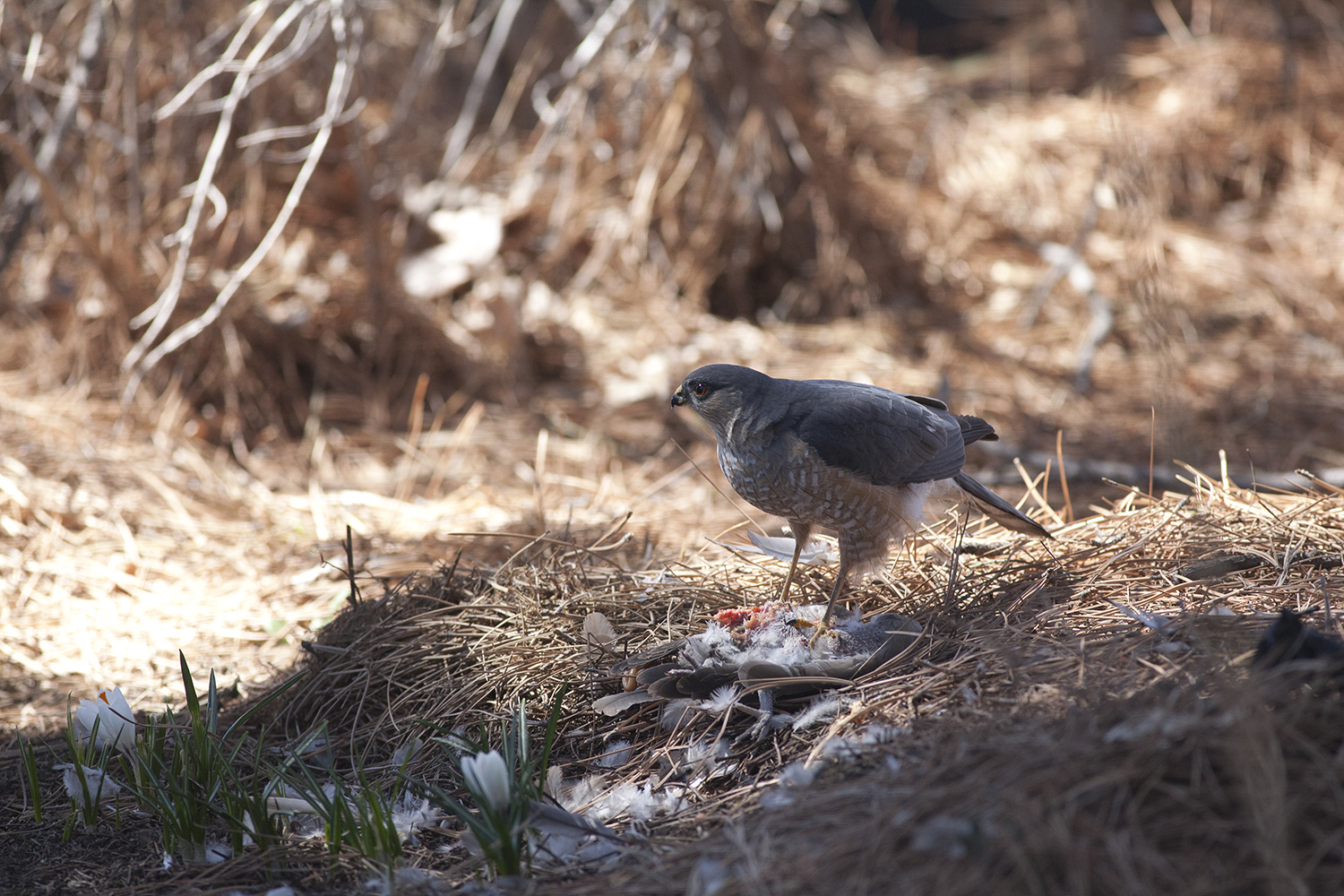
The snow told the tale— the tracks suddenly erased by a deep trench and, out on each side, the delicate marks of primaries four feet from tip to tip. A great horned owl. Not even a drop of blood as a memorial. One exquisite night, one adventurous soul, one violent death. Almost by reflex, I looked up. He must be close by, that hunter. Watching. But the moonlight kept his secret. After a long five minutes, I turned and started back up the hill. It was clear there would be no cottontail celebrations this night.
At that early time in my life, I’d already seen many dead things. Some, like the skunks and raccoons flattened on the road, seemed somehow trivial in death, as if their significance had been erased by the casual indifference of the person doing the killing, as if the dignity of their being had been stripped from them as they were maimed and abandoned. Other deaths seemed more important and, somehow, more respectful— the game animals my dad brought home, still recognizable, still colorful, the subject of endless stories, and, ultimately, a part of the sustenance that supported the family.
Still, the record of that cottontail’s death, the very moment of it, captured for a few fleeting hours on a parchment of fresh snow, opened my eyes to a world I‘d never seriously considered in my fourteen years of life in a quiet Midwestern suburb. In those tracks, I’d seen something far less passive than death. I saw more than the dying; I saw the killing. This was something outside human intention or control. It was the world, running on as it had since life began.
At the heart of that moment was one of the great overriding natural processes that has shaped all life on earth, the selection of the fittest by means that are, by modern human standards, sadistic and merciless. What we most admire in the biosphere around us— the grace, strength, speed, agility, ingenuity, endurance, self-sacrifice— is a product of that process, polishing, refining life over four billion years.
Here at the opening of the twenty-first century, many Americans are uncomfortable with that process, even disgusted by it. We are uneasy with the idea of death. This is, I think, more than the discomfort of mortal beings confronting an end to their individual existence. As we’ve moved away from subsistence farming as a way of life, we’ve taken steps to remove ourselves from any personal contact with death, from the dispatch of a chicken for supper to the passing of our loved ones. For generations now, we’ve been estranged from an intimate confrontation with death in our daily lives, a reckoning with the immutable fact that every breath we take is made possible by uncounted, and largely ignored, deaths. We don’t know death as our ancestors knew it, up close and personal. These days, the natural fear of our own ends is compounded by a fear of the unknown.
This discomfort reaches some sort of bipolar crisis when we contemplate the act of inflicting death. Much of our entertainment revels in killing, from computer games to mainstream film, providing us with ever more explicit, gruesome depictions of the violent deaths of other human beings. Nor is our taste for blood confined to digital fantasies. The United States remains a warlike nation, ready to “project power” anywhere in the world, a process that, even in the best of causes, kills innocent bystanders in the hundreds and thousands. The eagle on our national seal clutches an olive branch in one taloned foot, a sheaf of arrows in the other, symbolism that can be read in two ways: a commitment to peace unless forced to war or an equivocal view of the value and consequences of those two conditions. The proud credo on New Hampshire’s license plate— ‘live free or die”— aptly captures a national mindset.
Our thoughts on the use of violence against other species are even more tangled. Is it ethical to kill rats in our cities? Or mice in our pantries? Urban coyotes? What about mosquitoes or emerald ash borers? Is it okay to eat meat? What about meat raised in a confined animal feeding operation? Our pet cats kill as many as 4,000,000,000 wild birds each year, as many as 22,000,000,000 small mammals1— should we execute the offending felines? White-tailed deer serve as hosts for the tick that carries Lyme’s disease— should we kill deer to reduce the risk of human infections?2 What about deer that are damaging ornamental plants, gardens, or crops?3 Or flocks of geese on farm fields, golf courses, and city parks? Is there any ethical defense for hunting? Fishing? Is it ethical even to keep animals as pets?
There’s a good chance we’ve pondered the ethics of our relationship with other living things for as long as we’ve existed as a species, possibly even longer. Our shifting view of that relationship has colored our work and play, our emotional lives, even our religions since before time began, so it should probably come as no surprise that we wrestle with it still. The answers to that fundamental ethical question have never been easy to come by, but the culture we’ve built over the last century or more has rendered the inquiry even more difficult.
Our burgeoning economic demands on a spectrum of natural resources, the growing power of our technology, our intense specialization and division of labor, our general retreat from a direct connection with the land, and our exploding population have combined to cloud our thinking on the matter and limit the scope of our possible reforms, at least in the short term.
If Americans really aspire to defining and adopting a morality that is more than an uneasy social pact with other members of our own species, then our first step should be to abandon efforts to draw a boundary line between ourselves and the rest of life. The second step should be to accept the fact that natural processes operate and that those processes have no essential moral value. Once we’ve accepted those precepts, we can decide, not whether we participate, but how.
In this book, I propose a theory of animal rights that takes into account our modern understanding of ecology, ethology, organic evolution, our own development as a species, and our indelible membership in the natural world. As much as some of us struggle to deny it, we’re members of that world, not overseers, let alone demigods. We’re constrained by the same limits as all other life, dependent on the miracle of our mutual association with all its beauty and violence. Once we begin to understand the nature of that association, we can find our way toward a more ethical relationship with it.
Leave a Reply
You must be logged in to post a comment.