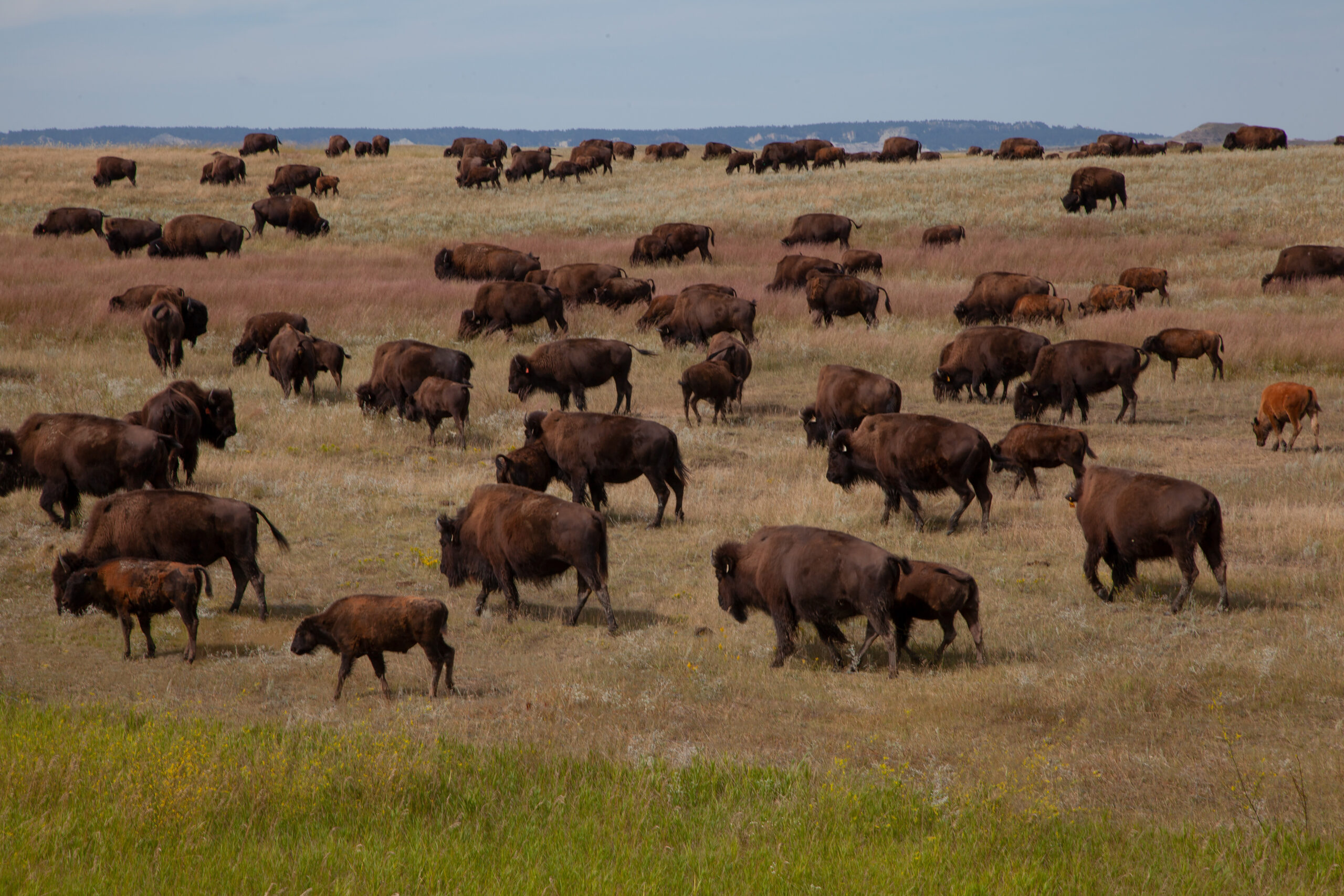
 ON THE MORNING OF MAY 29, 1843, JOHN FREMONT RODE OUT OF THE LITTLE VILLAGE of Kansas City with Tom “Broken Hand” Fitzpatrick as his guide and 38 other hard-bitten veterans of the frontier, bound for Oregon and California on a mission that was part exploration and part empire-building. After reconnoitering along the Front Range of the Colorado Rockies and recruiting, on the way, his friend and deeply knowledgeable mountain man, Kit Carson, Fremont turned north toward the Platte River and South Pass, the gateway to the Pacific.
On August 5, his party had found its way into Wyoming’s Shirley Basin, a broad sage-covered plain north of what is now the little town of Medicine Bow.
“The surrounding country appeared to be well stocked with buffalo,” he wrote in his report, “which it was probable, after a day or two, we would not see again until our return to the Mississippi waters. I determined to make here a provision of dried meat, which would be necessary for our subsistence in the region we were about entering, which is said to be nearly destitute of game.”[i]
Fremont was only repeating what Kit Carson and several of the other experienced mountain men in his party had told him— that the country west of the Great Divide was short on buffalo. As the party continued into Idaho, Utah, Oregon, and California, Fremont was to discover the truth in their observations. After many adventures and several brushes with starvation, the expedition headed back east the following spring. On June 11, 1844, they had come as far as the Continental Divide in what is now central Colorado.
“In the course of the morning,” he recorded in his journal, “we had the first glad view of buffalo, and welcomed the appearance of two old bulls with as much joy as if they had been messengers from home. . . . The hunters killed two fine cows near the camp. On the opposite river-plains herds of buffalo were raising clouds of dust.”[ii]
The question of where the buffalo roamed in early America has occupied generations of academics. Much has been written about the easternmost range of the bison, but remarkably little attention has focused on bison in the Intermountain West. It’s clear that the heart of buffalo country lay in the prairie fastness between the Mississippi River and the easternmost ramparts of the Rockies, but reports like Fremont’s have led some ecologists to assume that there were no bison much west of the Continental Divide.
Dr. Donald Grayson, ecologist and archaeologist with the University of Washington, has a more nuanced view based on concrete evidence from the past.
“Archaeological and paleontological records document that bison were widespread in the eastern and northern parts of the Great Basin, particularly after 1600 yr BP,” he writes. “The relatively small numbers of bison specimens that are generally provided by these sites suggests the existence of small herds of these animals, as opposed to the huge agglomerations that characterized the Great Plains during early historic times.” Grayson’s research suggests that bison were relatively recent arrivals in the Great Basin, that they weren’t found everywhere in the Basin, and that they weren’t very abundant anywhere.[iii]
Ecologists Richard Mack and John Thompson have pointed out that weather patterns in the Great Basin encourage most range plants to grow in early spring and become dormant during the drier summer months, which would deprive bison of nutritious forage at a time when calves are starting life. The two researchers also considered the strange difference in distribution of native dung beetles on the plains and in the basin— it seems there were always plenty of dung beetles east of the Continental Divide where there have always been lots of buffalo . . . and no dung beetles in the Intermountain country. No buffalo, no dung, no beetles.
“Perhaps small herds persisted in the steppe west of the Rockies only by withdrawing to sites of permanent water during the summer,” they conclude. “Nevertheless, bison herds in recent times certainly did not reach the numbers seen in the Great Plains in the early nineteenth century.”[iv]
The distinction between bison on the Great Plains and bison in the Great Basin has a practical corollary far beyond the lack of fresh meat for explorers like Fremont: The grasslands on the Great Plains were adapted to periodic heavy grazing by huge wandering herds of cattle-sized ungulates; the grasslands of the Great Basin were not. From a strictly ecological point of view, the introduction of cattle on the Great Plains after wild bison herds had been wiped out was little more than the substitution of one heavy-footed grazing animal for another. In the Great Basin, the arrival of cattle and sheep was an entirely new ecological phenomenon.
Before cattle, the dominant grasses growing alongside the Great Basin’s sagebrush were bunchgrasses that depended on establishing new plants by seed. The bare ground surrounding these tufts of grass was generally covered by a living crust of lichens, mosses, and cyanobacteria. As cattle grazed, they nipped off the tops of the grasses, destroying the seed heads, reducing reproduction, and often uprooting the plants themselves. At the same time, they trampled the soil crust into dust, encouraging erosion, decreasing the supply of fixed nitrogen, and exposing the soil underneath to increased evaporation. Sheep added to the grazing impact by browsing on shrubs as well as eating grass. By 1909, there were more than 6,000,000 sheep on the range in Wyoming alone, more than 700,000 cattle and 153,000 horses.[v] The effect on rangeland was predictable.
By themselves, the vast herds and flocks of livestock reduced the amount of food and shelter the native plants offered wildlife, and, as native vegetation weakened, the advent of farming along with ranching brought another ecological sledgehammer to the Intermountain West— cheatgrass. The ecological impact of cheatgrass is a huge topic in itself. Here, it’s enough to say that cheat was introduced accidentally and, occasionally, on purpose. It probably arrived in contaminated lots of small-grain seed, in straw bedding for livestock shoveled out of rail cars, and in the guts and manure of cattle and sheep themselves. It was even planted on purpose to produce fast-growing livestock forage. It was well adapted to the winter rains and summer droughts of the Intermountain West and probably would have gained a foothold even in the absence of grazing, but the massive range abuse inflicted by cattle and sheep from the 1870s well into the twentieth century created ideal conditions for its spread.
In the history of invasive weeds, few plants have achieved such total domination of entire landscapes in so short a time. In 1992, it was estimated that 3.3 million acres of rangeland in the Intermountain West had been overrun with cheatgrass and associated invasives, and another 62 million acres were at risk of invasion.[vi] Since then, new invasions have been occurring at the rate of more than 500,000 acres per year.[vii]
So what does all this have to do with sage grouse?
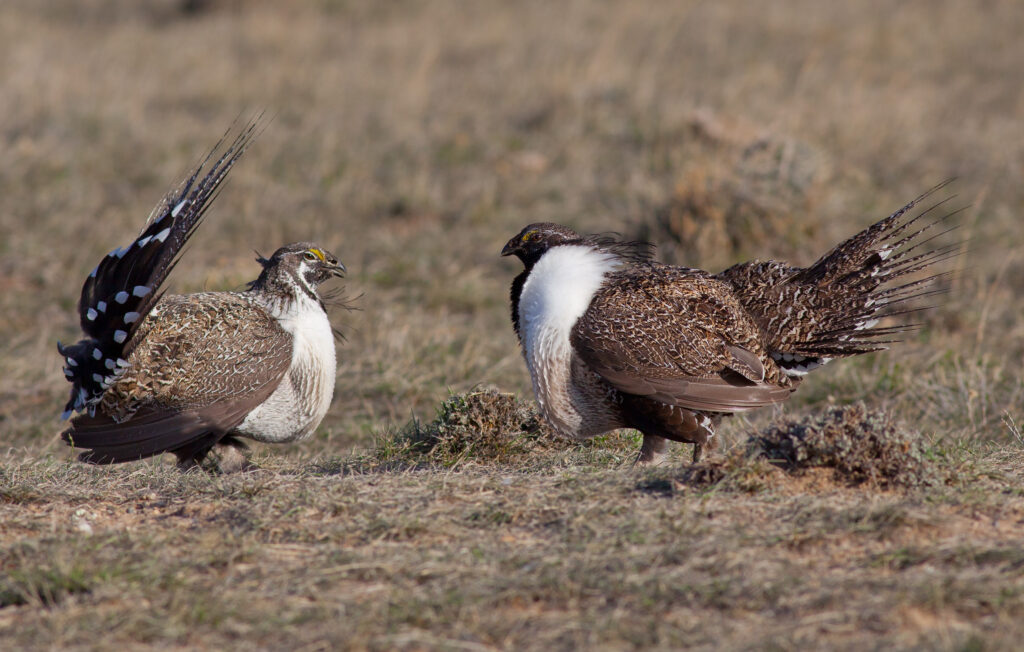 If there is one common denominator in four generations of sage grouse research, it is that sage grouse need sage. The birds depend on sagebrush and the native grasses and other plants underneath for cover and much of their food— they are, in the parlance of the ecologist, sagebrush obligates. Eliminate sagebrush, and you eliminate sage grouse. By 1900, much of the sagebrush that remained on the landscape was hardly fit to support livestock, let alone the wildlife that depended on it. In 1904, Wyoming’s wildlife officials estimated that there were only 5,000 pronghorn on the state’s primary antelope range.[viii] Sage grouse numbers had collapsed. According to the Wyoming state game warden at the time, “Sage grouse have decreased at an alarming rate. . . . The destruction of sage hens may justly be charged to excessive shooting and destruction of eggs and young broods by the large bands of range sheep.”[ix]
A generation later, the pioneering Wyoming sage grouse researcher George Girard saw the situation in about the same way.
“Many sections of the state, at one time favorable for the production of sage grouse, have been converted through agricultural development into areas of intensive farming and grazing,” he wrote in 1937. “The effect of this competition in its natural range, combined with the lack of protection from hunters, has resulted in the depletion of this game bird to a level which will require drastic measures for insurance of its restoration.”[x]
Sage grouse hunting was controlled by the late 1930s— several states closed their sage grouse seasons entirely, and when they were reopened, wildlife agencies had the enforcement personnel to make seasons and bag limits stick. At the same time, the Taylor Grazing Act imposed strict new limits on grazing in the public domain. The combination led to a renaissance in sage grouse numbers, at least where sagebrush cover still existed.
Still, the birds never rebounded to the astonishing densities the sage had supported before settlement. George Bird Grinnell, an eminent naturalist with long experience on the western frontier, was never fond of exaggeration. In the fall of 1886, he was camped in Wyoming’s Shirley Basin, the far eastern edge of sage grouse range. He woke one morning to the sound of wings.
“Looking up from the tent at the edge of the bluff above us, we could see projecting over it the heads of hundreds of the birds, and, as those standing there took flight, others stepped forward to occupy their places. The number of Grouse which flew over the camp reminded me of the oldtime flights of Passenger Pigeons that I used to see when I was a boy. Before long the narrow valley where the water was, was a moving mass of gray. I have no means whatever of estimating the number of birds which I saw, but there must have been thousands of them.”[xi]
By the early twentieth century, the unrelenting intensity of grazing had prepared the way for outright loss of huge tracts of sage to cheatgrass and devastated the sagebrush habitats that remained. Half the original habitat of the sage grouse was simply erased. It’s a legacy of ignorance and greed left to us by the generations of stockmen and farmers who first tamed the Intermountain West.
I think it’s fair to say that many modern ranchers share a concern for the sage and the wildlife it supports. For some, their only reason is the lingering threat of a federal listing of the sage grouse and/or another denizen of the sage, like the pygmy rabbit or Columbian sharp-tailed grouse, as threatened or even endangered. Others have a stake in the land that transcends business. Either way, they want guidance on grazing practices that provide for sage grouse. The question then arises: What sort of grazing regime suits sage grouse? Is it even possible to keep healthy populations of sage grouse and profitable numbers of cattle on the same landscape and, if it is, how?
And, even after decades of research, the shocking answer seems to be: We don’t know for sure.
In 1937, George Girard wrote: “An ideal sage grouse refuge would also necessarily have to be protected from grazing of any sort,” but he added, “If deferred grazing were practiced, giving the grass and other forage an opportunity to develop, it would furnish food and cover and consequently nesting areas.”[xii]
In his 1952 monograph on sage grouse, Bob Patterson made a distinction between grazing and overgrazing. “As a result of overgrazing by sheep, a small parcel of land at the lower end of Eden Valley lost its attractiveness as a nesting area for sage grouse,” but “there is no indication that moderate utilization of the range in the upper Green River Basin by sheep had created any conditions seriously detrimental to sage grouse.”[xiii]
In 1994, a group of Oregon researchers monitored 124 sage grouse nests. Only 18 of the nests escaped the notice of predators, and these successful nests had “greater cover of tall, residual grasses and medium height shrubs” than nests that had been destroyed by predators. Our data indicated the value of residual grass cover at sage grouse nests.”[xiv]
A 1998 study in southern Wyoming found that “areas with greater shrub coverage, taller grass, and residual grass, and greater litter cover were used for nesting.” The researchers went on to observe that “our results suggest that grazing management practices that promote increased height and coverage of grass will increase chick survival.” They recommended “maintaining residual grass heights of more than 10 centimeters to provide nesting sage grouse with suitable concealment and screening cover.”[xv]
In 2005, yet another group of researchers found that sage grouse preferred to nest in places that had more shrub canopy, residual grass cover, and grass height. They concluded that “management strategies that protect dense sagebrush stands and enhance residual grass cover and height within those stands should be used to increase nesting success of greater sage grouse.”[xvi]
Other studies have reached the same conclusions. The evidence is overwhelming— sage grouse prefer to nest and raise broods in stands of sage that have a thriving understory of grasses and broad-leaved plants. This makes intuitive sense. Grass cover helps hide a nesting hen from predators, provides escape cover for chicks after they hatch, and supports a smorgasbord of insects, seeds, and foliage to feed the growing brood. If a little grass/forb cover is good, it would seem that more would be better. In ecosystems that evolved with no significant herds of large grazing animals, the science suggests that the way to produce the most sage grouse would be to eliminate herds of large domestic grazing animals entirely.
Two long-term studies, one in Idaho and one in eastern Montana, have tried to quantify the effects different grazing regimes have on sage grouse. After a decade of research in each place, neither study offers much guidance for a rancher interested in supporting the birds. Is it better to rest a sagebrush pasture first thing in the spring when sage grouse are nesting, or is it preferable to leave some forage standing at the end of the growing season so there will be cover before the forage starts to grow the next spring? These studies provide little insight. Is it better to rest a pasture for a year or more? What about rest-rotation grazing? Is there some optimum level of grazing that supports livestock and grouse at the same time? The studies offer few answers, except to imply that, when managed “responsibly,” grouse and grazing seem to go together without much problem.
That’s a convenient conclusion, since it implies that ranchers and land managers like the BLM have had nothing to do with the ongoing decline in sage grouse numbers. It doesn’t bother to define what “responsible” management looks like; it flies in the face of a huge body of research at the scale of the individual nesting hen, and it ignores the history of livestock’s impact on grouse in the early twentieth century. The apparent contradiction is troubling.
It’s worth noting that stricter control of grazing on the public domain, beginning in the late 1930s, combined with effective regulation of hunting, gave sage grouse a boost that lasted more than 30 years. The renewed decline in the last decades of the twentieth century seems to be due, at least in part, to another influence. We know that sage grouse do better when the sage gets more precipitation, and a quick look at the data on drought shows that the last fifty years have been much drier than the fifty years that preceded them. A lack of moisture takes a toll on everything in the sage, from grass and forbs to livestock and wildlife like pronghorn and grouse. So maybe we can blame the decline on climate change.
But that doesn’t relieve us of our responsibility as managers. We can’t make it rain, but we can adjust livestock grazing pressure as conditions change, especially on the public domain. A recent analysis shows that 56,000,000 acres of range under the aegis of the Bureau of Land Management have failed to meet the agency’s own standards for ecological health, which are not known to be overly stringent. On at least 37,000,000 of those acres, overgrazing is the cause,[xvii] and on much of the rest, a long history of range abuse has almost certainly encouraged cheatgrass and contributed to the problem. Whatever effect well-managed grazing might have on sage grouse, we know from history that persistent range abuse is bad for grouse and other wildlife and no better for ranchers in the long haul.
There’s a lot we still don’t know for certain about the interaction between sage grouse and livestock in the Intermountain West. The best way to change that is with long-term peer-reviewed research. Until we have dependable answers from that effort, we should pay attention to what science already tells us and leave more grass for the grouse.
————-
[i] Fremont, John Charles, 1851. Exploring expedition to the Rocky Mountains, in the years 1842; and to Oregon and California, 1843-44. Hall & Dickson, Syracuse, NY. p.158 online, p.126.
https://archive.org/details/narrativeexplor02frgoog/page/n164/mode/2up?ref=ol&view=theater. Accessed August 14, 2024.
[ii] Ibid, p. 410-411 online, p.281.
https://archive.org/details/narrativeexplor02frgoog/page/n418/mode/2up?ref=ol&view=theater. Accessed August 14, 2024.
[iii] Grayson, Donald K., 2006. Holocene bison in the Great Basin, western USA. The Holocene 16(6): 913-925.
https://www.researchgate.net/publication/239927776_Holocene_bison_in_the_Great_Basin_western_USA. Accessed August 14, 2024.
[iv] Mack, Richard N. and John N. Thompson, 1982. Evolution in steppe with few large hoofed mammals. The American Naturalist 119(6): 757-773.
https://www.journals.uchicago.edu/doi/epdf/10.1086/283953. Accessed August 15, 2024.
[v] Patterson, Robert, 1952. The sage grouse in Wyoming. Sage Books, Denver, CO. P.274.
[vi] Pellant, Mike and Christi Hall, 1992. Distribution of two exotic grasses on intermountain rangelands: status in 1992. In: Proceedings— Ecology and management of annual rangelands. U.S. Forest Service General Technical Report INT—GTR_313.
https://www.fs.usda.gov/rm/pubs_int/int_gtr313.pdf. Accessed August 15, 2024.
[vii] Smith, Joseph T., et al., 2021. The elevational ascent and spread of exotic annual grass dominance in the Great Basin, USA. Diversity and Distributions 28: 83-96.
file:///Users/chrismadson/Downloads/Diversity%20and%20Distributions%20-%202021%20-%20Smith%20-%20The%20elevational%20ascent%20and%20spread%20of%20exotic%20annual%20grass%20dominance%20in%20the.pdf. Accessed August 15, 2024.
[viii] Nowlin, D.C., 1904. Annual report of the state game warden of Wyoming, 1904. Chaplin, Spafford, & Mathison Printer, Laramie, WY. Pp.9
[ix] Ibid, pp. 11-12.
[x] Girard, George, 1937. Life history, habits, habits, and food of the sage grouse, Centrocercus urophasianus. University of Wyoming Publications Vol. III, No. 1, pp.44-45.
[xi] Bendire, Charles, E., 1892. Life histories of North American birds with special reference to their breeding habits and eggs. United States Government Printing Office, Washington, D.C. p.111.
https://babel.hathitrust.org/cgi/pt?id=uc1.c026136661&seq=123. Accessed August 19, 2024.
[xii] Girard, p.45.
[xiii] Patterson, op cit. p.121.
[xiv] Gregg, Michael A., et al, 1994. Vegetational cover and predation of sage grouse nests in Oregon. Journal of Wildlife Management 58(1): 162-166.
[xv] Heath, B.J., et al., 1998. Sage-grouse productivity, survival, and seasonal habitat use among three ranches with different livestock grazing, predator control, and harvest management practices. Pittman-Robertson Project Completion Report, Wyoming Game and Fish Department, Cheyenne, WY.
[xvi] Holloran, et al, 2005. Greater sage-grouse nesting habitat selection and success in Wyoming. Journal of Wildlife Management 69(2): 638-649.
https://www.jstor.org/stable/pdf/3803734.pdf?refreqid=fastly-default%3Aa29f6e96c7a8b5c787c357178f2599f5&ab_segments=&origin=&initiator=&acceptTC=1. Accessed August 20, 2024.
[xvii] Rosenthal, Chandra and Josh Osher, 2024. Much of U.S. rangeland in poor ecological condition. Public Employees for Environmental Responsibility, May 15, 2024.
https://peer.org/much-of-us-rangeland-in-poor-ecological-condition/. Accessed August 20, 2024.
Leave a Reply
You must be logged in to post a comment.