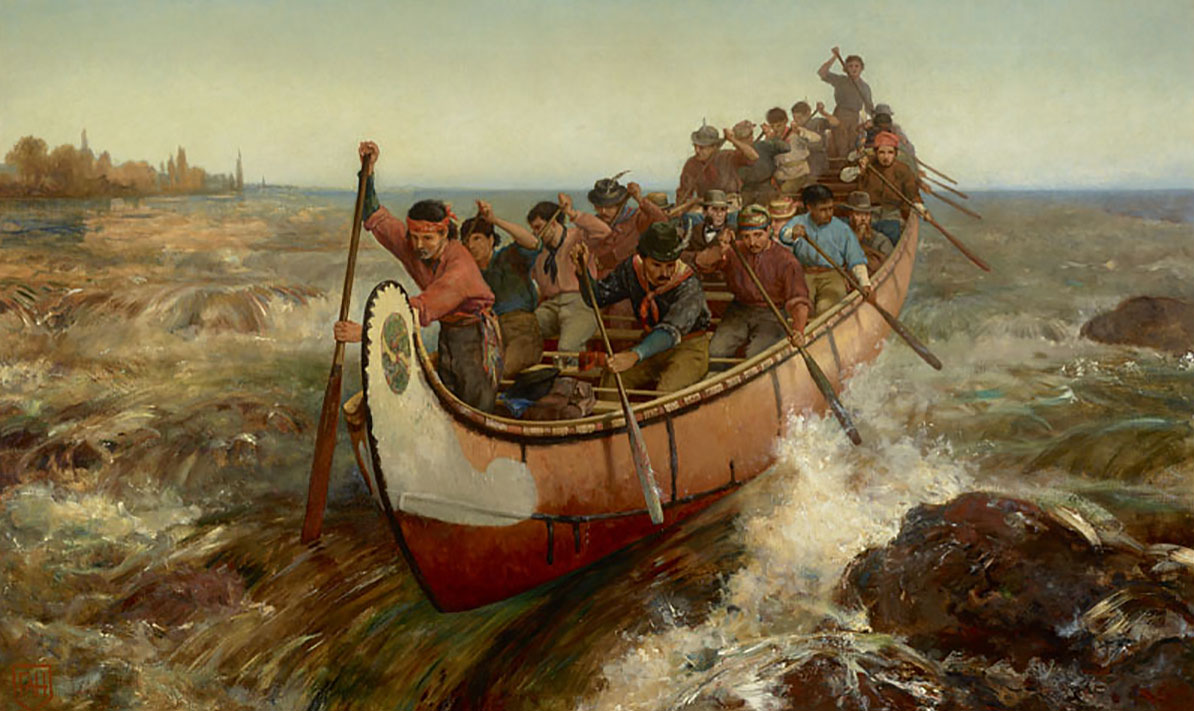
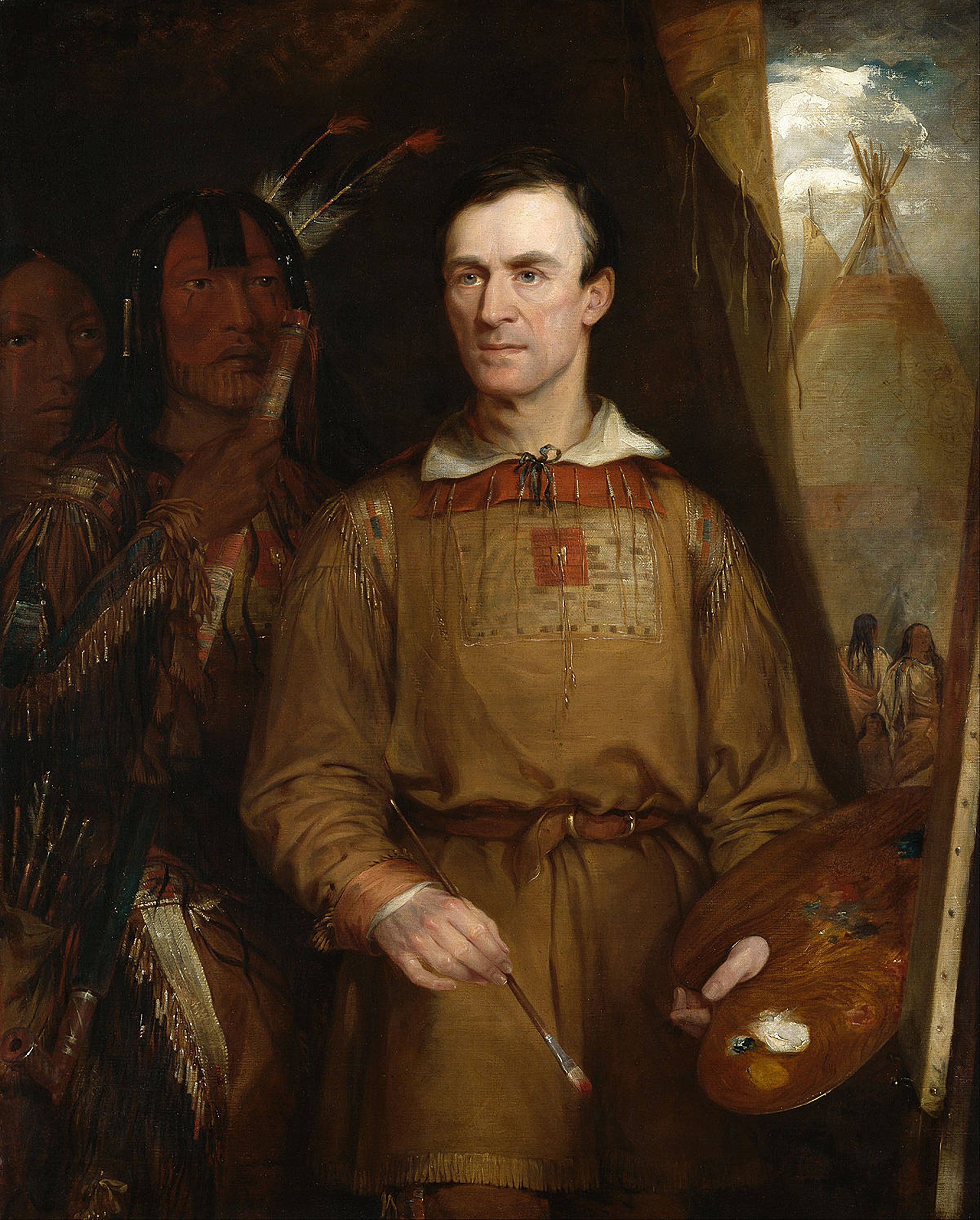
“Shooting the Rapids” by Canadian artist Frances Anne Hopkins, 1879. Courtesy of Library and Archives Canada.
FOR MILLENNIA, THE METHYE PORTAGE CROSSED THE HEIGHT OF LAND THAT SEPARATES THE WATERS OF HUDSON’S BAY FROM THE vast, impossibly remote wilderness of the Mackenzie River drainage. The path was a thoroughfare for native travelers and, for a century, the fur trade. Even today, it’s almost 400 miles north of any settlement an outlander would know; in 1859, it was 2,100 miles of jack pine, mosquitoes, and black flies from the jumping-off point on the northwest shore of Lake Superior.
Not the time or place one would expect a bookish Irishman and an American naturalist to strike up an acquaintance.
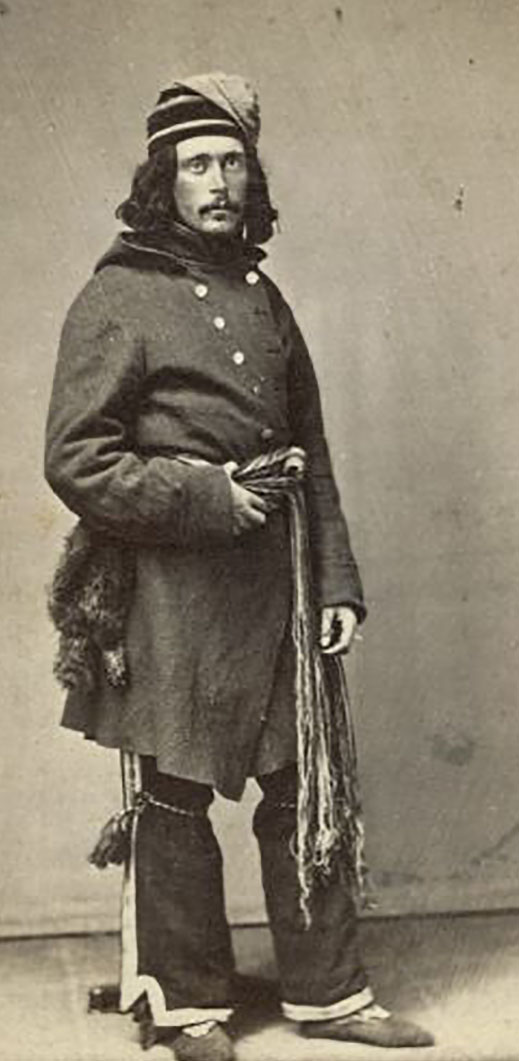
Robert Kennicott back from northern Canada in capote and moccasins. Courtesy of the Smithsonian Insitution.
Robert Kennicott arrived on the north end of the Methye Portage on July 24 that year, after a sixty-seven-day trip from Fort William, the Hudson’s Bay Company post on the site of what is now Thunder Bay, Ontario. Waiting for Kennicott’s party was Bernard Rogan Ross, chief trader at the company’s Fort Simpson Post, a mere 600 miles from Methye.
This was no chance encounter. Kennicott had come from his home in northern Illinois as an official representative of the United States Smithsonian Institution. Two years earlier, the leader of the Smithsonian had contacted Sir George Simpson, governor of the Hudson’s Bay Company, to ask for help in obtaining specimens of Arctic mammals and birds.
Simpson had replied most generously: “ The Hudson’s Bay Company are ever ready to render assistance towards the promotion of scientific research in their territory.” He sent copies of the Smithsonian letter to the HBC officers along the Mackenzie River, including Ross, and, in early 1859, sent another letter to company representatives in the northern territories, notifying them that Kennicott would be traveling their direction that summer.
Ross had taken the 1857 call for cooperation with the Smithsonian seriously. As he shook young Kennicott’s hand that day at Methye, he handed the year’s shipment of northern furs over to HBC voyageurs for the return to civilization. Included in those packs were several cases of study skins addressed to the Smithsonian.
Loading Kennicott and the freight for the winter into nine boats, Ross and his men headed back north, down the Clearwater to Lake Athabasca, over a divide to Great Slave Lake, west down the 300 mile-length of the lake to the headwaters of the mighty Mackenzie River, then downstream to the mouth of the Liard River and Fort Simpson. Another fourteen days into the northern wilderness.
This trek was all in a year’s work for the men of the Hudson’s Bay Company. The men who paddled and pulled the freight canoes back and forth across the continent were unimaginably tough, running— running!— over the portages with 180-pound loads, shooting rapids; meeting the wet, the cold, the voracious insects with a song. Most of them were born to the life and knew no other. They had little tolerance for weaklings or shirkers.
The managers were nearly as stout. These were men who would drive a dog sled a hundred miles through temperatures dropping past forty below zero to deliver the mail and chat, men who shrugged off the awful solitude of the Far North, a silence that was known to drive some visitors from civilization to the edge of madness.
When he arrived at Fort Simpson, Kennicott had already spent nearly three months in the rough company of this, one of the world’s most demanding fraternities. The Hudson’s Bay administrators had granted him the nominal position and per diem of a clerk, which gave him a certain official status, but there’s no doubt that he was watched for signs of weakness, for homesickness or impatience with the many discomforts of the trip. It was the hardest kind of initiation, an intense, extended test of strength and will that had broken many men.
By the time winter set in, it was clear that Kennicott had passed the test. In early January of 1860, he drove his own dog team— an arcane skill many white men never mastered— from Fort Simpson to Fort Liard, 260 miles, following the dog team on snowshoes and returning in early March. He learned to shoot a bow and did his best to learn the native languages, a process he found challenging because of the “absence of good interpreters.”
He traveled ceaselessly, by sled and canoe, in search of specimens of mammals and birds, making friends and converts to scientific collecting wherever he went. The winter of 1860-61 found him hunting and trapping at the HBC’s outpost on the upper Yukon River, 200 miles north and west of Fort Simpson. The following May, he joined other members of the post in a spring goose hunt, the meat to be used by the group, the skins to be sent back to the Smithsonian.
“The modus operandi of the hunters is to make a low cabin, or blind of willows, or logs,” he wrote in his journal. “In this the hunter stands, and when he sees a band of geese, imitates their call, when they will, generally, if not too high, and he calls well, turn and come to him. As fast as any geese are killed, they are ‘planted’ near the stand, and when there are a number of these decoys, and a good ‘caller,’ the geese will actually come within twenty feet of the stand.”
During a hunt on Great Slave Lake, someone in Kennicott’s party killed a white goose, barely bigger than a mallard, that lacked the “grinning patch” characteristic of the lesser snow goose. The base of the bill was covered with a rash of bumps not seen in snow geese. Kennicott prepared the skin and shipped it south where it immediately caught the attention of Smithsonian officials and ornithologist John Cassin.
On March 26, 1861, while Kennicott was still in the North, ornithologist John Cassin officially reported the find to science: “the smallest goose known to inhabit North America. Bill strongly warted or carunculated in front and on its sides near and at its base. Entire plumage white.”
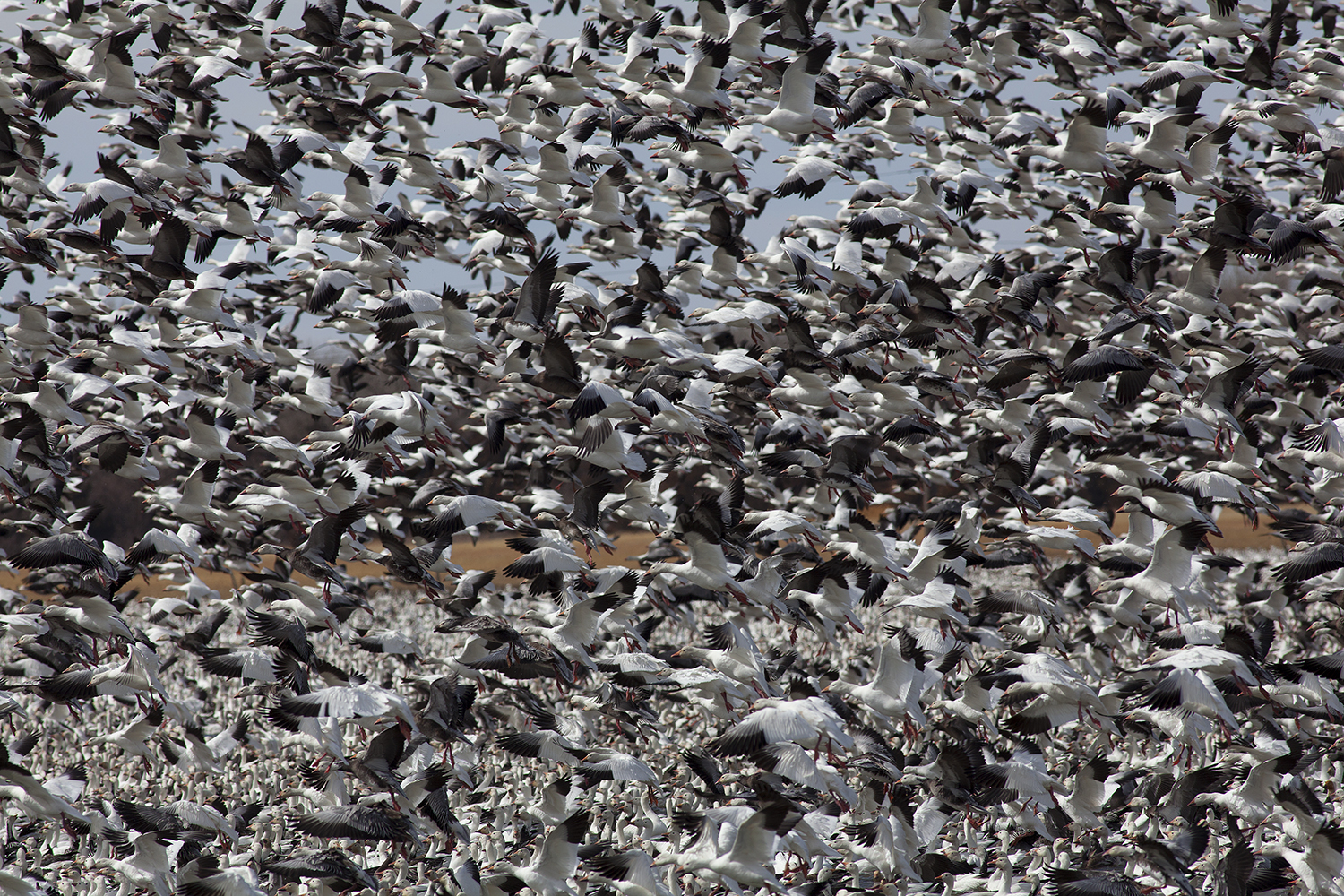
Mixed flock of lesser snow geese and Ross’ geese in Nebraska’s Rainwater Basin. (Photo copyright 2016, Chris Madson, all rights reserved)
Cassin recognized that this study skin was confirmation of a report that had been made nearly a century before by Samuel Hearne, another Hudson’s Bay Company man who had made two extensive expeditions into the Coppermine River region of northcentral Canada in the 1780s. Hearne called it the “horned wavy,” “wavy” being a corruption of the native word for “goose.”
With the physical evidence in hand, the scientific community could finally accept Hearne’s report as well as correspondence from Bernard Rogan Ross, who had insisted that this miniature snow goose was its own species. Ross had very probably adopted this opinion because the Dene tribes around Great Slave Lake considered the bird to be different from other geese.
All that was left was to choose a sanctioned name.
If there were justice in the world of taxonomy, the bird would have been called Hearne’s goose. Hearne had encountered the species as early as 1769 and furnished a detailed description in 1795 in his Journey to the Northern Ocean. However, he hadn’t brought back a specimen, the crucial piece of evidence the taxonomists of the time required.
Sixty years later, Kennicott was the man who prepared the skin so that it would survive the trip back to civilization. He was the Smithsonian’s man in the North, a collector of unparalleled energy and talent. The force of his example inspired several of the Hudson’s Bay Company men to begin collecting for the Smithsonian and other scientific institutions. In 1859, the Smithsonian received 208 scientific specimens from the Mackenzie district, all of them collected by Kennicott himself. In 1860, that number jumped to 1,872, of which 572 were Kennicott’s. In 1862, Kennicott was called back to the United States because of his father’s illness. He sent no specimens that year, but the Mackenzie men sent 2,400.
At least twenty-two employees of the Hudson’s Bay Company began collecting for the Smithsonian during Kennicott’s sojourn in the North. James Lockhart, chief trader at the Yukon post and one of Kennicott’s closest friends, contributed more than 1,000 specimens. Roderick McFarlane, an HBC trader on the Anderson River as well as at Fort Simpson, began an impressive collecting career when he met Kennicott, contributing more than 5,700 specimens over the next decade.
All of which is to say that Kennicott deserves a prominent place in the history of North American scientific exploration, not only for the collections he made but for the collections he encouraged. Perhaps even a species with his name attached: Kennicott’s goose has a certain ring. . . .
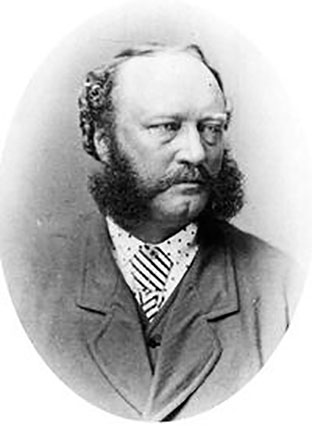
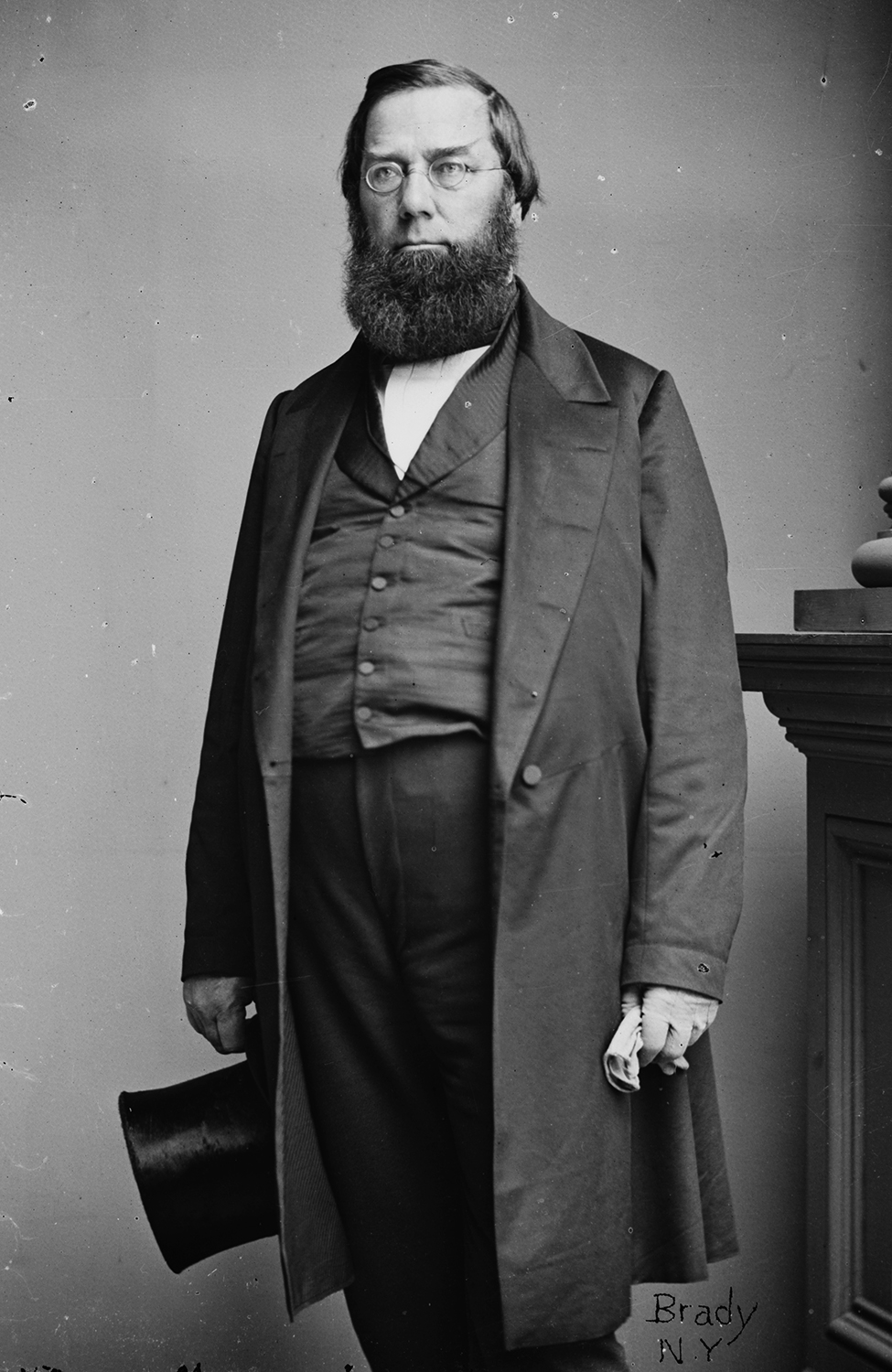
Bernard Rogan Ross, chief factor at the HBC post, Fort Simpson, NWT, during Kennicott’s stay. Courtesy of the Library of Congress.
Standing in the way of that christening was Bernard Ross, the highest authority the Hudson’s Bay Company had in the Northwest Territories. He was a man of ambition in a place where ambition was particularly hard to fulfill, a voracious reader, member of five scientific and philosophical societies, and an aspiring poet and journalist.
The 1857 letter from the Smithsonian asking for specimens, combined with Kennicott’s arrival, set a fire in Ross’s belly. Beginning with the 1859 shipment of specimens, he took credit for 2,259 specimens sent to the Smithsonian over the next decade. In 1861, he wrote to Spencer Baird at the Smithsonian: “I wish to make myself a name in the scientific world if possible, and I am sure you will do all in your power to gain it for me.”
The lion’s share of the specimens he claimed were actually collected by other men, a fact that rankled some of his subordinates, and it’s unlikely that he actually prepared more than a handful of the skins he sent. Still, he sent more than any of the rest of the company’s men along the Mackenzie, after McFarlane.
He also waived the freight charges for the shipments of specimens and for incoming shipments of collecting materials,, books, and the occasional bottle of whiskey, at least inside the confines of the Mackenzie district. As supportive as the Hudson’s Bay Company had been, this was not something that had been authorized, and it may be that his insistence on shipping under his name may have been an effort to justify the free transport and camouflage it. In 1865, the company discovered the liberties he had taken and fined and reprimanded him for the shipments.
Kennicott realized soon after his arrival at Fort Simpson how important Ross’s support was to the reconnaissance of the Mackenzie region. In 1860, he wrote to Spencer Baird at the Smithsonian: “I found Mr Ross very anxious to send all he could in his own name. . . Postmasters and clerks . . . were to hand over to him all the specimens. . . . As I of course wanted to see all the specimens sent possible— I thought this [a] better policy than to have them given to me.” Baird was quick to understand the situation, and when Cassin examined the Smithsonian’s study skin, Baird suggested that the new species be dubbed “Anser Rossii.” After subsequent decades of wrangling over taxonomic affiliations, the bird has been moved to a different genus and is now known to science as Chen rossii. Ross’s goose.
When Ross heard of the decision in November of 1861, he immediately wrote to Baird: “I am quite flattered at having the snow goose called after me,” he said. “It is about the pleasantest compliment that could be paid me.”
And so Bernard Ross gained the immortality he was so desperate to win. He stayed on with the Hudson’s Bay Company for another ten years, retiring in 1872 and dying quietly two years later in Winnipeg.
Kennicott returned to the north country in 1865 with the Western Union telegraph company’s expedition to run a line through Alaska and across the Bering Strait into Russia. He signed on as “Chief of Explorations,” with the understanding that he could appoint assistants and make extensive collections of the Alaskan flora and fauna.
The expedition was poorly provisioned and badly led by a commander whose only goal was the quickest possible installation of the telegraph line. There was almost no time for collecting; over the winter of 1865-66, the challenge was just trying to stay adequately fed. Kennicott became increasingly discouraged and, on the night of May 13, 1866, suffered an apparent heart attack while walking outside camp. He died alone on the banks of the Yukon River at the age of thirty-one.
It is somewhat ironic that this failed expedition led to the only recognition of Kennicott’s outstanding contributions to the field of ornithology. In March of 1866, one of his subordinates collected a small owl in the rain forest near Sitka. When the specimen was examined back in Chicago, it turned out to be a new species, the western or Kennicott’s screech owl, then classified as Scops Kennicottii. The task of describing the new bird for science fell to Daniel Elliot, curator of zoology at Chicago’s Field Museum. At the end of his technical description, Elliot added this note:
“In bestowing on this owl the name which I trust it is ever destined to bear, I simply express the desire which I am sure is felt by all ornithologists, to render honor to him who, combining the intrepidity of the explorer with the enthusiasm of the naturalist, twice penetrating the forbidding, cheerless districts of the far north, in order to extend the knowledge of his favorite science; and who perished in his early manhood, in the full tide of his usefulness, on the banks of the Yukon. Ornithology has met no greater loss, in these later days, than in the death of Robert Kennicott.”
Kennicott’s colleague William Dall spoke for many of Kennicott’s field companions when he wrote: “He joined to a noble and generous heart an enthusiastic love of nature; defying in the pursuit of knowledge the miasma of the tropics and the rigors of the Arctic winter; manfully enduring isolation, sickness and privation and dying in the field, a martyr to the conscientious discharge of his duty.”
The science of ornithology remembers Kennicott’s dedication and endurance with that single word—kennicottii— in the technical name of a bird that is as little remembered or appreciated as Kennicott himself, but it’s clear from the reaction following his death that his memory was cherished in the hearts of friends from the halls of the Smithsonian to the wilderness of the Yukon. In the end, that may be monument enough for any man.
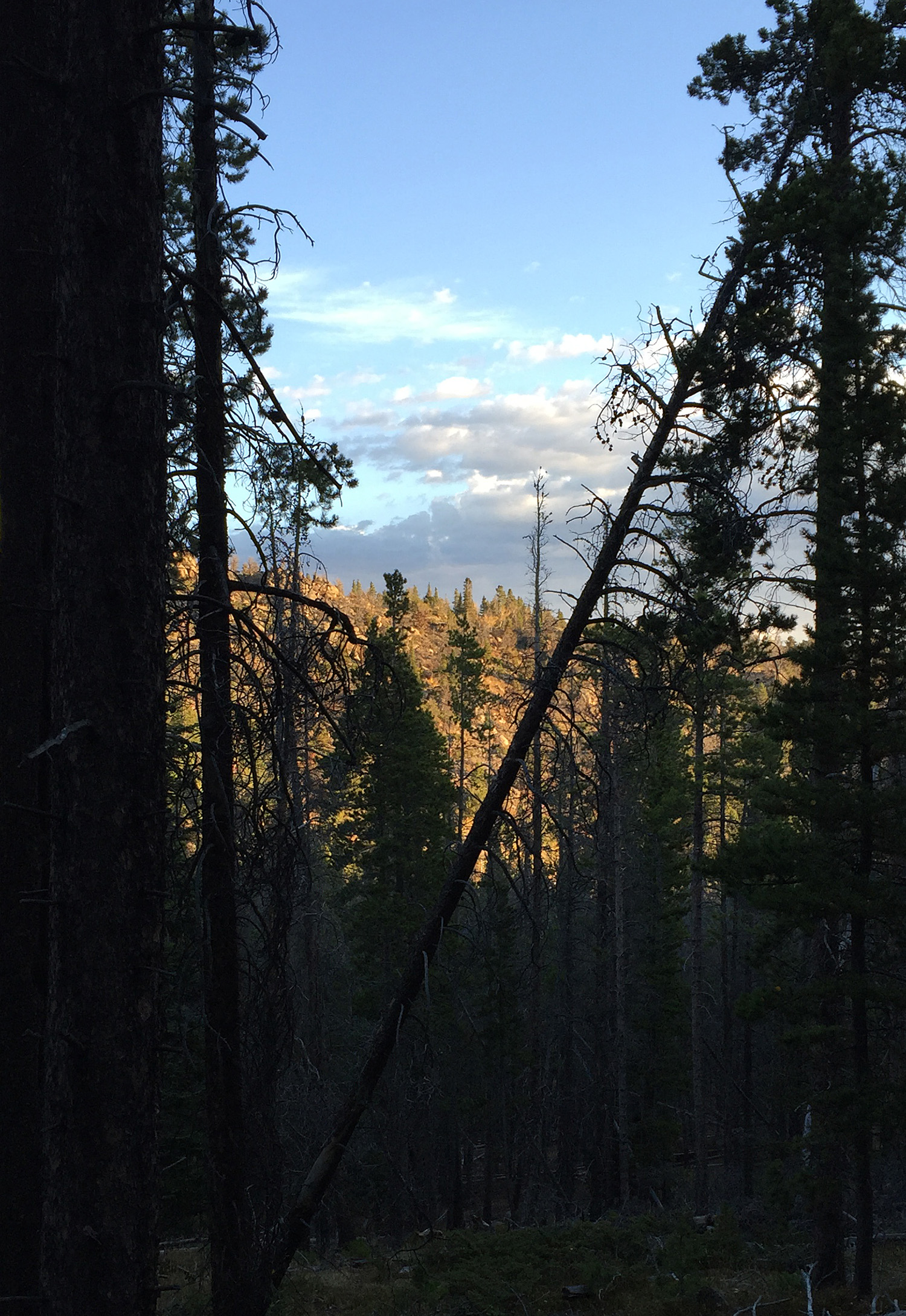
The pursuit of elk in the high West leads to some exceptional places at exceptional moments. There is an esthetic to the hunt that has to be lived to be appreciated. Photo by Chris Madson, copyright 2018, all rights reserved.
RAY FISCHER HAS BEEN A HUNTER EDUCATION INSTRUCTOR IN KANSAS SINCE 1994.HE’S ONE OF THE STATE’S most active volunteers and a member of the International Hunter Education Association’s Hall of Fame. Over his twenty-five years in hunter ed, he’s watched the change up close.
“In the ten to twelve classes we do in this area every year, our demographic for the last ten years has been average age of 20.2. We’re getting older students in our class. Eleven and twelve-year-olds— that’s what we would call our traditional student— we’re getting a few of those, but we’re also getting their mothers or their fathers or their grandfathers.”
It’s a trend that’s taken many observers by surprise.
Fifty years ago, several researchers found that between eighty and ninety percent of all hunters started hunting in their teens.[i] This finding led to a couple of conclusions at the time: first, that kids learned to hunt from their parents or other adult relatives and, second, that people who hadn’t started hunting by the time they were twenty probably never would.
A beginning hunter learning to see country in a different way. Photo by Chris Madson, copyright 2018, all rights reserved.
Not long after this information was collected, wildlife managers discovered a disturbing trend: the number of Americans who hunted had begun to decline. For thirty years after World War II, the number of hunting licenses sold in the United States rose steadily, reaching a peak of 16.7 million in 1982, but in the decade that followed, it dropped by more than a million,[ii] even as the population of the nation as a whole rose by nine percent.
The reasons for the shift were clear enough. More and more people were moving into urban areas, where wild places were hard to come by and the use of any hunting weapon, frowned upon. Added to that was a change in the structure of the American family; in 1960, one child in ten lived in a one-parent family; by 1990, nearly a quarter of all kids were living with a single parent. Nine out of ten of those single parents were moms faced with the demands of running a household and holding down a job.[iii] They had neither the time, the expertise, nor, in most homes, the inclination to introduce their kids to hunting.
The decline in the number of hunters sent a chill down the spine of anyone who followed wildlife conservation in America. The sale of hunting licenses, along with revenue from excise taxes on hunting arms and ammunition, had been a mainstay of funding for state wildlife agencies over the century, and beyond the financial support, hunters had been key players in the politics of conservation— in Congress, in state capitols across the country, and down at the grassroots, not only for game but for the spectrum of wildlife and wild land across the continent. It was clear to anyone in the field that the loss of the hunting tradition would cripple conservation and just as certain that the way to produce more hunters was to work with kids.
Driven by that sense of urgency, state wildlife departments threw ever more weight behind their hunter education programs, and a host of private-sector conservation groups launched outreach efforts to encourage new hunters. Guided by the information developed in the 1970s, the people who ran these programs targeted kids, assuming that anyone over the age of twenty had already made the choice to hunt . . . or not.
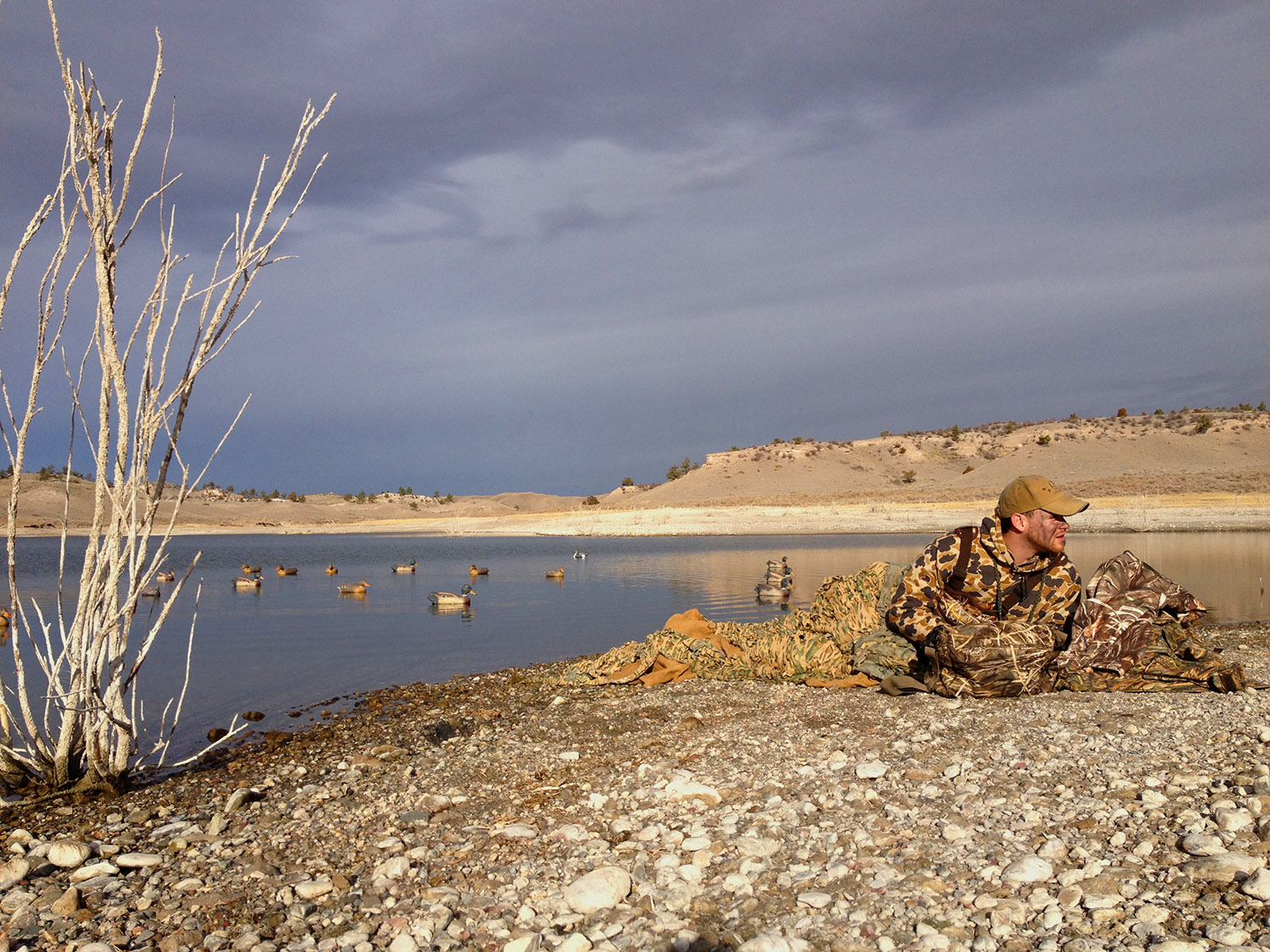
Some kinds of hunting, like waterfowling, are particularly gear- and knowledge-intensive. A mentor can help a beginner master the practical challenges of the hunt and recognize the esthetic and philosophical rewards as well. Photo by Chris Madson, copyright 2014, all rights reserved.
There’s no way of knowing how effective this focus on preteens and teens was in slowing the decline in the number of hunters, but as the years passed, it became clear that programs for kids, by themselves, weren’t turning the tide. There were several obvious reasons for that. In the modern era, kids don’t have the money to buy even the most basic equipment they need to hunt, and without driver’s licenses, they can’t get out of town to places where game can be shot. They are utterly dependent on adults for all that, and the adults in their lives often can’t or won’t provide it. Any number of other activities are easier for a kid to join and easier for an adult to support.
Still, the conservation community concentrated much of its attention on young people, hoping for the best and largely ignoring a crucial shift in attitudes among American adults.
Like most grassroots movements, the modern focus on healthy eating has obscure origins. Upton Sinclair’s1906 novel, The Jungle, may have been the first public expression of American concern over food, but that angst seemed to deepen in succeeding decades. Saccharin, cyclamates, red dye number 2, nitrites, PCBs, mercury, outbreaks of E. coli and Salmonella[iv] became front-page news, leading to the creation of the federal Food Safety and Quality Service (later the Food Safety and Inspection Service) in 1977 to keep watch over meat and poultry production. For a new generation of consumers, the inspection mandate was comforting, but it didn’t allay their deepening concern over nutrition. The “food movement” had been born.
When these activists considered the possible sources of locally grown, organic meat with no hormones or antibiotics, they found themselves drawn to wild game. And so a cohort of hunters was created, not from twelve-year-olds hoping to follow their dads into the field but from twenty- and thirty-somethings who were following an ethical, dietary, and political position to its logical conclusion.
In 2005, a new set of researchers revisited the question that had been asked in the 1970s: At what age do new hunters first take up hunting? And they discovered a seismic shift— a third of new hunters were starting after the age of twenty.[v] Ray Fischer’s observation in central Kansas turned out to be true for the entire nation.
Adults are taking up the hunt for a variety of reasons, recreational as well as practical and political, but one statistic suggests that getting organic red meat is a primary motive. In 2016, federal estimates of the numbers of hunters dropped across the board, but some kinds of hunting suffered more than others. Compared to the long-term average from 1991 through 2011, the number of big game hunters in 2016 dropped sixteen percent while the number of small game hunters dropped thirty-nine percent, and the number in pursuit of migratory birds declined by fifty-one percent.[vi] My guess is that the influx of adult locavores helped support the statistics for big game.
Some of these adult hunters have been self-starters. One of my oldest friends, wildlife biologist Neil Johnson, now retired from the Idaho Department of Fish and Game, is one of those.
“I grew up just outside New York City, on the Jersey side,” he says. “Dad never fished; he never hunted. Mom— she liked cats. I used to read Robert Ruark in Field & Stream and The Old Man and the Boy and that was probably the closest I got to doing anything outside.
“It was my second year in grad school when I decided biophysics wasn’t where I wanted to be, and I transferred up to UMass for wildlife.”
That was where he decided to take up hunting.
“I killed a couple of deer out of Vermont— archery. I got into shorthairs in Massachusetts, and my neighbor gave me a big black Lab. I ended up buying a little side-by-side twenty-gauge Ithaca.”
With the ink still drying on his Ph.D., he took a teaching position at Dakota College in Bottineau, North Dakota, then moved to Kansas and later to Idaho as a state wildlife biologist.
“I couldn’t say that anyone was a mentor,” he says, as he looks back over his decades as a hunter. “I had people I hunted with that were fairly knowledgeable and knew how to do it correctly.”
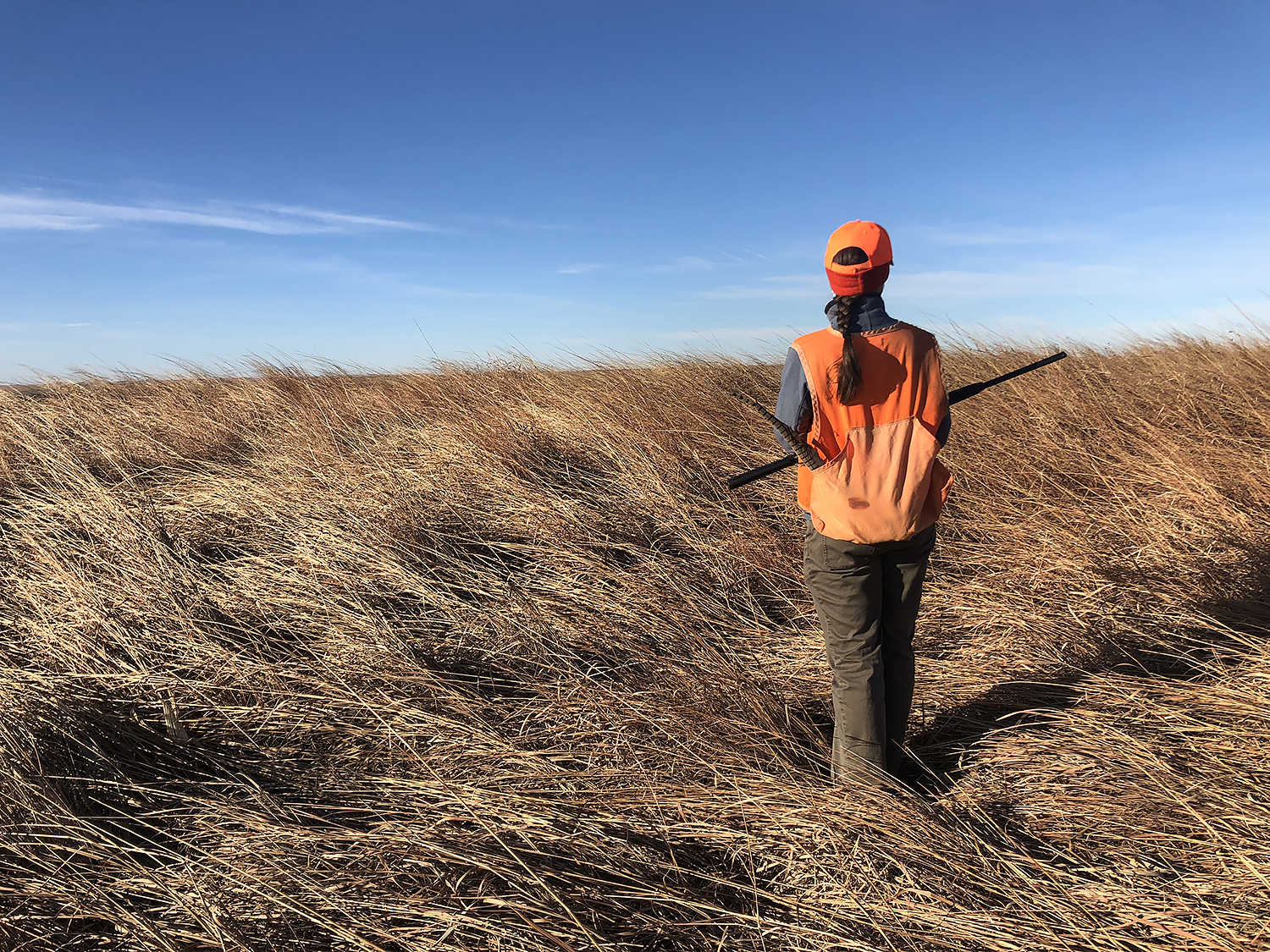
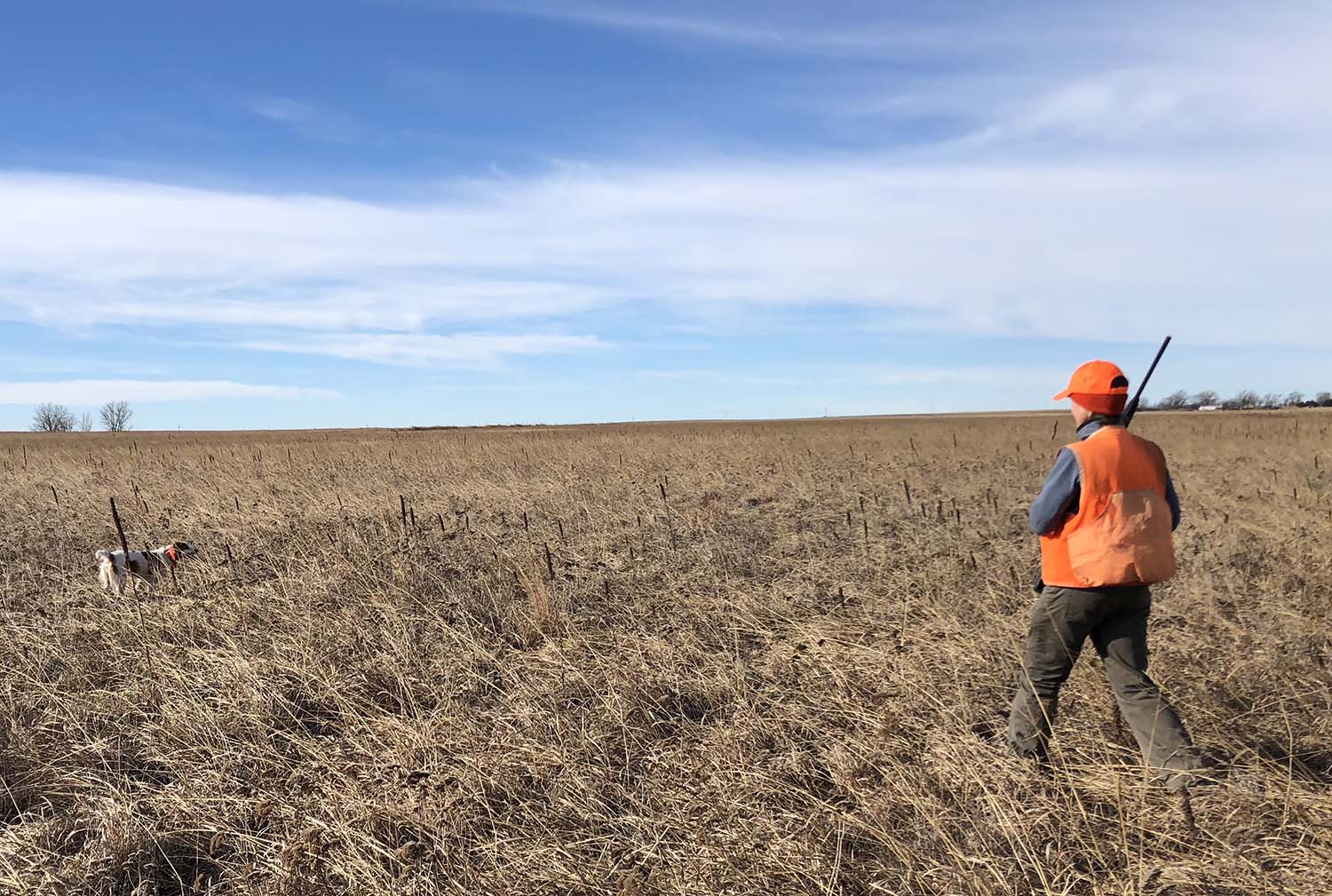
A thirty-something hunter walks in on her first pointed pheasant. Photo by Chris Madson, copyright 2018, all rights reserved.
Heidi Hillhouse is a grassland ecologist with the University of Nebraska whose introduction to hunting was almost as independent.
“My parents divorced,” she remembers, “so I didn’t spend a lot of time around my dad after I was in high school. My mom had done a little bit of hunting with him— at one point, she wounded a rabbit and was totally traumatized by the incident and never hunted again.”
Heidi went off to the university for undergraduate and graduate degrees, but after she launched her professional career, she revisited the idea of hunting.
“I’d wanted to get involved in hunting for quite a while but just never really wanted to jump in and go solo. By coincidence, my sister started dating a guy who did some hunting and offered to help me get started. Now it turns out, he was one of the worst teachers I have ever encountered. It was not a smooth start.”
After three muzzle-loader deer seasons that were long on frigid waiting and short on venison, her volunteer instructor was laid up with hip surgery. She jumped on the opportunity to get out on her own.
“I promptly got a modern rifle with a scope, got another friend to set me up with a place, and got two deer that year. The first time I shot a deer, I was solo.”
With the help of a couple of illustrated books, she taught herself to field-dress deer and decided to handle a lot of the butchering on her own as well.
“The first one I butchered, I didn’t have any help. I really like it because it gives you so much flexibility with what you can do with what you’ve harvested.”
These brave souls are probably the exception among hunters who start as adults. Matt Dunfee is the director of special programs with the Wildlife Management Institute. One of his main interests has been finding ways to shore up the declining population of hunters, and he’s enthusiastic about helping adults take up the discipline. In his experience, “self-starters are rare, and I don’t think there are enough self-starters out there to bolster hunting. There’s an old Japanese proverb— paraphrasing it, it says, ‘If you’re passionate about what you want to do, you’ll teach yourself; if you’re just interested in doing something, you’ll have somebody else teach you.’”
He’s convinced that helping adults who want to start hunting is a smart move.
“They’re a better investment than a kid,” he argues. “They’re motivated by authentic experience and local sustainable living— you tie into their motivations and they’ll find the time and money to do it.”
The organized effort to teach adults how to hunt may well have started in Wisconsin. In 1991, Christine Thomas, a professor at Wisconsin-Stevens Point, launched a program she called Becoming an Outdoors Woman, designed to teach women a variety of outdoor skills, including hunting. It proved immensely popular— today, thirty-eight states and six Canadian provinces offer B.O.W. workshops.[vii]
Jamie Fischer, Ray Fischer’s wife, was less than interested in taking hunting lessons from her husband, but, eight or ten years ago, her daughter-in-law decided to attend a B.O.W. workshop, and Jamie went along.
“I was hooked after that,” she says.
“I love going deer hunting or turkey— to watch nature wake up. Just to go and have that quiet time. To watch who’s out and around and who isn’t around. I love the meat we get that way and the time spent together.”
Another early effort to tailor hunter education to an adult audience was launched at the University of Wisconsin-Madison in 1993. Two professors in the Department of Wildlife Ecology, Scott Craven and Don Rusch, recognized that many of the department’s undergraduate and graduate students had never had an opportunity to hunt. Since hunting remains one of the most important— and controversial— parts of American wildlife management, the profs thought it was vital for these developing wildlife managers to understand something about it. They saw it as an important part of the curriculum for future professionals, but it also turned out to be one of the earliest efforts to teach hunting to adults.
There are some scenes only a hunter is present to witness. Photo by Chris Madson, copyright 2015, all rights reserved.
Their program included a hunter education class and certification, training in the use and safe handling of firearms, roundtable discussions on the relationship between hunting and wildlife conservation, and a day of actual hunting in the field. The Wisconsin Student Hunter Program, as it was called, was adopted by several other university wildlife departments, and in 2005, it was expanded to an even more extensive course of training, Conservation Leaders for Tomorrow.[viii]
These programs at the two state universities stimulated a broader approach to hunter recruitment in Wisconsin. Keith Warnke, a biologist with the Department of Natural Resources, began working on hunter recruitment in the 1990s and took over the position of hunting and shooting sports coordinator in 2011. In 2018, the DNR promoted him to lead its R3 [Recruitment, Retention, Reactivation] Team.[ix]
Warnke emphasizes the connection between the locavore movement and adults taking up hunting for the first time:
“Hunting provides us with that deep connection to our food— local, sustainable, self-gathered, and delicious.” And he’s seen the same shift Ray Fischer has experienced: “These are adults, many of whom have not had any experience with guns or hunting, or shooting. It’s really exciting because you have an invested, motivated learner, somebody who’s just really eager to learn how to hunt.”[x]
About six years ago, Scott Harmon and Mark Gochnour, members of the Izaak Walton League’s Bethesda-Chevy Chase chapter, came to the same conclusion. The chapter had been running a traditional hunter education program designed to meet the state’s requirements, but Scott and Mark recognized the need for a “post-graduate” course.
“We were wanting to pass the knowledge on that we have,” Scott says. “We’ve hunted for years. I’ve bow-hunted since 1982. There’s a lot of knowledge you’d like to pass on and help folks out as they’re first starting out.”
Safety is a key part of the curriculum, but they also delve into the practical knowledge a hunter has to have to be successful.
“We go into the basics of scouting in the woods,” Scott explains. “Tracks, preferred food. Figuring out the ‘why?’ If you can figure out the ‘why,’ you can figure out the ‘when’ and ‘where’ easily. We talk about scent control, wind direction, being proficient, practicing with your firearm, your crossbow, your bow.”
It’s proven to be a popular seminar. Scott says, “We have some younger children who come through, but it’s mostly adults, eighty-twenty, ninety-ten, depending on the class.”
Bit by bit, state wildlife agencies have begun efforts to expand their hunter education to meet the needs of adults. The Wisconsin Department of Natural Resources has developed an extensive outreach effort aimed at adult hunters, online and in the field. Much more recently, the New Mexico Department of Game and Fish recognized that their hunter numbers were dropping and decided to take a new approach to recruitment.
Lance Cherry, chief of Information and Education for the New Mexico Department, remembers that time.
“In 2011, we dropped eleven percent” in license sales, he says. “That was absolute rock bottom. The bulk of our buyers were still baby boomers— our primary customer was aging out of the sport.”
Cherry says that they completely revamped the department’s hunter education program. “We started requiring some responsible adult to come with those kids to those programs.” Cherry and his staff could see that “the parents didn’t have the skill sets we were trying to give the kids. We started sneaking that in.”
As the parents built their own skills, the demand for more sophisticated classes grew. The department launched a cooperative program with the Mule Deer Foundation to reach out to adults, especially parents.
“There are a lot of single moms out there,” Cherry says. “We built a program that encourages them to go to the extremes. We’re going to teach you how to hunt and how to field dress. To be successful in these things.”
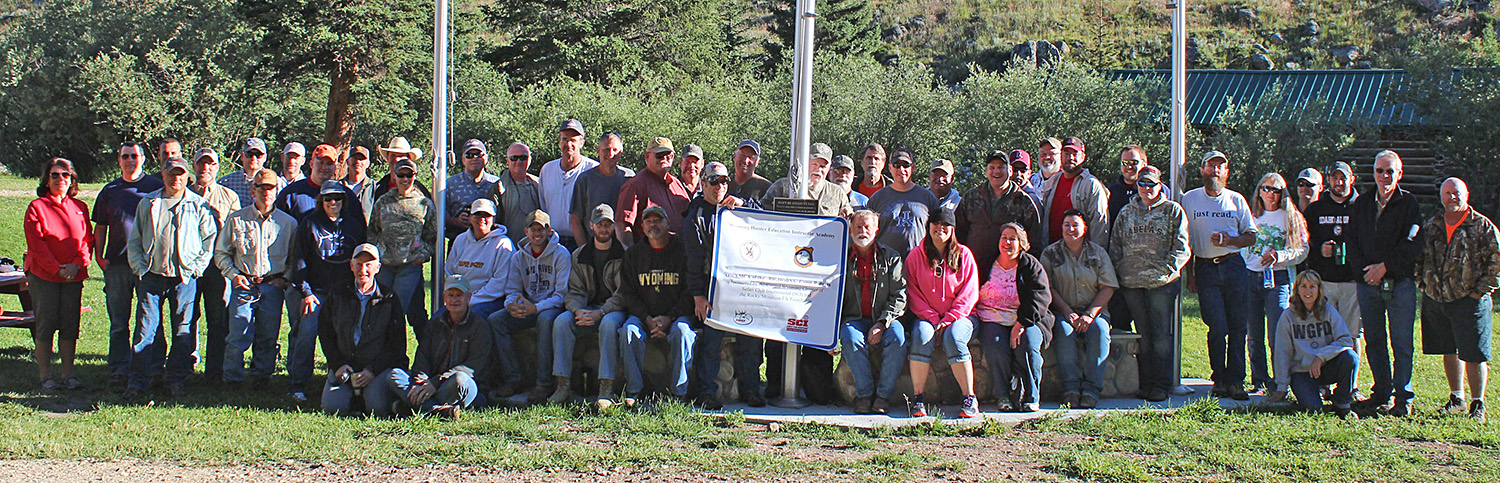
Wyoming’s hunter education instructors gather for a group photo after two days of meetings to hone their skills. Hunter education in the modern era should reach out to beginning adults as well as kids.
After that, the department expanded its outreach even further.
“We’ll do those specific kinds of hunter ed classes where it’s just adults that come in,” Cherry adds. “They’re not required, but you’d be amazed how many adults want to go do that so they know enough to be those role models for their own kids.”
The result? Sales of hunting licenses in New Mexico rose from 66,000 in 2011 to 115,000 in 2017. Cherry sees most of the growth in two age groups: “youth, eight to eighteen, and adults, around twenty-eight to forty.”
There is, in this resurgence of interest among adults, great reason for hope. It shows us that hunting is more than a child’s pursuit. It’s a way of understanding the world that gains meaning rather than losing it, as we spend more and more of our lives in cages of our own making. There is really only one reality, and it’s not virtual. The new generations of hunters have recognized that fact. They’re reaching out, reaching back, to connect with the earth in the most intimate, most serious way.
All they need is a guide.
——————-
[i] pp.105-106, Applegate, J.E., 1977. Dynamics of the New Jersey hunter population. In: Transactions of the Forty-second North American Wildlife and Natural Resources Conference. Wildlife Management Institute, Washington, D.C.
[v] p.5. Leonard, Jerry, 2007. Fishing and hunting recruitment and retention in the U.S. from 1990 to 2005. Report 2001-11, U.S. Fish and Wildlife Service, Arlington, VA.
[vi] Data from these reports: p. 32, 1996 National Survey of Fishing, Hunting, and Wildlife Associated Recreation. p.33, 2006 National Survey of Fishing, Hunting, and Wildife-Associated Recreation. p. 35, 2016 National Survey of Fishing, Hunting, and Wildlife-Associated Recreation, all from U.S. Department of the Interior, Fish and Wildlife Service and U.S. Department of Commerce, Bureau of the Census.
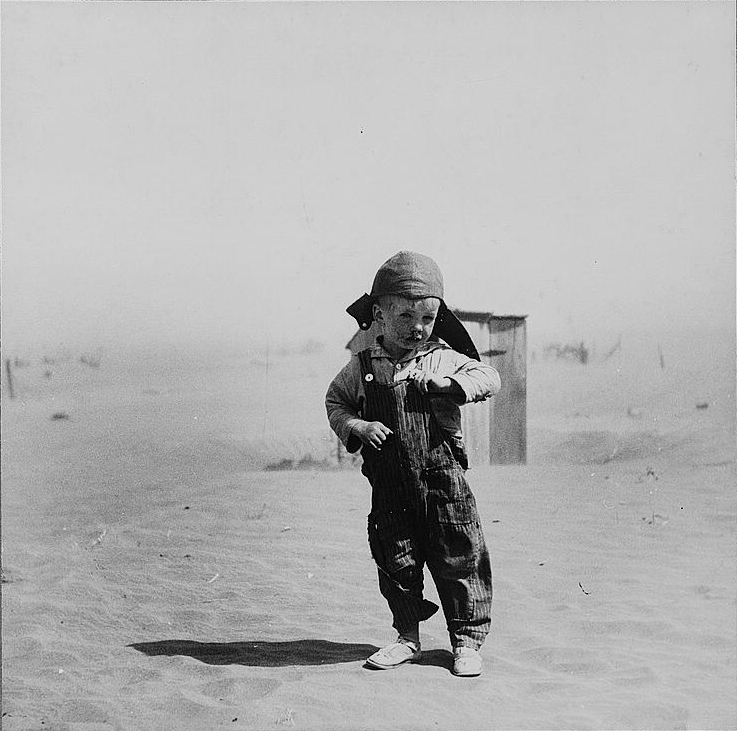
Boy on farmstead, Cimarron County, Oklahoma, 1936. Arthur Rothstein.
THERE’S A POEM THAT’S HAUNTED ME MUCH OF MY ADULT LIFE.
Many years ago, my mother sent me a fragment of it— just five or six lines— that she’d found in a magazine somewhere. I kept the clipping on a bulletin board above my desk, but it tore loose from its moorings during an office move and disappeared along with the attribution, the author, and any hint of a connection to the broader context. In the years that followed, the verse kept coming back to me, a jumbled version of the words emerging in moments when the walls seemed to be closing in.
At one point, I called the chair of the state university’s English Department, hoping for guidance. That patient, sympathetic soul heard me out and, unable to identify the garbled passage I quoted, sent me on to a colleague at the University of Indiana. It was heartening to talk with people whose love affair with words is as passionate as my own, people who understood how frustrating it can be to find a passage that speaks so eloquently and then lose it. They dug through quaint and curious volumes of forgotten lore; they made inquiries of their own and suggested other avenues for the search, but, in the end, they couldn’t help.
At long last, it was the rise of the internet that unearthed the source. I entered the verse as I remembered it— no hits. I cut out a phrase or two I wasn’t sure of— still no hits. Finally, I used just two words, “men” and “freedom,” and there it was.
The work was “The Land of the Free” by Archibald MacLeish. MacLeish, a poet with a law degree from Harvard, ambulance driver and artillery officer in the First World War, one of America’s Lost Generation in Paris during the 1920s, and witness to the crash of 1929 and the Great Depression. In the late 1930s as the smothering gray clouds of the Dust Bowl were beginning to settle, he sat down to draft an accompaniment to a collection of eighty-eight photographs of the era made by Dorothea Lange and other visual geniuses who worked with the Farm Security Administration to document the common man’s view of the decade. The words he set down as companions to their
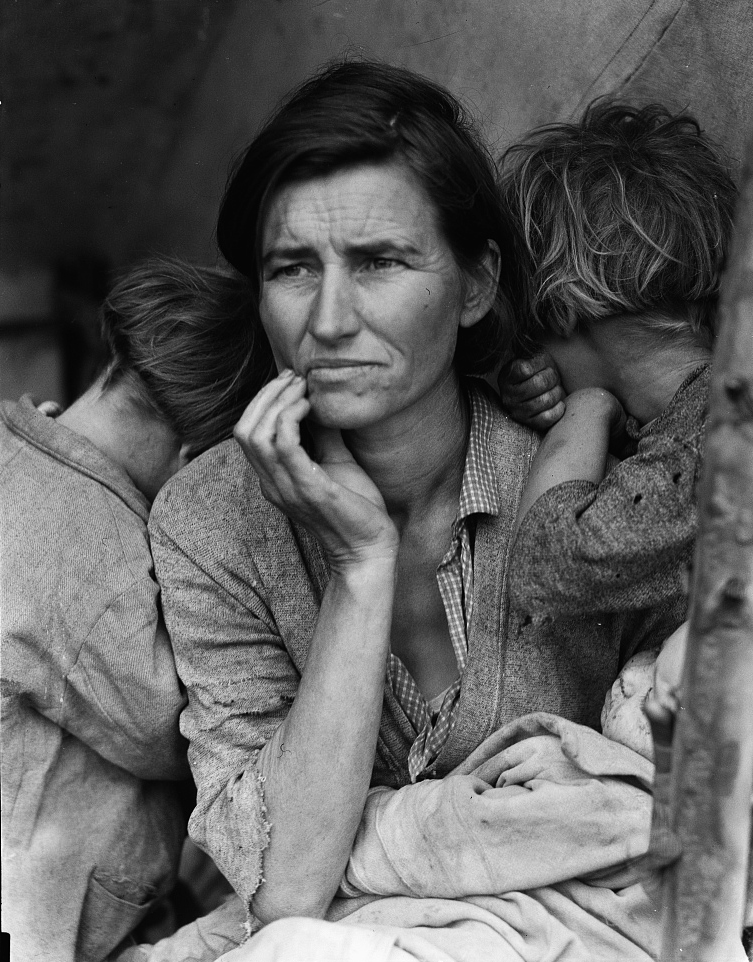
Destitute pea pickers in Nipomo, California, 1936 Photo by Dorothea Lange.
images were an anthem to the suffering of a generation of common people and an expression of their new-found doubt:
“We wonder whether the great American dream
Was the singing of locusts out of the grass to the west and the
West is behind us now;
The west wind’s away from us
We wonder if the liberty is done:
The dreaming is finished
We can’t say
We aren’t sure
Or if there’s something different men can dream
Or if there’s something different men can mean by Liberty. . . .
Or if there’s liberty a man can mean that’s
Men: not land
We wonder
We don’t know
We’re asking”.
Doubt, born of hard times. And, braided through the verse, a query that has defined generations of the American experience: “We wonder . . . if there’s liberty a man can mean that’s Men: not land.”
We’re a long, long way from any time as hard as the Dirty Thirties. Hardly anyone among us lived through those trials or the cataclysm of the second Great War that followed. In nearly every way imaginable, the vast majority of us are pampered beyond the wildest imaginings our grandparents might have cherished for us.
And yet there is this vague feeling of being restrained. Confined. Obstructed. Powerless. I suspect there’s nothing new in the sensation; in fact, I think it’s been a major force in the flow of our history, possibly even the prime mover— a sensation so powerful that it led generations to pack their meager belongs and take the great gamble, heading west, always west, through the merciless storms of the North Atlantic, across the Alleghenies, across the Mississippi and Missouri, across the great grasslands and deserts, the ice-bound ramparts of the Rockies, the Sierras, the Coast Range, and on into the trackless wastes of the Pacific. Generation after generation, looking for that ineffable commodity Daniel Boone called “elbow room.”
This was not, at its heart, an antisocial impulse; in fact, community was a common theme in the great emigration. Hospitality was one of its most cherished traditions. More often than not, contact with other people was a spice that flavored the quiet of day-to-day routine. But it was the quiet itself, born of space, of “elbow room,” that nourished our sense of freedom.
There are revolutionaries who argue that overweaning government is the thief that has deprived us of our freedom. While there may be a grain of truth in that observation, I see the growth of rules and regulations as a symptom, not a cause. A wise friend of mine once observed that “freedom is a finite commodity; how much you have depends on how many people you have to split it with.” My freedom to swing my fist stops at the end of my neighbor’s nose, so my fist-swinging is bound to be limited by the number of neighbors I have and how close we are together. It seems my friend was right— at a practical level, freedom often becomes a simple question of real estate— and I find I barely have room to raise my voice, let alone my fist. I have nowhere left to go.
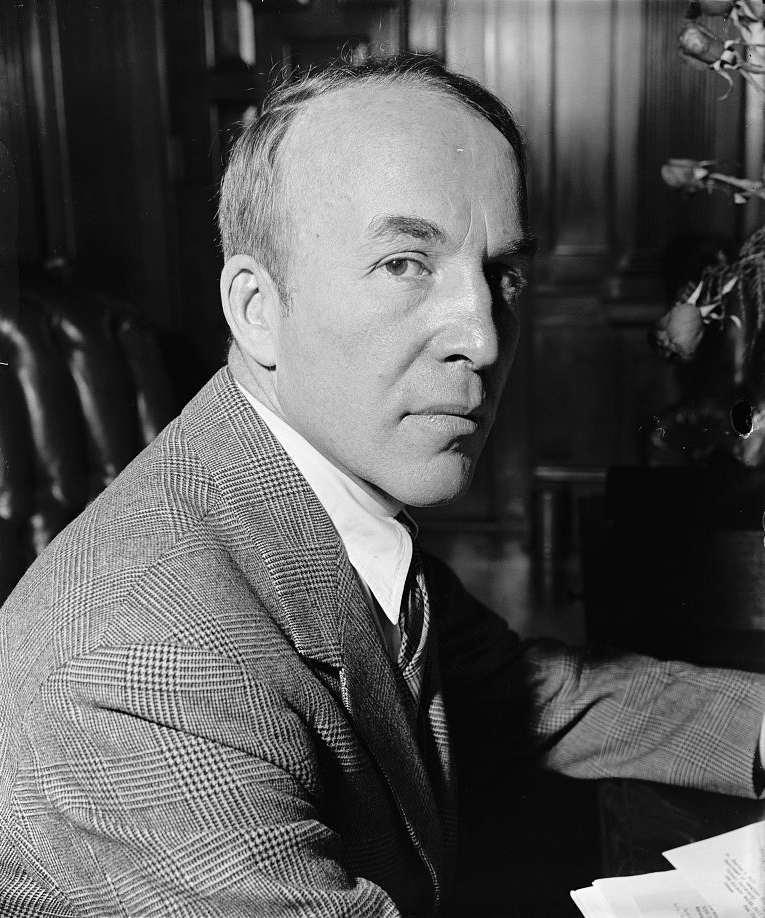
Archibald MacLeish in 1938. Harris & Ewing, photographers.
Thomas Jefferson assured us that we were all endowed “with certain unalienable rights, that among these are life, liberty, and the pursuit of happiness.” Tom also harangued an infant nation into putting up the money for the Louisiana Purchase. I suspect he’d smile in agreement at MacLeish’s words: “We looked west from a rise and we saw forever.”
That was the view from Jefferson’s time. He is to be forgiven for failing to imagine the view from the other side of forever. Elsewhere in “The Land of the Free,” MacLeish captured it:
“Now that the land’s behind us we get wondering
We wonder if the liberty was land and the
Land’s gone: the liberty’s back of us. . . .
We can’t say
We aren’t certain
We’re asking . . .”
There are times when faith gives way and doubt rises. Times like these. Is the liberty done, the dreaming finished? I’m not sure. I don’t know. I’m asking.
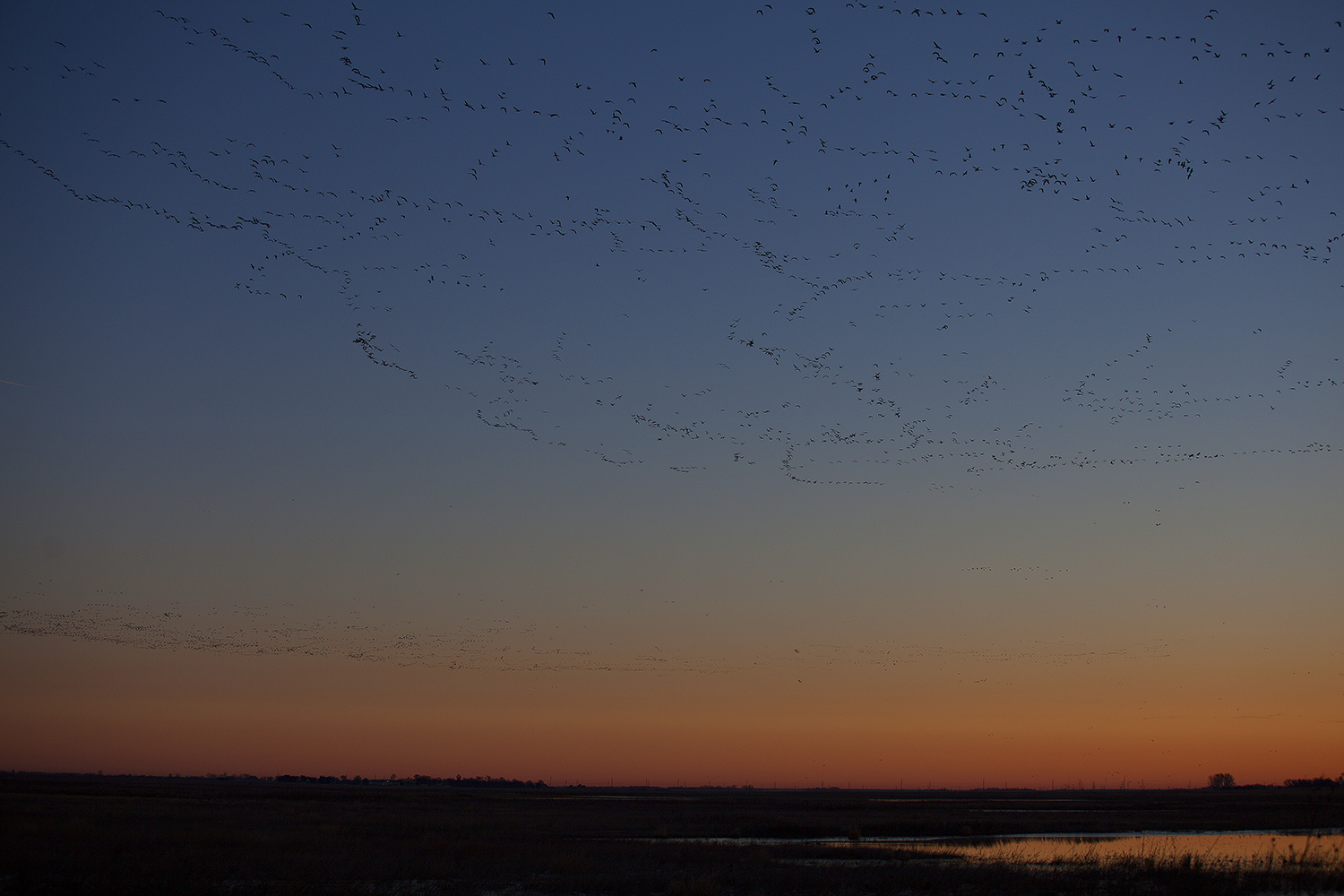
Snow goose migration in central Nebraska. Copy right 2017, Chris Madson, all rights reserved.
THE WIND PAUSED FOR TEN MINUTES OR SO— AN UNUSUAL PHENOMENON ON THE HIGH PLAINS—WAVERED, THEN swung into the north. We’d enjoyed three days of spring, but at the foot of the Rockies in the first week of May, spring is an ephemeral condition. As the sun set, a spattering of rain and those little ice balls the weathermen call graupel rattled at the windows as the temperature dropped. The sound alone was enough to send a shiver down the spine. The Lady of the House and I scuttled gratefully under the down comforter, thankful for shelter on such a night.
Sometime before dawn, the big blue spruce outside the window sighed one last time and grew still. As the light came up, I could tell there was a heavy overcast, but, overcast and chill notwithstanding, Freya the Brittany insisted on her morning run. After I’d put on my tall boots against the wet grass in the field and added a wind shell to my fleece, we stepped out into the gray morning, Freya shouldering her way into the weeds as a cloud of small birds rose in front of her, hundreds of them rolling out of her way to disappear in the vegetation ahead, their call notes like electric sparks.
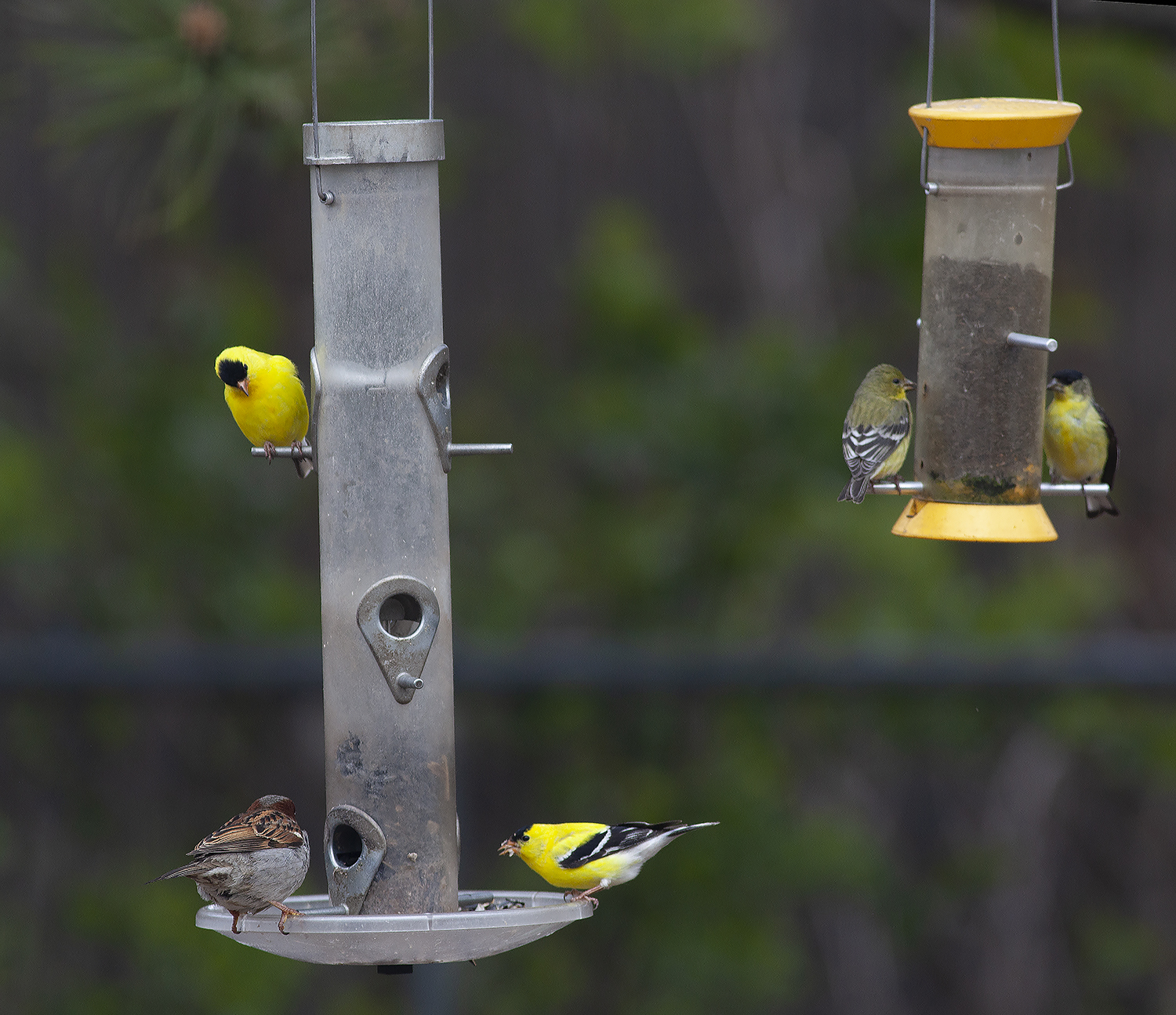
Three American goldfinches and a lesser goldfinch on feeders in May. Photo copyright 2018 by Chris Madson, all rights reserved.
The light was flat, and I hadn’t brought a binocular. I strained to pick out some signs of color and field marks. They were mostly sparrows: lark, chipping, white-crowned, clay-colored, vesper with a few horned larks, a goldfinch or two, and a scattering of what may have been siskins. One larger specimen perched on a fencepost to get a better look at me— a Say’s phoebe. As the dog and I continued across several hundred acres of open ground, the cover swarmed with this sudden invasion. “How many?” I wondered. No way of telling. An immense, unfathomable number.
As we turned for home, a larger shape streaked through a shelterbelt and swept close overhead— a sharp-shinned hawk with something small and feathered in one talon, the cheetah following the herd of wildebeest, feeding at will on the assembled throng.
It was a wave of the spring migration, broken for a day or two against the arctic front to settle in these empty fields. Ordinarily, these small migrants travel at night, navigating by the stars and the tiny electrical flux they generate as they cleave the magnetic field of the earth, landing at dawn and using the daylight to feed and rest for the next big push. When they found themselves bucking a fierce headwind, they dropped out of the sky into these neglected open places at the edge of town, guided by an instinctive aversion to burning energy needlessly. Freya and I were the only earthbound residents to mark their arrival.
As I watched the loose flocks rolling through the cover ahead of us, I wondered how many other waves had passed me by— unseen, unfelt. Insulated by cocoons of our own making, we miss all but the most overwhelming changes of the seasons. We’re moderately aware of the shift in weather; we may stop and listen to a chevron of geese on its way to nurseries beyond the reach of our imagination, but, mostly we’re simply unaware of the ebb and flow of living things that sweep over us. The tides of life.
It is this estrangement, I think, as much as our insatiable appetite for everything the planet offers, that has caused such harm. The populations of nearly every species I saw that morning have been declining for at least as long as counts have been made. Entire landscapes have been transformed, degraded, stripped of their native vegetation, restocked with alien pests of all sizes, descriptions, and capacity for mischief. If it’s true that we cannot love what we do not know, then it may be that we have set the stage for a massive pogrom. There may be no more evil act than to kill with indifference.
These are the thoughts the hard numbers inevitably bring. But, setting the data aside, there is a certain hope that comes with the wave. For all the difficulties they face, the birds still return, often in flocks so overwhelming they appear on radar and fill the fields we have left with bustle and cheer, vast waves sweeping up and down the continent, following traditions as old as life itself. As delicate as they seem, they are survivors, far travelers— tough, resilient, but ultimately dependent on the health of the land that supports them. Their future is ours.
I wonder when we’ll summon the wisdom to recognize that.
The wind stayed in the north all that day and most of the night. Sometime in the wee hours, it swung into the southwest and then the south. The next morning, Freya and I watched the sun rise in a flawless sky as we headed for the fields once again. The meadowlarks were in fine form, embroidering the morning with song. But the wave of migrants had gone, headed north again in the night.
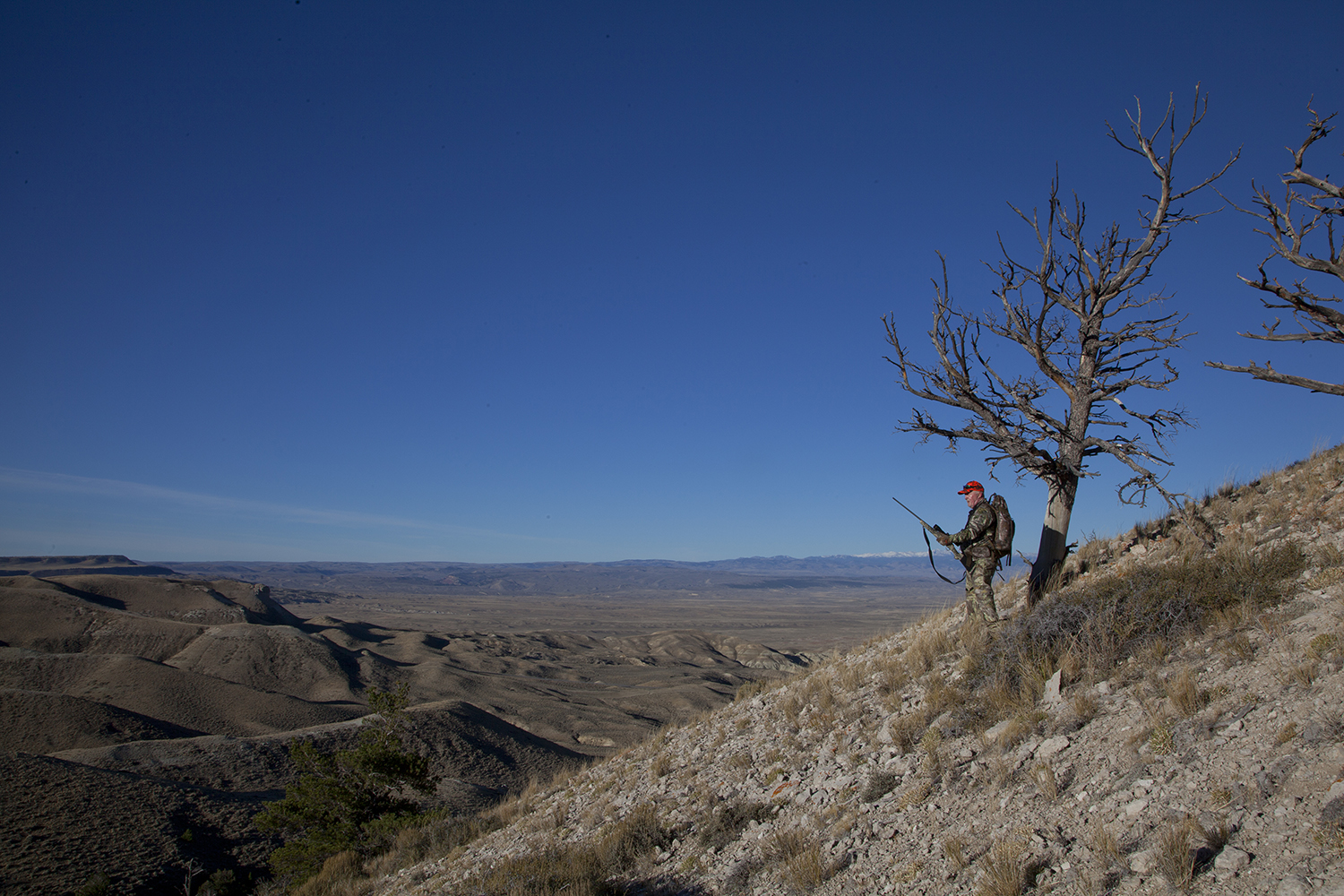
A mule deer hunter on Wyoming’s Beaver Rim. Copyright 2017, Chris Madson, all rights reserved.
I COME BACK TO IT AGAIN AND AGAIN:
“A thing is right when it tends toward the integrity, stability, and beauty of the biotic community. It is wrong when it tends otherwise”[i]— the ecologist and philosopher Aldo Leopold’s land ethic, set down in the summer of 1947, at the end of a long and illustrious career.
A graduate of Gifford Pinchot’s school of Forestry at Yale University in 1909, Leopold had started out as a disciple of the reigning commandment of the conservation movement of the time: the idea of wise use. The continent’s renewable natural resources existed for the benefit of man, the precept ran, but the sensible man would give those resources a chance to renew themselves. Wise use was sustainable use, the emphasis to fall equally on both words.
Yale’s version of this precept had grown from Pinchot’s experience with timber, and the training was intended to prepare America’s first generation of foresters to carry out the mission of the nascent U.S. Forest Service, the federal agency that was to oversee forest and grazing management on the system of national forests Pinchot and his good friend, Theodore Roosevelt, had established.
A hard point on an Iowa rooster. Copyright 2016, Chris Madson, all rights reserved.
Leopold took the Pinchot utilitarian view of resource management to his first assignment with the Forest Service in Arizona where he applied it, as many other conservationists did at the time, to wildlife management as well as forestry. In some of his earliest writings, he was an enthusiastic supporter of predator control as a tool for producing game.
“For some unfathomable reason, there appears to have been a kind of feeling of antagonism between men interested in game protection and between some individuals connected with the stock growing industry,” he wrote in 1915. “. . . It seems never to have occurred to anybody that the very opposite should be the case, and that the stockmen and the game protectionists are mutually and vitally interested in a common problem. This problem is the reduction of predatory animals.”[ii]
It was a point of view that served as common ground in his day-to-day contacts with local ranchers, but even as he wrote it, his professional understanding of wildlife management was already shifting, partly in response to the catastrophic decline of many wildlife species and partly because of his own evolving perceptions. That same year, he wrote a Forest Service plan for wildlife management that began: “The breeding stock must be increased. Rare species must be protected and restored. The value of game lies in its variety as well as its abundance.”[iii]
It was also in 1915 that he was ordered to review a growing problem on the south rim of Grand Canyon, then a national monument managed by the Forest Service. Twelve years before, Teddy Roosevelt had advised Arizonans:
“I hope you will not have a building of any kind . . . to mar the wonderful grandeur, the sublimity, the great loneliness and beauty of the Canyon. Leave it as it is. You cannot improve on it. . . . The ages have been at work on it, and man can only mar it.”[iv]
In the decade after that speech, the south rim of the Canyon had rapidly become a tourist ghetto with ramshackle hotels, fly-by-night tour companies, electric signs, cesspools, and garbage dumps.[v] Leopold braved the stiff opposition of the entrepreneurs who were responsible for this mess and filed a sixty-eight-page report that recommended major limits on development. “The public visits the Grand Canyon to enjoy a great spectacle of nature,” he wrote in the 1916 report. “At the same time the public needs and demands certain material services and conveniences. The latter are necessarily out of harmony with the surroundings, and it should be the first object of an efficient administration to reduce this necessary discord to a minimum.”[vi]
As he gained experience over the next twenty-five years, Leopold’s ideas on conservation of wildlife and wild land continued to evolve from the strictly utilitarian approach he’d been taught. He couldn’t ignore the problems he saw in American land management, and he began to give more and more weight to the “wise” in wise use.
In 1922, he championed an entirely new concept— federal wilderness— with the establishment of the Gila Wilderness in New Mexico’s Carson National Forest. With several other wildlife experts of the time, he was forced to confront the problems with too many deer on Arizona’s Kaibab Plateau, the result of a generation of intense predator control. It was an experience he carried with him as he moved to the University of Wisconsin and faced similar problems with the north country’s burgeoning deer herd. He toured the hyper-managed forests of Germany and came to the conclusion that managing timber like a vegetable garden was not good for wildlife or people.
He became a founding member of the Wilderness Society; he served as president of the Ecological Society of America, and as his understanding deepened, he began to regret some of the things he had thought and done when he was young and certain.
He remembered the brooding black presence of Escudilla Mountain in eastern Arizona, the home of the region’s last grizzly.
“No one ever saw the old bear,” he wrote in 1940, “but in the muddy springs about the base of the cliffs you saw his incredible tracks. Seeing them made the most hard-bitten cowboys aware of bear. Wherever they rode they saw the mountain, and when they saw the mountain they thought of bear.”
At the behest of local ranchers, the federal authorities brought in a trapper who, in due time, killed the bear.
The end of a long day in the elk timber, Wyoming. Copyright 2017, Chris Madson, all rights reserved.
“It was only after we pondered on these things,” he continued, “that we began to wonder who wrote the rules for progress. . . . Escudilla still hangs on the horizon, but when you see it you no longer think of bear. It’s only a mountain now.”[vii]
And he remembered helping shoot a wolf and her pup in his early days in Arizona.
“We reached the old wolf in time to watch a fierce green fire dying in her eyes. I was young then, and full of trigger-itch; I thought that because fewer wolves meant more deer, that no wolves would mean hunters’ paradise. But after seeing the green fire die, I sensed that neither the wolf nor the mountain agreed with such a view.”[viii]
Twenty years after it was published, Leopold’s A Sand County Almanac became the New Testament of environmentalism, more influential in its way than even Silent Spring. A generation of flower children desperately wanted to believe in Leopold, but before he could be canonized, there was a significant problem to be confronted: He was a hunter. An influential segment of the environmental movement found the idea of a person killing an animal for food, let alone pleasure, simply too repugnant to contemplate.
So they tweaked his biography.
A number of years ago, I was invited to speak at the University of Colorado in Boulder. I can’t remember who issued the invitation, but I said I’d be honored to come speak on the philosophical power of the land ethic. It must have been the allure of the subject that caught local attention— I’m not known as an orator— but whatever the reason, there were a lot of people there that night. Sizable room, pretty well stuffed with humanity.
I stole liberally from Leopold’s marvelous writings, and the speech seemed to be well received. After I finished, the moderator asked if there were any questions or comments from the audience. A young woman at the back of the room raised her hand.
“I think Leopold was one of the greatest environmentalists,” she said. “But it’s really, really important to remember that he quit hunting. All you have to do is read that part where he shoots the wolf, and you can see that, when he got older, there was no way he would kill something.”
All the faces in the audience turned back to me.
“We share a love of Leopold’s writing,” I replied. “In fact, it was Leopold’s writing that made me decide to do my graduate work at the University of Wisconsin-Madison. I studied right next to the glass cabinet where they kept one of the bows Leopold made. It hung over the original manuscripts of Sand County. I’ve read and reread just about everything that ever appeared under Leopold’s byline, along with some stuff that’s never been published. My advisor was Aldo Leopold’s last graduate student. And I have to tell you, my advisor hunted woodcock with Leopold six months before Aldo died. Leopold was a hunter. All his life. Big game, small game, upland birds, waterfowl, snipe. Archery, rifle, shotgun. I know this is hard to absorb, but Leopold the hunter, Leopold the ecologist, Leopold the philosopher— they were all the same man.”
She wouldn’t believe it.
It wasn’t the first time I’d run into the argument. Yes, it goes, Saint Aldo might have been a sinner in his younger, testosterone-soaked days, but anyone who reads his work can tell that he gave up hunting with all those other antiquated nineteenth-century ideas he’d picked up in the Roosevelt era. Only then could he be accepted as a true environmentalist.
There’s a problem in this that clearly reaches far beyond a distortion of history and a great man’s reputation. It touches on the image of hunting itself.
The end of a successful day in western Nebraska with the young lady who made it happen. Copyright 2019, Chris Madson, all rights reserved.
There’s no doubt that the behavior of some hunters, in our time and in Leopold’s, richly deserves censure. Leopold himself had a jaundiced view of many of the things he’d seen hunters do in the field. While much of his writing dealt with the broader issues of human attitudes toward the land, his essays occasionally focused on hunting as he too often saw it practiced. He had a problem with the proliferation of “an infinity of contraptions, all offered as aids to self-reliance, hardihood, woodcraft, or marksmanship, but too often functioning as substitutes for them.” He mourned what he saw as the passing of the “go-light idea, the one-bullet tradition.”[ix]
But there’s also no doubt that hunting was a central part of his life from the time he was old enough to join his dad in the bottomlands of the upper Mississippi to the day the heart attack claimed him as he was fighting a neighbor’s grass fire in 1948. It was much more than recreation for him; it was a way of seeing; it was a way of understanding the natural world.
In one of his later essays, he described a lane he’d cut through the cover behind the little cabin he called “The Shack.” He called it the “deer swath,” and he used it as a way of keeping track of the deer that were trading back and forth between his property and the river. He pointed it out to a number of visitors and watched their subsequent notice of it. Always the scientist, he classified their reactions.
“Most of them forgot it quickly, while others watched it, as I did, whenever chance allowed. The upshot was the realization that . . . the deer hunter habitually watches the next bend; the duck hunter watches the skyline; the bird hunter watches the dog; the nonhunter does not watch.”[x]
In another essay, he wrote: “The true hunter is merely a noncreative artist. Who painted the first picture on a bone in the caves of France? A hunter. Who alone in our modern life so thrills to the sight of living beauty that he will endure hunger and thirst and cold to feed his eyes upon it? The hunter. . . . Critics write and hunters outwit their game primarily for one and the same reason— to reduce that beauty to possession. The differences are largely matters of degree, consciousness, or that sly arbiter of the classification of human activities, language. If, then, we can live without goose music, we may as well do away with stars, or sunsets, or Iliads. But the point is that we would be fools to do away with any of them.”[xi]
And in the actual almanac of A Sand County Almanac, Leopold filled the entire month of October with recollections of hunting. “I sometimes think that the other months were constituted mainly as a fitting interlude between Octobers,” he concludes, “and I suspect that dogs, and perhaps grouse, share the same view.”[xii]
There are many people of good heart and intention in the environmental community who struggle to understand how an intellect as incisive as Leopold’s could possibly reconcile his lifelong commitment to wildlife and wild land with his lifelong passion for the hunt. I don’t find that struggle surprising. My dad once said that trying to explain hunting to a nonhunter was like trying to explain sex to a eunuch— there was simply no common experience, in his view, to serve as a starting point. If any message could bridge that gulf, it was Aldo Leopold’s.
He understood hunting at the emotional level of a participant, at the scientific level of an ecologist, and at the ethical level of a philosopher. It was an almost unique combination, one that contains a critical lesson for anyone who aspires to follow in his footsteps. His admonition to humanity as a whole holds special significance for those of us who hunt: “When we see land as a community to which we belong, we may begin to use it with love and respect.”[xiii]
Amen.
[i] pp.224-225, Leopold, Aldo, 1949. A Sand County Almanac and Sketches Here and There. Oxford University Press, New York, NY.
[ii] p. 47. Flader, Susan and J. Baird Caledcott, 1991. The River of the Mother of God and Other Essays by Aldo Leopold. University of Wisconsin Press, Madison, WI.
[iii] P.146. Meine, Curt, 1988. Aldo Leopold, His Life and Work. University of Wisconsin Press, Madison, WI.
Upland bird cover at sunset in western Nebraska. Copyright 2018, Chris Madson, all rights reserved.
WE CLOSED THE SEASON YESTERDAY, FREYA THE BRITTANY AND I, PASSING THE LAST HOURS IN A LONG WALK OVER THE HILL TO A PLACE I CALL “THE SECRET SPOT” because the best cover is out of sight from the road. We were both limping a bit, Freya because of the screw in her right elbow that holds the end of her humerus together but still gives her some arthritis, and I because an unexpected encounter with a badger hole a few miles back had given one of my aging knees a wrench.
Considering our condition, the prudent thing would have been to call it a day, but this was the last day, and I think it was fair to say that neither of us was willing give up the final hours. I knew it would be almost nine months before we passed this way again. Freya is probably not burdened with such foresight— the chase is simply her reason for being, the white-hot flame that flares in her eyes as she catches the scent and burns there when she points. So we went on to the bitter end.
Which brought us here, to the first day of February, with the northwest wind rattling the windows and threatening snow, bereft. Freya is curled up tightly in her favorite spot, recovering from the last hard week, her eyes following me as I walk in and out of the room, expecting another ride to the country. The vest is hanging in the closet; the boots are in the corner, their seams frayed, their toes polished black by the endless miles of prairie grass, thistle stems, and crop stubble, down at the heel, soles worn smooth. I have chores that have been too long postponed, but for this day at least, I’d rather look back over the last three months and consider what it was I found there.
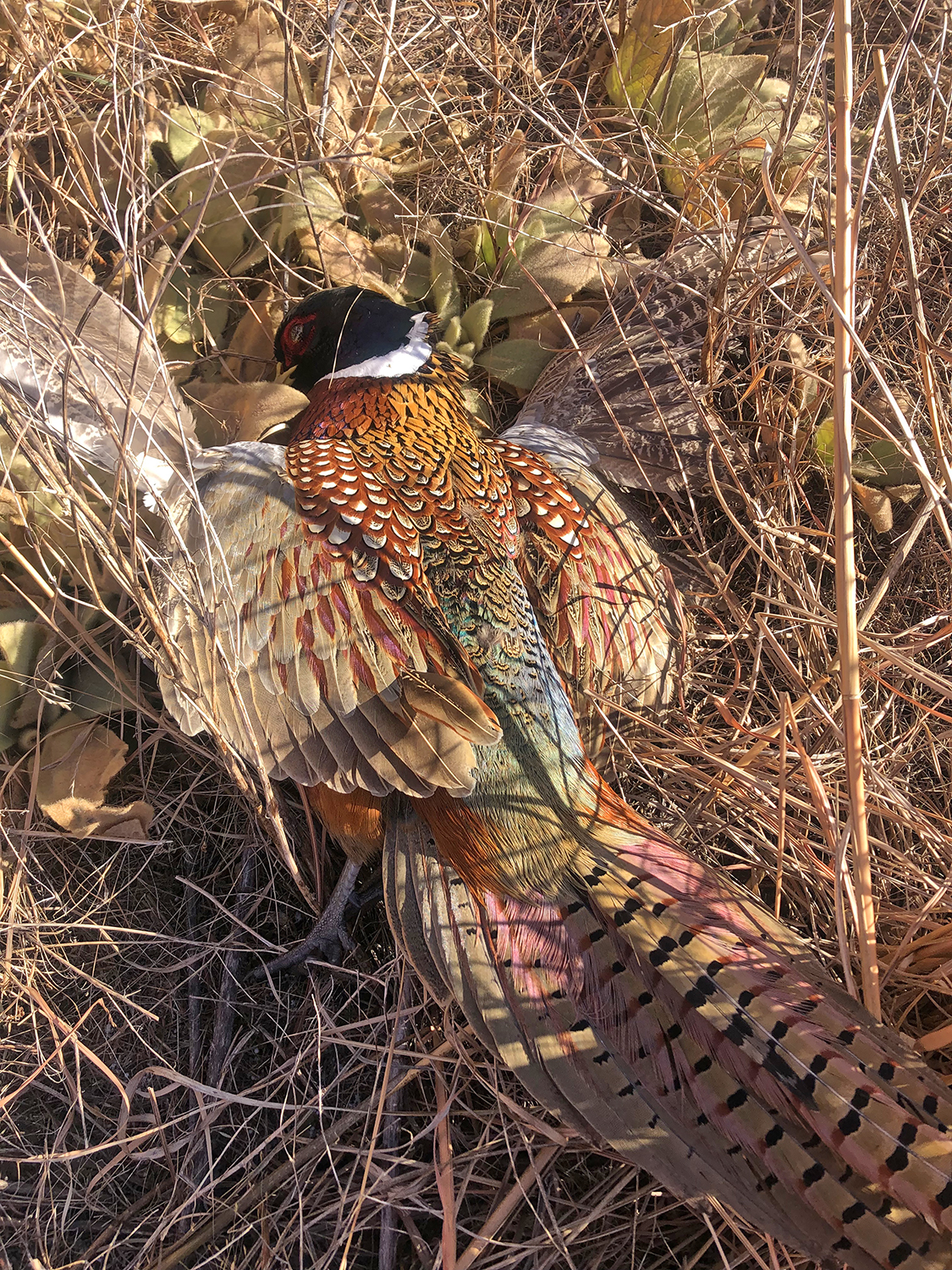
A Nebraska pheasant after the shot. Photo copyright 2019, Chris Madson, all rights reserved.
There were birds, of course: neon rooster pheasants rising with a shower of frost in the first morning sun, coveys of bobwhite quail exploding underfoot, flocks of prairie chickens and sharptails beckoning on the horizon. We hunters speak of such moments in shorthand, stringing them together like jewels on a necklace, even though we all know how rare and fleeting they are.
My overarching memory of the season is far less tangible. It is a feeling of sky and wind on my face; bright sun and snow squalls; cold that penetrated to the skin like an ice pick; sudden, unexpected warmth in the shelter of a cutbank; a short-eared owl floating over the grass; a prairie falcon streaking low over the cover like an arrow from the bow; a guild of tree sparrows and juncos picking seeds in a patch of kochia; crystals of frost clinging to the grass like diamonds in the dawn; a string of mule deer disappearing over the far ridge; the buck standing up, thirty yards away, in a stand of switchgrass; the color of little bluestem in the last five minutes of the day; a skein of snow geese almost invisible against the cirrus, their tenor traveling chorus floating down out of heaven like an anthem. The fuzzy leaves of mullen flat to the ground, green in the depths of winter. The graceful curve of an empty milkweed pod. The drag of the heavy cover on my feet at the end of ten straight hours in the field. Knees that don’t want to lift for the next step.
Such is the content of the hours and hours spent for the second of the shot. When I was young, I wanted one without the other. When the shooting was slow, I was irritated. Little by little, I learned what I was told was patience— distracting myself with thoughts of appointments, commitments, deadlines until the dog caught scent or I heard the slap of a primary on the grass behind me. I’m not sure that approach improved my wing shooting, but I suppose it lowered my blood pressure.
As the miles and the years have passed, I’ve settled into something altogether different. When I’m in the field, a thought will occasionally roll through my head, but mostly, I’m just there, behind the dog, in the moment. If I had to pick one word to describe the mental state, it would be meditation. The occasional points, the shots, the birds in the bag are a critical part of the whole—they supply the motivation for the day and test particular skills in hunter and dog.
But they aren’t the only part.
After sixty years in the field, it seems that what I hunt is not only a bird, not only a day, but a frame of mind. Maybe even a state of grace. I can’t tell where the importance of one stops and another starts. But I think it’s why I keep coming back.
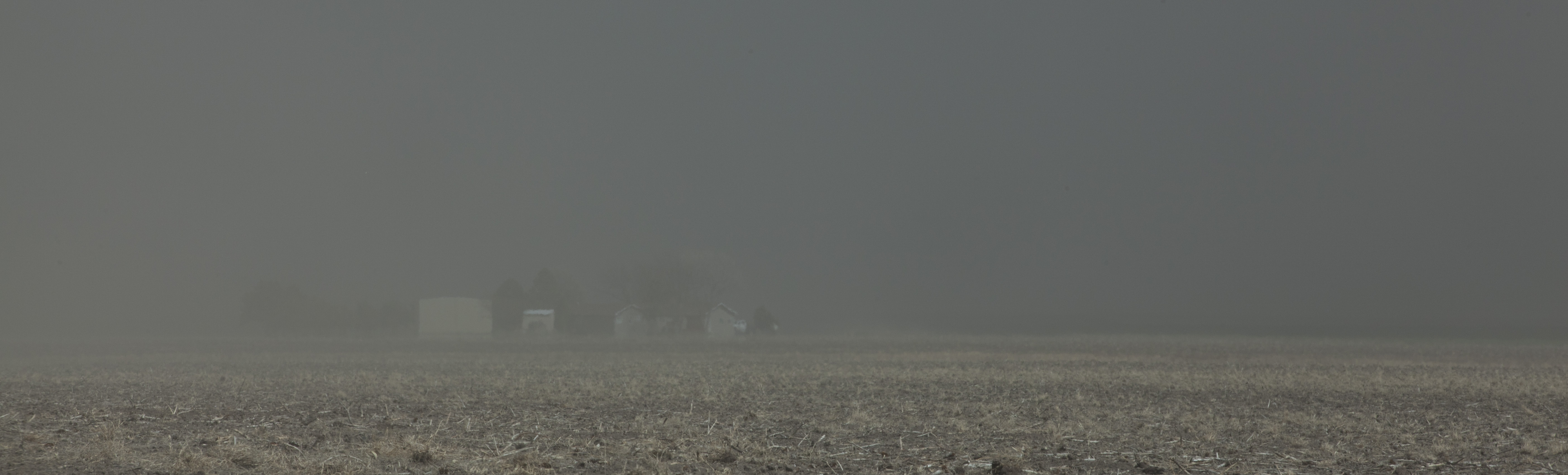
The dust storms of the Dirty Thirties are returning to the high plains of America’s heartland. This storm ripped across eastern Colorado and northwestern Kansas in March of 2014. Photo copyright 2014, Chris Madson, all rights reserved.
AS THE DISCUSSION OVER CLIMATE CHANGE— OR DEBATE OR DONNYBROOK, HOWEVER YOU PREFER TO THINK OF IT— CONTINUES, I THINK IT’S appropriate to pause at the beginning of the new year and consider the adventures in weather we’ve enjoyed across the United States over the previous twelve months. For those of us who have ducked the nastiest the atmosphere has generated, it’s easy to forget the storms, fires, and droughts that caused significant inconvenience across the country. So, in the interest of recalling some of the nation’s most spectacular events, here’s a quick review of 2019 in weather:
Things started off in late February with a strong Arctic cold front that dropped more than a foot of snow on parts of Iowa, Minnesota, and Wisconsin, driven by winds of nearly sixty miles an hour.[i] As the blizzard moved east, the wind intensified, reaching gust of nearly seventy miles an hour in Massachusetts, New York,[ii] and southern Ontario[iii]. Farther south, the
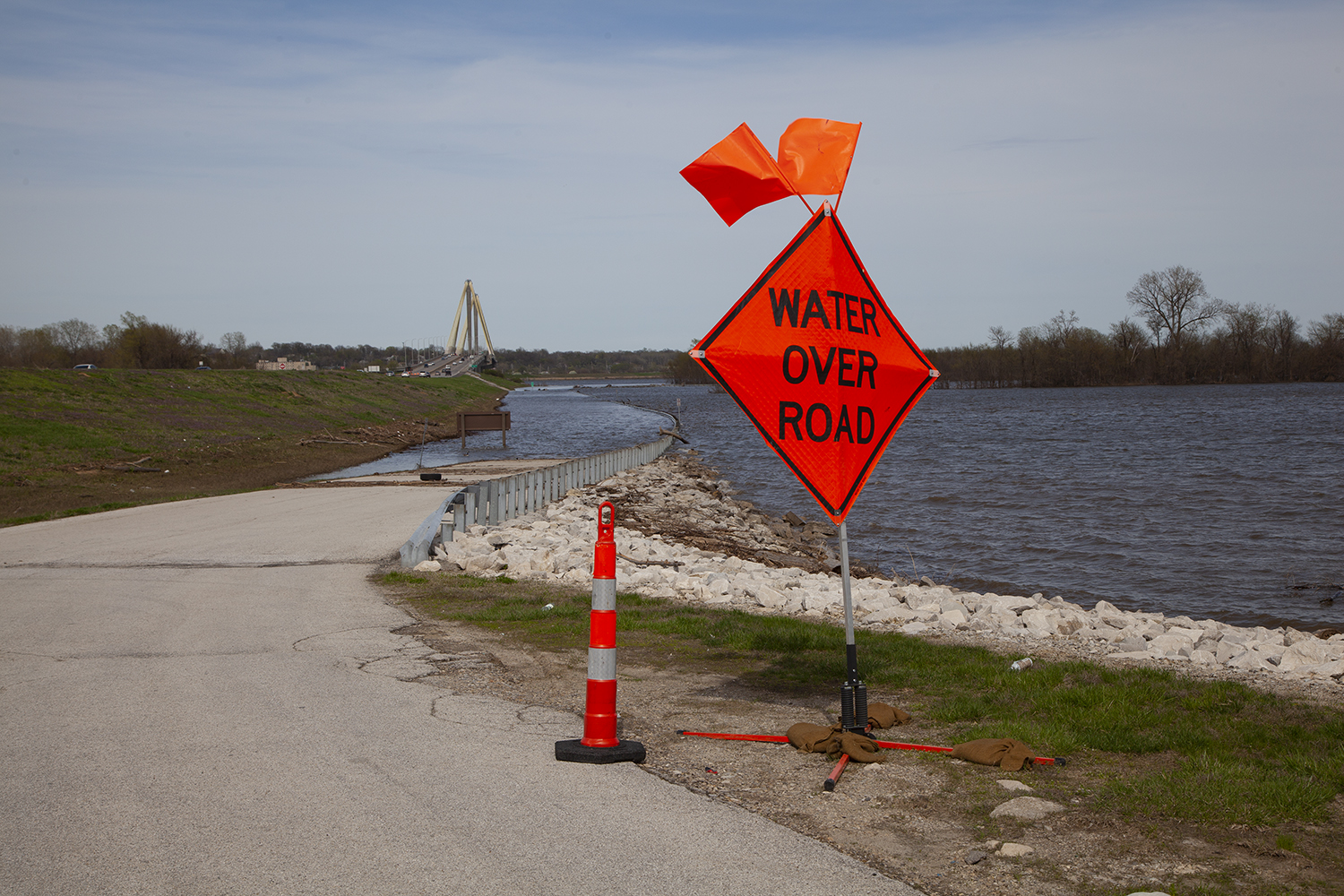
Flood water on the upper Mississippi River near Alton, Illinois. Photo copyright 2019, Chris Madson, all rights reserved.
system brought nearly a foot of rain to the Tennessee valley, causing extensive flooding.[iv] On the night of February 23, the front triggered several tornados, including an EF3 twister that leveled much of the business district in Columbus, Mississippi, and killed one person. Altogether, the storm caused an estimated $1.3 billion in damage and claimed two lives.[v]
On March 14, a strong storm system rolled into the northern plains. With much of the region still in the grip of winter, the heavy rain caused rapid snow melt, all of which ran off still-frozen ground. Nebraska and western Iowa took the brunt of the flooding, but there was significant damage from eastern North Dakota to Missouri as well as Wisconsin and Michigan. The early runoff set the stage for flooding farther down the Mississippi watershed. Estimates of damage ran to $10.8 billion. Three people lost their lives.[vi]
Meanwhile, on the southern plains, severe hail storms from March 22 to March 24 pummeled Oklahoma City, Dallas, and surrounding farmland. People who have not seen a hail storm on the Great Plains would be shocked at the devastation one can inflict. Damage was estimated at $1.6 billion.
A cold front on April 13 and 14 swept through the Southeast, spawning more than fifty tornados across central Mississippi and Alabama and another twenty-five from Georgia to Pennsylvania. High wind and hail also caused damage in several areas. After the front had passed, damage was estimated at $1.3 billion. Seven lives were lost.[vii]
Again on May 16 through 18, a strong cold front caused severe thunderstorms across Illinois, Indiana, Iowa, and Texas. Another $1.0 billion in damage.
Yet another storm front swept across the Great Plains and on to Ohio, Pennsylvania, and New Jersey from May 26-29. The front spawned 190 tornados, damaging hail, and high winds. Salient among the tornados was an EF3 twister that touched down near Dayton, Ohio, killing one person. Damage estimate: $4.5 billon. Three persons killed.
This succession of storm fronts also led to major flooding in the Arkansas River watershed, from eastern Oklahoma to Little Rock, Arkansas. Officials estimated $3.0 billion dollars in damage and attributed five deaths to the high water.
The flooding that began at the end of winter in the upper Midwest continued through the end of July in many parts of Oklahoma, Kansas, Nebraska, Missouri, Illinois, Arkansas, Kentucky, Tennessee, Texas, Mississippi, and Louisiana as well as parts of Indiana and Ohio. The cumulative damage done to industry and agriculture by these floods is estimated at $6.2 billion. Four deaths were blamed on the high water.[viii]
On July 4 and 5, storms with hail up to one inch in diameter went through the Denver metro area. Damage was estimated at $1.0 billion.
Then came the hurricane season. By the standard of 2018, it was relatively mild, but in late August, Dorian came ashore in North Carolina, causing $1.6 billion in damage and killing ten people. On September 17, Tropical Storm Imelda brought almost three feet of rain to the Houston area, causing another $5.0 billion in damage and claiming five more lives.[ix]
On October 20, a nasty low-pressure system rolled over Dallas, then continued to Oklahoma, Missouri, Arkansas, Louisiana, and Tennessee. Estimate of damage: $1.7 billion. Two people killed.[x]
Out in California, the drought that was largely responsible for the catastrophic fires season of 2018 finally broke. The moisture
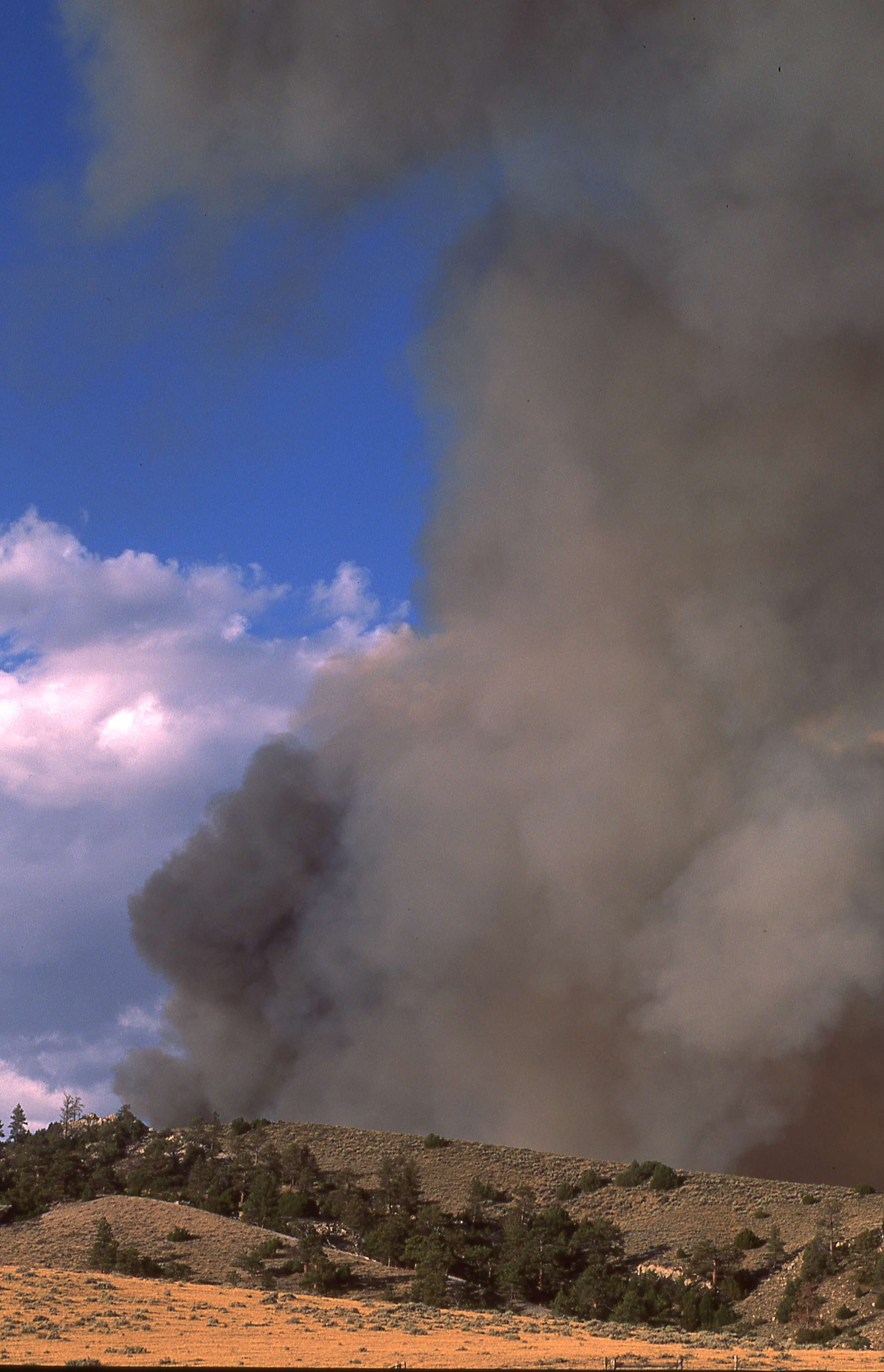
Rising temperatures and deepening drought set the stage for wildfires across much of the West. This fire burns near Casper, Wyoming. Photo copyright 2012, Chris Madson, all rights reserved.
during the winter and early spring allowed much of the vegetation in the state to recover, which, in turn, provided exceptional fuel for yet another round of wildfires. State officials estimated that almost 8,000 fires consumed nearly 260,000 acres in 2019, destroying more than 700 buildings and killing three people.[xi] Pacific Gas and Electric, the utility whose power lines were found to be responsible for several of the most damaging fires in 2018, took the precaution of turning off electricity to as many as 2.7 million people[xii] when high wind threatened to bring down more electrical lines in 2019. The resulting losses of power were said to be responsible for more than $2 billion in additional economic loss.[xiii]
While it rained— and rained— in America’s heartland, southeastern Alaska found itself in the grip of a major dry spell, beginning in July 0f 2018 and continuing through much of 2019.[xiv] The city of Juneau set all-time records for high temperatures, and, farther north, the ice pack along the melted early as temperatures in the Arctic Ocean were as much as nine degrees above average.[xv]
The heat and drought created ideal conditions for wild fires. By late summer, more than 2.5 million acres had burned, less than the 2004 record of 6.5 million acres but still worrisome. According to Scott Rupp, deputy director of the International Arctic Research Center in Fairbanks, “What has been changing is the frequency and the magnitude of these fires.”[xvi]
The combination of the fires in California and Alaska did an estimated $4.5 billion in damage and claimed the lives of three people.[xvii]
These are 2019’s biggest weather events: $45 billion in damage and forty-four people dead. Compared to 2018, we got off easy. As you may recall, there were three killer hurricanes in 2018, along with drought and fires and hail. Severe weather alone caused $223 billion in 2018 and took something like 282 lives. Still, even a quiet year like 2019 gets my attention. Forty-five billion here, 45 billion there— pretty soon, you’re talking serious money.
No one knows what 2020 will bring, but the people who have studied climate most carefully say the chances are that it will be worse. It’s impossible to say whether any or all of these events were caused by the increasing amount of heat in the atmosphere, impossible to know if they were just made worse. But these events, their severity and impact, are perfectly consistent with the predictions that several independent groups of researchers have made. In fact, there’s growing reason to believe that the predictions made by the International Panel on Climate Change and other reputable research groups have been unduly conservative, which is to say that things in the real world are getting worse faster than many scientists had predicted.
This year, next year, the year after that, we’ll set new records for high temperatures, new records for intense rainfall, for tornados, hurricanes, flooding, wild fires, even for paralyzing blizzards. The cost in damage and lost lives is the price we pay just to “adapt” to a changing climate. That cost will increase at an alarming rate over coming decades because “adapting” to the changing climate does nothing to stop the root cause— more and more energy trapped in the atmosphere, the oceans, and the land mass of the planet Earth by greenhouse gases. It’s like treating a serious infection with a damp washcloth and an aspirin— it may ease the suffering for a while, but it’s no substitute for an antibiotic.
In the year 2020, we’ll have no choice but to cope with the symptoms of climate change. But that won’t cure the disease.
Flick doing what he did best, on an Iowa rooster. (Photo by Chris Madson, copyright 2019).
This afternoon, Flick joined his predecessors on the other side. The spirit was willing, but his hips finally gave out. As I mourn his passing, I remember the companions who came before him. They were far better at being dogs than I am at being a person. I miss them . . .
IT’S MADE OF BRASS, ABOUT THE DIAMETER OF A SILVER DOLLAR WITH A NYLON STRAP LOOPED THROUGH THE TOP SO IT CAN BE STRUNG ON A COLLAR. It has no markings, but the catalog house that sold it to me, many years ago, said it came from England— certainly, it has that English look and feel, an exquisite bit of craftsmanship from another time that combines simplicity, elegance, and dependability to do a job that is largely irrelevant in the modern age. It has a bright, clear tenor voice, not loud but surprisingly penetrating, even on a day when the first cold front of November is hurrying across the prairie, tousling the bluestem as it passes.
I must have bought it around 1987. I was starting Britt at the time. He was the most talented bird dog I’ve ever owned, and he was just starting to show his worth when we encountered the Conservation Reserve Program. We were used to working fencelines and shelterbelts, long strips of cover Britt could hunt from the outside. When he went on point, he was nearly always out in the stubble where I could see him. The bird might not hold, but there was at least no problem finding the dog.
The first CRP field we hunted was a full section of switchgrass just reaching maturity. Some of the seed heads were eight feet off the ground; the vegetation below was almost impenetrable. We both saw the potential and dived into the jungle with high expectations. I saw Britt’s wake for the first fifty yards, then the grass was still. I stopped to listen for him. Not a whisper. I figured he was within sixty yards of me, almost certainly pointing a pheasant, and there was no way I was going to call him off that point.
I started a spiral search pattern, and in about five minutes, I found him, still holding, but with the relaxed tail that told me the scent had gone cold. The rooster had quietly departed for other hiding places.
By the time that field had finished with us, I could see that Britt and I needed some way of keeping track of each other if we intended to hunt any more CRP. The first generation of beeper collars had just been invented, but fresh out of college, I didn’t have the money to buy one, and I didn’t really want one anyway— that infernal beeping felt a little like spray-painting graffiti on the Mona Lisa. So I bought the bell.
We went back to that section of CRP on a clear, quiet morning with the temperature hovering around five. The frost lay like snow on the grass— I figured Britt would be able to smell a rooster from a quarter-mile away. He skirted the edge of the heavy grass for a hundred yards before a plume of scent lured him into the cover, and listened as the bell traced his progress, out and across the lee of a low rise. Then, suddenly, nothing, a hole in the air where the clear tink-tink had been. I headed toward the last place I had heard the sound, holding the shotgun high enough to keep the grass stems out of my eyes.
I almost stumbled over him, head high, stub tail at full attention, taut as a violin string. One more step and the rooster came straight up, clawing into the blue sky with a clatter and a squawk, his flanks like molten copper in the first light.
Taken by surprise, as I nearly always am when a rooster flushes, I missed with the first barrel but managed to catch him with the second. Britt disappeared into the switch, the bell marking his progress, farther away, farther, then a pause, closer, closer still, and suddenly, two amber eyes out of the wall of grass— Britt with the bird.
OVER THE NEXT TEN YEARS, the two of us spent a lot of time in this strange, one-way telecommunication, Britt transmitting out of sight while I tried to interpret the message. I could tell a lot by the sound of the bell. There was a steady cadence with a syncopated flourish when he was quartering, looking for scent. When something caught his attention, the cadence broke, and the irregular notes of the bell signaled every move of his head. There was a Doppler change in the tone as he worked— higher as he came back toward me, lower as he went away. Early in his career, he was fond of pointing meadow voles, and I could often tell by the bell that his tail was wagging as he pointed, a sign that he was mousing. And now and then, that hole in the air, the sudden silence— a rooster, a covey, a band of chukars, a ruffed grouse, a blue, a bomber. We hunted them all, Britt following his unerring nose while I followed the bell.
One evening, the friend who had told me about Britt’s litter called me about another litter in the same line, so on the way to a quail hunt in the Flint Hills, I stopped to look the pups over. That was how little Meg came to our house.
Flick in the tall stuff with a bird holding tight. Wrong move for the pheasant . . . (Photo by Chris Madson, copyright 2019).
Britt tolerated her, and she paid him the respect due to his age and experience. They hunted together for two seasons before she inherited the bell. She might not have had the talent of her great uncle, but she was still a better bird dog than I deserve. I remember her pointing a pheasant on the slope of one of those huge prairie swales that break up the high plains, staunch in the wine-colored little bluestem as my partner walked in. The rooster flushed wild, and the shot rocked him but didn’t break a wing. We watched and Meg watched as the bird flapped and glided, flapped and glided down the long slope, across the creek bed, and up the other side, almost to the horizon before he sat down.
My eyes dropped back to another movement, Meg crossing the creek bed on line. She trotted up the long slope on the far side, a tiny white speck by this time, paused on the hilltop, then turned back toward us. As she crossed the creek bed, I could see she was carrying something. She disappeared in the grass on our side, and a long minute passed before I heard the bell approaching. She walked up to me with the bird in her mouth. I took it and scratched her ear. Good dog; good dog.
The two of us chased many birds across many states to places I don’t think I would ever have seen on my own: the pocket just under the rim of Tatman Mountain in northern Wyoming where a tiny spring waters a lush stand of wild rye and a perennial covey of Huns and you can see for fifty miles. The terrace in Iowa where there is always a rooster and Meg once pointed the biggest whitetail buck I’ve ever seen, caught napping in the switchgrass. The prairie slope out over the Missouri River in North Dakota with its sharptails, the buffaloberries scarlet on the hillside and the hawthorn fruit fuschia against the gray branches in the draw.
The moments fade in the telling, like picked wildflowers, but in my head they are forever bright against the background of the autumns we shared, the collection of days stitched together by the play of light and shadow on the grass, the sigh of the wind, and the tinkling of a small bell.
NOT LONG AFTER MEG PASSED HER FOURTEENTH BIRTHDAY, a friend invited us to hunt his farm in western Iowa. The farm reflects Tom’s commitment to conservation— terraces, grassy waterways, and buffer strips to keep the topsoil in place; blocks of conservation reserve to rebuild topsoil where it’s been lost; and wetland reserve to purify the runoff. That kind of management produces pheasants even when the surrounding farms have been scalped for profit.
Meg was still good for two hours in the morning, and while her pace had slowed, her enthusiasm for the game was as bright as ever. On the morning of the fifth day, I was packing to leave, one bird short of Iowa’s possession limit. Always the gracious host, Tom told me to stop and check one last hillside on my way to the interstate, so I headed south, Meg riding shotgun in the pickup, marking every meadowlark as it flushed off the side of the road.
The CRP Tom has recommended was a perfect corner for pheasants— bluestem and switchgrass with a mix of broad-leafed plants just below a harvested cornfield. I Unbuckled Meg’s collar and slipped on the bell before I lifted her out of the truck, then grabbed the Model 12 and followed her down the fencerow. She disappeared into the grass, and I waited, listening to the bell as it made its invisible way down the slope. A hundred yards from the truck, it stopped.
I walked that way and found her just a couple of yards into the heavy cover, rock solid. As I passed her ear, two roosters exploded out of the grass. I picked the left bird and crumpled it. Meg Disappeared. Then, I saw her coming back through the short brome of the field edge, tail and head up, with the rooster in her mouth, the light of the December morning warm on them both. A fine way to end a hunt, I thought, and a season.
At the time, I couldn’t know that it was also the end of a career. That Iowa rooster was Meg’s last bird.
The last day of the Nebraska pheasant season. Three birds from three perfect points. (Photo by Chris Madson, copyright 2019).
AND SO THE BELL PASSED TO FLICK. He’s eighteen months old now, with two seasons under his belt, a passion for rabbits, and a talent for birds. He’s presided over the demise of about fifty pheasants already, and just last week, I had a chance to introduce him to some Kansas bobwhite. He didn’t know what to make of the first covey, but he quickly filed the scent under the general heading of “game,” trotted down the edge of the milo field to a thicket of sand plum and pointed a single. Which I promptly missed.
As I strolled along behind my new companion toward the next covert, it occurred to me that a bird hunter measures his life in dogs. With luck, I may have one more after Flick. Or he may be the last. Such thoughts can lead out into areas of metaphysics and theology I’m not qualified to navigate. Is there another world beyond the pale? I’m sure I don’t know. But I find it hard to imagine a place much better than the one we were all born to, this small blue planet where life has gathered against all the odds.
I’m not anxious to leave. If I were given a choice between crossing over into an unknown paradise or melting back into the ground of this one, I think I’d just as soon stay. Still, there is the possibility that, when the time comes, the fields on the other side will be drenched in the morning sun of November with the scent of fall on the breeze . . . and the sound of a small brass bell, fading toward the horizon.
And, if that’s the call, I just might have to follow.
AS I’VE RUN OUT MY STRING OF YEARS, I’VE DEVELOPED A DEEPENING APPRECIATION FOR THE effortsof the people who fought the fight for the land long before we did. There’s an epigram that’s made the rounds for years. It’s been attributed to Mark Twain, although no one seems to be able to find it in his writing. Chances are good that it was synthesized by that famous writer, Anonymous, and like many things of his, it has a certain weight. “History may not repeat itself,” the saying goes, “but it rhymes.”
I’d like to consider a few of those rhymes, contained in the work of three men in our now-distant past, largely neglected today, who advocated the conservation of renewable resources like soil, water, wildlife, and wild land before the need for conservation was recognized by America at large. They were ahead of their time, which is, all too often, an uncomfortable place to be.
So, the text of this sermon comes from a source I seldom cite: the King James version of the Bible, specifically, the prophet Isaiah, chapter 40, verses 3 and 6:
“The voice of him that crieth in the wilderness . . . And he said, What shall I cry? All flesh is grass, and all the goodliness thereof is as the flower of the field.”
I am, perhaps, to be forgiven if this biblical passage has stuck in the back of my mind over the course of a career that has spanned more than forty years. Back there in the early 1970s, when my cohort of wildlife people were finishing graduate school, it seemed that the nation was poised on the verge of a wholehearted commitment to the precept of wise use. The Clean Water Act with its migratory bird rule, LWCF, the Wilderness Act, NEPA, wild and scenic rivers, ESA, the Fish and Wildlife Coordination Act, ANILCA, the return of CRP under the 1985 Farm Bill, Sodbuster, Swampbuster, NAWMP, NAWCA— Americans were unanimous in their support of conservation of wildlife, both game and nongame, along with a sensible approach to the management of renewable natural resources.
Or so it seemed. As the last forty years have proven, the apparent consensus on conservation and the environment was far, far more fragile than my generation in the profession thought. We’ve watched as the political and financial support for conservation has waned, as traditional coalitions have dissolved, as former allies have declared holy wars against one another, and as special interests have exploited the disarray to begin the job of dismantling the regulatory framework that defined conservation in the twentieth century.
The wildlife profession has been engaged in a fighting retreat for a generation, and the advocates of enlightened conservation find themselves isolated, with little political leverage, our recommendations and objections like “the voice of him that crieth in the wilderness.”
In such times, I think it’s comforting— and often instructive— to look back over our shoulders and attend to other voices, raised in other times, who also cried out in a wilderness of indifference.
Voices like George Catlin’s.
—————–
CATLIN was crazy. Scion of a middle-class Pennsylvania family, he trained as an attorney, following in his father’s footsteps, and spent two or three years comfortably practicing law before he sold all his law books to buy paint and canvas. With no formal training, he set out to support himself as a portrait painter in Philadelphia. He was far from a brilliant artist, but he managed to make ends meet for several years, and if that was as far as his ambition had taken him, he would have faded into obscurity.
George Catlin in 1849 by William Fisk.
Then, one summer afternoon, a delegation of Winnebagos passed through Philadelphia on their way from Wisconsin to the Great White Father’s house in Washington, D.C., to complain about illicit lead miners on their land. Catlin was transfixed by their costume and bearing. As he told it, he made up his mind on the spot: “The history and customs of such a people, preserved by pictorial illustrations, are themes worthy of the life-time of one man, and nothing short of the loss of my life, shall prevent me from visiting their country, and of becoming their historian.”[i]
Friends and family tried to reason with him. “I broke from them all— from my wife and my aged parents,” he wrote, and “with these views firmly fixed— armed, equipped, and supplied, I started out in the year 1830 and penetrated the vast and pathless wilds of the great ‘Far West’ with a light heart.”[ii] He would be gone for eight years.
In St. Louis, he managed to hitch a ride with William Clark, then the Indian commissioner for the region, as Clark traveled up the Mississippi for a council with several tribes at Prairie du Chien. Along the way, Catlin met a dozen of the tribes gathered along the upper reaches of the river and got his first taste of what was then the American frontier.
Back in St. Louis, he began looking for ways to get farther west and was lucky enough to find a new form of transportation. He booked passage on the steamboat Yellowstone, bound for the mouth of the Yellowstone River on the upper Missouri, where he found what he’d been looking for:
“. . . the interminable and boundless ocean of grass-covered hills and valleys . . . where the bison range, the elk, the mountain-sheep, and the fleet-bounding antelope— where the magpie and chattering paroquettes supply the place of the red-breast and the blue-bird— where wolves are white and bears grizzly— where pheasants are hens of the prairie, and frogs have horns!”[iii]
He spent time with the Crow, the Mandan, the Sioux, the Iowa, the Konza, the Pawnee, and then, down along the Arkansas River, with the Osage, the Cherokee, the Comanche, and back north into Minnesota, with the Chippewa, the Menominee, the Winnebagos, the Sac and Fox— fifty tribes according to one count. By the time he returned to the East, he’d seen most of the Great Plains, and somewhere in his travels, he’d come up with a big idea.
“This strip of country, which extends from the province of Mexico to lake Winnepeg on the North, is almost one entire plain of grass. . . . It is here, and here chiefly, that the buffaloes dwell; and with, and hovering about them, live and flourish the tribes of Indians, whom God made for the enjoyment of that fair land and its luxuries.
“It is a melancholy contemplation for one who has traveled as I have, through these realms, and seen this noble animal in all its pride and glory, to contemplate it so rapidly wasting from the world, drawing the irresistible conclusion too, which one must do, that its species is soon to extinguished, and with it the peace and happiness (if not the actual existence) of the tribes of Indians who are joint tenants with them, in the occupancy of these vast and idle plains.
“And what a splendid contemplation too, when one imagines them as they might in future be seen, (by some protecting policy of government) preserved in their pristine beauty and wildness, in a magnificent park, where the world could see for ages to come, the native Indian in his classic attire, galloping his wild horse, with sinewy bow, and shield and lance, amid the fleeting herds of elks and bison. What a beautiful and thrilling specimen for America to preserve and hold up to the view of her refined citizens and the world, in future ages! A nation’s Park, containing man and beast, in all the wild and freshness of their nature’s beauty!
“I would ask no other monument to my memory, nor any other enrolment of my name among the famous dead, than the reputation of having been the founder of such an institution.”[iv]
It had been the reason he’d set out, and the things he’s seen over the thousands of miles, back and forth across the Great Plains, had only deepened his conviction that this unique North American wilderness should be somehow preserved. All that was left was to use his art to convince the rest of the nation. He spent most of the rest of his life in that attempt, touring the United States with the paintings and artifacts in what he called his “Indian gallery.” The admission price wasn’t enough to support him, so he appealed to Congress, asking them to buy the collection. Congress declined.
Short of funds, he packed up the gallery and headed to Europe where the exhibition generated a reasonable amount of money but not enough to keep him clear of debt. Back in the states, he sold the collection to an industrialist, then began reproducing many of the paintings from memory to support his family. Hungry for the wilderness of his youth, he made extensive trips to Central and South America along with another trip back to the American West.
He died in Jersey City, New Jersey, in the winter of 1872 in the knowledge that his worst predictions concerning the native peoples and wildlife of the Great Plains were rapidly coming true. It would be another seven years before the collection of his art and tribal artifacts were finally donated to the Smithsonian Institution. But just before he died, in the spring of 1872, the nation granted his greatest wish— a “magnificent park,” forerunner of a revolutionary “protecting policy of government” that would set the standard for the world.
—————
WHILE Catlin was crisscrossing the wilderness of the Great Plains, another man of his generation was doing his best to build a life in the much more settled landscapes of Vermont— George Perkins Marsh. The son of a prominent lawyer and Congressman, Marsh attended Dartmouth College, where he graduated at the head of his class at the age of nineteen, then passed the bar exam as Catlin had and set up a law office in Burlington.
George Perkins Marsh in 1855 by Matthew Brady. (Courtesy of the Library of Congress.)
Like Catlin, he seemed to have had little taste for the law. After the death of his partner in 1832, his business steadily declined— he closed the office ten years later and launched his campaign for a Congressional seat. He won the election in 1843 and spent the next six years in Congress. The contacts he made in Washington eventually led to an extended career as a diplomat, first as the U.S. minister to Turkey, then as minister to Italy.
From his earliest boyhood, he’d shown a deep interest in the relationship between people and the land. He saw that relationship through two, often conflicting lenses. On one hand, the Calvinist philosophy he had absorbed as a boy remained with him all his life. Unlike Catlin and another contemporary observer of the natural world, Henry David Thoreau, Marsh had little use for wilderness.
In a speech in 1847, he argued that “in North America, the full energies of advanced European civilization were brought to bear on a desert continent, and it has been but the work of a day to win empires from the wilderness. . . . This marvelous change has converted unproductive wastes into fertile fields and filled with light and life the dark and silent recesses of our aboriginal forests and mountains.”[v]
He believed that wildlife was more abundant in areas where the primeval forest had been interspersed with small farms, that the New World was better off for the crops and animals that had been introduced from the Old, and that the waves of emigrants sweeping westward across the continent were actually a pacifying influence.
“The arts of the savage are the arts of destruction,” he believed. “Civilization,” he argued— against all the bloody evidence on both sides of the Atlantic, even then— “is at once the mother and the fruit of peace.”[vi]
In many of his opinions, he was very much a man of his time.
But he was also a keen observer. In that same speech— in 1847— he anticipated a problem that no one else had even considered:
“Though man cannot at his pleasure command the rain and sunshine, the wind and frost and snow, yet it is certain that climate itself has in many instances been gradually changed and ameliorated or deteriorated by human action. The draining of swamps and the clearing of forests perceptibly affect the evaporation from the earth, and of course the mean quantity of moisture suspended in the air. The same causes modify . . . the power of the surface to reflect, absorb and radiate the rays of the sun, and consequently influence the distribution of light and heat, and the force and direction of the winds.”[vii]
He’d watched as the timber had been cleared indiscriminately from the watersheds of eastern Vermont, and he’d seen the results:
“Steep hill sides and rocky ledges are well suited to the permanent growth of wood, but when in the rage for improvement they are improvidently stripped of this protection, the action of sun and wind and rain soon deprives them of their thin coating of vegetable mould, and this, when exhausted, cannot be restored by ordinary husbandry. They remain therefore barren and unsightly blots, producing neither grain nor grass, and yielding no crop but a harvest of noxious weeds. . . . The vernal and autumnal rains, and the melting snows of winter, no longer intercepted and absorbed by the leaves or the open soil of the woods, flow swiftly over the smooth ground, washing away the vegetable mould as they seek their natural outlets, fill every ravine with a torrent, and convert every river into an ocean. There is reason to fear the valleys of many of our streams will soon be converted from smiling meadows into broad wastes of shingle and gravel and pebbles, deserts in summer, and seas in spring and autumn.”[viii] George Perkins Marsh . . . in 1847.
Thanks to his diplomatic assignments, Marsh had the chance to travel through much of the western Mediterranean, where he saw the lasting effects of millennia of intensive farming and overgrazing: the salt-poisoned soils of the Fertile Crescent, the eroded hills where the vaunted cedars of Lebanon had once grown, the ravaged hillsides of north Africa and Italy, still showing the scars of wounds inflicted by the farmers of the Roman Empire soon after the birth of Christ.
The examples of the Old World and the trajectory of land use in America weren’t lost on Marsh. He began work on a detailed analysis of land management, the culmination of thirty years of observation and largely ineffective proselytizing. It was massive— 465 pages that appeared in 1864. He called it Man and Nature: Or Physical Geography as Modified by Human Action.
Much of his Calvinist confidence in civilized man seems to have evaporated in his masterwork, no doubt as a result of his experiences in Europe and the rapidly accelerating destruction that was already apparent in America.
“Man has too long forgotten that the earth was given to him for usufruct alone, not for consumption, still less for profligate waste,” he wrote. “Man is everywhere a disturbing agent. Wherever he plants his foot, the harmonies of nature are turned to discords. The proportions and accommodations which insured the stability of existing arrangements are overthrown. Indigenous vegetable and animal species are extirpated, and supplanted by others of foreign origin, spontaneous production is either forbidden or restricted, and the face of the earth is either laid bare, or covered with a new and reluctant growth of vegetable forms, and with alien tribes of life. These intentional changes and substitutions constitute, indeed, great revolutions; but vast as is their magnitude and importance, they are insignificant in comparison with the contingent and unsought results which have flowed from them.”[ix]
A retired medical doctor, Franklin B. Hough, read Man and Nature soon after it hit the streets and was deeply impressed. As the man in charge of the 1855 and 1865 census in New York state, he’d worked through data on shrinking timber supplies and found the numbers alarming. He reported them in an address to the annual meeting of the American Association for the Advancement of Science in Portland, Maine, in 1873. The day after his speech, the association voted to approach Congress “on the importance of promoting cultivation of timber and preservation of forests.”[x] Three years later, Hough was appointed to begin a study of the condition of American forests, and his report led to the creation of the Division of Forestry in 1881, forerunner of the U.S. Forest Service.
Marsh died the next summer. He lived just long enough to see a lifetime of advocacy validated in the creation of the Forest Service. It would be another fifty years before the federal government translated his concerns over soil erosion into action with the establishment of the Soil Conservation Service— his warnings about the environmental and political consequences of large-scale irrigation were never taken seriously. And his passing thoughts on climate? Ignored at the time, forgotten for a century and a half, and still locked in political paralysis today.
Crying, crying in the wilderness . . .
———————
THERE is a third man of this generation who spoke to a wide audience during his life and has been largely forgotten since. Henry William Herbert was born in England to the offspring of nobility. His father was the unlucky third son of the Earl of Carnarvon; his mother, the daughter of Joshua Allen, fifth Viscount of County Kildare in Ireland. With no hope of inheriting title or estate, the father
Henry William Herbert, aka Frank Forester, by Matthew Brady. (Courtesy of the Library of Congress.)
trained as an attorney, then turned to religion and died as the Dean of Manchester Cathedral, the income from which allowed his son to gain an outstanding education at Eton and Cambridge while he nursed an abiding sense of having been somehow cheated out of a position among the British elite.
Soon after he graduated, Herbert left England to escape debt. He went first to Brussels, then Paris, and finally to New York in 1831, where he took a position teaching Greek in a fashionable prep school while he began writing novels and historical studies. To fill in the financial gaps between books, he wrote for several magazines, often focusing on hunting and fishing under the pseudonym Frank Forester.[xi]
He was by no means the first writer to advance the code of outdoor sport as it was understood by the aristocracy of Britain and Europe, but he was almost certainly the most influential.
America was, he thought, a paradise:
“There is, perhaps, no country in the world which presents, to the sportsman, so long a catalogue of the choicest game, whether of fur, fin, or feather, as the United States of North America; there is none, certainly, in which the wide-spread passion for the chase can be indulged, under so few restrictions, and at an expense so trifling.”
But he was quick to point out that this state of affairs was at risk.
“All this, notwithstanding, it is to be regretted that there is no country in which . . . the gentle craft of Venerie is so often degraded into mere pot-hunting; and none, in which, as a natural consequence, the game that swarmed of yore in all the fields and forests, in all the lakes, rivers, bays, and creeks of its vast territory, are in such peril of becoming speedily extinct.”[xii]
Some of this, he saw, was due to the thriving market in wild game, which encouraged every farmer’s son to shoot everything he could, whenever he could. “Knowing nothing, and caring less than nothing, about the habits or seasons of the birds in question, he judges naturally enough that, whenever there is a demand for the birds and beasts in the New York markets, it is all right to kill and sell them. And thanks to the selfish gormandizing of the wealthier classes of that city, there is a demand always.”[xiii]
But the problem reached far beyond commercial traffic in game, he knew. The vast majority of American hunters knew nothing about the animals they hunted— whether they migrated, when they courted and tended young, how many offspring they produced. Without that understanding, too many of them shot as many as they could at any season of the year. Forester pointed out impacts of that unrelenting pressure that were already obvious in the 1830s— the rapid decline of the heath hen, the local extirpation of the wild turkey and white-tailed deer. As Forester saw it, the hunter had a responsibility to know his quarry and conserve it, and he pounded that message home in his writing.
There had been efforts to control hunting of some high-profile species long before Forester’s arrival in America. New York adopted its first deer season in the mid-eighteenth century,[xiv] and the state adopted a law protecting the heath hen in 1791.[xv] Such statutes, Forester believed, “are intended solely to protect the animals in question, during periods of nidification, incubation, and providing for the youthful broods.”[xvi] The problem, as he saw it, was that these laws “emanated from the dwellers in cities,”[xvii] which encouraged the rural majority to ignore them. Without adequate enforcement, it was clear that regulations would not stem the carnage.
Forester hammered on these issues with a consistency and authority that encouraged more and more people to join the ranks of self-proclaimed “sportsmen.” At the same time, the local extinction of game along the East Coast emphasized the seriousness of the problems facing America’s wildlife.
Had Forester lived as long as Catlin and Marsh, he would have seen the first fruits of his labor. In 1871, Congress created the U.S. Fishery Commission to begin the job of rebuilding dwindling populations of game fish. In 1885, the Division of Economic Ornithology, forerunner of the U.S. Fish and Wildlife Service, came into being. Two years later, Theodore Roosevelt and George Bird Grinnell launched the Boone and Crockett Club, a group of patrician easterners who were prime movers in drafting and enacting laws like the Lacey Act and sweeping new federal programs like the national wildlife refuge system.
Never a contented man, Forester seemed to have great hope for a change in his life when he married for the second time in 1858. He and his bride had just moved into his cottage in rural New Jersey when he was called away on business. While he was gone, a woman came to visit the new Mrs. Herbert and filled her in on the gossip concerning her husband, his rumored violent tendencies and his reported need for cash. Without waiting to confront him, she packed and left.
It was, apparently, the last straw for a man who had spent most of his life in a battle with depression. Late on the night of May 16, 1858, he excused himself from a conversation with a close friend, went into the next room, and shot himself. He was fifty-one.
In the letter he left behind, he asked the members of the press to “let the good that I have done, if any, be interred with my bones; let the evil also.”[xviii] A strange request, it seems, and one that, by accident more than intention, was granted. The memory of his real or imagined sins has long since faded, along with the substantial credit he deserves for mobilizing hunters and anglers in the service of conservation. Only the legacy of his pioneering leadership in the community of American hunters has survived. Another voice in the wilderness . . .
———————
THERE were a few others in this generation who saw the situation in America more or less the same way these three men did and took every opportunity to mount the argument that the nation needed to change its attitude toward the land. But, in the first half of the nineteenth century, the nation wasn’t listening. I suspect some of the people of that time believed the natural resources they consumed were infinite; a few saw the growing evidence of the damage that was being done but didn’t believe they could change the course of events. And a great many simply didn’t think about the impact of what they were doing or where their single-minded pursuit of profit ultimately led.
Sylvan Lake, Montana, Beartooth Wilderness, Montana. (Photo copyright 2017 Chris Madson, all rights reserved.
The shift, when it came, seems to me to have been the result of two forces. One was the undeniable proof of the landscape-scale destruction that was spreading west with civilization. More and more people could see it out their back doors.
The second was the power of the message a tiny group of pioneering conservationists persisted in spreading. It was that message that gave focus to growing doubts and reassured people who might otherwise have believed they were alone in their assessment of the developing problem. The second half of the nineteenth century produced the greatest leaders the conservation movement has ever seen, but I think it’s important to recognize they were as much an effect as a cause. The movement itself rose, with steadily increasing power, out of the grassroots.
My feeling is that this generation of wildlife professionals finds itself in a situation remarkably similar to the one Catlin, Marsh, Forester and their cohort faced almost 200 years ago. We’ve been talking, remarkably few Americans have been listening. Maybe this is a holdover from the 1970s, when it felt like we had all this under control. Or maybe it’s some sort of weird swing of the pendulum, back to a time when the nation was almost entirely controlled by the captains of industry. Whatever the cause, it has led us dangerously close to the precipice of environmental disaster.
I certainly can’t deny that, from the standpoint of wildlife conservation and the broader issues of environmental health, these are dark times, possibly even darker than the circumstances the nation faced in the middle of the nineteenth century. Any light I see at the end of the tunnel could well be just an oncoming train.
But here, I have to express a personal article of faith. It takes dark times to rouse Americans, and I believe these have been dark enough for long enough to do the trick. The people are starting to wake up, as they did in the years following the Civil War. The change in sentiment in those years resulted in our first national park, national forest, national monument, national wildlife refuge; the first laws against water pollution; the first widespread enforcement of hunting regulations; the removal of wildlife from the market, the recovery of the wood duck, trumpeter swan, elk, pronghorn, white-tailed deer; international protection of songbirds, shorebirds, and waders, and on and on and on.
It was startling— a revolution— driven, in part, by harsh necessity, and, in no small measure, by the tireless efforts of people who invested their entire lives in making it happen.
There’s no doubt— we live in different times. We’ve lost the margin of safety that was still in our grasp in the nineteenth century, and frankly, I don’t know whether we can prevail in the face of the crisis we’ve created. But before we can even begin to solve the problems that face us, we need broad agreement on the nature— and seriousness— of those problems. Over the last forty years, the wildlife profession has struggled to engage the mainstream of the American public, even at that elementary level.
I think that’s beginning to change. Conversations that, twenty years ago, were the province of academics and other professionals at the margins of society are merging into the
Drilling rig in the Green River basin, Wyoming. (Photo copyright 2015, Chris Madson, all rights reserved)
mainstream— discussions of climate change; sustainable agriculture; plummeting populations of mammals, birds, herptiles, fish, even insects; clean water; declining aquifers, instream flow. The same influences that changed the minds and hearts of other generations of America in other times are at work today. There is undeniable proof of landscape-scale destruction, in the evening news, on Facebook, and right out our back doors. And there is the undeniable power of the message that motivated professionals, like the ones in this room, persist in spreading. It gives focus to growing doubts and reassures people who might otherwise believe they are alone in their concern.
In 1938, the American poet Archibald MacLeish wrote a free-verse narrative that was intended to accompany the Depression-era photographs of Dorothea Dix and other contributors to the WPA. At the end of that poem, MacLeish reflected on the central role the American continent played in the rise of the American character:
“We wonder whether the great American dream
Was the singing of locusts out of the grass to the west and the
West is behind us now;” he wrote.
“The west wind’s away from us.
We wonder if the liberty is done;
The dreaming is finished.
We can’t say.
We aren’t sure.
“Or if there’s something different men can dream
Or if there’s something different men can mean by
Liberty. . . .
Or if there’s liberty a man can mean that’s
Men: not land.
We wonder.
We don’t know.
We’re asking.”
I believe that a substantial part of what it means to be an American is not men, but the land. And I believe that, somewhere between MacLeish and today, most Americans lost sight of that fundamental truth. The planet is in the process of reminding us. I believe Americans will be recalled to the duty they owe the land, and the grassroots will rise once again.
History may not repeat itself, but when I look back over the record of the struggle for conservation in America, I can hear the rhyme.
This is the text of a speech delivered at the Central Mountains and Plains Section of The Wildlife Society. My thanks to the organizers for providing the motivation to crystallize some of these thoughts.
[i] Catlin, George, 1842. Letters and Notes on the Manners, Customs, and Condition of the North American Indians. Volume I. Wiley and Putnam, New York, NY. p.2.
[v] Trombulak, Stephen, C. (ed) 2001. So Great a Vision: The Conservation Writings of George Perkins Marsh. Middlebury College Press, Hanover, NH. p.2
[vi] Ibid, p.5.
[vii] Ibid, p.10
[viii] Ibid, pp.16-17.
[ix] Marsh, George P., 1864. Man and Nature: Or Physical Geography as Modified by Human Action. Belknap Press of Harvard University Press, Cambridge, MA. p.36
[x] Steen, Harold K., 2004. The U.S. Forest Service: A History. University of Washington Press, Seattle, WA. pp 9-10.
[xi] Forester, Frank, 1864. Frank Forester’s Field Sports of the United States and British Provinces of North America. W.A. Townsend, New York, NY. Memoir of the author.
[xii] Ibid, pp.11-12.
[xiii] Ibid, p.21.
[xiv] Trefethen, James, 1975. An American Crusade for Wildlife. Winchester Press, New York, NY. p.40.
[xv] Gross, Alfred O., 1928. The Heath Hen. Boston Society of Natural History, Boston, MA. p.496.
[xvi] Frank Forester’s Field Sports, op cit., p. 19.
Portrait of John James Audubon by John Syme, painted in 1826 when Audubon was touring the United Kingdom to raise money and find a printer for his Birds of North America.
ON THE AFTERNOON OF DECEMBER 21, 1826, forty-one-year-old John Audubon looked out on the streets of Edinburgh, Scotland, from his second-story room after a day spent with two naturalists who wanted to learn his techniques for painting birds. He’d been in Edinburgh for nearly two months, away from home for nearly eight, and in spite of the acclaim he had met in the British Isles, he was worn out with luncheons, eight-course dinners, and the attentions of the aristocracy.
“The weather is clear, with a sharp frost,” he confided to his journal. “What a number of Wild Ducks I could shoot on a morning like this, with a little powder and plenty of shot.”[i]
His visit to Britain was a desperate attempt to find support for the project that had been the central dream of his life— an oversized book of his paintings of the birds of North America. America had not supported the idea, partly because engravers there said the plates were too challenging, partly because he had enemies, some of his own making, some who owed loyalty to his predecessor in the work of identifying American birds, the pioneer naturalist Alexander Wilson.
So necessity had brought him to the Old World to find printers skillful enough to reproduce his work and patrons wealthy enough to support it.
He called himself the American Woodsman, and while he was no Daniel Boone, there’s no doubt that, by this time in his life, he had earned his moccasins with years of wandering in the near-wilderness of the Ohio and Mississippi valleys. He came to his backwoods experiences by a circuitous route. The illegitimate son of a French naval officer and a slave girl in Santo Domingo, he grew up in the French countryside. It was that experience that kindled the two great passions of his life: birds and art.
During the American Revolution, his father spent some time in the United States and bought a farm near Philadelphia. In 1803, he sent the young Audubon there, partly to help manage the place and partly to put him beyond the insatiable demand of Napoleon’s military draft. Audubon left the farming to the Quaker tenant, preferring to spend his time in the woods. “Hunting, fishing, drawing, and music occupied my every moment,”[ii] he remembered years later.
Utterly uninterested in the farm, he set out down the Ohio River in 1807 with his new wife and a friend from France. The stated goal of the trip was to establish a store on the Kentucky frontier, but it soon became clear that Audubon was far more interested in the wilderness than in commerce.
In 1807, settlement of the Ohio River valley was just beginning. While big game and passenger pigeons got top billing in most journals of the time, the flocks of waterfowl were undoubtedly spectacular. Audubon took them mostly for granted, but in his recollections of those early years, a whisper of the old abundance emerges.
“I never spent a winter without observing immense flocks of these birds,” he wrote of the Canada geese along the river, “especially in the neighborhood of Henderson, where I have killed many hundreds of them, as well as on the Falls of the Ohio at Louisville, and in the neighboring country.”
Nor were Canadas the only species of goose he found along the Ohio. He recalled an “English gentlemen, who spent a few weeks with me at Henderson, [and] was desirous of having a tasting of some of our game. His desire was fully gratified, and the first that was placed before him was a White-fronted Goose. I had killed seven of these birds, the evening before, in a pond across the Ohio, which was regularly supplied with flocks from the beginning of October to the end of March. He pronounced it ‘delicious’. . . .”
In the winter of 1810, he and his business partner loaded several barrels of Kentucky whiskey on a keelboat and headed to the settlements in eastern Missouri to try the markets there.
“We could easily perceive that the severe and sudden frost which had just set in had closed all the small lakes and lagoons in the neighborhood,” he remembered eighteen years later, “as thousands of wild waterfowl were flying and settling themselves on the borders of the Ohio.” As they passed Cache Creek, just above the confluence of the Ohio River and the Mississippi, he saw “innumerable ducks driven by winter to the south from the Polar Regions” along with “thousands of paroquets [Carolina parakeets] that came to roost.”
His party stopped at Cache Creek in Illinois Territory where they shared a campsite with a band of Shawnee. The natives had found a lake on the Tennessee side of the river “to which immense flocks of swans resorted every morning.” The swan skins were valuable in trade, so the Shawnee and white men made plans to set an ambush the next morning.
The next day— Christmas Day, 1810, as it turned out— Shawnee women paddled the hunters across the river and spent the morning hunting for nuts while the men made their way through the willow thickets and surrounded the backwater. “There they lie,” Audubon wrote, “by hundreds, of a white or rich cream color— either dipping their black bills in the water, or leaning backwards and gently resting with one leg, expanded. Men were placed behind the trees who knew how to take a dead aim, and every shot told.”
There’s no record of what firearms Audubon carried on this trip, although his shotgun was certainly a flintlock and probably one of the best that could be had with the last of his father’s funds. He was, by all accounts, an excellent wing shot, and his report of this morning suggests that many of the swans were taken on the wing. However, the party was shooting for the market, not for pleasure, and as the birds flew back and forth from one group of men to the other, no mercy was shown.
“What would those English sportsmen . . . say to this day’s devastation amongst the swans? I saw these beautiful birds floating on the water, their backs downwards, struggling in the last agonies of life to the number of at least fifty, their beautiful skins all intended for the ladies of Europe.”[iii]
Such was frontier waterfowling in 1810.
His shop-keeping business and subsequent investments eventually failed, in no small part because Audubon couldn’t bear to tend the store or keep the books. Mired in debt, he escaped down the Ohio, leaving his wife to support their young family as a governess and teacher. With barely a cent to his name, he lived off the land.
In an introduction to one of his series of bird biographies, he offered a generic description of this trip and many others during the lean years he spent in the wilds, combing the backcountry for specimens and shooting for the pot as well as for study: “When evening approaches, and the birds are seen betaking themselves to their retreats, he looks for some place of safety, erects his shed of green boughs, kindles his fire, prepares his meal, and as the Widgeon or Blue-winged Teal, or perhaps the breast of a Turkey, or a steak of venison, sends its delicious perfumes abroad, he enters into his parchment-bound journal the remarkable incidents and facts that have occurred in the course of the day.”[iv]
Eventually, he worked his way down the Ohio and Mississippi to New Orleans, where he barely managed to support himself selling chalk portraits to the wealthy citizenry. During his stay, he came by a new scattergun in a most unusual way.
As he walked down the street one afternoon, a veiled woman of fine figure stopped him and asked if he was the French artist who drew birds. Audubon said he was. She gave him an address and told him to meet her there in half an hour. Intrigued, Audubon appeared at the appointed hour and was shown into the young woman’s residence. She asked him to do a drawing of her as she posed— in the nude. Flabbergasted, he agreed and spent five sessions making the drawing.
Subsequent historians have identified her as “Mrs. Andre,” probably the mistress of a wealthy Frenchman who was investing in New Orleans real estate at the time. As the drawing progressed, she inquired about the price. He told her he would be satisfied with whatever she was willing to pay.
“One who hunts so much needs a good gun or two,” she replied, according to Audubon. “This afternoon, see if there is one in the city. I must see it and if I do not like it you are not to have it.”
He dutifully went looking and when his choice met her approval, he apologized for the price— $125. According to Audubon, she was unperturbed: “Take this, be happy, think of me sometimes as you rest on your gun, keep my name forever a secret.” She directed him to have the gun engraved with this memorial (in French): “Do not refuse this gift from a friend who is in your debt; may its goodness equal yours.” Under the ramrod, he added, “Property of LaForest Audubon, February 22, 1821.”
One of Audubon’s smoothbores, this one built by Thomas Conway of Manchester, England, and given to Audubon in recognition of his work as a naturalist and artist.
He sent a description of the encounter to his wife, who was still in Kentucky and apparently had unbounded faith in her husband.
It was about this time that Audubon began to crystallize his lifelong ambition— a book of the birds of North America. Most critics, then and now, believe that Audubon’s art improved significantly during these years; in fact, Audubon himself set about repainting many of his earlier works in an effort to meet his refined standard. He didn’t paint from life. He killed specimens, used wire to suspend them in more or less lifelike positions, then used a grid system to set down an outline of exactly the same size as the bird itself. Over the next five years, he traveled up and down the Mississippi and Ohio River valleys, identifying birds with the aid of a shotgun and adding to his portfolio.
Unable to find backers or engravers willing to undertake the production of his book in America, Audubon scraped together every penny he and his wife had managed to save over five years and left for Great Britain. His paintings and his evident expertise were an immediate sensation. He was inducted into several scientific and honorary organizations, including the Royal Society of Scotland, the Wernerian and Antiquarian societies, the Zoological Society of London, the London Royal Society, and the Linnaean Society of London. This last group honored him with a presentation firearm, a percussion-cap smoothbore built by Thomas Conway of Manchester, England. The inscription on the barrel read: “John James Audubon, Citizen of the United States. F.L.S.L. [Fellow of the Linnaean Society of London]”[v] This shotgun is currently housed at Princeton’s Firestone Library.
With the first plates for his book coming off the press and a heartening list of subscribers in his pocket, Audubon returned to America to continue his painting . . . and shooting. A note from his journal in the Southeast reveals his method of identifying birds: “While I was at General Hernandez’s in Florida, the Pintails were very numerous. They alighted everywhere, and I shot a few in order to satisfy myself that they were of the same species as those I had been accustomed to see.”
He continued his travels, voyaging to the east coast of Canada, then up the Missouri River to Fort Union, writing, painting, and hunting as he went. By the time of his death in 1851, he was regarded as the foremost naturalist of his generation, both in the United States and in Europe, and as the American conservation movement grew in the decades after the Civil War, his reputation grew with it.
The portrait of a pair of Canada geese from Audubon’s Birds of North America, now held by the Library of Congress.
In 1886, the editor of Forest and Stream magazine, George Bird Grinnell, proposed the formation of a new conservation group called the Audubon Society, whose members were required to take an oath that they would avoid “killing, wounding, or capturing any wild bird not used for food.” Americans were beginning to wake up to a scarcely believable reality— that humans could wipe out entire species of animals. In some quarters, public sentiment shifted from support for maintaining thriving populations of wild animals to giving them absolute protection.
At about this time, Maria Audubon, one of the great man’s granddaughters, began preparing his journals for publication. Dedicated to protecting her grandfather’s status and reputation, she eliminated anything she found that was out of step with the value system of her age, then destroyed the original journals so that their secrets would be kept. Fragments of the missing journals have emerged from other sources, and these bits of evidence suggest that details of Audubon’s birth, upbringing, and affairs of the heart were eliminated from the published versions.
It’s also likely that some of his descriptions of his shooting were excised, and it’s certain that others were revised to reflect a conservation ethic that was more consistent with the times. And so a granddaughter helped drive the wedge that would eventually separate the conservation movement into two camps.
There could hardly be a more ironic twist to Audubon’s legacy. The conservation movement of the nineteenth century was largely the invention of a group of sportsman-naturalists who combined an appreciation for wildlife and wild places with an enthusiasm for hunting.
Grinnell, the founder of the first Audubon Society, held a Ph.D. in paleontology and was an acknowledged expert on American birds and mammals, a champion of national parks and wildlife refuges, a charter member of the American Ornithological Union, and one of the principal authors of the ground-breaking Model Bird Law protecting nongame birds. He was also a founder of the Boone and Crockett Club and a dyed-in-the-wool hunter.
T. Gilbert Pearson, the executive director of the burgeoning National Association of Audubon Societies at the beginning of the twentieth century, grew up collecting birds and their eggs much as Audubon himself had eighty years earlier. And, of course, there was the leading luminary of the conservation movement, Teddy Roosevelt, an avid hunter and a lifelong birdwatcher, author, at an early age, of The Summer Birds of the Adirondacks.
At the time, there were some who believed, as Maria apparently did, that there was something unnatural in the combination of an affection for wildlife and the attraction of the hunt. Some believe it still. In fact, the two things are inextricably braided together, an emotional whole as old as the human species itself. In John James Audubon, it burned with a particularly pure flame— a scientist’s interest in the diversity of life, an artist’s love affair with things wild and free, a hunter’s passion for the chase. For Audubon, and for generations of hunters before and since, they are all one.
[i] p. 331. Arthur, Stanley C., 1937. Audubon: An Intimate Life of the American Woodsman. Harmanson Publisher, New Orleans, LA.
[ii] p. 17. Audubon, Maria R., 1994. Audubon and His Journals: Volume I. Dover Publications, Minneola, NY.
[iii] pp. 23-24. Rhodes, Richard, 2006. The Audubon Reader. Alfred A. Knopf, New York, NY.
[iv] p.vi. Audubon, John J., 1838. Ornithological Biography, or an Account of the Habits of the Birds of the United States of America, Accompanied by Descriptions of the Objects Represented in the Work Entitled, Birds of America, Together with an Account of the Digestive Organs of Many of the Species, Illustrated by Engravings on Wood. Volume IV. Adam & Charles Black, Edinburgh, Scotland.