SO, UNDER PRESSURE FROM HUNDREDS OF THOUSANDS OF AMERICANS, UTAH’S LAND-GRABBING SENATOR MIKE LEE WITHDREW HIS PROPOSAL TO PUT THE NATION’S PUBLIC LANDS up for sale. Much justifiable celebration has ensued. Largely lost in the outcry over his provision in the Big Beautiful Bill Act was an announcement by Secretary of Agriculture Brooke Rollins: The Department of Agriculture is rescinding the 2001 Roadless Rule that has prohibited road construction and timbering on 58.5 million acres of national forest.
Brooke Rollins, who brought her vast experience with federal lands from her home in Texas to Washington, D.C., first as a minor functionary in the first Trump administration and later as the co-founder of a D.C. lobbying group, America First Policy Institute. What she knows about the issues surrounding the uses of federal land could be comfortably contained in a thimble.
The order was a canny political move, since it’s likely to split the constituency that voiced outrage over the outright sale of federal land. A substantial part of that opposition came from users of ATVs, snowmobiles, and other vehicles designed to move people into the backcountry with a minimum of sweat. Many of those people will be happy to hear a huge swath of federal land is now open to motor vehicles.
Even more will be alarmed. Backpackers and other wilderness aficionados prefer their forests roadless. So do many big game hunters, since elk, mule deer, and bighorn sheep shy away from roads, even the seldom-used two-tracks that wind their way through the public domain. The first step in planning a big-game hunt on federal land is to spread out a map and look for the places the roads don’t go— those are the places big game is likely to be found, especially after the opening morning of the season.
I mention this proposal for a couple of reasons. First, if it isn’t quickly rescinded, it will have dire consequences for those of us who prefer to maintain some places only a horse or boot leather can take us. Over decades of debate, we’ve struck a balance between motorized access on national forests and the unique character of true backcountry. I’m not surprised that a President whose idea of wilderness is the rough on a golf course appointed a woman who comes from one of the most fenced-in, jealously guarded, privately held states in the nation to oversee a system of federal lands that is a powerful symbol of freedom for tens of millions of Americans. Not surprised, just deeply disappointed.
The second reason I raise this matter is to consider the way it fits in the fight over federal land, a fight that started almost as soon as Yellowstone, the nation’s first national park, was set aside in 1872. In the years that followed that unprecedented action, powerful economic interests in the West started a campaign to get control of the park, maneuvering to build a rail line from Gardiner, Montana, to Cooke City, slicing off the northern and western edges of the park in the process. One of the park’s first superintendents, Robert E. Carpenter, was fired when his part in the scheme came to light.[i]
In 1891, President Benjamin Harrison created America’s first forest reserve, a huge tract of high-country timber east of Yellowstone Park that would eventually become the Shoshone National Forest. At first, local residents ignored the regulations that were intended to protect timber, pasture, and watersheds from the senseless abuse they were absorbing, then, as the regulations were enforced, they pressed their representatives in Washington, D.C., for relief. Several Congressmen from the West took up that cause, which was eventually shared by the Speaker of the House in those years, Illinois Congressman Joe Cannon.[ii]
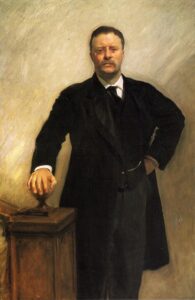
In 1907, the western anti-forest coalition managed to attach an amendment to a large agriculture appropriations bill. It appropriated $125,000 for the Forest Service, provided: “that hereafter no forest reserve shall be created, nor shall any additions be made to one heretofore created within the limits of the States of Oregon, Washington, Idaho, Montana, Colorado, or Wyoming, except by Act of Congress.”[iii] The identities of the authors of this provision are lost in the minutiae of Congressional records, but the list of states it was supposed to protect from Teddy Roosevelt’s ongoing campaign to establish national forests tells us where they lived.
While this contest was simmering in Washington, westerners fought federal authority on the ground. In 1906, rancher Fred Light turned 500 head of cattle loose on the Holy Cross Forest Reserve in Colorado without a permit from the Forest Service. The resulting legal battle went all the way to the U.S. Supreme Court, funded by a special appropriation from the Colorado state legislature. A similar case in California also made its way to the Supreme Court. The ranchers lost their bid to undermine Forest Service regulations— the court supported Congressional authority to establish federal reserves and appoint officials to control the ways they are used.[iv]
Supreme Court decisions notwithstanding, stockgrowers and settlers near the public domain continued to flout regulations and dodge limited enforcement efforts, and the damage to federal land deepened and widened.[v][vi] In 1923, Aldo Leopold, then an assistant Forest Service supervisor in the department’s Southwest region, reported that, on the forests in his district, “overgrazing is responsible for much more abnormal erosion than all other causes combined.”[vii]
The situation worsened as the region descended into the droughts of the 1930s, which led conservation-minded legislators to impose some sort of reasonable management on federal lands, especially the parts of the public domain that were neither part of the national systems of parks and forests nor owned by private interests. The Taylor Grazing Act of 1934 allowed the secretary of the interior to organize “grazing districts” on those orphan federal lands, issue permits to control grazing, and charge a fee for those permits. Oddly enough, the sponsor of the law, Congressman Edward Taylor of Colorado, was an opponent of federal controls and hoped to give local residents control over the new federal grazing bureau.[viii]
One of the most entrenched opponents of the Taylor Grazing Act was Pat McCarran, U.S. senator from Nevada. When the act took effect, McCarran set about undermining the new federal Grazing Service. He set standards for the election of local advisory boards that favored the biggest ranchers; he made sure the boards could set grazing fees well below prevailing market prices; he pushed regulatory loopholes that favored ranches controlled by banks, and he pressed board members to buy their grazing districts outright. Over the next twenty years, he attacked Grazing Service employees for alleged abuses of authority and fought proposals to increase grazing fees.[ix] He was his generation’s leader in a war against federal land that was already fifty years old.[x]
After World War II, Ed Robertson, U.S. senator from Wyoming, took up the cause, introducing a bill that would have turned over federal grazing lands to the states in which they were found and holding extensive “investigative hearings” across the West to root out instances of BLM employees abusing their authority. He pressured the Department of Agriculture to maintain unsustainable stocking rates for sheep and cattle on national forests and helped strangle BLM efforts by slashing the agency’s budget. Other members of Congress championed laws that expanded assistance to permittees grazing public land and limiting the authority BLM and Forest Service professionals had to regulate grazing. Frank Barrett, a Wyoming senator, introduced a bill that would have allowed permittees to sell their permits. Thankfully, it failed. At the same time, timber harvest on federal land expanded drastically, with no attention given to restrictions explicit in the federal laws that were supposed to control the Forest Service.[xi]
Through the 1960s and 1970s, the American public at large reacted to the longstanding hegemony local interests had exercised over federal lands. The Wilderness Act, the Wild and Scenic Rivers Act, and other federal laws sought to protect amenities the nation at large valued, and the Federal Land Policy and Management Act of 1976 kept BLM lands in federal hands while mandating management that considered “the long-term needs of future generations for natural scenic, scientific and historical values” as well as “recreation, range, timber, minerals, watershed, wildlife and fish.” All of this was to be done “without permanent impairments of the land and the quality of the environment.”[xii]
FLPMA was a glove in the face of the traditional masters of the public domain, and it elicited a response that came to be known as the Sagebrush Rebellion, yet another attempt to give federal land to the states. Prominent in the movement at that moment were candidate Ronald Reagan and Orrin Hatch, U.S. senator from Utah.
This brings us into the realm of living memory. Following the Sagebrush Rebellion, Cliven Bundy and his son, Ammon, dared the federal government to enforce its regulations concerning the use of public land. Ammon was found not guilty of occupying a national wildlife refuge at gunpoint, and, after ten years, Cliven is still grazing his stock illegally on BLM land.
And now comes Mike Lee at the head of the most recent insurgent action in a fight that has stretched on for 140 years. Should anyone mistake his intentions after his land sale provision was taken off the table, he said that he “continues to believe the federal government owns far too much land— land it is mismanaging and in many cases ruining for the next generation. Massive swaths of the West are being locked away from the people who live there.” He promised to continue his efforts to “put underutilized federal land to work for American families.” We have more than a century of abuse of the public domain by a tiny minority of people to help us define what he means by “work” and “American families.”
Forcing Lee and his cronies to back down was a signal victory, well worth celebrating. So find a friend, face your favorite corner of public land, the place that always brings a smile to your face, and raise a libation to success. Then get a good night’s sleep. Tomorrow morning, they’ll be at it again.
References:
[i] Haines, Aubrey L., 1996. The Yellowstone Story: A history of our first national park. University Press of Colorado, Boulder, CO.
[ii] Steen, Harold K., 2004. The U.S. Forest Service: A history. Forest History Association and University of Washington Press, Seattle, WA.
[iii] Anon, 1907. Public laws of the United States of America passed by the Fifty-ninth Congress, 1905-1907. Session II, Chapter 2907. P.1271.
I WASN’T BORN IN WYOMING, BUT, AS THE OLD SAW GOES, I GOT HERE AS SOON AS I COULD. FOR ME THAT WAS AUGUST OF 1960 WHEN MY PARENTS PACKED UP THE KIDS AND headed west from St. Louis, a station-wagon version of Lewis and Clark. On our way home from the Pacific, we bent south, like William Clark, and found ourselves along his fork of the Yellowstone River in the Sunlight Basin. I was not quite ten years old, and the North Absarokas were an obsidian-tipped arrow straight into my soul.
Up until that week, my idea of freedom was a hundred acres of timber along a creek that cut its way down a steep valley through the bluffs of the Mississippi, dove into a culvert under a four-lane highway, and found its way down the rip-rapped bank to join the Father of Waters. It was a marvelous place for a bunch of suburban kids— oak, hickory, and wild cherry on the uplands, giant sycamore and soft maple along the creek, whose dappled waters trickled over limestone outcrops and lingered in gravel-bottomed pools— but it was a tiny spark of wildness in a landscape that had been thoroughly settled. Even the kids knew that.
If we left the creek and climbed up toward the ridges on either side, we ran into the back fences of suburban yards, carefully mowed, and festooned with “No Trespassing” signs. Now and then, an irate householder would catch a glimpse of us in the woods and yell— we disappeared back into the shadows like smoke.
So the water and timber and wildflowers and snowfields and peaks of the Shoshone National Forest were like a revelation of God to me. The family came back again and again over the next several years, and I was loosed with a flyrod, four Muddler Minnows, and a smashed peanut butter sandwich to follow the creek as far as curiosity and gumption would take me.
After college, I settled down in the Midwest to start a family, but, every summer, I was back for as long as the company could spare me, with a wife and two apple-cheeked little girls in tow, to taste the freedom we had somehow lost back east.
Then, I had a chance to come to Wyoming full time. The offer was exhilarating, but I thought it over before I accepted, not because of what the job entailed, but because of how I felt about the West. They say familiarity breeds contempt, or at least boredom, and I wondered whether the sage and mountains might lose some of their shine for me if they were always at the back door. I decided to take the chance.
That was 1983. In the years since, I’ve rambled around most of the state, from Devil’s Tower to the Bear River Divide, Jenny Lake to Vedauwoo. I’ve hunted, fished, canoed, hiked, photographed, picnicked, and contemplated my navel, and I’m pleased— and relieved— to report that the big sky has never lost its shine for me. In fact, the love affair has deepened over time as I’ve come to appreciate the subtle charms of the sage as much as the flower-strewn meadows above timberline. It wasn’t until I moved to Wyoming that I experienced September and October here, arguably the best months of the year, not only in the West but anywhere.
All of this is set against the backdrop of public land. I own, by actual count, 34 of the BLM’s 1:100,000-scale maps covering Wyoming, 32 of the USGS quads, and an assortment of national park and forest maps on the side, all of them dog-eared and stained from days spent crammed into backpacks. I’m proud to say I’ve worn out two compasses, something that never could have happened behind the Midwest’s fences.
Wyoming is many things to many people. The boosters tout its minerals; the politicians brag on the rugged independence of its people. But, let me tell you— public land is what defines Wyoming. It’s why I came; it’s why I stay. I think I share that sentiment with many other residents.
You hang a “No Trespassing” sign on Wyoming, and it will be no different than Illinois, with a lot less rain and much longer winters. If all I have left is the view of the Tetons from a crowded parking lot and locked gates off every highway, I can think of better places to spend my time.
Back in the 1930s, America’s poet laureate, Archibald MacLeish, looked at the state of the nation and asked a penetrating question:
We wonder whether the great American dream
Was the singing of locusts out of the grass to the west and the
West is behind us now:
The west wind’s away from us
We wonder if the liberty is done:
The dreaming is finished
Or if there’s something different men can dream
Or if there’s something different men can mean by
Liberty . . .
Or if there’s liberty a man can mean that’s
Men: not land
We wonder
We don’t know
We’re asking
I wonder whether there’s liberty a man can mean that’s men, not land. Here in Wyoming, I think there’s little doubt. Public land means my freedom.
EVER SINCE THE FIRST SPANISH ENTRADA, MYTHS HAVE HAUNTED THE AMERICAN WEST.
The Northwest Passage, the Seven Cities of Gold, Cibola, the Welsh prince Madoc and his band of colonists settling in the New World 300 years before Columbus, the Buenaventura River flowing from the west slope of the Rockies across the Great Basin and the Sierra Nevada Range to San Francisco Bay— flights of imagination have led generations of explorers to confusion, hard times, disappointment, and, all too often, death.
It took us nearly 400 years to purge these monumental errors in our understanding of geography and culture on the western landscape. These days, the myths are smaller, but they persist.
Take, for example, the myth of the mustang. As the story goes, these noble beasts are the direct descendants of the stallion Hernan Cortez rode into Tenochtitlan after he had subjugated the Aztecs. Or perhaps the lineage reaches even further into the past. Since the family tree of the equids is deeply rooted in North America, a few true believers argue, it could very well be that the horse never really disappeared from the New World. Just look at the modern representatives of the breed, they say— the faint striping on haunches and legs of some wild horses shows a genetic link with some far-off ancestor that must have dodged the great Quaternary extinction that claimed mammoths, mastodons, ground sloths, and saber-toothed cats. A further argument maintains that, even if the horse became extinct in North America, the species disappeared so recently that wild horses on the modern landscape are really just a reintroduction of a native species.
None of these assertions stands much scrutiny. The notion that horses roaming free in the West are the pure progeny of Spanish mounts ignores the escape of untold thousands of horses and burros from travelers, native tribes, and ranches over four centuries. Whatever “pure” blood may have established horses in the West has long since been overwhelmed by more recent contributions from these escapees.
While science has found fragmentary evidence of isolated herds of horses in North America that are more recent than the remains of mammoths and other extinct species, the overwhelming consensus in the scientific community is that the horse was extinct in the New World for several thousand years before the first Europeans hit the beach. Since there is no evidence that paleohunters paid much attention to horses as prey, we’re left to conclude that the disappearance of the equine line in America was due to fundamental ecological change in the niche they occupied, not persecution by humans, whether armed with stone-tipped spears or rifles.
The notion that the escape of the modern domesticated horse in America is some sort of “reintroduction” simply ignores the evolutionary reality of extinction. Modern humanity didn’t erase this species from the New World; it disappeared as a result of natural forces that came into play thousands of years ago. We’re not well equipped to understand how those forces operated, but it’s more than a little arrogant to assume that a species returning from the dead can claim an ecological place on the modern landscape without any consequences.
These matters of prehistoric ecology and patterns of American conquest would be of little interest to anyone but paleontologists and historians . . . except that the growth of feral horse herds on the western landscape has thrown a huge monkey wrench into the day-to-day management of several million acres of the public domain.
Managing feral horses on the public range would be a relatively simple matter if the Bureau of Land Management (BLM) were allowed to treat them as any other livestock or game animal. There is a market for horsemeat, hides, and other commodities— a sustained harvest of feral horses might almost pay for itself while maintaining horse populations at levels that would leave forage for domestic livestock and possibly even habitat for the host of wild animals that share the public range with these newcomers. Fans of feral horses would still have horses; ranchers would have more forage for sheep and cattle, and wildlife enthusiasts would have more deer, pronghorns, sage grouse, and other wildlife that depends on the sagebrush steppe.
Alas, killing even a single feral horse is something a small, highly motivated group of extremists simply will not tolerate. As a result of generations of their vehement demands, the BLM has cobbled together what seemed, over the years, to be a workable compromise. Instead of killing surplus horses on the range, BLM officials proposed, we will trap them and allow people who care to adopt them.
There are some horse activists who object even to the process of trapping feral horses, arguing that the stress of being hazed by helicopters, confined in corrals, and shipped in trailers is unacceptably cruel, but most seem willing to tolerate the effect on individual horses in the interest of avoiding damage to public rangeland.
But three fundamental problems with the adoption program have emerged.
First, it’s expensive. In 2023, BLM asked Congress for $154,800,000 for wild horse and burro management.[i] Some of this supported efforts to control reproduction among feral horses, a project doomed to failure, partly because feral horses can be difficult to approach, partly because they don’t care to be sterilized, and partly because contraceptive drugs would have to be administered across the West on a regular basis in order to be effective.
Second, the BLM can’t find enough people to adopt feral horses. In 2023, BLM paid landowners $109,000,000 to board feral horses that had been trapped but were not sold or adopted.[ii] That outlay is likely to increase as the BLM increases the number of feral horses it traps and the number of people interested in adopting even more horses declines.
It’s becoming increasingly clear that BLM trapping and contraception together haven’t checked the growth of feral horse herds, which means that— third— there are too many horses on the public range. In 2023, BLM had a goal of keeping no more than 26,785 feral horses and burros on the land it manages. Official estimated that there were actually 82,883 on the range, an excess of 56,098 or about 300 percent more than the established ceiling for the breed. Those numbers are likely to increase until feral horses have so degraded the range that they no longer have enough food to produce foals. Or until we take a more practical approach to managing feral horses.
Wildlife biologists have long suspected that too many feral horses in the sage have affected many of the true native residents of the region. In the last few years, carefully designed research has reinforced that view. A study in 2021 concluded that “our models predicted a 70.9% reduction in sage-grouse numbers across approximately 4,500,000 acres of sage-grouse habitat in Nevada and northeastern California, assuming horse populations continue to increase at their current rates.”[iii] A 2024 study in Wyoming found that “overabundant free-roaming horses negatively affected nest, brood, and juvenile survival”[iv] among sage grouse in the area.
There’s good reason to believe that too many feral horses may be just as bad for pronghorns as they are for sage grouse,[v] and that generalized effect probably applies to most of the other wildlife in sage country.
I think it’s safe to say that most wildlife biologists and conservationists familiar with the West would prefer to eliminate feral horses entirely from western rangeland. With all the other stresses we’ve inflicted on the sagebrush steppe, the system would be far better off without this large, highly adaptable exotic in competition with native wildlife. Clearly, the mustang constituency will never agree to this, the most ecologically sound, approach.
A compromise has to be made. But that workable compromise would bear little resemblance to the breathtakingly expensive, largely ineffective system that’s been assembled out of mismatched parts under the provisions of the Wild Horse and Burro Conservation Act. Feral horses should be managed with clearly defined objectives, just as all other wildlife and human activities are— or should be— managed on the public domain. Contraception for feral horses may seem a humane option, but it isn’t practical or affordable. It’s seems inevitable that a sustainable commercial harvest of feral horses would be part of any workable program.
It’s been said that the multiple-use approach to management of the public domain is all too often a justification for multiple abuse. In 2023, the BLM admitted that half the rangeland it manages did not meet the agency’s own standards for healthy pasture.[vi] Half— 57,000,000 acres. According to the BLM, overgrazing by domestic livestock is a significant reason for that condition on 38,000,000 acres, and, if even the BLM offers this estimate, it’s a good bet that the situation is substantially worse.
Across the West, feral horses are an insignificant part of range abuse, in large measure because feral horses are confined to specific, relatively small parts of the public domain. Still, where they are too abundant, the research cited above shows that they’re not good for sage grouse and other wildlife.
Politically powerful interests in the cattle and sheep industry have fought federal efforts to manage the public domain effectively for well over a century. Their abuses are the root of the problem on BLM land. If the issue of feral horses intrudes on my concerns about the public domain, it’s because I suspect I share many of my views of conservation and environmental justice with the advocates of feral horses. I suspect these people admire the wildlife of the sage as I do; I suspect they take pleasure in watching the sage country blossom. I’m dismayed when I discover that they seem unwilling to accept a management regime that provides for sage grouse as well as for mustangs.
There is common cause to be made here. The BLM needs a constituency that supports conservation— wise use of the range— before it can counteract the influence of the traditional interests that scalp the public domain for their own profit. There has to be a limit on the number of cattle and sheep that graze on federal land. There has to be a limit on the number of feral horses, too. When the population of those horses is up to seven times the recommended maximum,[vii] it’s hard to mount a cogent defense of the way they’re being managed.
Caught between widespread abuse of rangeland by domestic livestock and the damage done in a few key areas by burgeoning herds of feral horses are all the native wild things that depend on the sage for food and shelter. Those of us who speak for that last group aren’t asking for everything, but we insist on getting something like a fair share.
There are those who see the mustang as the symbol of the sage. I much prefer the pronghorn and the sage grouse, the true natives, evolved over millennia in equilibrium with the land that nurtures them. Whatever your preferences, it’s clear that the land can sustain only so much. If there is to be balance on the modern landscape, ecological or ethical, we have arrange it; it won’t happen on its own.
[i] Stone-Manning, Tracy, 2023. The President’s Fiscal Year 2024 budget for the Bureau of Land Management. U.S. Department of Interior.
[iii] Coates, Peter S., et al., 2021. Sage-grouse population dynamics are adversely affected by overabundant feral horses. Journal of Wildlife Management 85(6): 1132-1149.
[v] Hennig, Jacob, et al., 2022. Habitat selection and space use overlap between feral horses, pronghorn, and greater sage-grouse in cold arid steppe. Journal of Wildlife Management 87(1): e22329.
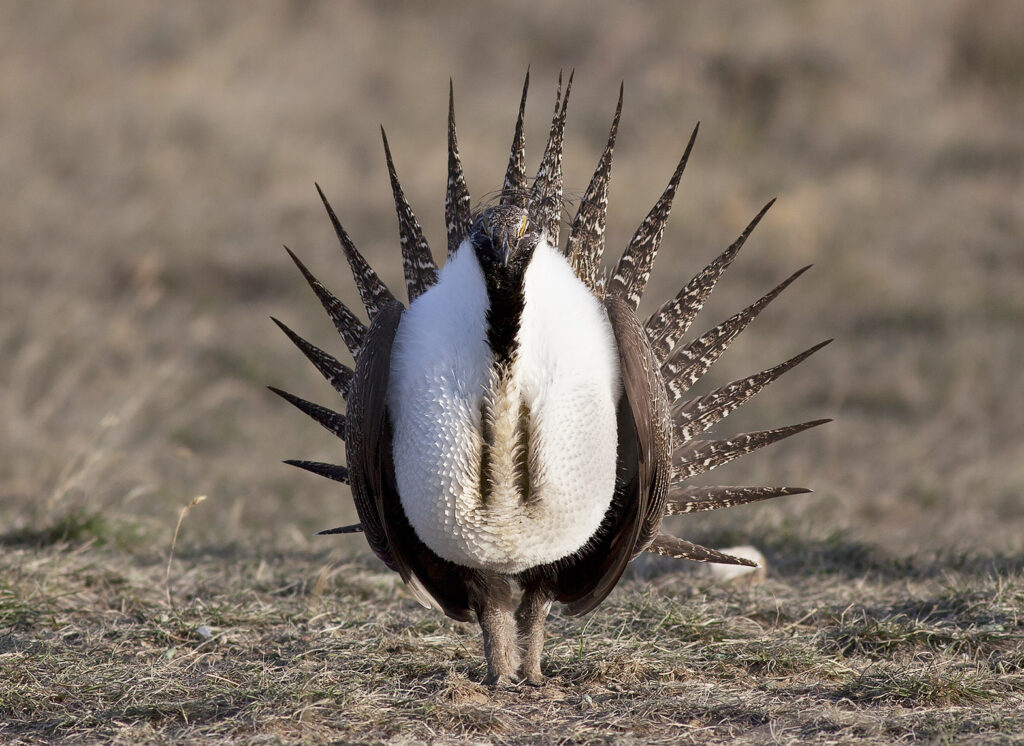
A male lesser prairie chicken displaying on a breeding ground in southern Kansas. Photo by Chris Madson, copyright 2014, all rights reserved.
WELL, THE DECISION COMES AS NO SURPRISE.
On March 29, David Counts, a Trump-appointed judge in the U.S. District Court for the Western District of Texas, split a legal hair to block any action to protect the lesser prairie chicken, a bird the U.S. Fish and Wildlife Service listed as” threatened” in part of its range and “endangered” in the rest back in 2022. In his decision, Counts conceded that the Fish and Wildlife Service was not required to weigh the economic impacts of its decision as part of its intention to list a rare species and threatened or endangered. BUT, before the Service makes rules to protect that species, he ruled, it is legally bound to consider the economic impact of those rules.[i]
Get it? The Fish and Wildlife Service has the authority to list the lesser prairie chicken, regardless of the economic impact that decision may have, but it can’t make any rules to protect lesser prairie chickens without considering the economic impact those rules might have.
The contortions Judge Counts goes through to justify this explication of the Endangered Species Act cover ten double-spaced pages, and at the end of that careful argument, a careful reader is left wondering how we can expect the Fish and Wildlife Service to “provide for the conservation of the . . . lesser prairie chicken” as the Endangered Species Act requires while, at the same time, avoiding any regulation that might inflict the least economic inconvenience on anyone doing any sort of business on the southern Great Plains.
Practically all the former and currently occupied range of the lesser prairie chicken is privately held, and, practically speaking, the Fish and Wildlife Service can’t and won’t prosecute a landholder for overgrazing native prairie, building fences, plowing a quarter section of grassland to install a center-pivot irrigation system, or doing much of anything else that threatens the species.
About the only activities the Service might impede would be large-scale development by big corporations— the installation of major utility lines or the opening of new oil and gas fields. Even in those cases, the interests of the lesser chicken and the developers would be balanced in court before any limit would be placed on a developer’s plans.
The Fish and Wildlife Service, state wildlife agencies, and the vast majority of conservationists with an interest in lesser chickens are fully aware of the challenges that arise when the last remnants of a wild species survive only on private land. That’s why efforts to recover populations of lesser chickens focus almost entirely on incentives that compensate farmers and ranchers for managing their grasslands to encourage these native grouse.
It’s interesting that the judge himself conceded that the lawyers who sued the Fish and Wildlife Service hadn’t produced evidence that their clients were actually harmed by the rules protecting lesser chickens— they “brought too little in the way of national impact,” according to Judge Counts. That should come as no surprise since the on-the-ground impact of the listing has had little, if any, impact on landholders. Nor is this lack of effect unusual on the modern landscape.
Over the decades, the Fish and Wildlife Service has been made painfully aware of the fact that, in most cases, successful protection and recovery of threatened and endangered species depends on public support, at the national level and also down where the management of those species touches the lives of the people who live with them. The Service has made arrangements to suspend the rules of the Endangered Species Act in places where rare species like the black-footed ferret are introduced, recognizing that the way the landholder is managing his land already favors the ferret, that the best way to help the species is to cooperate with that landholder. The Service compensates ranchers for the loss of livestock to wolves and grizzlies because the impact of those losses should rightly be shared by the public at large. And, in the case of the lesser prairie chicken, efforts are being made to use funding from the Farm Bill to help landholders help the birds.
In short, the Fish and Wildlife Service routinely considers the potential cost of managing threatened and endangered species, especially where traditional practices by farmers and ranchers are concerned.
The application of the Endangered Species Act has evolved over the decades since its adoption in 1973, partly because of shifting legal precedent and, in large part, because the real-world challenges of protecting and re-establishing habitat for rare wildlife have become obvious to conservationists and the public at large. The benefits and costs of protecting endangered species are already being weighed, and the efforts on behalf of those species have long been tempered by that process.
Judge Counts would like to bring that process into his courtroom. I must say I doubt his motives, and I challenge his ability to find fairer compromises than the ones already being made.
The long-standing debate between people who care about our wild heritage and people who are focused solely on the bottom line reminds me of an observation the British wit Oscar Wilde made many years ago. “A cynic is a man who knows the price of everything,” he quipped, “ . . . and the value of nothing.” It’s easy to build a balance sheet with columns for profit and loss, far more difficult to determine the value of a lesser prairie chicken and the prairie it calls home.
———
[i] Counts, David, 2025. Kansas Natural Resource Coalition, et al. v United States Fish and Wildlife Service. MO:230CV-00159-DC.
Late season pheasant cover as it was thirty years ago.
SOMETIME AROUND THE YEAR 2000, A FRIEND OF MINE ALERTED ME TO SOME PUBLIC ACCESS HUNTING AREAS IN SOUTHWESTERN NEBRASKA. With his good reports in mind, I waited until a couple of weeks after the pheasant opener to make sure the crowds had gone home, loaded Flick the Brittany in the back of the truck, and made the three-hour drive from Cheyenne to investigate.
Turned out, my friend was right. I wasn’t keeping written records back then, so I have to depend on my memories of those hunts, and the memories are quite pleasant. With a capable pointing dog in front of me, I moved sixty or eighty pheasants on a typical day. Some days, I missed a chance or two, and we came home with a pair of birds or just one. Some days, we walked twelve or fourteen miles to get three or four good chances and came home long after dark. Once or twice, we walked out of the cover with three roosters at nine in the morning. It was nothing like the huge flocks of pheasants South Dakota offered in those days, but, if I held up my end of the bargain, Flick would give me three or four great points over the course of a long day, and we’d come home with all the birds the law allowed.
A fair number of pheasants, an occasional sharptail or covey of quail, more cover than there were hunters, all of this within a four-hour drive from home— it was the kind of situation that appeals to me. So three generations of dogs and I have gone back to those same places every fall and winter over the last twenty-five years.
I didn’t start keeping records until the fall of 2020, but my general impression of the places the dogs and I kept visiting was a steady decline in the number of pheasants we moved and the number we brought home. Twenty years ago, I’d guess we averaged something like 2.5 roosters in the bag per day, sometimes a very long day, but, still, a legal limit more days than not. My hunting diary confirms the decline over the last five years:
1.5 pheasants brought to the bag per day in 2020,
1.2 in 2021,
0.6 in 2022,
0.7 in 2023,
and 0.8 last season.
It’s getting to be a long dry spell.
There have been changes. When the hunting was particularly good in the early 2000s, the hunting pressure on the walk-in areas increased perceptibly, although I never saw a day when I couldn’t find a field to hunt by myself. The amount of CRP has declined steadily over the last ten years, which has reduced the amount of cover in the walk-in areas. The summer of 2022 was exceptionally dry, so the folks at the Natural Resources Conservation Service allowed farmers to cut hay on their CRP, which drastically reduced the amount of cover that fall and winter as well as the amount of nesting and brood-rearing cover in the spring of 2023, which meant poor recruitment for the fall of 2023. Still, the winter of 2023-24 was mild, and the summer of 2024 was nearly ideal for pheasant nesting. The pheasants barely responded. As you might expect, the hunting pressure has fallen off drastically, simply because there were practically no birds to be found.
I’m the first to admit that my data set is severely biased. The hunting was so bad in 2022 and 2023 that the dogs and I didn’t get back to Nebraska as often as we have other years. Some years, I’ve hunted with veteran dogs; some years, I’ve had beginners. Still, the numbers of pheasants the dogs and I move on the same landscape have steadily diminished over the years.
And the annual summer pheasant surveys run by the Nebraska Game and Parks Department show a trend frighteningly similar to the drop in my numbers. Every region of the state has seen a steady decline in the number of pheasants rural mail carriers see along country roads. Every region has seen a drop in pheasant numbers that began sometime in the early to mid-1980s and has never recovered. In the southwest region where I’ve hunted, survey numbers have dropped more than eighty percent since 1970, fifty percent since 2010.[i]
Those of you who have hunted pheasants as long as I have will remember that the conservation title of the modern Farm Bill launched the Conservation Reserve Program in 1985. Conservationists in farm country welcomed the advent of CRP and its sister programs, and there’s little doubt that the long-term cover established under the Farm Bill slowed the decline of grassland birds, game and nongame, across the Midwest and out onto the Great Plains.
Slowed the decline . . . but didn’t stop it, let alone reverse it. Something has changed in pheasant country, something 20 or 30 million acres of federally subsidized cover hasn’t fully remedied. As I’ve meandered through the cover after the dogs over the last twenty-five years, I’ve had more and more time between points by the Brittanies to consider what’s happened to pheasants and other birds in the farming heartland. I’ve started to consider the possibility that food has become even more important than cover as a limiting factor in the life cycles of our grassland birds, and, just this week, a new synthesis of a huge body of field research in the journal Science lends some credence to that point of view.
Collin Edwards with the Washington Department of Fish and Wildlife, with the help of more than thirty other biologists, reviewed nearly 76,000 surveys of butterflies across the United States.
These researchers found that butterfly abundance dropped by twenty-two percent between 2000 and 2020.
Butterflies have declined in every region of the country.
Some species, like the beloved monarch, are threatened with extinction.[iii]
Many years ago, some now-forgotten biologist in the Rocky Mountain West considered the long-term decline in the region’s mule deer population and observed that “nothing we’ve done on the landscape in the last eighty years has been good for mule deer.” Much the same could be said of many, even most, wildlife species.
It certainly applies to butterflies. For more than four centuries, we’ve looked for ways to get rid of them. Sixty years ago, we invented sprays like chlorpyrifos and pyrethrins that have been staples in the battle against insects, and, in the mid-1990s, a new class of particularly effective insecticides called neonicotinoids were introduced in the U.S. The first of the group, imidacloprid, was permitted for use on crops from soybeans to safflower in 1994.[iv][v] In 1999, the EPA permitted another neonic, thiamethoxam, for use on wheat and sorghum.[vi] Clothianidin was permitted for use on corn and canola in 2003.[vii] Dinotefuran was permitted for use on a variety of crops in 2004.[viii] All of them deadly to nearly any invertebrate, including beetles, ants, thrips, fleas, ticks, bees . . . and butterflies.
Through the last half of the twentieth century and into the new millennium, we’ve also whittled away at the places butterflies and other insects live and reproduce. Urban and exurban sprawl has turned large swaths of former habitat into bluegrass deserts, and widespread applications of highly effective herbicides like glyphosate have killed off many of the pesky broad-leafed “weeds” on farmland, reducing the food supply and shelter for many insects, including butterflies.
And we’re not-so-slowly turning up the continental thermostat. The Edwards study and other smaller-scale research has shown that the warming, drying trend in the western U.S. is not good for butterflies. Climate change is changing entire ecosystems.
Why, you may ask, does an upland bird hunter like me care about butterflies? Well, I like them. I’ve admired them since I was a kid, along with the wildflowers they frequent. The world would be a poorer place without butterflies and the native plants that support them.
And, as an ecologist, I strongly suspect that the trend in butterflies reflects a much broader trend in the world of arthropods, all those creepy crawlies that provide the foundation of life on dry land across most of the globe. Studies of the food habits of all our game birds show that rapidly growing youngsters require a high-protein diet, which is to say, bugs. Pheasant chicks tend to prefer large species of leafhoppers, aphids, and beetles; young quail leaned more toward ants, small caterpillars, and skippers.[ix] If bugs are hard to come by, parent birds are forced to lead their broods farther and farther afield— the more movement, the more likely chicks will be separated from the brood and lost, the more likely a predator will find the brood and kill some or all of them. If there are no bugs, young birds quickly weaken; they don’t grow properly and may simply starve to death.
The youngsters slowly wean themselves off insects as they reach adulthood and the first frosts cut the supply of bugs, but the shift to a vegetarian diet doesn’t mean they’re suddenly flush with provisions. These days, the crop fields that once provided plenty of waste grain are swept clean. Like most other equipment in this technological age, mechanical combines have improved drastically since they were introduced in the late 1950s. Around 1970, researchers in Iowa found that the typical combine lost 3.7 bushels per acre of corn harvested— some lost as much as 23 bushels per acre.[x] This at a time when average corn yield hovered between seventy and eighty bushels per acre.[xi][xii]
The use of new hybrids, nitrogen fertilizer, and efficient pesticides has boosted average yield of corn to nearly 180 bushels per acre,[xiii] but much less of the grain is lost during harvest. According to one study in central Nebraska, the amount of corn lying in the fields on either side of the Platte River after harvest dropped 24 to 47 percent in the twenty years between 1978 and 1998.[xiv] In many areas, farmers stretch electric fence around their cornfields after harvest and turn cattle loose to clean up anything of nutritional value that’s left after the combine goes through. By the time the cattle are finished, there’s no food or cover left for wildlife.
One other trend in farming has also taken a toll of pheasants and other birds in farm country— the advent of soybeans. Until World War II, small grains like oats, barley, and rye were commonly planted crops. In the decades following the war, the acreage of soybeans grew steadily, mostly by replacing the small grains. Pheasants should like soybeans— they’re full of protein— but neither pheasants nor native game birds like bobwhite quail, prairie chickens, sharptailed grouse, most waterfowl, and sandhill cranes care much for them. In 1950, farmers harvested about 15 million acres of soybeans in the U.S. In 2020, they harvested 82 million acres.[xv] The soybean not only falls short as a food item for birds, but soybean fields also fail to provide much shelter in the winter when wildlife needs shelter most— in January, a harvested Iowa soybean field offers less food and cover for wildlife than the typical Walmart parking lot.
With all these changes, it’s not surprising that the population curves for pheasants and butterflies are strikingly similar, and there’s every reason to believe that the similarity stretches back to the beginning of pesticide use in the U.S. A classic paper from biologists in Illinois found that survival of pheasant chicks during their first six weeks of life declined by almost 50 percent from 1946 to 1996.[xvi] The results from the butterfly study suggest that this decline has probably continued, if at a slower rate, through the first decades of the twenty-first century.
No wonder the dogs and I aren’t seeing as many pheasants as we did thirty years ago.
So the comment about mule deer in the West keeps ringing in my head. Of course, we have done one thing for pheasants— the conservation title of the modern Farm Bill. It has slowed the loss to a trickle, but, with every new version, the acreage ceiling for the various programs is cut, and the funding reduced to a point where it can’t begin to compete with the income to be had from a corn-soybean rotation. We further exacerbate the situation by continuing a handsome tax break for corn-based ethanol, a commodity that was supposed to stand on its own in the market but seems to fall short of that promise without a massive federal subsidy.
CRP, as it exists today, isn’t enough to sustain populations of game birds and the rich guilds of other grassland birds in America’s agricultural heartland. Nor is it enough, in its current form, to stop the loss of butterflies.
When I was first learning the science of ecology and the art of wildlife management in the 1970s, experience had shown that, in farm country, the key to improving wildlife habitat was providing more cover. There was plenty of winter food scattered across the grain fields; wildlife managers mostly needed to provide cover for nesting, brood-rearing, and winter shelter. In the 1960s, the success of the Soil Bank program as a way of increasing wildlife populations in general and pheasant numbers in particular demonstrated the importance of cover on the farm landscape of that era.
Two generations of advances in ag technology and chemistry have shifted that equation. Birds on the prairies and plains could certainly use more cover— they could also use more food. A return to a 40-million-acre cap on CRP— the ceiling for the program when it was first established— would provide much needed cover and, if we used a wide variety of plants on those retired acres, we could encourage the insects that are the prime groceries for young birds as they grow and adults as they molt into new feathers.
That would help fill the larder during the summer. When fall and winter come around, we may need to broaden our notion of adequate habitat. On the modern farm landscape, that almost certainly means providing year-round sources of food along with cover— the birds need extensive food plots to replace the waste grain that has all but disappeared from most working farms.
Once upon a time, wildlife habitat in the uplands of corn and wheat country happened largely by accident as the limitations of equipment and the demands of the markets combined to create a mosaic that benefitted people and wildlife. We’ve drifted away from that situation and find ourselves faced with the hard reality that we’ll have to pay for the habitat and wildlife we once had almost for free.
I’m sure there are many Americans who don’t share the passion my Brittanies and I have for sharptails and quail and pheasants. I hope those people find another way to understand the situation and the ways it affects them. Maybe the Edwards butterfly study will help. It’s one more indication that the trouble in farm country reaches far beyond game birds.
The litany of loss is daunting: Eastern meadowlarks sang from every third fencepost when I was growing up in Iowa— their population has declined by two-thirds since the 1960s. Same with the bobolink. And the eastern kingbird. And the horned lark. The lark bunting, once the most common bird along the backroads of the High Plains, has declined by 72 percent. Numbers of barn swallows have dropped by ninety percent.[xvii][xviii] A recent study estimated that the grasslands have lost 700 million breeding birds from thirty-one species since 1970— these researchers reported that three-fourths of grassland bird species are in decline.[xix]
We started out to make a garden, but, somewhere, we went wrong. We’re well along in the process of turning one of the world’s richest landscapes into a factory. And, when, at the end of the long day of work, we step away from the machinery that converts land into money, we lie down next to the conveyor belts, looking for rest and respite— and find none. As I walk behind the dogs, the stillness in the cover sinks into my bones. No pheasant beds, no coyote tracks, not even a junco in the kochia. And I wonder how we’ve come to this pass. This is no way to treat a place we call home. There must be a better way.
There must be a better way.
A Nebraska corn stubble field in January, 2022, after it has been grazed.
———————–
[i] O’Connor, Bryan and Jeffrey J. Lusk, 2024. 2024 rural mail carrier survey. Nebraska Game and Parks Department Research, Analysis, and Inventory Section Unit Report Federal Aid in Wildlife Restoration Project W-15-R. https://outdoornebraska.gov/wp-content/uploads/2024/08/2024-JULY-RMCS-REPORT.pdf
[ii] Edwards, Collin B., et al, 2025. Rapid butterfly declines across the United States during the twenty-first century. Science 387: 1090-1094. https://www.science.org/doi/epdf/10.1126/science.adp4671.
[iii] U.S. Fish and Wildlife Service, 2024. Endangered and threatened wildlife and plants: threatened species status with Section 4(d) rule for monarch butterfly and designation of critical habitat. Federal Register 89(239): 100662-100716. December 12, 2024.
[vi] Keigwin, Richard P., Jr. and Joan Harrigan-Farrelly, 2011. Thiamethoxam summary document registration review: initial docket December 2011. Environmental Protection Agency, Docket Number: EPA-HQ-OPP-2011-0581. file:///Users/chrismadson/Downloads/EPA-HQ-OPP-2011-0581-0002_content.pdf
[vii] Kenny, Daniel C., 2003. Pesticide fact sheet: Name of chemical: Clothianidin; reason for issuance: conditional registration; date issued: May 30, 2003. Environmental Protection Agency, Washington, D.C. https://web.archive.org/web/20140326133528/http://www.epa.gov/opp00001/chem_search/reg_actions/registration/fs_PC-044309_30-May-03.pdf
[viii] Keigwin, Richard P., Jr., 2011. Dinotefuran summary document registration review: initial docket: December 2011. Environmental Protection Agency Case No. 7441, Washington, D.C. file:///Users/chrismadson/Downloads/EPA-HQ-OPP-2011-0920-0002_content.pdf
[ix] Doxon, Elizabeth D. and John P. Carroll, 2010. Feeding ecology of ring-necked pheasant and northern bobwhite quail chicks in Conservation Reserve Program fields. Journal of Wildlife Management 74(2): 249-256. https://www.jstor.org/stable/pdf/27760446.pdf?refreqid=fastly-default%3A9a2f6cb43c7ddc222138862c4a5bbca8&ab_segments=0%2Fbasic_search_gsv2%2Fcontrol&initiator=search-results&acceptTC=1
[x] Hanna, Mark H., 2010. Combine harvest setting to reduce grain loss and improve grain quality. 2010 Integrated Crop Management Conference, Iowa State University, Ames, IA. https://dr.lib.iastate.edu/server/api/core/bitstreams/319c47e5-906d-42d1-bef5-64af32baac13/content
[xii] Nielsen, R.L., 2023. Historical corn grain yields in the U.S. Corny News Network, Purdue University. https://www.agry.purdue.edu/ext/corn/news/timeless/YieldTrends.html
[xiii] Anon, 2025. Corn yield, United States. USDA National Agricultural Statistics Service. https://www.nass.usda.gov/Charts_and_Maps/Field_Crops/cornyld.php
[xiv] Krapu, Gary L., et al., 2004. Less waste corn, more land in soybeans, and the switch to genetically modified crops: trends with important implications for wildlife management. Wildlife Society Bulletin 32(1): 127-136. https://www.jstor.org/stable/pdf/3784550.pdf?refreqid=fastly-default%3A4d60f6ece2fa9d2420a76884afc2f2a5&ab_segments=&initiator=&acceptTC=1
[xv] National Agricultural Statistics Service. https://quickstats.nass.usda.gov/results/823B649C-6769-386B-BBD6-7F641DF4984A
[xvi] Warner, Richard E., et al., 1999. Declining survival of ring-necked pheasant chicks in Illinois during the late 1900s. Journal of Wildlife Management 63(2): 705-710. https://www.jstor.org/stable/pdf/3802660.pdf?refreqid=fastly-default%3A9a2f6cb43c7ddc222138862c4a5bbca8&ab_segments=0%2Fbasic_search_gsv2%2Fcontrol&initiator=search-results&acceptTC=1
[xvii] U.S. Geological Survey, nd. BBS trends 1966-2022. https://eesc.usgs.gov/MBR/
[xviii] Heisman, Rebecca, 2023. Prairie plight: five of the fastest declining grassland birds in the U.S. American Bird Conservancy.
[xix] Rosenberg, Kenneth V., et al., 2019. Decline of North American avifauna. Science 366: 120-124. https://www.science.org/doi/epdf/10.1126/science.aaw1313
Snow goose migration. Copyright 2017, Chris Madson, all rights reserved.
IT WAS AN UNSEASONABLY TEMPERATE DAY FOR THE HIGH PLAINS IN EARLY MARCH, A FEW CIRRUS CLOUDS AGAINST A CLEAR SKY AND THE TEMPERATURE RISING INTO THE SIXTIES. Shirtsleeve weather. I’d spent the afternoon artfully camouflaged at the edge of a spread of snow goose decoys with little hope of success. Four dozen decoys is a reasonably large spread when the quarry is the wily mallard, and, in Wyoming, it’s usually enough to fool the occasional Canada goose.
Snow geese in the spring are a different proposition. At about five in the afternoon, I heard the first tenor call somewhere in the west. It took a long minute to make them out against the fathomless blue of the March sky, a chevron of white specks, impossibly high, a hundred birds or more, intent on the traveling chant that carries them across two thousand miles from the southern plains to the tundra at the edge of Queen Maude Gulf. They were not to be moved by my pathetic offering so far beneath them.
Over the next two hours, I watched three or four thousand more pass overhead, their ranks punctuated now and then by flocks of sandhill cranes, just as high, an occasional V of mallards, and the trailing cohorts of the Canada goose migration, the diminutive cacklers who were heading almost as far north as the snows.
The sun sank behind the mountains at last, and I set about gathering decoys as the night deepened. In the last light, weary geese began settling into the marsh in small bunches until the night was filled with their gossip— a garrulous bunch, these birds, in the security of the night. Flocks of sandhills followed, so low I could hear their primaries cutting the air as counterpoint to that strange trill they share as they fly— resonant woodwind voices, otherworldly, a sound from the Pleistocene. When I looked up, I could just make out the silhouettes of their formations against the brightening stars as they swept low overhead on their way to the shallows out in the middle of the basin.
The breeze had been steady out of the west all day, but it died with the sun, so all the wild conversation of the marsh stood out in the silence and the dark, the small talk of beings who cross a continent the way I travel my front walk— confident, casual, the small talk of far travelers.
The moon rose in the east, only a night or two past full, to shed its pale light on the marsh, brightening the darkness, as it always does, without revealing anything, which it never does. I could tell by the sound that the edge of the roosting flock of geese was no more than a hundred yards away, but they couldn’t see me, nor I, them. Sure of their privacy, they gabbled their secrets, careless of who might be around to hear them.
After I’d finished gathering my gear and strapping it on the cart, I started the long pull back to the truck, while the thousands of voices around me vibrated in the moonlight, and the sensation came to me as it sometimes does when I walk through wild places in the dark, the feeling that I’ve been admitted to something denied to humans in the daylight world, a moment when all the ancient barriers are lifted and kindred spirits speak to each other and are heard.
Magic. It’s become a pale word, stripped of the power it once had over us, but what other word is there to describe that moment? I walked in the moonlight, with the chorus rising all around me, wrapped in magic. Such are the gifts that come, unexpected, to a wanderer in the night.
A male lesser prairie chicken displaying on a breeding ground in southern Kansas. Photo by Chris Madson, copyright 2014, all rights reserved.
AS WE WATCH WHAT COULD BE THE BEGINNING OF THE END OF THE WORLD’S OLDEST DEMOCRATIC REPUBLIC, I HESITATE TO raise issues that seem clearly subordinate. But, for those of you who care about the American relationship with wildlife and wild land, I thought the impact of the last month’s executive orders on a specific conservation effort might be of interest.
The decline of the lesser prairie chicken on America’s southern great plains over the last century has been catastrophic. More than 90 percent of its original prairie habitat has been destroyed, and much of the habitat the birds still occupy is degraded. For that reason, in 2023, the U.S. Fish and Wildlife Service classified the lesser chicken as “threatened” under federal law in the northern part of its range and “endangered” in the southern part.
Any effort to maintain the birds that are left, let alone an approach that would allow the population to grow, is complicated by the fact that the species lives almost entirely on privately held land. Efforts by the federal government and the Western Association of Fish and Wildlife Agencies to help lesser chickens have met with little success.
Enter the North American Grouse Partnership, a small group of wildlife biologists and landowners with deep experience in conservation work in farm and ranch country. The partnership has sought out landholders who were interested in helping the lesser chicken and asked them what help landowners needed to provide for the species on their property. Not surprisingly, the ranchers were worried that an aggressive effort to improve prairie habitat for the chickens was likely to reduce their income. Was it possible, they asked, for someone to reimburse them for at least some of that loss?
Ted Koch, executive director, and members of the board of directors and staff thought funding from the conservation title of the federal Farm Bill might do just that. They discussed the possibility with the state offices of the Natural Resources Conservation Service in the region, the offices in charge of the Farm Bill, and generated support for the approach. With that groundwork laid, they approached the National Fish and Wildlife Foundation with a grant proposal. Give us the funding for a full-time person to coordinate this effort, they said, and we will connect landowners with the help they need to provide for the native grouse.
Last year, the Fish and Wildlife Foundation approved the grant, and the Grouse Partnership set about hiring a person to make the connection that would help landowners help lesser prairie chickens. There was a lot of quiet enthusiasm about the new approach from federal wildlife authorities and NRCS staff, from knowledgeable conservationists in the private sector, and from a growing number of landowners. One veteran of the conservation movement said this program could well be the template for programs intended to support rare wildlife on many other working landscapes. Late in 2024, the Grouse Partnership hired a person to serve as lesser prairie chicken coordinator.
And, about two weeks ago, the Grouse Partnership heard that all funding from the National Fish and Wildlife Foundation was frozen indefinitely, which meant that the new prairie chicken coordinator would have to be paid from some other source, not yet identified, or let go. The blanket reduction in force the administration has ordered across most federal agencies is still percolating down through the U.S. Department of Agriculture, but there’s a good chance that staffs in NRCS offices across the country will be reduced, even slashed, which will drastically complicate any effort to use conservation funding from the Farm Bill to help lesser prairie chickens or any other wildlife.
What remains to be seen is whether the two immense federal conservation laws involved in the plan to save the lesser chicken— the conservation title of the Farm Bill and the Endangered Species Act— will themselves survive the attentions of the current administration. Both have been controversial, and the listing of the lesser prairie chicken, in particular, was met with intense opposition in some quarters when it was announced. Whether either law is funded, enforced, gutted, or simply erased is likely to depend on the number of voices raised for or against them.
As is so often the case with rare species, the lesser prairie chicken is just one component of an ecosystem under siege. As a group, grassland birds have been in steep decline over the last fifty years. An effective strategy to recover lesser chickens would benefit a host of other wildlife, and the plan the Grouse Partnership has assembled would benefit many landowners as well. But, like so many other worthy programs that depend on federal funding, this one is on indefinite hold.
I hope the funds from the National Fish and Wildlife Foundation begin to flow again. I hope the Natural Resources Conservation Service has the staff and budget to continue, even expand, its vital conservation work. I hope the conservation title of the federal Farm Bill is expanded and adequately funded to help the lesser prairie chicken and other wildlife on other landscapes. I hope we continue to acknowledge the dire condition of native landscapes on the southern plains and elsewhere and look for ways to care for the grasslands that remain. I hope all those things will come to pass, but I doubt any of them will happen without vigorous public support.
In 1775, Tom Paine observed that “those who expect to reap the blessings of freedom must, like men, undergo the fatigue of supporting it.” As citizens, we have work to do.
I note that the views I’ve expressed here are my own and do not necessarily reflect the positions of the North American Grouse Partnership or any other organization or government entity.
SAM HARRIS RECENTLY POSTED A PODCAST OF A CONVERSATION WITH THAT CHAMPION OF EVOLUTIONARY biology, Richard Dawkins. Near the end of their discussion, the issue of generative AI arose. Sam raised the possibility that so many other cogent observers have raised— that the AI of the future might utterly supersede any human intellectual activity. This is something that has concerned me.
As these two great thinkers considered the possibility that AI might carry on the human quest for understanding, creativity, ultimate knowledge, etc., etc., something occurred to me, once again: Does this quest exist outside the human mind? There seems to be a conviction that the fruits of this effort are somehow universally important, that they stand outside— one might say above— humanity or even life itself. We ask the questions, “Why do we exist?” and “Why does the universe exist?,” as if the answers are objectively important. When it is manifestly obvious that they have no importance outside of our own fevered obsession with them.
We’re desperate to answer the “Why?” question when it is meaningless. There is no “why” to existence. It simply “is.” This applies to every living thing and the cosmos at large. I think Douglas Adams was onto something foundational when he described the planet of intellectual beings who have waited seven-and-a-half million years for their most sophisticated computer to give the answer to “Life, the Universe, and Everything.”
“You’re really not going to like it,” the computer warns.
“Tell us!” the people cry.
“The answer to the Great Question Of Life, the Universe, and Everything,” the computer announces, “is forty-two.”
The intellectual and spiritual pursuits in which we engage are unique to the human animal and are of utterly no importance to the rest of life, the planet Earth, or the universe at large, except, in the very short term, how they affect our interactions with each other and the rest of life on Earth. If AI renders us obsolete or even extinct, I think there’s good reason to believe that a more enlightened machine will simply abandon much of what we believe is of universal value in our art, technology, and philosophy. I wonder whether that machine would even have the will to continue its own existence. The need to procreate, the forlorn hope of eternal life, are drives that are probably unique to biological entities. I wonder whether an enlightened machine would look at the beauty and complexity of the natural world and simply decide to turn out the lights, effectively committing suicide in the interest of preserving the marvels of the “Is.” I doubt that a computer, no matter how sophisticated, has any innate interest in the question, “Why?”
Our manic search for meaning in a universe that has no meaning is of no importance to anything but ourselves. “Forty-two” is as good an answer as any. On this day of Thanksgiving, I am grateful simply to be, to wander in the places I know, to have the people I love. On this lone enclave of life in the void, nurtured by the warmth of a distant star on a tiny blue orb in an infinity of darkness, bathed in beauty, what greater insight, what greater gift could there be than to be part of it? To exist. And so I give thanks . . .
A LITTLE MORE THAN A YEAR AGO, THE WYOMING GAME AND FISH Department arranged the slaughter of 129 cow elk on a ranch in southeastern Wyoming. The rancher, with backing from influential political interests, had pressured the department to bring in professional shooters because, he said, the elk were eating grass his cattle needed to get through the winter.
It was another installment in the long-running confrontation between a few private landholders and the biologists charged with the management of Wyoming’s big game, arguably one of the most valuable natural resources in the state, and it led to the introduction of a bill in the last session of the legislature that would have guaranteed payment to “any landowner, lessee, or agent . . . for loss of forage . . . to any big game species on private land.”
In Wyoming, hunters already pay landholders for any hay elk might eat out of a haystack, any fences they might damage, even “extraordinary damage to grass.” This bill would have gone further, paying ranchers whenever elk ate more than 15 percent of available forage. One version would have paid 150 percent of the estimated value of that grass.[i] In order to qualify for the damage payment, the bill would have required a rancher to allow “reasonable hunting” on his property. The bill didn’t offer a definition of “reasonable,” but past experience with similar provisions suggests that it would fall far short of serious public access and wouldn’t disperse a herd of elk for more than a few days, if that.
The bill didn’t pass— this time— but in the aftermath of the legislative debate, Jim Magagna, executive vice president of the Wyoming Stock Growers Association, took the Game and Fish Department to task for not being “more aggressive” in its efforts to keep elk and other big game off privately owned rangeland. Magagna expressed his approval of the elk slaughter and thought Game and Fish should issue up to twenty permits to any landholder that would allow him, or anyone he chooses, to kill elk on his property.[ii]
It all sounds so sensible. The downtrodden rancher struggling with an elk herd state officials refuse to control. Who couldn’t sympathize?
Well, I can’t, and I suspect I speak for the vast majority of hunters and other citizens of the state who value our wild heritage. As is so often the case in such matters, the devil is in the details.
First, it’s important to recognize that the only cost-effective way to control elk numbers is to kill some of the females that would otherwise bear calves. Selling licenses that allow hunters to do the job actually raises money for wildlife conservation, but, in order for hunters to kill elk, said hunters have to get within a couple hundred yards of their quarry. And that’s where the problem starts. Many of Wyoming’s elk spend much of the fall and all winter behind locked gates, far out of reach of the most motivated hunter.
The Game and Fish Department has bent over backward trying to unlock those gates. Its AccessYes program pays landholders to allow public hunting, tailoring different kinds of access to fit the tastes of landholders. A rancher or farmer who is willing to allow anybody to hunt can sign up for the walk-in program— the department posts the property and includes it in an atlas of available access areas. If the landholder wants to limit access, he can enroll his land in the hunter management program— the department issues a limited number of access permits, posts the property, includes it in the access atlas, and keeps an eye on the place to make sure no unauthorized hunters trespass. If the landholder prefers to deal with potential hunters by himself, he can sign up for the Hunter/Landowner Assistance Program— the department advertises the landholder’s contact information so that hunters can get in touch.
Last year, landholders were paid $979,000 for their participation in these programs.[iii] They’re strictly voluntary, and a rancher is free to opt out of them if he prefers, but when that same rancher complains he has too many elk on his pastures, it’s hard for the average hunter to have much sympathy.
What many of these landholders seem to prefer is getting big game permits they can distribute on their own, giving them the power to issue the licenses outside the official application procedure. Magagna points out that state law already allows the Game and Fish Department to issue up to twenty licenses to a landholder who says he has problems with elk. These licenses can be given to anyone the rancher chooses. Magagna says the landholder can give them to “friends and family” but “they can’t make money off of them.”[iv]
That may be what the regulation says— like many other observers, I’m deeply skeptical that it would ever be enforced. If the landholder doesn’t sell the license itself, he can still charge an “access fee,” and, if he or a business partner happens to be an outfitter, he can make even more money by selling guiding services as part of a package that circumvents the state’s random drawings for big game permits. And, even if he sells the license outright in violation of the law, I can’t imagine how the state could catch the transaction or prosecute.
The other alternative some ranchers favor is having professional shooters slaughter some or all the offending elk. That’s what Game and Fish arranged in 2023 for the rancher in southeastern Wyoming. The shooters are under strict control; the killing is efficient, and the processed meat can be donated to a worthy cause. Almost like a domestic livestock operation. Who could complain?
I, for one.
From a strictly practical point of view, I decry the substantial loss of income to the state’s conservation coffers. A nonresident bull elk tag currently costs $692. It’s worth noting that shooting bull elk does nothing whatsoever to control an elk population, but if a rancher has carte blanche with the tags Game and Fish gives him, he stands to make a lot more money selling trophy bulls than cows, perhaps even enough to assuage his anguish at losing all that grass. A nonresident cow-calf tag runs $288. A resident bull tag sells for $57. A resident cow-calf tag goes for $43 or less, depending on the type.[v]
Giving free licenses to landholders would put a significant dent in Game and Fish Department revenue. Twenty licenses sold to nonresidents looking for trophies amounts to nearly $14,000; even if the licenses went to resident cow hunters, the street value is nearly a grand, all of which is lost if the permits are given to landholders. The 129 elk shot by the professionals last winter would have brought more than $7,000 if the department had sold the permits to residents, far more if they had gone to out-of-staters.
That’s the dollars-and-cents argument against giving landholders free elk licenses, but, as unsettling as these numbers are, I find the objections based on law and tradition more persuasive.
For centuries, the rulers of medieval Europe laid sole claim to the game in their domains. Until 1299, a common Englishman could be executed for killing one of the “king’s deer” or have his hand or bow fingers cut off; for centuries after that, he might face a year in prison or banishment from the realm. That rankled the common folk. Hence, the legend of Robin Hood, the young commoner who was condemned as an outlaw for shooting one of the royal stags. The roots of that story reach back into the thirteenth century, an expression of the simmering resentment the yeomen of the time cherished against the nobility’s claim on the country’s game.
And, according to the eighteenth-century English barrister William Blackstone, feudal monarchs had other reasons for depriving the yeomanry of the right to hunt:
“All forest and game laws were introduced into Europe at the same time,” Blackstone wrote in 1765, “and by the same policy as gave birth to the feudal system. When a conquering general came to settle a vanquished country, it behooved him to keep the natives in as low a condition as possible, and especially to prohibit them the use of arms. Nothing could do this more effectually than a prohibition of hunting and sporting; and therefore it was the policy of the conqueror to reserve this right to himself, and such on whom he should bestow it; which were only his capital feudatories, or greater barons.”[vi]
When the first English settlers made their way to the American wilderness, they discovered a pantheon of liberties they had hardly dreamt of in the Old World— the freedom to hunt was one they particularly cherished and, with it, the right to bear arms.
In the United States, landowners do not own the wildlife that may spend time on their property. The Supreme Court enshrined this concept in American law nearly 200 years ago, stating that game was held by “the people of each state . . . for the benefit and advantage of the whole community.”[vii]
There are still landholders in Wyoming who see the game on their property in this light. I tip my hat to them and pledge to do whatever I can to help with the burden they bear for the well-being of the public’s wildlife.
As for the landholders who deny public access to the public’s game, I’m still more than willing to look for ways to ease the impact of elk and other wildlife on their livelihood. But they should understand that this is a discussion among neighbors, not a decision they can dictate unilaterally. The farming/ranching community in Wyoming accounts for three percent of the jobs in the state and a little more than one percent of the state’s domestic product.[viii] There are other, larger interests involved in our game management. Last year, nearly 58,000 people hunted elk in Wyoming, and the number who applied for licenses but didn’t draw is significantly higher.
The fact is that the urban majority has done much to support their rural neighbors, in the matter of big game management and many other sectors of farm life, including funding for the roads, power lines, cell towers, and internet that are an irreplaceable part of life in Wyoming, in the country or in town. In return, I don’t think urban hunters are expecting too much when they ask for access to herds of elk, especially when those herds are troubling private landholders.
There are programs in place that offer help to any rancher who is wintering large numbers of elk, nearly all of which are currently funded by hunters. I support those programs, and I think they should be expanded, preferably with money from the state’s general fund. These subsidies should emphasize the general public’s access to the public’s game on private land. The tools exist to deal with elk numbers on private property, if landholders are willing to use them. Contrary to what Jim Magagna and his supporters may think, the Game and Fish Department has been extremely aggressive in its effort to deal with this issue, but there’s a limit to what can be done without cooperation from affected landholders.
I can’t support giving individual landholders the power to issue hunting licenses. Ranchers already control who can and cannot hunt on their property. They must not be given the authority to decide who is licensed to hunt. That power is reserved to the people through the Game and Fish Department. It is administered fairly, without prejudice, and available to anyone who cares to participate. That can’t be allowed to change. Equality in the hunt has been a cornerstone of American tradition and law since the Pilgrims came ashore at Plymouth Rock. It’s a concept many of us cherish as much as the guarantees in the Bill of Rights.
And I can’t condone the slaughter of game animals by hired guns, except where there is no other safe technique for controlling a game population that threatens human life or property. Wildlife in Wyoming, and across the United States, is a public trust. It should be managed in the public interest, not in the interest of a single property owner. In the case of increasing numbers of elk, a perfectly workable solution is available, if the landowner is willing to apply it— it’s hard to believe those elk would have stayed on that ranch in southeastern Wyoming if it had been opened to public hunting, with more than 100,000 city dwellers living within a fifty-mile radius.
As a modern “yeoman,” a common man who still cherishes the long-standing tradition of democracy in American hunting, I’d have thought the “Freedom Caucus” and Libertarians of the Wyoming legislature would stand up for me. Instead, recent news coverage advises me that they’re standing with a tiny minority of the Wyoming public that claims title to most of the land in the state. Owning the land does not mean they own the wildlife.
I understand that many ranchers are less than enthusiastic about allowing public access, although I suspect the horror stories that have made the rounds over the decades are often exaggerated by people who simply prefer to lock the gate. But, when a landholder is worried about too many elk, the problem comes down to a fairly simple choice: Put up with hunters from town or live with a herd of elk on the pasture. These may not be the alternatives some landholders prefer, but they’re the only ones those of us who own the elk will accept. When you ask a neighbor for help, you have to be willing to meet him halfway.
We left the notion of the “king’s deer” far behind us when we came to the New World. Wyoming’s elk belong to us all. We should all have an equal chance of hunting them.
—————————
[i] Heinz, Mark, 2024. Critics say paying Wyoming ranchers for grass-gobbling elk could break budget. Cowboy State Daily, February 19, 2024.
[vi] Blackstone, William, 1915. Commentaries on the Laws of England. Bancroft-Whitney Company, San Francisco, CA. pp. 1272-1273. https://archive.org/details/commentariesonl01jonegoog/page/1272/mode/2up?q=hunting
[vii] Taney, Roger, 1842. Majority opinion in the case of Martin v. Waddell. 41 U.S. 367 (1842).
[viii] Anon, nd. Income, employment, and gross domestic product by industry. Economic Analysis Division, Wyoming Department of Administration and Information. https://ai.wyo.gov/divisions/economic-analysis/economic-data/income-and-employment
Remarks on the occasion of the fiftieth anniversary of the Cheyenne chapter of the Audubon Society
HISTORY HAS SOME STRANGE TWISTS. THE NAMES THAT ARE SO OFTEN UP IN lights in our textbooks and memories weren’t always as influential as the record would have us believe. I was taught that James Watson and Francis Crick deserved complete credit for deciphering the structure of the DNA molecule.
Even today, the name of Rosalind Franklin is largely forgotten, even though she refined the equipment and techniques that ultimately revealed the nature of the double helix and first recognized the symmetry in the molecule, the difference between dried crystalline DNA and the more important hydrated form, and the fact that the order of base pairs on the ladder didn’t affect the overall structure of the molecule. These were all crucial insights into the function of DNA.
The labs at Radio Corporation of America— RCA— have long been given credit for the invention of the television, which the company’s CEO essentially stole from the true inventor, Philo Farnsworth. By the time I started watching TV, Philo’s name had become a punchline while RCA was reaping billions in profits.
Guglielmo Marconi is remembered in the texts as the inventor of the radio, even though Nicola Tesla held earlier patents for systems that transmitted information with radio waves.
Like the record of technological advances, the histories of great political transformations, breakthroughs in social justice, and innovations in the arts are often told through the biographies of a handful of luminaries whose reputations have outrun their actual contributions.
Theodore Roosevelt portrait by John Singer Sargent.
And so I come to Theodore Roosevelt. I’m a fan of Teddy’s. He was a lifelong birder and enthusiastic amateur naturalist. His efforts on behalf of wildlife and wild land are undeniable. He was the right man in the right place at the right time. But he did not invent conservation, nor do I think he was really the prime mover in that field. If that credit can be given to anyone in his generation, it belongs to someone else.
When Teddy was twenty-seven, he met that man. Teddy had just returned from six months on his nascent cattle ranch in the North Dakota badlands, recovering from the shock of the deaths of his mother, Mittie, and his wife, Alice, within twenty-four hours of each other on Valentine’s Day, 1884. On his return, he’d launched into a feverish period of writing that led to his book, Hunting Trips of a Ranchman, which appeared in July of 1885.
The book was generally well received, but there was one review that rankled Roosevelt. The editor of Forest & Stream, possibly the most influential outdoor periodical of the age, thought the book an excellent effort . . . with certain reservations:
“Mr. Roosevelt is not well known as a sportsman,” the editor wrote, “and his experience of the Western country is quite limited, but this very fact lends an added charm to the book. He has not become accustomed to all the various sights and sounds of the plains and the mountains, and for him all the differences which exist between the East and the West are still sharply defined. . . . We are sorry to see that a number of hunting myths are given as fact, but it was after all scarcely to be expected that with the author’s limited experience he could sift the wheat from the chaff and distinguish the true from the false.”[i]
George Bird Grinnell
Fuming at this insult to his experience and knowledge, Teddy stomped into the Forest & Stream premises at 40 Park Row in New York and demanded to see the editor. George Bird Grinnell invited him into his office. I’d like to have been a fly on the wall during that conversation.
Grinnell was nine years older than Roosevelt, a gap in age that made a huge difference in the experiences of the two men. Grinnell had first gone west in the summer of 1870 with a paleontological expedition organized by Yale University professor Othniel Marsh. On that trip, he saw the last of the great bison herds and made a buffalo hunt with the Pawnee.
In 1874, he rode with the George Custer and the Seventh Cavalry on a surveying expedition into the Black Hills, sacred land of the Lakota.
In 1875, Colonel William Ludlow invited Grinnell to join a survey expedition across Montana into what is now Yellowstone National Park. On that trip, Grinnell noted the rising tide of big game slaughter that would nearly eliminate bison, elk, deer, and pronghorn in the region. In 1876, Custer invited him to serve as naturalist on yet another foray into Sioux country, but the demands of Grinnell’s work at the Yale museum kept him from going.
Which is why he was not with his dear friend, Lonesome Charley Reynolds, chief of the Seventh’s Pawnee scouts, on the afternoon of June 25 as they fought a rearguard action at the ford of the Greasy Grass, giving their lives so that Marcus Reno and his command could gain the bluffs that saved them from the fury of the Sioux and Cheyenne.
Members of the 1870 Yale University expedition to Wyoming. (George Bird Grinnell stands third from left)
In the years that followed, Grinnell hunted extensively in the West and, in 1883, bought a ranch in Shirley Basin, where he spent much of his time over the next decade. He’d seen the last of the best of the western frontier.
Roosevelt quickly realized that there were few New Yorkers, few Easterners, who knew the West better than George Bird Grinnell. What began as a confrontation soon became a fast friendship.
By that time, Grinnell had already distinguished himself as the leading voice for conservation in the America of his time. His tireless campaigning in the pages of Forest & Stream had helped persuade Congress and the American people to give adequate protection to big game in Yellowstone National Park. He’d been a critical force in convincing states to establish game codes and wildlife agencies.
And his interests reached far beyond big game. Along with a handful of other naturalists, he’d watched the trends in several bird species with growing alarm.
The great auk, North America’s only penguin, had disappeared before the Civil War.
The Labrador duck, a waterbird with a taste for mussels, was probably also extinct before 1880.[ii]
The heath hen, the prairie grouse of the barren-ground openings along the northeastern coast, had disappeared from the American mainland by 1869.[iii]
The “great flocks of the gorgeous” Carolina parakeets “that formerly roamed over nearly all the eastern part of our country,” according to Arthur Cleveland Bent,[iv] had largely disappeared by the 1870s.
At the same time, Eskimo curlews, one of the most abundant shorebirds on the continent, were being shot by the wagonload, “the wagons being actually filled, and often with the sideboards on at that.” By the 1880s, they were on their way to extinction.[v]
Martha, the last living passenger pigeon
And the passenger pigeon— before settlement, there may have been as many passenger pigeons in North America as there are birds OF ALL SPECIES on the continent today. While reducing the unimaginable abundance of the passenger pigeon to a single estimate was impossible, one of the leading experts on the species believed there were between three and five billion passenger pigeons in America when the first Europeans landed.[vi] Grinnell was old enough to remember seeing a dogwood tree behind his house so full of passenger pigeons “that all could not alight in it, and many kept fluttering about while others fed on the ground, eating the berries knocked off by those above. . . . There were regular autumnal flights of pigeons up and down the bank of the Hudson River until 1873 or 1874. We boys killed a few, shooting them from the roof.”[vii]
By the time Roosevelt and Grinnell met in 1885, the passenger pigeon was in free fall. Laws to protect the bird were passed as early as 1862, a recognition of their decline, but the combination of indiscriminate killing and the wholesale clearing of old-growth deciduous forest was more than the pigeons could survive.
Both Grinnell and Roosevelt were undoubtedly aware of these, and other, shocking declines, but it was Grinnell, not Roosevelt, who had taken up the challenge of doing something about them. When Roosevelt left Grinnell’s office, he traveled west again to hunt and play cowboy for eight months before returning to New York to run as the Republican candidate for mayor.
In February 1886, Grinnell used the front page of Forest and Stream to call for a new organization to end “the fashion of wearing the feathers and skins of birds,” popular among stylish ladies of the age. “The Forest and Stream has been hammering away at this subject for some years,” he continued. “Legislation of itself can do little against this barbarous practice, but if public sentiment can be aroused against it, it will die a speedy death. . . . We propose the formation of an association for the protection of wild birds and their eggs which shall be called the Audubon Society.”[viii]
It was far from the first of Grinnell’s efforts on behalf of birds, both game and nongame. In 1883, a small group of ornithologists gathered to establish a national organization to support research and protection of birds. They called the new outfit the American Ornithologists’ Union. The founders of the union immediately voted to add another twenty-four noted students of ornithology as active members. Grinnell was near the top of that list.[ix]
Lilian Russell modeling extravagantly plumed hat, the fashion of the last 19th century in America.
The AOU wasted no time in advancing its goals in the conservation arena. Within two years, the leaders of the organization had convinced Congress to create the Division of Economic Ornithology, which, with the existing U.S. Fish Commission, would eventually become the U.S. Fish and Wildlife Service. At the same time, the committee on bird protection, with Grinnell as a prominent member, drafted a model law that could be used as a guide for state legislatures who wanted to protect birds. Much more on the model law in a few minutes. Still, the committee recognized that the AOU could do little to help birds without broad public support. Their response to that challenge has George Bird Grinnell’s fingerprints all over it. Trained zoologist, experienced naturalist, expert on the emerging debates over wildlife and wild land, editor, and prolific writer, Grinnell was an expert in the art of public outreach.
It’s hard to say who actually invented the idea that resulted in the Audubon Society. At least one other member of the committee had issued a public call for “the formation of bird protective societies.” Days after Grinnell’s formal solicitation for Audubon members in Forest and Stream, other AOU members contributed seven articles in a special supplement to Science magazine focused on the increasing slaughter of birds to provide feathers and entire skins for ladies’ hats.
“One thing only will stop this cruelty— the disapprobation of fashion,” the committeemen wrote. “Let our women say the word, and hundreds of thousands of bird-lives every year will be preserved.”[x]
Still, two things seem clear: first, that Grinnell named the new organization and, second, that he shouldered the entire responsibility for organizing and administering it. By May 1886, his office had received more than 5,000 pledges to protect birds. In August, the society was incorporated with Grinnell as the president pro tem. By the end of the year, Audubon had more than 300 local secretaries and nearly 18,000 members. In January of 1887, Grinnell published the first issue of Audubon magazine.
Over the next three years, nearly 50,000 people joined the society. With no membership dues or treasury, the load became unsupportable— in January of 1889, Grinnell announced that he was discontinuing the magazine “as its preparation calls for a good deal more labor than our busy staff can well devote to it.”[xi] With that, the de facto national headquarters of the organization had closed, and according to one of the AOU stalwarts, “the organized effort for bird protection” also seemed to have lost its momentum.[xii]
While tangible progress may have been lacking, ongoing commitment was not. The AOU members continued to reach out to other professionals in the field of ornithology and the general public, led by the redoubtable Grinnell, and the unending barrage of articles in popular magazines and technical journals fed the growing concern in America. The ideal that had emerged in Grinnell’s Audubon Society hadn’t died with his announcement— in fact, it was quietly growing into a political force.
——-
Harriett Lawrence Hemenway, co-founder of the Massachusetts Audubon Society. (Portrait by John Singer Sargent)
SOMETIME IN THE WINTER OF 1895-96, Harriett Lawrence Hemenway, a scion of a well-known Boston family who had married into another of Boston’s elite lineages, had finally had enough. Educated at Radcliff and raised by a famous abolitionist to speak her mind, Hemenway had been keeping up with the reports of carnage in the nesting rookeries to the south. Some sources speculate that it was an article by William Hornaday that set her off, but I suspect she’d been following the growing controversy for years. I wouldn’t be at all surprised if she had been one of the 50,000 members of Grinnell’s original Audubon Society.
Whatever the proximal cause, she looked out on the bleak Boston winter and decided it was time to do something. She sat down with her friend and cousin, Minna B. Hall, and the two of them took up the challenge of ending the plume trade from the consumer’s end. They used their connections in Boston society to chat with the ladies of means about the immorality of decorating hats with the feathers and skins of birds that had been slaughtered as they tried to raise their young.
On February 10, 1896, Hemenway invited Minna and six other interested parties to her home to organize a state effort on behalf of birds. Nine days later, the Massachusetts Audubon Society was officially launched. The two women recruited William Brewster, the state’s most famous ornithologist and one of the leaders of the AOU, to serve as its first president. Harriett became one of the society’s vice presidents; Minna was appointed to the board of directors.
“We sent out circulars asking women to join a society for the protection of birds, especially the egret,” Hall said years later. “Some women joined and some who preferred to wear feathers would not join.” There weren’t many in that second category— at the end of the first year, the organization had 926 associate members and 385 school members.
Minna B. Hall, co-founder of the Massachusetts Audubon Society.
One of the new society’s highest priorities was “to influence other States to start Societies,” and its astounding success in that effort was tribute to the popularity of the idea that Grinnell had pioneered. Late in 1896, the state of Pennsylvania established its own Audubon Society, and in 1897, New York, New Hampshire, Illinois, Maine, the District of Columbia, Wisconsin, New Jersey, and Colorado followed.[xiii] By 1900, there were enough state Audubon Societies to justify a national conference, which was held, appropriately enough, in Cambridge, Massachusetts.
Hemenway and Hall fought the good fight for conservation for the rest of their lives, which were considerable— Minna died in 1951 at the age of 92; Harriett lived to 102, dying in Boston in 1960.
There’s a story about these two I have to share. A few years before Minna died, Harriett, already in her nineties, confided to a friend that she thought Minna was working too hard— she was just too busy. At a concert some weeks later, Minna told a friend that she thought Harriett looked tired.
“She doesn’t know when to stop,” Minna said.
I wish I’d had the chance to know the two of them.
——-
AT THE BEGINNING, the epicenter of the bird protection movement lay somewhere on the East Coast, but the appeal of the concept reached across the country, even as far as Cheyenne.
In March of 1882, a young man came to town to take a draftsman’s job with the surveyor-general’s office. Born in 1856 to a farming family in eastern Iowa, Frank Bond grew up with an abiding interest in birds.
Frank Bond
Before he finished his master’s degree at the University of Iowa, he’d amassed a collection of more than 500 bird specimens, which he left to the university before coming west. In 1890, he was elected to the Wyoming House of Representatives for one term, and in 1895, he was hired as editor of the Wyoming Eagle.
Through those years, he continued his ornithological interests. He was accepted as a member of the American Ornithological Union in 1887 and published his first technical note in the union’s journal two years later. Because of that connection, he was aware of the AOU’s model bird law, a framework of restrictions designed to protect nongame birds, their nests, and eggs.[xiv] It was intended to provide guidance to state legislatures, which, at the time, had sole authority to protect birds and other wildlife. The AOU and Audubon societies throughout the country had been pressing state lawmakers to adopt the model law for more than a decade with little success.
Bond pressed for passage of the model law in Wyoming. Since the newspapers he edited were printed on high-acid paper, none of them have survived, but he must have used the daily to press his argument. His acquaintance with the legislators in the state certainly gave him the opportunity to make a case for the bill.
Early in 1901, Governor DeForrest Richards recommended that “some measure be passed guaranteeing protection for our song and insectivorous birds.” On Valentine’s Day, Wyoming’s version of the model law passed both houses.
Other states had passed measures that offered some protection to birds— according to Grinnell himself, New York adopted a version of the model law in 1886— but, on that date, no other state had followed the AOU guidelines in full. Wyoming the second state in the nation to back the AOU framework.
The second state in the nation.
Seven other states adopted similar laws in 1901, but Wyoming was a leader in the effort . . . thanks to Frank Bond.
Following that success, Bond announced a meeting to consider the formation of the Audubon Society of the State of Wyoming. An article in Bird-Lore, the national Audubon periodical, noted that, on April 29, 1901, “a crowd of enthusiastic ladies and gentlemen assembled in the parlors of the Inter Ocean Hotel”[xv] to organize the new group. “Bird lovers,” it concluded, “a term which will soon include all of the farmers and agriculturists of the country, if it does not already, will be gratified to learn that the Audubon Society started out with a membership of 900, the result of a few days’ work only.”
And here I have to pause to wonder what series of events blighted this heroic beginning. By rights, we should be celebrating the 123rd anniversary of Wyoming’s Audubon movement tonight, not just its fiftieth.
In any case, Bond was elected president of the fledgling society, and it must have been a bittersweet moment, since he probably already knew he’d be leaving Cheyenne that summer to join Teddy Roosevelt’s administration as chief of the Drafting Division of the General Land Office in Washington, D.C.
Pelican Island during nesting season.
Bond was aware of a small island on Florida’s Indian River that was a magnet for wading birds of all sizes and descriptions. It was owned by the government, and, as he considered the vast public domain still under federal control, he had an idea: a national refuge for birds. He committed the concept to paper, and it made its way up through the bureaucratic chain of command until it landed on President Roosevelt’s desk. Teddy liked it, and, in 1903, signed the executive order creating Pelican Island National Wildlife Refuge.
In his position with the Land Office, Bond was uniquely positioned to expand the refuge concept to other federal holdings that were particularly important to birds and other wildlife. He reached out to AOU and Audubon members across the country, toured many of the potential reserves, and built a list of new refuges for Teddy’s signature— fifty-one more of them by the end of his first term.
In 1911, the head of the new National Association of Audubon Societies praised Bond’s work on the refuge idea: “It was he who prepared the Executive Orders and important explanatory letters of transmittal to the President for the remaining fifty-one reservations. . . . No man, at this early period in the bird protection movement, can even estimate the value of these reservations to the rising generation, which is now taking up the burdens of human existence, much less foretell the blessings the increase in bird life will confer upon those who follow in the centuries to come.”[xvi]
Bond could well be called the father of the national wildlife refuge system. And no one remembers his name.
——
THERE’S A SHOPWORN HOMILY THAT’S MADE THE ROUNDS in management seminars for generations. I think it was first written down by a nineteenth-century Englishman who said he heard it from a Jesuit priest: “A man may do an immense deal of good,” he commented,” if he does not care who gets the credit for it.” Sometimes, the only difference between a piece of wisdom and a cliché is just how often it’s been repeated.
When I read the history of wildlife conservation covering the crucial sixty years between 1870 and 1930, I find George Bird Grinnell at every turn, a member of every committee, a mentor who framed enlightened national policy, an indispensable spokesman for the movement. An influential member of the AOU, the mind behind the Audubon Society, a founder of the Boone & Crocket Club, he is always there, and, just when the moment of success arrives, when the pictures are taken, and the laurels given, he takes two quiet steps to the rear and lets others take the credit.
I became aware of Harriett Hemenway and Minna Hall when I stumbled across their names footnoted in an obscure biography of another person. Dig as I might on the internet, I’ve found relatively little testament to their lives and contributions. When the time came to name a president of the Massachusetts organization they had built from scratch, they gave the office to a man of reputation and spent most of the rest of their lives in the trenches, always striving toward the goal, never caring who got the credit.
And Frank Bond. In 1903, a fashionable publishing company brought out a ponderous tome, Progressive Men of the State of Wyoming, a guide to the founders of the state who had won fame by their outstanding contributions to society. Frank’s twin brother, Fred, who served as the Wyoming state engineer and guided some of the state’s most ambitious irrigation projects, is mentioned prominently. Frank does not appear. In fact, the only real tribute to his work is the article in Bird-Lore, which outlines a career that has few parallels in American conservation. I don’t imagine Frank cared who got the credit.
These are by no means the only people of that era history has forgotten. There’s Gil Pearson, the Carolina farm boy who united the Audubon movement and led the national organization through its formative years. Mabel Osgood Wright, the woman who did in Connecticut what Hemenway and Hill did in Massachusetts, then went on to serve on the board of directors of the National Association of Audubon Societies for twenty years and eleven years as the editor of Bird-Lore, the precursor of Audubon magazine. Mrs. Mary Riner who took over the presidency of the Wyoming Audubon Society after Frank Bond left the state, and the thousands of other Audubon activists who served as officers and board members across the country. The hundreds of thousands of people who signed the Audubon pledge, joined the society, and lent political weight to the cause of conservation.
While there were prominent voices raised on behalf of America’s wildlife beginning as early as 1630, I think it’s fair to say that the true conservation movement did not begin with leaders. It rose out of the grass. The same can be said of most important social movements— they profit from great leadership, but they rise from a shift in public consciousness, public conscience. The movement creates the leader, not the other way around.
Theodore Roosevelt addresses a crowd in Colorado
I believe that was the case with the conservation movement in the late nineteenth and early twentieth centuries. Theodore Roosevelt is the face history has put on the conservation effort of that time. Certainly, it rose from a point of view he shared and was happy to advocate, but he was, first and foremost, a politician, occupied with gaining and wielding power. In the conservation movement, he recognized, not only a righteous cause, but a political opportunity he was happy to represent and exploit.
——
NEARLY A CENTURY AGO,the English essayist Aldous Huxley had this to say about our collective memory: “That men do not learn very much from the lessons of history is the most important of all the lessons that history has to teach.”[xvii] I hope we can glean at least something from the history our predecessors made, the legacy they left us.
The successes of the Audubon movement and the rest of conservation in its first thirty years were staggering. The model bird law was adopted across the country, followed by a succession of federal laws that culminated in the Migratory Bird Treaty Act, which protected migratory birds, game and nongame, across the entire continent. The conservation community created state and federal wildlife agencies that helped build the scientific foundation for wildlife management and hired the wardens needed to enforce the protection laws on the books. The national park system, the national wildlife refuge system, and the national forest system were all launched and rapidly expanded.
The impact on wildlife was heartening. While the passenger pigeon, Carolina parakeet, and heath hen were too far gone to be saved, other spectacular bird species were pulled back from the brink of extinction.
The trumpeter swan.
The whooping crane.
The snowy egret.
Thanks to the efforts of two generations of conservationists, few people remember that the wood duck was once thought to be beyond help. In 1901, Grinnell himself was pessimistic about the wood duck’s future: “Being shot at all seasons of the year they are becoming very scarce and are likely to be exterminated before long.”[xviii] What a gift to those of us who came after that this species was saved.
Greater sage grouse male displaying in southern Wyoming. Copyright 2020 Chris Madson.
There’s no doubt that these successes were due, in no small part, to the leadership Roosevelt and influential members of Congress provided over the decades. But there is also not a shred of doubt that these leaders would have gotten nowhere without the massive power of the citizen conservation movement— one important lesson the history of those times has to teach.
The years that separate us from those activists impart another somber lesson— the work of conservation is never done. In spite of the legacy of law, habitat protection, and science we’ve inherited from them, we have our own heath hens.
The Attwater’s prairie chicken clings to existence on a tiny sliver of native grassland along the Texas coast.
The lesser prairie chicken has been classified as threatened and even endangered on a corner of the High Plains that is almost entirely in private hands, a prairie landscape that has been plowed almost out of existence.
And, closer to home, the greater sage grouse continues its century-long slide toward oblivion, a victim of the pernicious fable that the sagebrush grasslands can be all things to all people.
The work is never done. But the good news from the past is that conservation rises from the grass. From us. The people of a future age may not remember who we were, but they will remember what we saved.
——————-
[i]Grinnell, G.B. 1885. “New Publications: Hunting Trips of a Ranchman”. Forest & Stream, July 2, 1885. https://archive.org/details/sim_forest-and-stream-a-journal-of-outdoor-life_1885-07-02_24_23/page/450/mode/2up
[ii] Chilton, G. (2020). Labrador Duck (Camptorhynchus labradorius), version 1.0. In Birds of the World (A. F. Poole and F. B. Gill, Editors). Cornell Lab of Ornithology, Ithaca, NY, USA.
[iii] Gross, Alfred O., 1928. The heath hen. Memoirs of the Boston Society of Natural History, Boston, MA.
[iv] Bent, A.C., 1964. Life histories of North American cuckoos, goatsuckers, hummingbirds, and their allies. Dover Publications, New York, NY.[v] Bent, A.C. 1962. Life histories of North American shorebirds. Dover Publications, New York, NY.
[vi] Schorger, A.W., 1973. The passenger pigeon: its natural history and extinction. University of Oklahoma Press, Norman, OK. P.204.[vii] Reiger, John f. [ed.], 1985. The passing of the Great West: Selected papers of George Bird Grinnell. University of Oklahoma Prress, Norman, OK. P.11.
[viii] Grinnell, George Bird, 1886. “The Audubon Society”. Forest and Stream: A weekly journal of the rod and gun. Volume 26 (2): 41. February 11, 1886. https://archive.org/details/sim_forest-and-stream-a-journal-of-outdoor-life_1886-02-11_26_3/mode/2up
[x] Anon, 1886. “An appeal to the women of the country in behalf of birds”. Science 7(160S): 205. https://www.science.org/doi/epdf/10.1126/science.ns-https://www.science.org/doi/10.1126/science.ns-7.160S.204
[xi] Grinnell, G.B., 1889. “Discontinuance of the ‘Audubon Magazine’”. Audubon 2(12): 262. https://archive.org/details/audubonmagazine02nati/page/262/mode/2up
[xii] Orr, Oliver H., Jr., 1992. Saving American Birds: T. Gilbert Pearson and the founding of the Audubon movement. University Press of Florida, Gainesville, FL. P.30. https://archive.org/details/savingamericanbi0000orro/page/30/mode/2up
[xiii] Packard, Winthrop, 1921. “The story of the Audubon Society: Twenty-five years of active and effective work for the preservation of wild birdlife”. Bulletin of the Massachusetts Audubon Society for the Protection of Birds, 5(8): 3-5. Boston, MA. https://books.google.com/books?id=v90UAAAAYAAJ&printsec=frontcover&source=gbs_ge_summary_r&cad=0#v=onepage&q&f=false
[xv] Anon., 1901. ” The Audubon Society of the State of Wyoming”. Bird-Lore 3(4): 148. https://archive.org/details/sim_bird-lore_july-august-1901_3_4/page/148/mode/2up?q=Bond
[xvi] Pearson, T. Gilbert, 1911. “Some Audubon workers: Frank Bond”. Bird-Lore 13(3): 175-177. https://archive.org/details/sim_bird-lore_may-june-1911_13_3/page/176/mode/2up
[xviii] Grinnell, George Bird, 1901. American duck shooting. Field and Stream Publishing Company, New York, NY. p.142. https://archive.org/details/americanduckshoo01grin/page/142/mode/2up
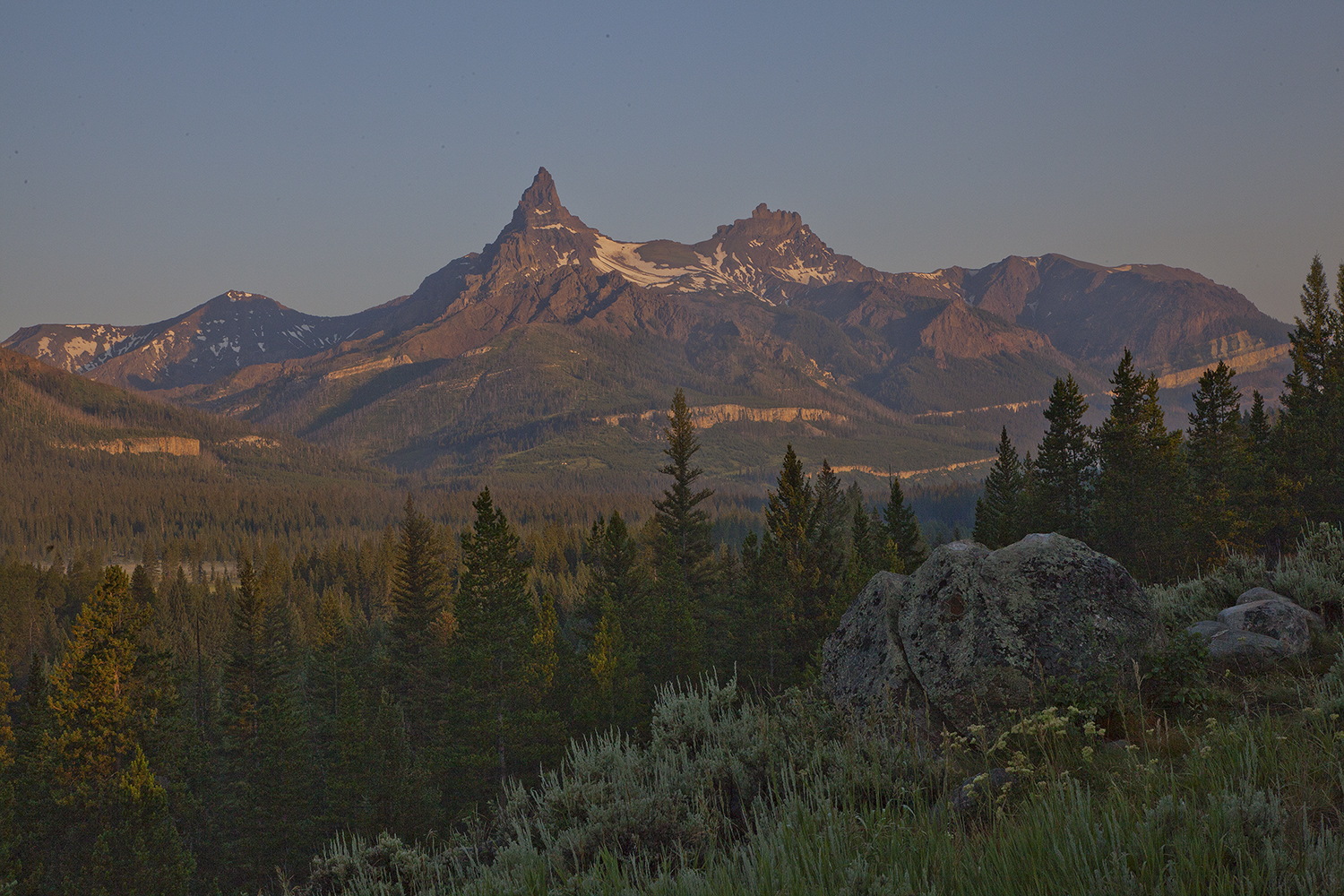
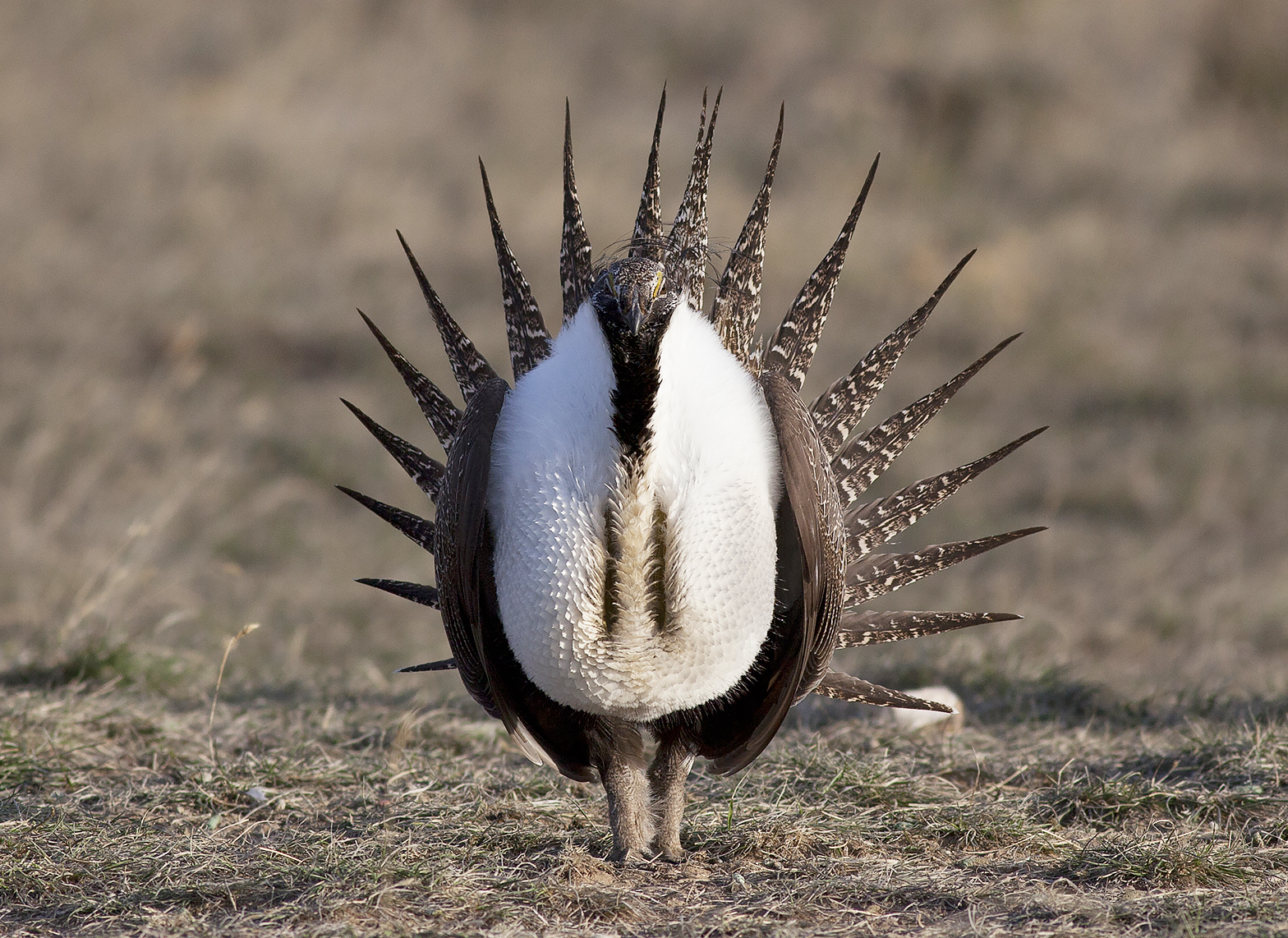
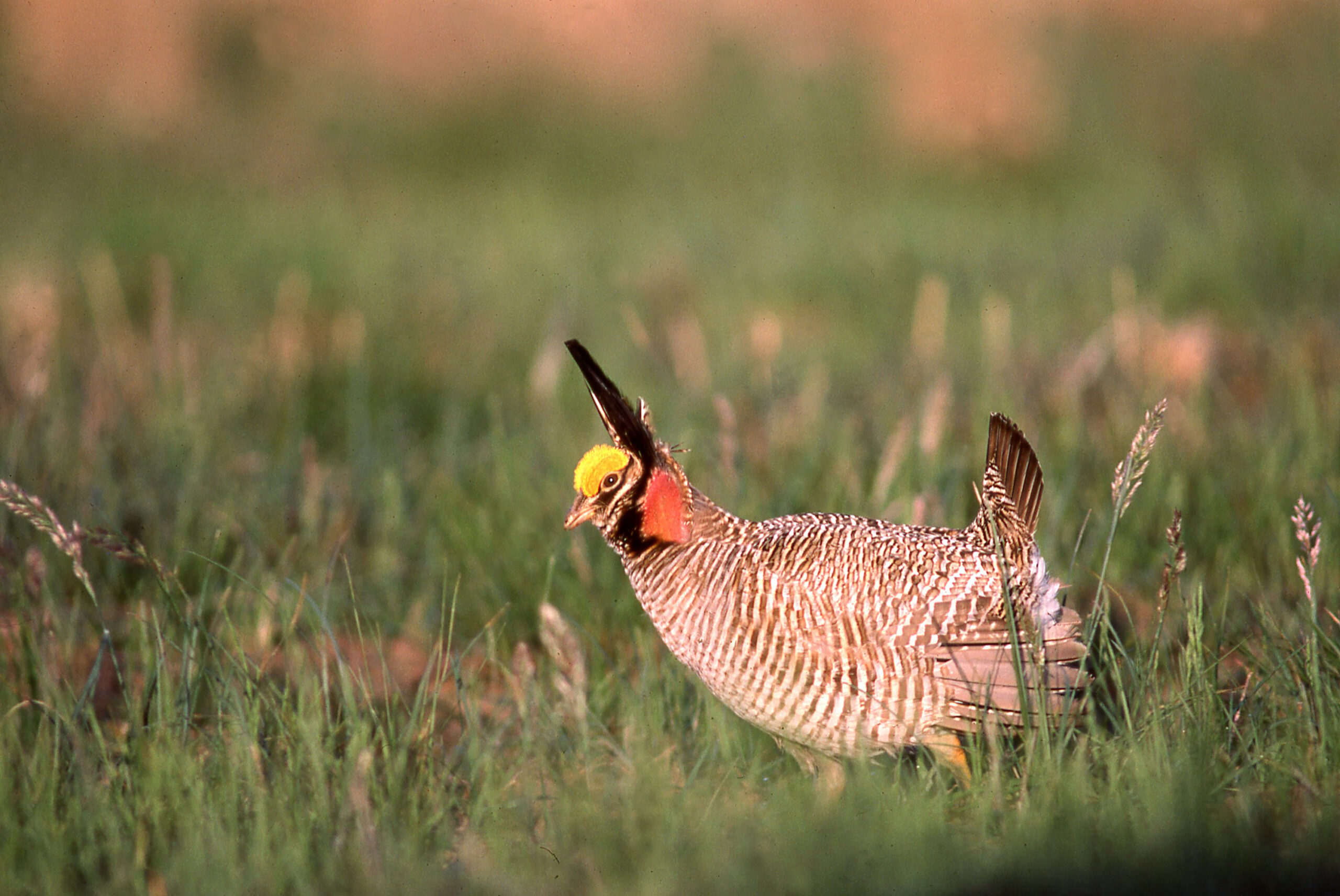
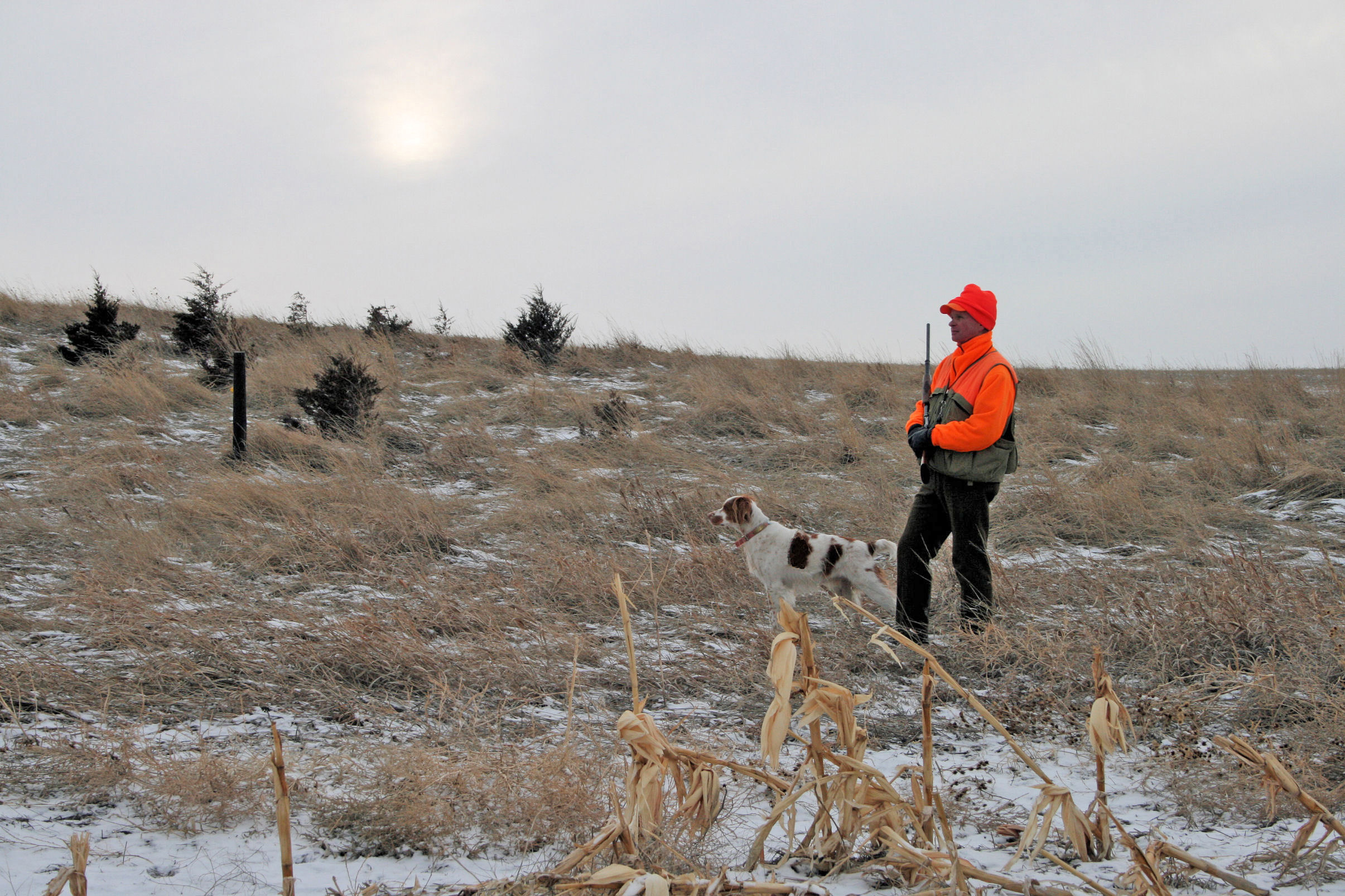
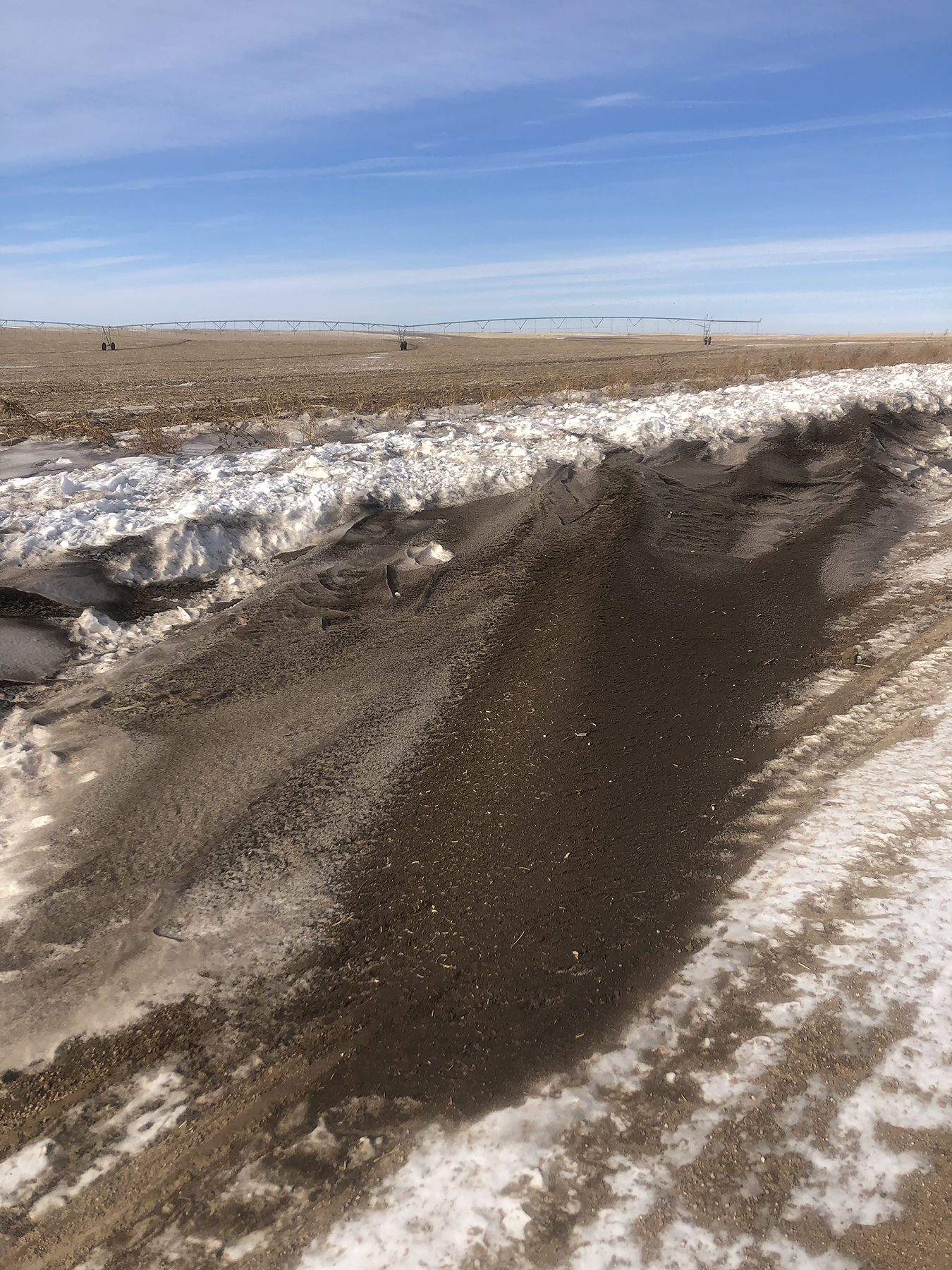
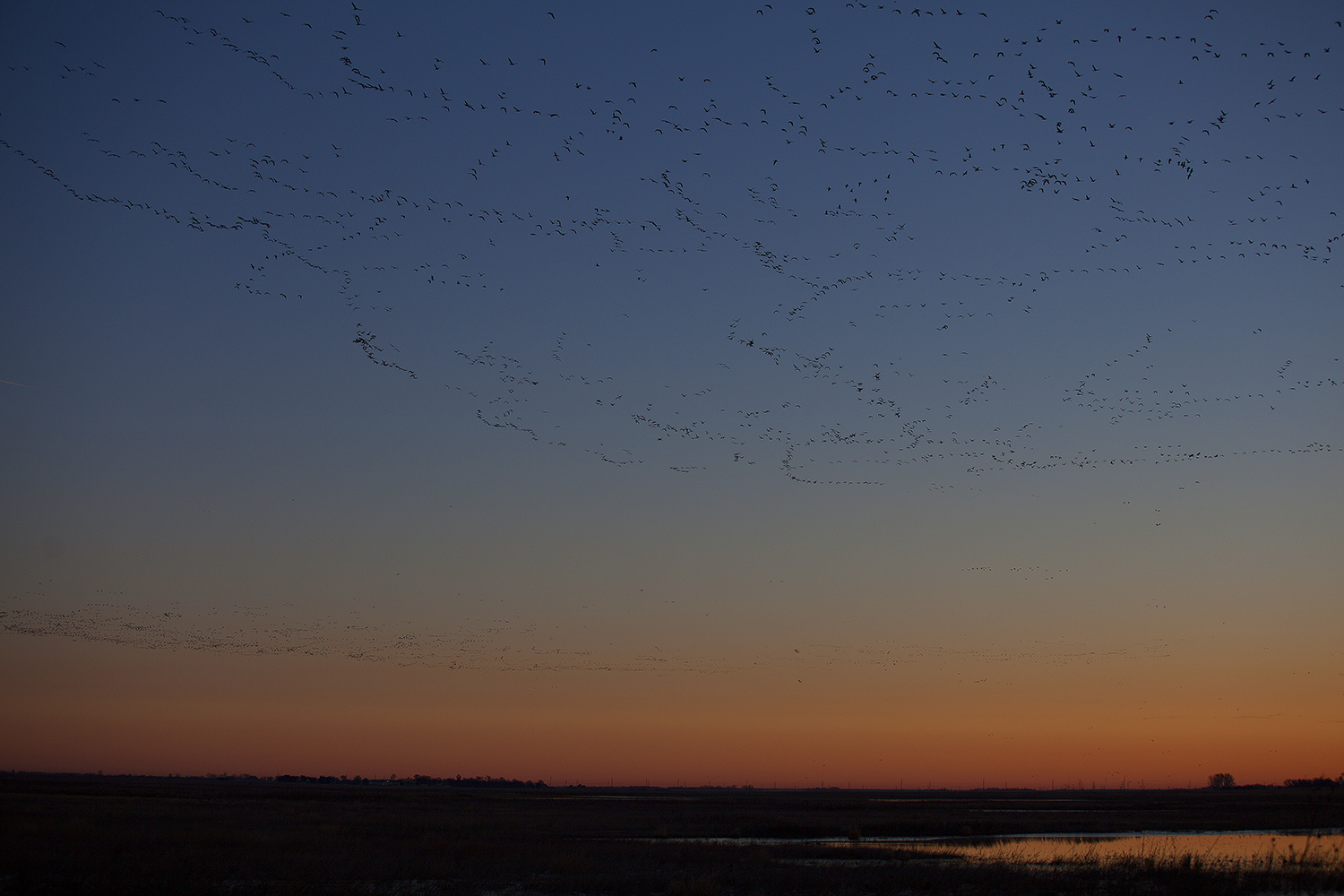
 SAM HARRIS RECENTLY POSTED A PODCAST OF A CONVERSATION WITH THAT CHAMPION OF EVOLUTIONARY