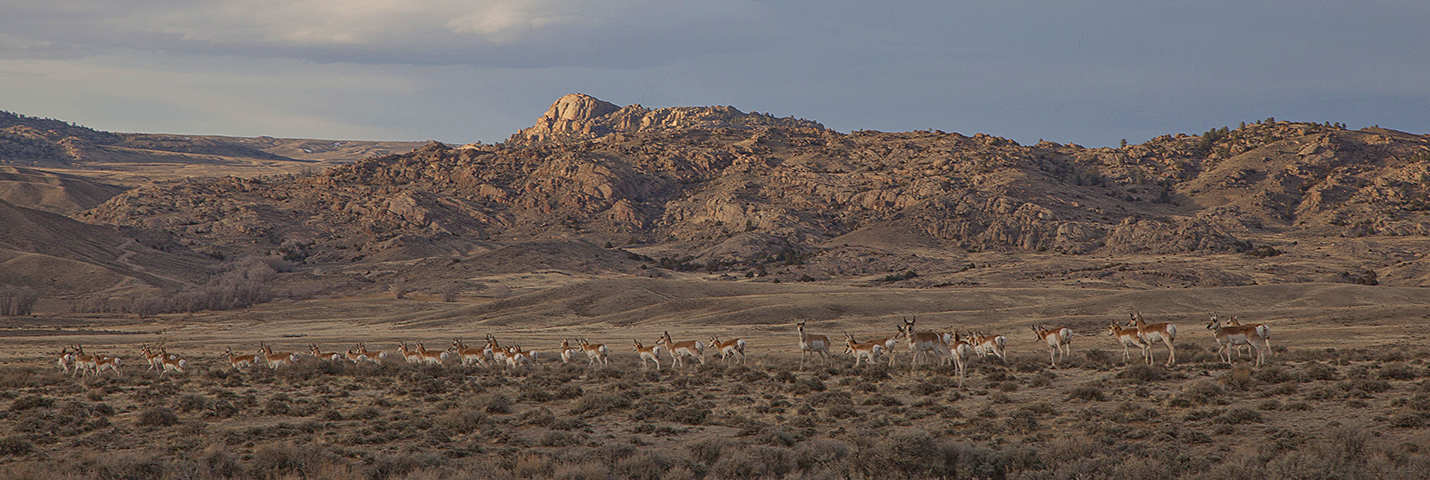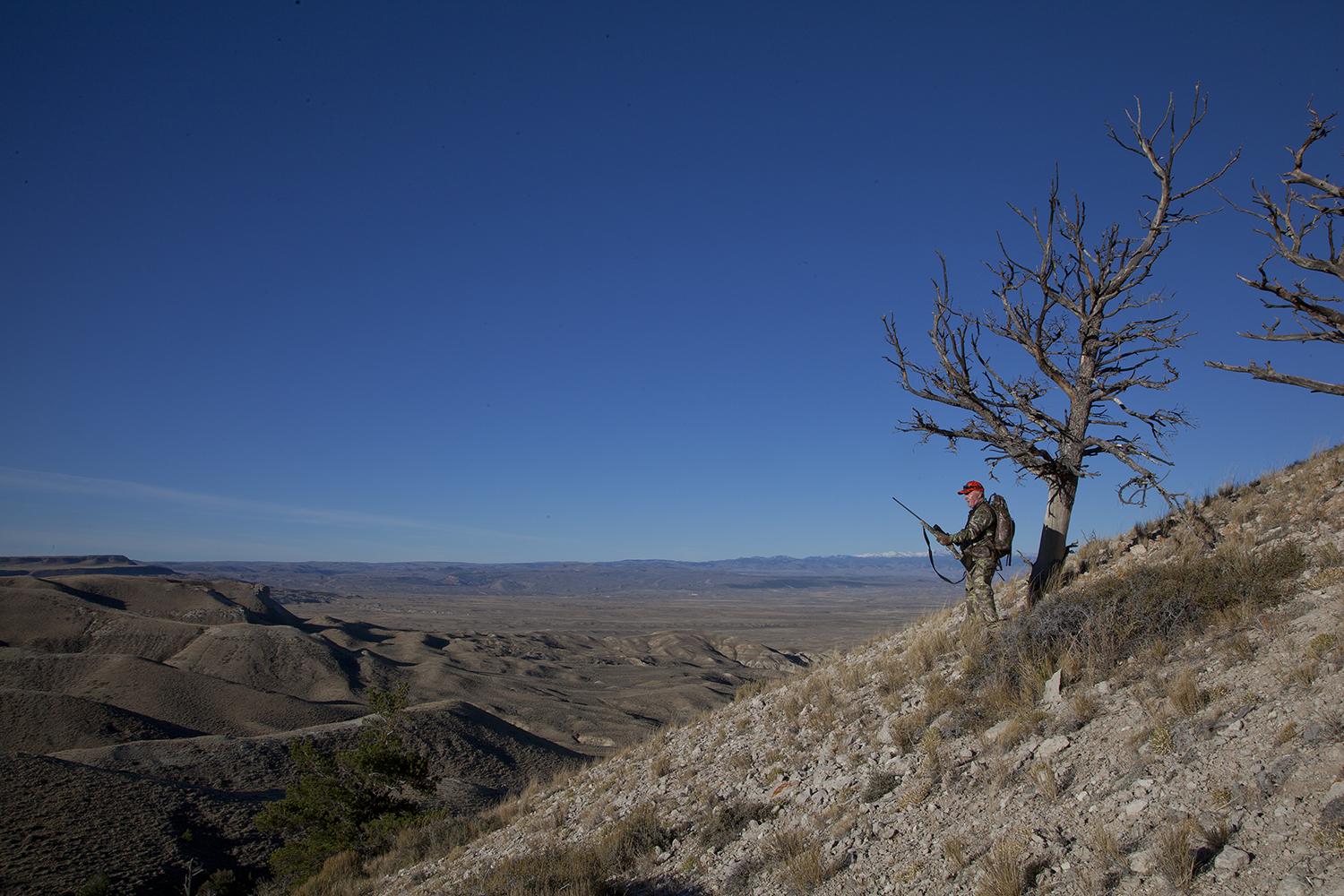
Deer hunter on Beaver Rim, Wyoming. (Photo copyright 2017, Chris Madson, all rights reserved)
ABOUT A WEEK AGO, A WOMAN ON FACEBOOK POSTED A DECEPTIVELY SIMPLE QUESTION: “WHY DO MEN HUNT?” I DON’T THINK she intended to be provocative, but whether she wanted to start a heated argument or not, she certainly succeeded. Since I’ve been a hunter all my life, I was curious to find out how the responses to her question described my motives and psyche.
Looking down through these comments, I saw that various people thought of me me as one or more of the following: 1) a hypocrite who talks about living with the planet while entertaining myself by killing my fellow creatures; 2) a control freak who hunts to establish my dominance over lesser creatures; 3) a fiend driven by an excess of testosterone; 4) a sadist who kills simply for the pleasure of shedding blood; 5) a eunich who attempts to compensate for his lack of sexual prowess by exerting “extreme ultimate power” over other animals; 6) a male who is driven to kill by the instinct to procreate; or 7) a person so lacking in self esteem that he must kill to cover his weakness and impotence. These insights are offered mostly by people who freely admit that they do not hunt and have never hunted.
Any effective answer to the original question would fill most of an encyclopedia. I have a stack of books here on my desk that attempt to respond, and I’m working on another one myself. Here, I’d like to make just one or two points.
First, it is not possible for a human to live on earth without killing. Taking the vegan pledge doesn’t relieve a person of the responsibility for the death of many fellow beings. We all have an effect on other living beings, whether we eat meat or not. We demand space, water, and food, all of which deprives other living things of resources they must have in order to survive. We are changing the climate with our appetite for energy; we kill millions of animals on our highways; we pollute the world’s air, water, and soil. The effects of these elements of our lives are infinitely more pervasive and dangerous to wild land and the wildlife it supports than any hunting that currently occurs in North America.
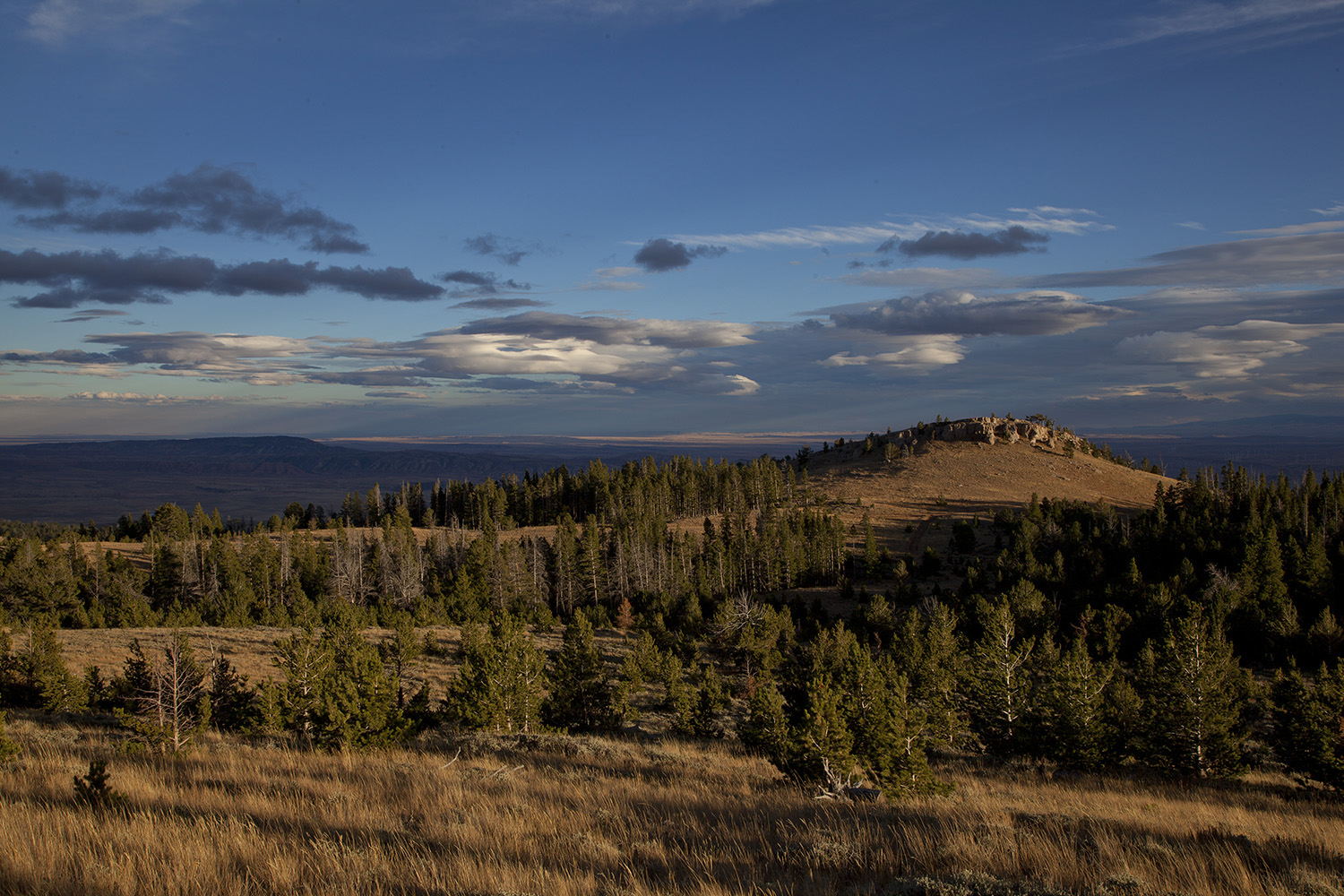
An elk hunter’s view at the top of the world. (Photo copyright 2018, Chris Madson, all rights reserved)
Those who depend on vegetable sources for protein should take a hard look at the impacts agriculture has on the natural world. Take a look at a harvested soybean field, which is about as welcoming to life as a Walmart parking lot. And the vegetarian kills plants. Is this somehow less objectionable than killing animals? We know that plants are sentient, capable of sensing their environment, reaching for key nutrients, even responding to sound and touch. I submit that the distinction we make between plants and animals is a distinction of convenience, nothing more. We make it because an objective ecological analysis would reveal an uncomfortable reality: The vegetarian kills to live, just as surely as the omnivore. Some may consider this as a manifestation of original sin, a trap of immorality that we cannot escape. I prefer to see it as an affirmation of our inextricable link with the land. Either way, it is a fact of life.
Industrial-scale production of food as it is practiced in the civilized world today is unspeakably violent, whether the final product is cotton, soybeans, chicken, or beef. The reality of domestication itself may be the most nakedly violent projection of human dominance in our long history on the planet. None of us can completely divorce ourselves from these realities of western civilization, but, as strange as it may seem, hunting is an effective way to minimize support for some of the most distressing of them.
Nearly all the meat my family and I have eaten over the last forty years has been taken in the wild. I have to face the violence that provides that meat. I see the life fade from the eyes of the beautiful wild things I take to feed my family. I confront the natural process that brings life from death. I do it with humility and gratitude. I do it sustainably, partly because that is an element of the ethical debt I owe to the animals I have killed and partly because, from a very practical point of view, I depend on the continued well-being of the game populations that support me.
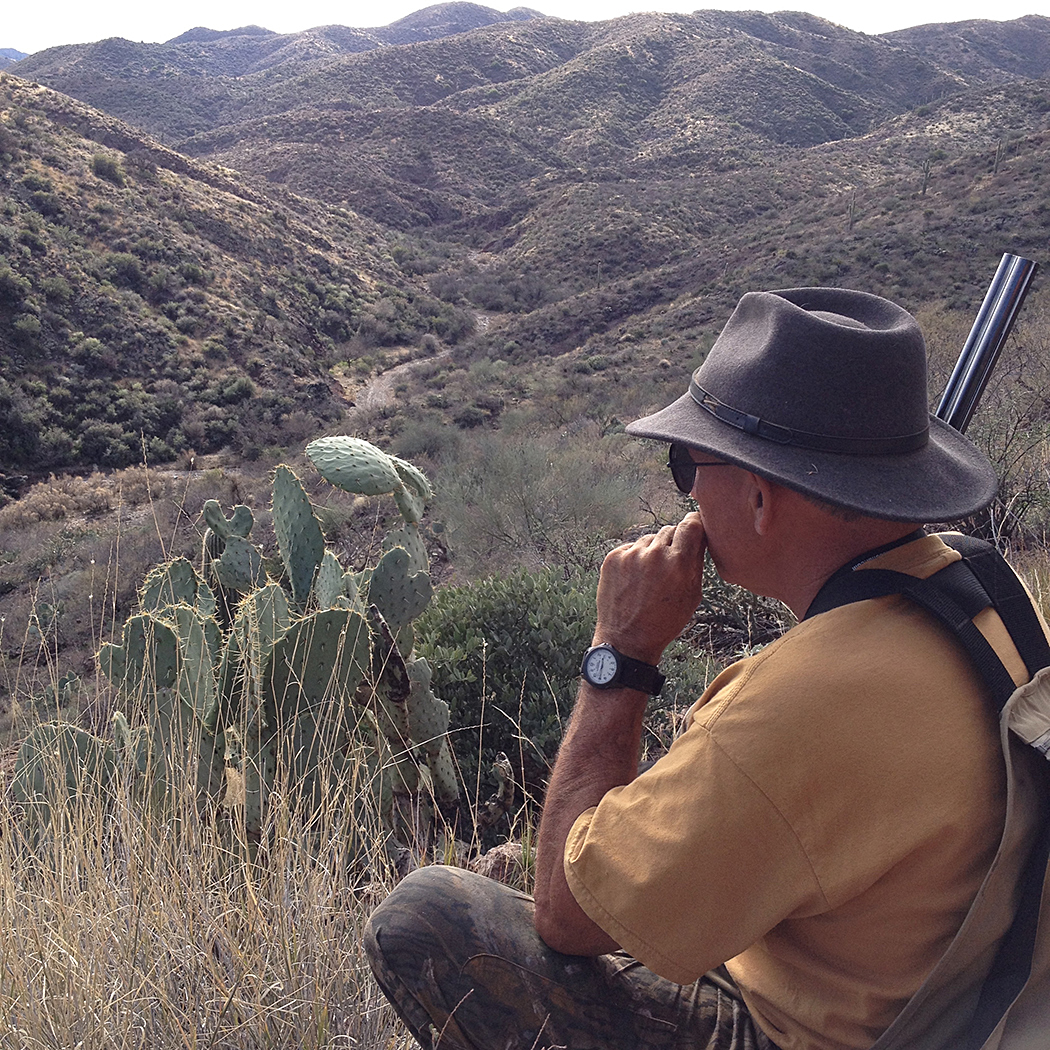
A Gambel’s quail hunter under the Mogollon Rim in central Arizona. (Photo copyright 2015, Chris Madson, all rights reserved)
Wild country has always been the centerpiece of my life. I enjoy wild places in many ways— hiking, backpacking, canoeing, feeding birds in the backyard. These are all sources of insight and peace in my life. But they also reinforce the mistaken feeling that I am somehow apart from the natural world. When I take the role of predator, I am a part of the natural world. I feel that, and the animals I pursue feel it as well. I am a participant, not an onlooker. I come away from the hunt with an understanding of wild places and wildlife I could not get any other way. And I come away with a sense of belonging, a reverence for the world that supports me, and a fundamental understanding of my place in it all. For me, hunting is, at once, a practical harvesting of sustenance, an immersion in places and processes outside of my otherwise urban way of life, and, finally, a source of spiritual renewal.
I have had this conversation with many people who have never hunted. Now and then, I meet a person who is willing to consider the history and prehistory of human hunting, who is willing to stretch his or her imagination to grasp some of what I’m trying to express. More often, I simply can’t find a way to communicate matters of this depth. Occasionally, I’m accused of self-deception, outright lying, or a cynical effort to camouflage my real intentions. I can only say that I am being as honest as I know how in my effort to describe a central part of my life, a communion that I have inherited from generations of hunters, whose traditions and emotions may be older than the human species itself. I don’t claim to speak for any other hunter, only myself. I cherish the hope that some of you who read this will do me the courtesy of believing that I am at least sincere.
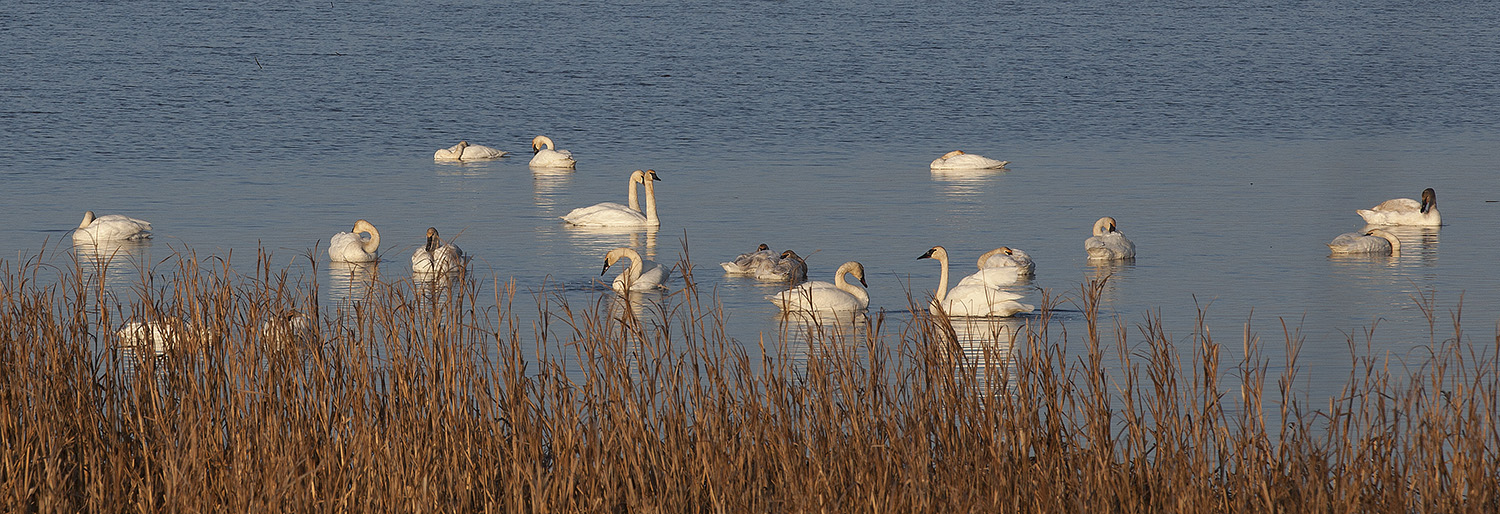
Trumpeter swans at Loess Bluffs National Wildlife Refuge in northwestern Missouri. (Photo copyright 2017, Chris Madson, all rights reserved)
IN 2001, THREE LUMINARIES OF THE WILDLIFE PROFESSION, VALERIUS GEIST, SHANE MAHONEY, AND JOHN ORGAN, were called upon to consider the role hunting has played in the development of wildlife conservation in America. The paper they presented at the 66th North American Wildlife and Natural Resources Conference, “Why hunting has defined the North American model of wildlife conservation,” (Geist, et al., 2001) was immediately hailed as a ground-breaking analysis of the influence hunters have had in the recovery of wildlife populations, many of which were on the brink of extinction little more than a century ago.
As hunting and hunters have come under renewed attack in the last thirty years, the message this paper delivered has become more and more important. For generations, hunters have provided irreplaceable funding and political support for conservation, and their demand for abundant, widely distributed game populations has protected millions of acres of habitat and provided the impetus for the creation of millions more. The bond between hunters and the places they hunt has proven to be a powerful force in conservation, and it will continue to exert great influence for generations to come.
Many of the most persuasive voices in the conservation movement have belonged to hunters— Frank Forester, John James Audubon, George Bird Grinnell, Theodore Roosevelt, Aldo Leopold, and scores of others convinced the American public that wildlife and wild land are essential parts of our national heritage, as precious as the American flag and our founding documents.
For all these reasons, the wildlife profession not only embraced the Geist paper but began to refer to it in the same reverential tones once reserved for A Sand County Almanac. “The North American Model” has become a catch phrase in any philosophical discussion of wildlife management and an instant rebuttal to nearly any criticism leveled against the profession. Since we in the business offer it as a comprehensive defense against any attack, it should come as no surprise that, in recent years, a small but growing number of critics have pointed out what they believe to be shortcomings in our implementation of the model and, in a few cases, blind spots in the model itself. [See, most recently, Artelle, et al., 2018.]
This ongoing interchange has led to several newer publications. Perhaps the most comprehensive is The Wildlife Society’s technical review, “The North American Model of Wildlife Conservation,” [Organ, et al., 2012] undertaken by sixteen wildlife professionals, including the three authors of the 2001 paper. In that document, the authors list challenges the seven tenets of model face and offer responses. What they do not do is offer any revisions to the tenets as they were originally stated.
I think there’s great virtue in several of the tenets described by Geist, et al.: Our wildlife should be held in trust for the public, as they point out; it’s generally a good thing that, with some salient exceptions, markets for wildlife are no longer legal; allocation of wildlife by law is right and proper, as is the “democracy of hunting,” which grants “all citizens the opportunity to participate.”
But I think there are elements of the other three tenets in the model that are confusing and, with increasing regularity, expose the profession of wildlife management to criticism it does not deserve. Probably most important, the model as it currently exists fails to give weight to one of the longest standing missions of wildlife managers and wildlife conservation itself. Here are my concerns:
Wildlife can only be killed for a legitimate purpose
There continues to be vigorous debate over the idea that “wildlife can only be killed for a legitimate purpose.” The devil resides in the definition of “legitimate.” In Wyoming, hunters are allowed to leave the neck and ribs of a big game animal in the field while taking only the
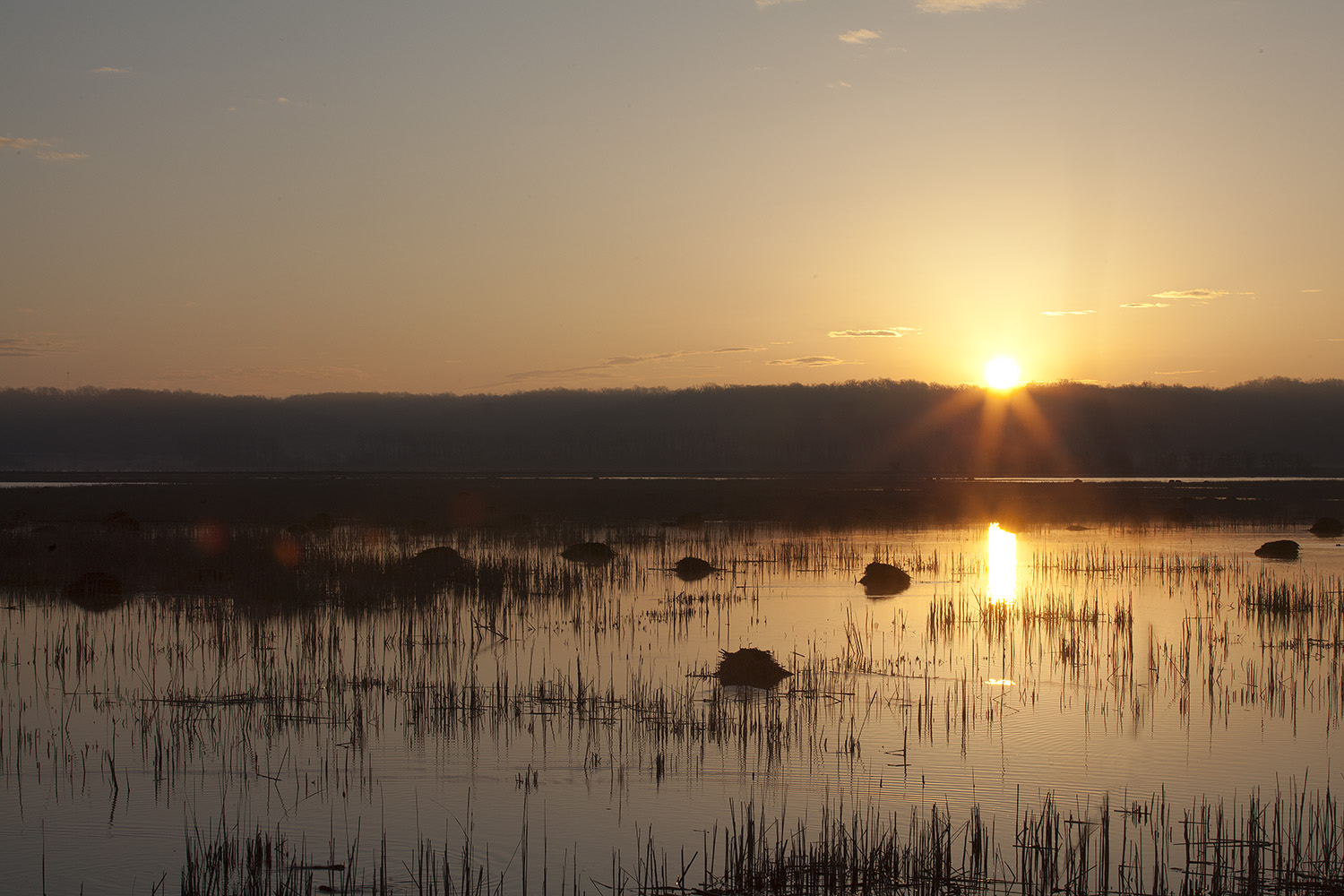
Muskrat houses at sunrise on Loess Bluffs National Wildlife Refuge, Missouri. (Photo copyright 2017, Chris Madson, all rights reserved)
upper legs, loin, and tenderloin. In Alaska, this would be considered wanton waste. Is one of these more legitimate than the other? Faced with justifying the take of furbearers for no more than their pelts, the professional manager may have little more than historical precedent to offer in defense of this as a “legitimate purpose.” All this confusion when, from a strictly ecological point of view, the whole idea of meat, hide, extremities, or internal organs left in the field as being somehow “wasted” is an oxymoron. Unused parts from a dead animal are more surely wasted if they are consigned to a sanitary landfill than if they are left in the habitat where the animal died. The wildlife profession approaches this issue with remarkably little underlying thought or consistency. At the very least, we should consider an overarching definition or definitions of the word “legitimate.”
Wildlife are considered an international resource
Another tenet of the model is that “wildlife are considered an international resource.” Well, animals that move back and forth across international boundaries are certainly considered “an international resource,” except, possibly, in the cases of some marine mammals and fishes. While we use this expansive classification quite successfully in the management of
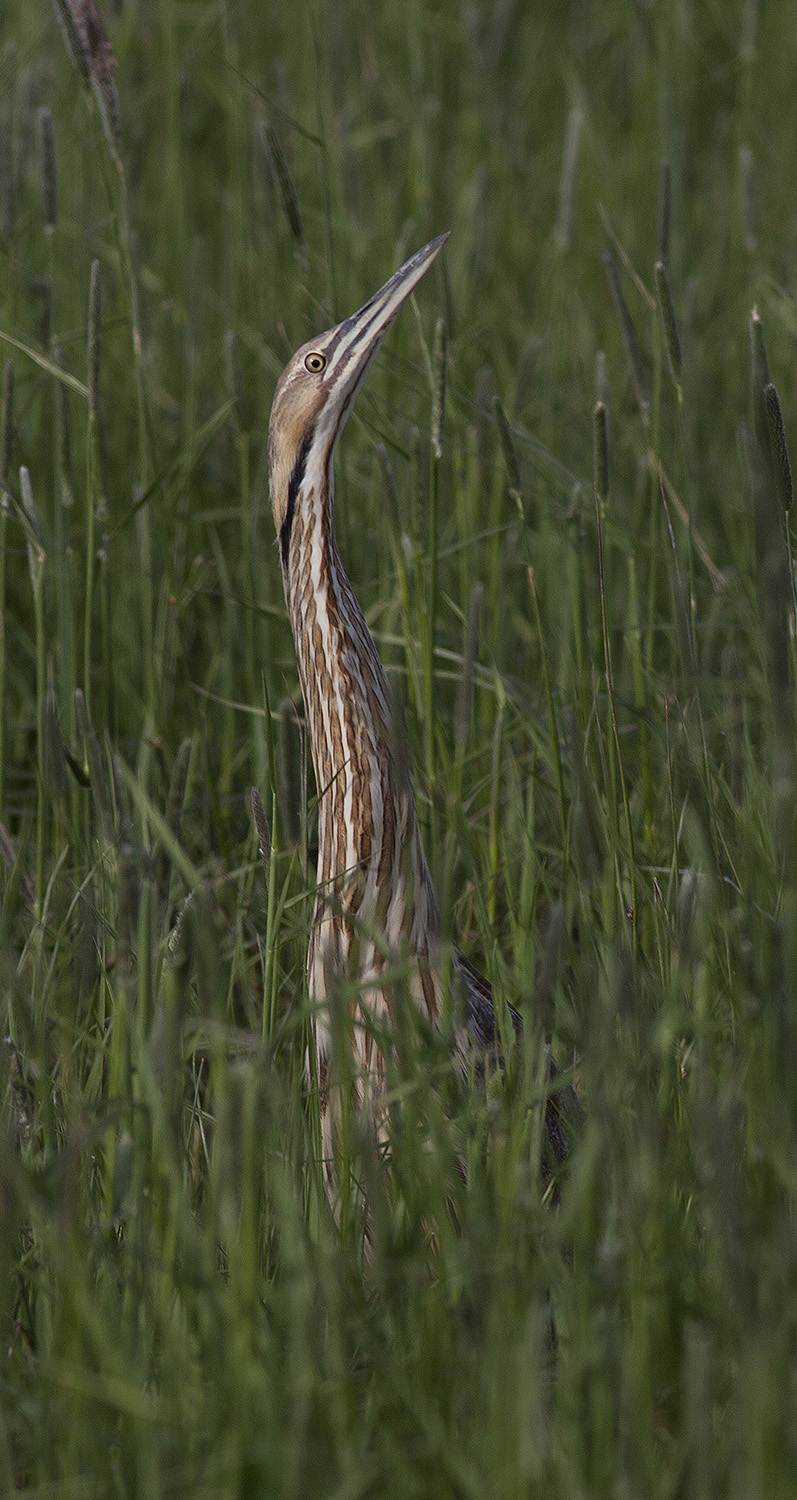
Bittern on Cokeville Meadows National Wildlife Refuge, Wyoming. (Photo copyright, Chris Madson, 2015, all rights reserved)
waterfowl, it seems to me that we struggle to apply it effectively in the conservation of locally rare mammals like the wolverine and gray wolf, as well as many of the neotropical migrant birds. The concept of a “distinct population segment,” which could be considered as a challenge to this tenet since it is essentially contradicts the general idea of connectivity and broad distribution, is a matter of repeated legal confrontations. We continue to engage in periodic donnybrooks over the authority of state wildlife managers versus their federal counterparts when it comes to populations of wildlife that may cross state boundaries or move in and out of federal reservations. Some wildlife is remarkably sedentary; other wildlife often moves inconveniently across all sorts of political boundaries. This tenet as it has been understood and is currently applied seems to be the subject of extensive debate. At the very least, it could use some clarification.
Science is the proper tool for discharge of wildlife policy
And the one remaining tenet: “Science is the proper tool for discharge of wildlife policy.” These are the words in the original paper, and they are carefully chosen. Certainly, we would be remiss if we did not collect pertinent data on how a given management decision affects the wildlife population it’s designed to influence. Easily said— much harder to do. Dependable indices to population size are a starting point in nearly any management effort, but as any field professional will tell you, getting really dependable indices is remarkably difficult and expensive for most big game populations and nearly impossible for most species of small game, especially when those estimates need to be made at a landscape scale at least once a year. The profession does the best it can, but I think we have to admit that the application of science to the task of monitoring game populations is still far from perfect. Where data are incomplete or lacking, management decisions still have to be made.
Beyond the practical challenges of applying sound techniques of data collection on a landscape scale, I’m concerned that this tenet has been paraphrased into something like: “We believe in science-based management.” Geist and his colleagues stressed that science was a tool for the “discharge” of wildlife policy. The paraphrased version of the Geist tenet can easily lead off toward the idea that wildlife policy should be based on science.
I don’t know how that can be done. An unbiased approach to collection of data can answer a lot of questions about the current state of a wildlife population and its habitat. It can help us understand the effect of a management action or other changes in the environment. In a few cases, it may even help us predict the effect of an action we haven’t yet taken.
What it cannot do is answer any question that starts with: “Should we . . . ?” Science can’t tell us whether we should protect a species from extinction. It can’t tell us whether we should allow construction in a deer migration corridor, dam a creek, log a hillside, apply a pesticide, impose antler restrictions, or close a hunting season. These are questions that can only be answered by consulting our values. Wildlife policy has always been driven by collective preference, prejudice, and, quite often, moral judgment. The only help science can give us in these matters has more to do with opinion surveying than aerial transects or call counts. To suggest that science can somehow help us decide what we want is not only inaccurate but opens science to accusations of bias that damage the discipline.
The missing eighth tenet: the importance of nongame
This brings me to a glaring omission in the Geist paper. There should be an eighth tenet. Boiled down to its essentials, it should go something like: “All wildlife has value, whether we hunt it or not.” This would account for the huge gathering of wildlife that is classified as “nongame.”
I’m not surprised that Geist and his co-authors neglected this element of wildlife conservation in North America. Their primary goal in drafting the paper for the North
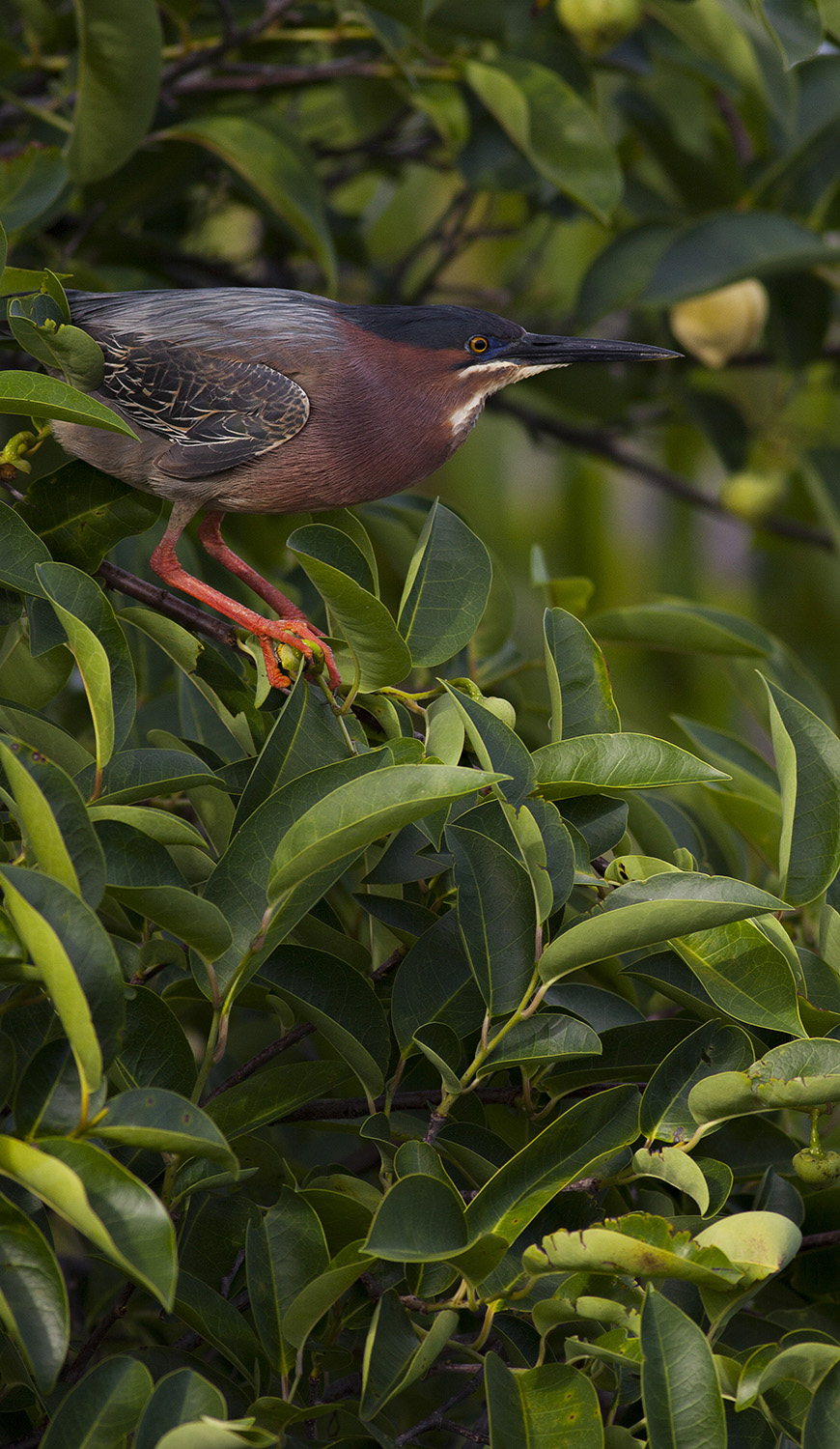
Green heron. (Photo copyright 2016, Chris Madson, all rights reserved)
American was to defend hunting as a critical part of the broader conservation movement. Their use of the broad term “wildlife” faintly implies that nongame species have benefited from the application of the model— which is true— but tenets that stress “elimination of markets,” allocation of wildlife,” and “the democracy of hunting” suggest strongly that, in this paper, “wildlife” mostly means “game.” In the context of the argument the authors were making, this is understandable.
What I have more trouble understanding is why the wildlife profession has still not included nongame explicitly in its “North American model.” It certainly isn’t because we’ve ignored nongame. As early as 1705, researchers were in the field in the American wilderness, risking their health and often their lives to catalog nongame species. John Lawson, Mark Catesby, the Bartrams, Alexander Wilson, and a score of others labored to open the eyes of people on both sides of the Atlantic to the diversity and abundance of wildlife in the New World. By the time Audubon came on the scene, a community of natural historians was already well established in America, and they were already concerned about the declines of nongame species and natural systems they were witnessing.
The smoke had barely cleared from the battlefields of the Civil War when a new generation of conservationists— almost all of them hunters— began the effort to protect nongame animals from the ravages of habitat loss, overharvest, and pest control. The federal government’s Bureau of Economic Ornithology was established in 1885 with the primary mission of convincing farmers that most nongame birds weren’t threats but assets. In 1886, the avid hunter George Bird Grinnell launched the Audubon Society, mainly to galvanize protection for plume birds. The Migratory Bird Treaty Act was adopted in 1918, not only to rebuild populations of waterfowl but to protect all migratory nongame birds.
In the modern era, wildlife managers with federal and state agencies along with a host of private-sector groups are moving mountains to understand the ecology of nongame species, from plants to mammals, and protect populations that are in trouble. The Endangered Species Act gives legal protection to rare plants and animals and has been instrumental in the recovery of taxa as diverse as the bald eagle and the Colorado butterfly plant. The nascent State Wildlife Action Plan has mandated a comprehensive approach to cataloging nongame and provided some money to help the work along. More funding, more manpower would help the work go faster, but there’s no doubt that nongame management is an intrinsic part of modern conservation.
None of this is even mentioned in the “North American Model” as it is currently written.
From a strictly philosophical point of view, I find this disturbing. It neglects a rich part of
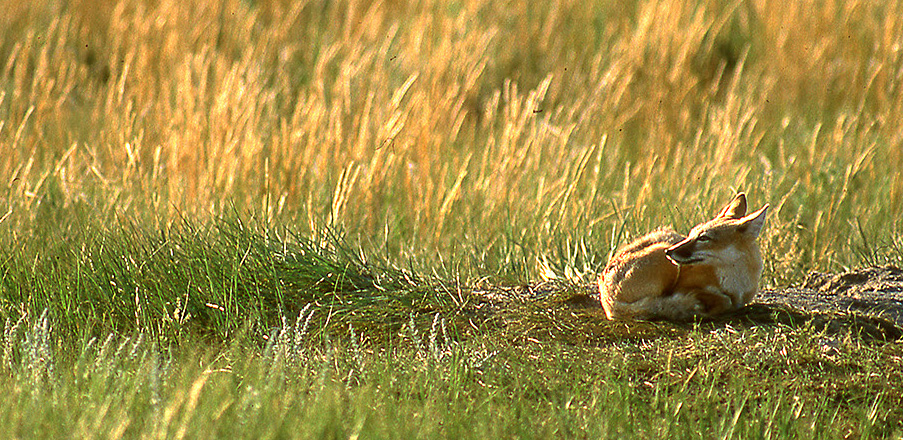
Swift fox, Shirley Basin, Wyoming. (Photo copyright 2012, Chris Madson, all rights reserved)
the history of the wildlife management profession and fails to stress that, over the history of conservation, hunters have been motivated by much more than a selfish interest in producing targets.
From a more practical point of view, the failure to present a model that accurately portrays wildlife conservation leaves the profession and the community of ethical hunters open to criticism from groups who are genuinely interested in maintaining abundant, diverse wildlife as well as organizations whose main interest is in disrupting the conservation traditions that have brought us so far. When we’re called on to defend our efforts, it would be useful to have an accurate description of American wildlife management in the “model” that intends to define it.
The upshot
I certainly don’t offer this critique to impugn the contribution represented by the original paper. It’s clear that the profession needed a statement of philosophy when Geist and his colleagues made their presentation, and it remains an excellent foundation on which to base our work. However, I think there are difficulties with the current description of wildlife management contained in the model, and I don’t agree with the authors of the TWS review that we should not “revise, modify, or otherwise alter what has heretofore been put forward as the Model.” We should do precisely that.
I hasten to point out that I’ve been a hunter all my life. I feed my family on wild game. I hunt for the freezer; I hunt for connection with the wild world; I hunt for spiritual renewal. I heartily support the notion that hunting has been, is, and, in all likelihood, will continue to be a critical part of wildlife conservation in America. But game management, hunter management, are subsets of the profession of wildlife conservation. We would serve ourselves better if we gave the world a model that accurately reflects everything we do, not just a part.
I hope these comments encourage discussion to that end.
Literature cited:
Geist, Valerius, Shane P. Mahoney, and John F. Organ, 2001. Why hunting has defined the North American Model of Wildlife Conservation. Transactions of the 66th North American Wildlife and Natural Resources Conference 66: 175-185.
Artelle, Kyle, A., John D. Reynolds, Adrian Treves, Jessica C. Walsh, Paul C. Paquet, and Chris T. Darimont, 2018. Hallmarks of science missing from North American wildlife management. Science Advances 4(3): eaao0167, 7 March 2018.
Organ, J.F., V. Geist, S.P. Mahoney, S. Williams, P.R. Krausman, G.R. Batcheller, T.A. Decker, R. Carmichael, P. Nanjappa, R. Regan, R.A. Medellin, R. Cantu, R.E. McCabe, S. Craven, G.M. Vecellio, and D.J. Decker, 2012. The North American Model of Wildlife Conservation. The Wildlife Society Technical Review 12-04. The Wildlife Society, Bethesda, Maryland, USA.
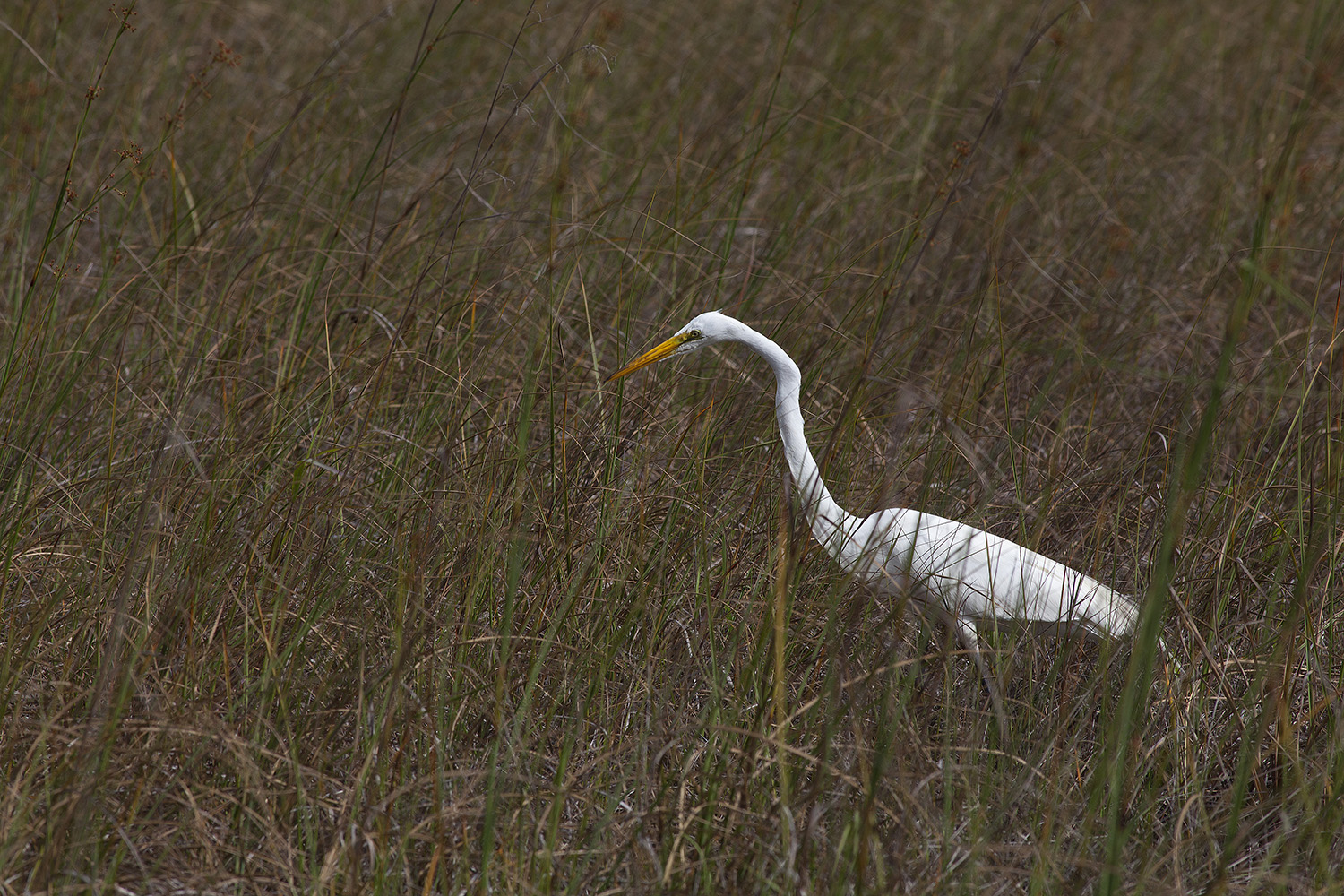
The great egret, one of several species of wading birds that were pursued for their plumes in the late nineteenth and early twentieth centuries. Frank Bond was a major influence in the protection of these birds and the establishment of the national wildlife refuge system. (Photo copyright 2016, Chris Madson, all rights reserved)
ON FEBRUARY 14, 1901, THE MEMBERS OF THE SIXTH WYOMING LEGISLATURE DID SOMETHING THAT SEEMED UTTERLY OUT OF character. These were men who had settled the frontier, cattlemen and miners, an unsentimental bunch of hard-nosed businessmen who spent most of the session deliberating over placer claims, wolf bounties, and licenses for the sale of liquor.
For someone looking back on the men and their times, it’s a bit of a shock to come across this passage in Governor DeForrest Richards’ message to that legislative body “I would respectfully recommend that some measure be passed guaranteeing protection to our song and insectivorous birds.” Ten days later, Senator Charles Guernsey introduced “an act to protect birds and their nests and eggs.”
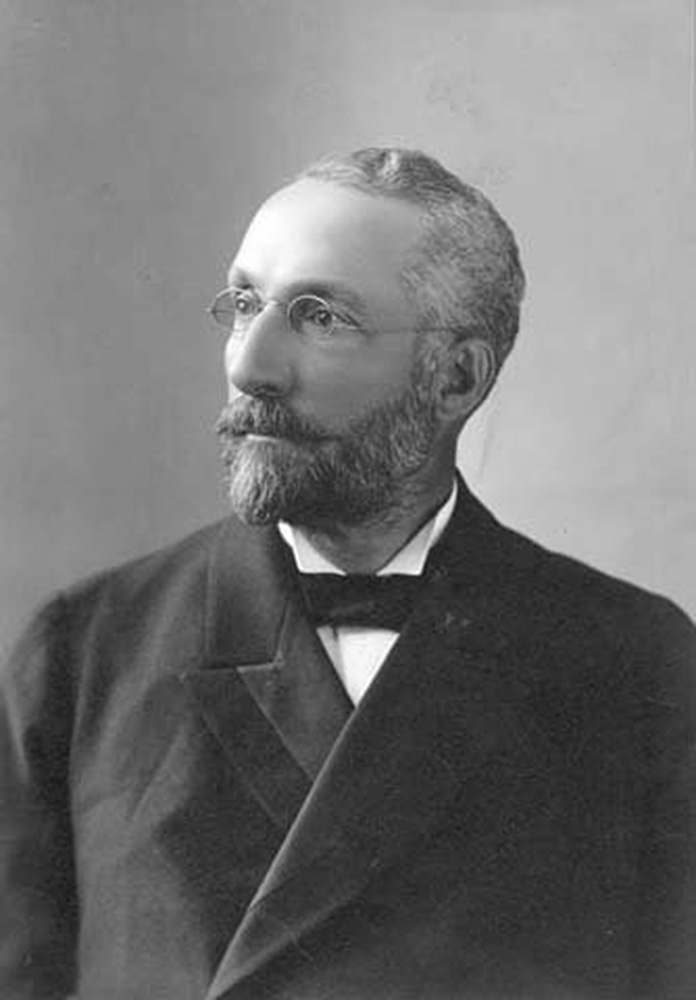
DeForrest Richards, governor of Wyoming, 1901 to 1905, and an advocate of Frank Bond’s model bird law. (Photo by W.G. Walker. Courtesy of Wyoming Archives and Historical Department)
“Any person,” Senator Guernsey wrote in his draft legislation, “who shall kill or catch any wild bird other than a game bird shall for each offence be subject to a fine of not more than five dollars for each such bird killed or imprisonment for not more than ten days, or both, at the discretion of the court. . . . Any person who shall take or needlessly destroy the nest or the eggs of any wild bird shall be subject for each offence to a fine . . . or imprisonment. . . .”
The record doesn’t tell us who voted for and against, but a majority of the legislators supported the proposal, and it took effect immediately on its passage. Wyoming’s sudden commitment to the protection of songbirds was surprising enough, but even more unexpected was the fact that Wyoming was the first state in the nation to approve such wide-ranging protection for nongame birds. Eight other states passed similar legislation in 1901, but Wyoming was the first to adopt the law and the first to put it into effect.
Conservation was not a foreign concept in the Wyoming of that time. Responsible citizens of the new state had recognized with growing concern the decline of big game, sage grouse, and trout and had taken the first steps toward reversing the losses of these valuable species, but this action on behalf of dickeybirds was something different. It was a commitment to a broader definition of wildlife’s value to the nation, and it was brought to Wyoming by a man with a talent for drawing and a passion for birds.
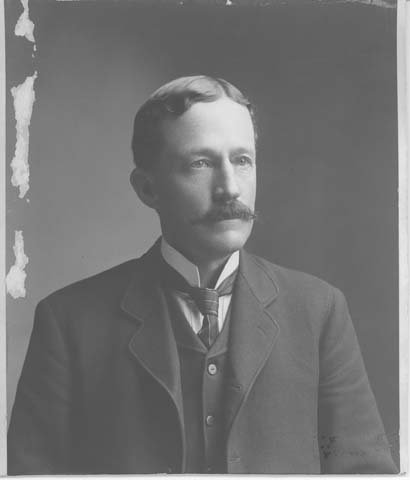
Fred Bond, Frank’s twin brother. Photos of Frank are hard to find. (Photo courtesy of Wyoming Archives and Historical Department)
Frank Bond climbed off the westbound train in Cheyenne sometime in late March 1882. He was twenty-five years old with a bachelor’s degree from the University of Iowa and an appointment as a draftsman with the Wyoming surveyor-general’s office.
He’d grown up on a prosperous farm near Iowa City where he developed an abiding love of the outdoors in general and birds in particular. With his twin brother, Fred, he collected and preserved more than 500 bird specimens during his college career, donating the collection to the university at the end of his undergraduate work. The opportunity to come west to the ragged edge of the frontier must have been irresistible.
When he wasn’t in the office, he was in the field, acquainting himself with new landscapes, collecting more bird specimens, and making careful notes on his natural history observations. By 1884, he’d completed his work for a master’s degree from the University of Iowa, and in 1887, he joined the American Ornithologists’ Union, a group of scientists and amateur birders that had formed in New York in 1883.
That year, he wrote his first ornithological paper, which appeared two years later in the AOU’s journal, The Auk. The subject was the Townsend’s solitaire, but his introductory remarks showed that his time in the field wasn’t spent solely in scientific pursuits.
“On December 7, 1887,” he wrote in the technical note, “I was invited by a conductor on the Cheyenne and Northern Railway, to go out to the end of the road and take a shot at mountain sheep. For the last three miles the road winds along in the magnificent North Platte Cañon and looks, from the brow of the perpendicular precipices on either side, like two silver threads glistening in the sun, and the construction train appears like the toy train of the nursery. I had with me only my long range Sharps rifle and was wholly unprepared to collect bird skins where were to be had here for the taking.”
He went on to report “countless thousands” of Townsend’s solitaires, robins, red-breasted nuthatches, and Steller’s jays feeding on juniper berries, “like school children out for a holiday.” The flocks chattered as they flew back and forth across the canyon— “It warms one’s heart,” he wrote, “to enter such a vale of melody in cold December.”
Bond’s obvious affection for songbirds was widely shared in the America of his time, but there were other views. Many immigrants from eastern and southern Europe embraced the traditions of the old country, which included the use of a wide variety of birds for the pot, with little concern for season or limit. They either shot the birds themselves or bought them from market gunners. In addition, a broad segment of the agricultural community was convinced that nongame birds ate grain before it could be harvested, and there was a widely held opinion that hawks and owls were a constant threat to poultry, which led many farmers to shoot raptors and songbirds on sight.
These motives must have accounted for the loss of a substantial number of nongame birds, but they paled into insignificance compared with the slaughter of birds for feathers used on women’s hats. Demand for the plumage of many species was intense, but the most prized were the breeding plumes of snowy and American egrets and a few other preferred species of wading birds.
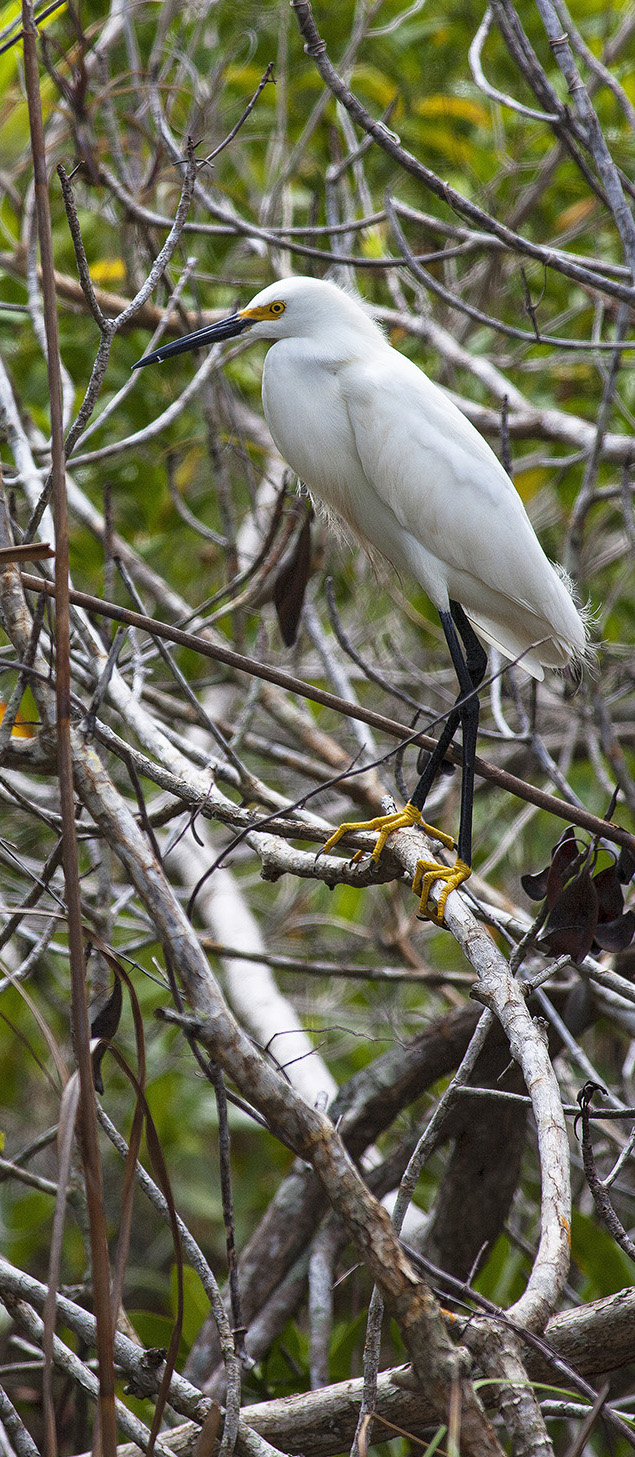
The snowy egret was pursued nearly to extinction to provide plumes of ladies’ hats in the late nineteenth and early twentieth centuries. Frank Bond was one of the major champions of a law to protect all nongame birds, including the snowy egret. (Photo copyright 2016 by Chris Madson, all rights reserved)
One observer of the feather trade at the turn of the nineteenth century wrote: “In 1903 the price of plumes offered to hunters was $32 per ounce, which makes the plumes worth twice their weight in gold.” (At the time, gold was selling for an average of $19 an ounce.) He reported that, in 1902, a single wholesale house in London sold 1,608 thirty-ounce packages of heron plumes. “These sales meant 192,960 herons killed at their nests, and from two to three times that number of young or eggs destroyed.”
In 1886, William Dutcher, a member of the AOU’s committee on bird protection, offered a similar report: “A New York taxidermist informed me that he had in his shop thirty thousand bird-skins, made up expressly for millinery purposes.” Demand had changed little in 1903 when he wrote that “nearly 80,000 Snow Buntings were found by a State game warden in a cold storage house in one of the larger eastern cities. The writer of this report has recently seen offered for sale by one of the leading department stores in New York such valuable birds as Flickers made up for millinery ornaments.”
One of the AOU’s primary reasons for being was to stop this uncontrolled carnage. In this first year of the organization’s existence, its members pressed the federal government to begin research on the ways birds benefitted agriculture. This pressure led to the formation of the Bureau of Economic Ornithology, forerunner of the U.S. Fish and Wildlife Service.
AOU member George Bird Grinnell used his position as editor of Forest and Stream magazine, which was the nation’s most influential outdoor periodical, to launch a new organization for the public. He called it the Audubon Society. The only requirement of membership was to sign a pledge to protect nongame birds. Within three years, the group had 50,000 members.
In its ongoing protection effort, the AOU drafted a model statute protecting nongame birds. The intent was to apprise state legislators of the problem and give them a way of solving it. Over the next fifteen years, AOU members visited states across the eastern part of the country in an effort to get the model law passed— with little success.
Bond was undoubtedly aware of all these measures. He remained active in the AOU and continued to contribute articles to The Auk as his knowledge of the region’s bird life expanded. At the same time, he was rising to a position of respect in the community. In 1890, he served a term in the state’s first legislature and by 1895, he had left the surveyor-general’s office and taken over as editor of the Wyoming Tribune, Cheyenne’s leading daily newspaper. If anyone was in a position to proselytize for adoption of AOU’s model bird law, Bond was the man.
Most of the issues of the Wyoming Tribune Bond edited have been lost to the deterioration of high-acid paper and poor storage, so there’s no way of knowing whether he used his position with the paper to push conservation the way George Bird Grinnell used Forest and Stream magazine on the national stage. It’s possible he editorialized on the issue, but considering the number of people in the state, he probably didn’t need to use print. In 1900, the city of Cheyenne had just over 14,000 residents, and the entire state’s population was under 100,000. Bond was in a unique position to sell the AOU’s model bird law to the handful of people who had settled in Wyoming, and following the examples of other prominent AOU members farther east, he certainly must have.
The governor’s support for a model law and the fact that Guernsey’s version passed so early in the session suggest that someone with connections had taken the time to acquaint the lawmakers with the plight of nongame birds and the growing public support for measures to protect them. Bond was almost certainly that someone.
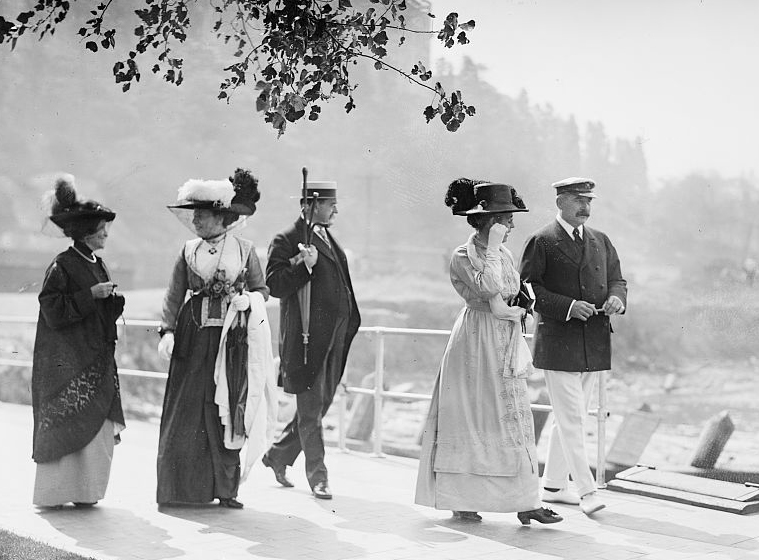
J.P. Morgan (right) strolling In New York City with three fashionable women, all displaying bird plumes on their hats. (Photo courtesy of the Library of Congress)
Two months after Wyoming passed its version of the law, Bond called an organizational meeting in Cheyenne to propose the establishment of an Audubon Society for the state. In a report later that year, an observer wrote that “quite a crowd of enthusiastic ladies and gentlemen assembled in the parlors of the Inter Ocean Hotel. It was found that public sentiment was overwhelmingly with the bird-protection movement, and that the new Audubon Society would soon embrace in its membership more than a thousand persons, in fact, two thousand members in Cheyenne, alone, did not appear an extravagant figure to those who met at the Inter Ocean hotel last evening.”
Frank Bond was elected president of the new group and immediately directed the treasurer to order another thousand pledge cards because the first thousand were “nearly exhausted.”
It’s an odd quirk of history that Bond launched the new group just as he was preparing to leave the state. The owner of the Wyoming Tribune, Joseph Carey, had just hired a new editor for the newspaper because Bond had accepted an appointment in Washington, D.C.
Irrigation wizard and Wyomingite Elwood Mead was in charge of “irrigation investigations” for the U.S. Department of Agriculture at the time. He knew Bond from their years in Cheyenne and was aware of Bond’s background as a cartographer with the Wyoming surveyor-general as well as his ability as a writer. Sometime in 1901, Bond made the move east, first to Mead’s irrigation investigations unit, and then to the federal General Land Office, forerunner of the modern Bureau of Land Management
The move to D.C. didn’t stop his conservation efforts, however. When Teddy Roosevelt set aside Pelican Island as a refuge for birds in 1903, Bond saw an opportunity to create a system of similar reserves on federal land elsewhere in the nation. He made a careful study of federal holdings and began to recommend especially productive habitats as “bird preserves.” According to T. Gilbert Pearson, who was then the chief executive of the National Association of Audubon Societies, Bond’s work effectively led to the creation of the national wildlife refuge system.
“It was he who prepared the Executive Orders and important explanatory letters of transmittal to the President for the remaining fifty-one
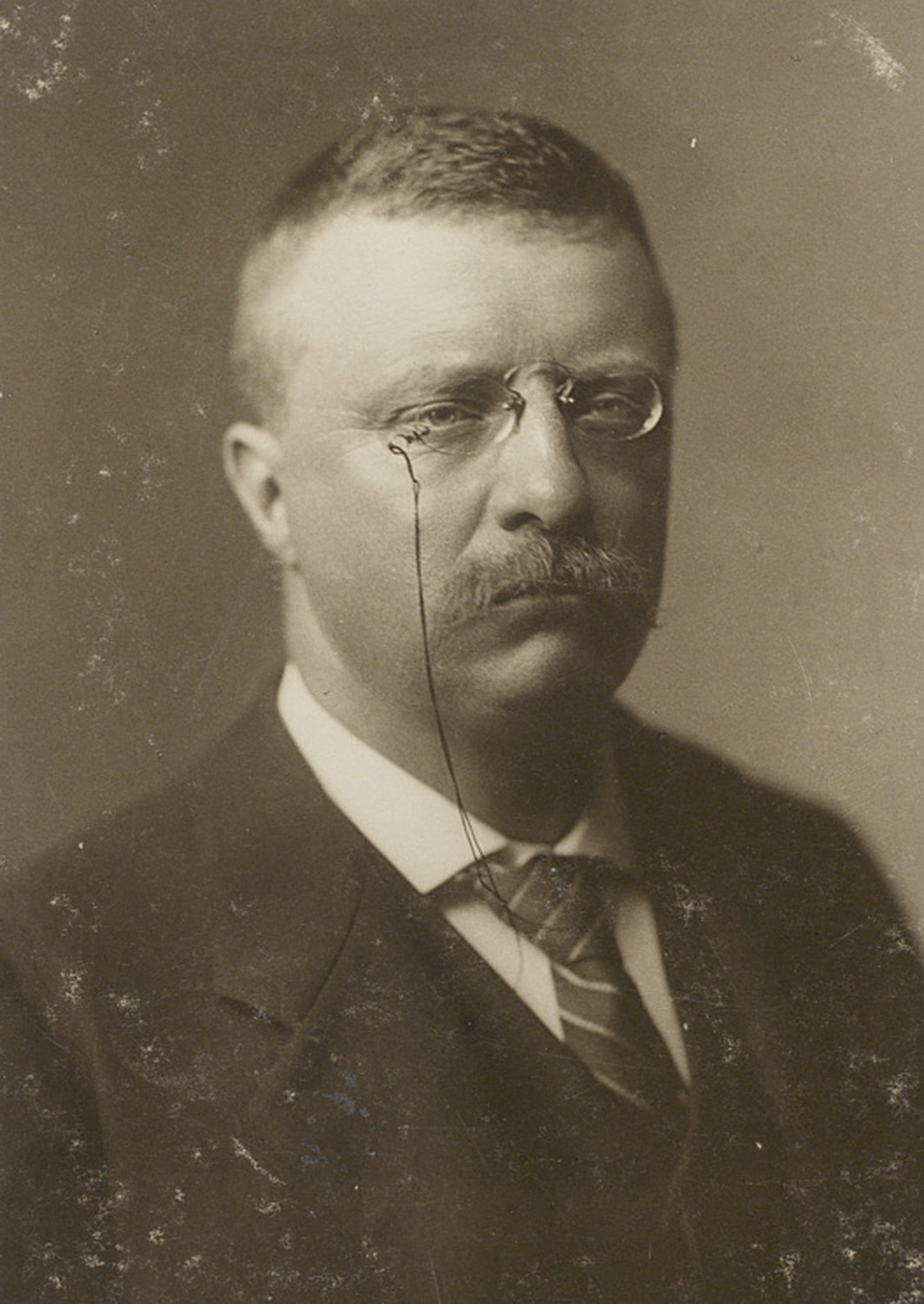
President Theodore Roosevelt, 1900. Roosevelt depended on Frank Bond’s encyclopedic knowledge of birdlife on federal lands, along with his mapping skills, to choose many of the earliest national wildlife refuges. (Photo by R.W. Thatcher, courtesy of the Library of Congress)
reservations,” Pearson wrote in 1911. “No man, at this early period in the bird-protection movement, can even estimate the value of these reservations to the rising generation, which is now taking up the burdens of human existence, much less foretell the blessings the increase in bird life will confer upon those who follow in centuries to come.”
Bond’s expertise in cartography was useful in the protection of national parks and monuments as well as refuges. He came to the 1912 conference on national parks held in Jackson Hole, where other attendees repeatedly sought his comments on pending reservations, challenges to titles, inholdings, and budgets. He had earned the respect of the greatest conservationists of the age, combining personal commitment with professional expertise to render exceptional service to the movement when it was desperately needed.
He remained with the General Land Office until his retirement in 1926, rising to the position of chief clerk, and he maintained his membership in the American Ornithologists’ Union until his death in 1940 at the age of eighty-four.
History is a quirky thing. Some people are woven into the commonly accepted narrative; others, often just as important in changing the flow of events, are forgotten. Frank Bond helped change the course of conservation in America. The fact that he’s been forgotten is no reflection on the magnitude of his contribution; it is due entirely to the vagaries of historical discourse and the faulty memories of those of us who came after him.
Gilbert Pearson remembered sitting with Bond on the veranda of the Endicott Hotel in New York one summer evening, entranced by the man’s ability to mimic the songs of American birds. It was the clearest possible evidence of Bond’s affection for “the vale of melody” that had claimed his attention over a lifetime. And it can be said that, as much as any other man of his time, Frank Bond saved those songs and the birds that sang them.
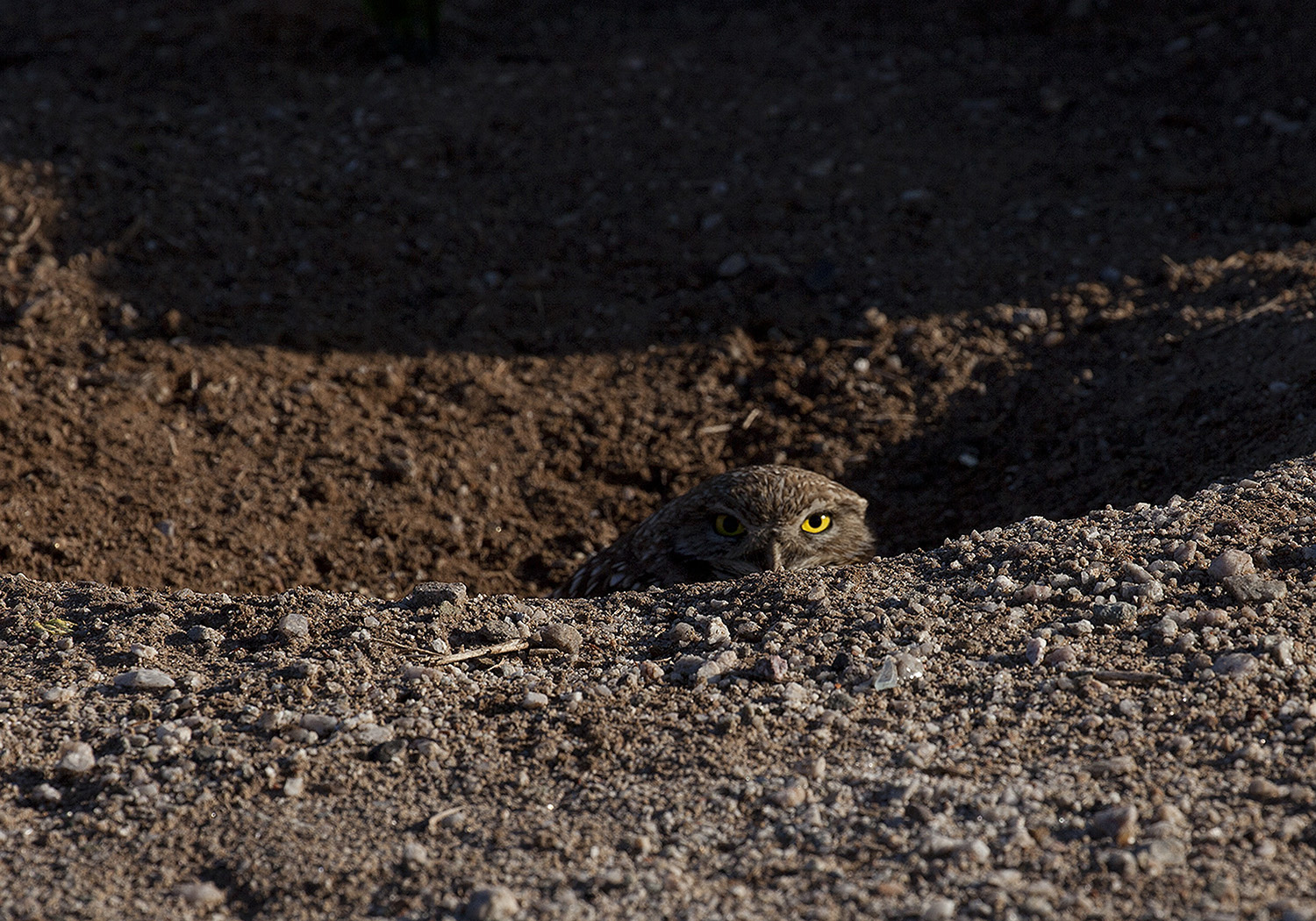
Burrowing owl west of Phoenix, Arizona. (Photo copyright 2016, Chris Madson, all rights reserved)
A WHILE BACK, I FOUND MYSELF IN A HOTEL CONFERENCE ROOM WITH THE BLINDS DRAWN, GLASSES AND PITCHERS OF WATER ON the draped tables, a projector for Powerpoint presentations, a flip chart and magic markers in the corner. This was clearly a place that had been equipped for some deep thinking. Fifteen or twenty of us were sequestered behind closed doors, charged with plotting the future direction of a major conservation group, and we were all contemplating a draft mission statement on the screen. While the wordsmithing went on, my attention was drawn to a phrase near the beginning: “We have an opportunity to create a world in balance, a world where human needs do not come at the expense of nature.”
I lingered a while over the notion of “a world in balance,” the quaint idea that, in spite of the constant shifts in everything from incoming solar energy and the orientation of the earth’s axis to the evolution of bacteria, it might be possible to establish some sort of stasis on an entire planet. Neither physics nor biology held out much hope for a balance, but I thought I knew what the authors of this draft were trying to say, so I drifted to the second half of the sentence: “a world where human needs do not come at the expense of nature.”
Creeping around in the background of that statement, unexpressed but palpable, is one of modern man’s most enduring prejudices— that, somewhere in our rise to enlightenment, we transcended our animal lineage and became qualitatively different, and distinctly better, than the menagerie that surrounded us. In this case, the phrasing went on to imply that we could find ways to live that made no demands on ecological systems— we could exist without appetite or impact, almost like angels.
The question is one of the most central issues in human thought: Are we a part of nature or are we apart from it? It haunts our discourse on philosophy and religion, shapes our debate on practical ethical matters from our appetite for meat to our concepts of animal welfare, and colors the way we use land and the resources it provides. Not too surprisingly, it emerges in nearly every discussion of conservation and the environment.
Trumpeter swans at Loess Bluffs National Wildlife Refuge in northwestern Missouri. (Photo copyright 2017, Chris Madson, all rights reserved)
Of course, the differences that distinguish us from all other living things are unmistakable, even though it’s proven remarkably difficult to build a quick, air-tight definition of what sets us apart. When I first stepped into a college classroom, anthropologists were describing us as the tool-using animal, but in the last forty years, we’ve found many examples of other animals, from chimps to sea otters to crows, that use tools. In some cases, these animals use items that are handy without altering them, but in others, they modify an object before using it, which calls into question the revisionist claim that we are the only tool-making animal.
It can be argued that, even if we can’t make an absolute distinction in this behavior, there is certainly a difference of degree: We’re much better at making and using tools than any other species, which has turned out to be a good thing for us, at least in the short run, since we can’t run, jump, swim, or fly nearly as well as other life forms do.
There’s no doubt that we’re unique; we fill a niche in the scheme of things, and we’re one endpoint in four billion years of selection for success. The same can be said of every other living thing that shares the planet with us. We’re different, for certain, but not necessarily better.
No one really knows when the concept of human exceptionalism began, but I suspect it’s a relatively recent development. Probably the earliest undeniable record we have of abstract human thinking comes from places like El Castillo Cave in northern Spain and Chauvet Cavern in southwestern France, where complex artwork was committed to the cave walls almost 40,000 years ago. Earlier engraved lines and dot patterns may be much older, but the images of game animals in these and other caves are testament to an advanced ability to translate three-dimensional reality into two dimensions, along with a remarkable eye for the unique anatomy of a number of wild animals, and the capacity to refine and apply pigments so that they last for millennia. The paintings suggest that those ancient artists understood the earth and its teeming life in much the same way as contemporary Stone Age cultures do. It seems likely that then, as now, people whose lives depended on good hunting and foraging for their livelihood felt a close kinship with other animals, a relationship that transcended the pragmatic and took on the trappings of religion.
Among the modern subsistence hunting cultures that have been studied, each species has its unique place in the world, but no species, not even man, exerts control over the whole. I don’t think it’s far-fetched to assume that the prehistoric hunters who painted in the caves felt much the same way.
It’s interesting that there are no strictly human figures among the artistic subjects at Chauvet or the more recent cave paintings in places like Lascaux and Altamira. The occasional images that suggest humans have the heads of bison or horses. Archaeologists have speculated that these may be drawings of shamans or possibly illustrations of visions from trances. Either way, they leave the impression that the people of that time and culture felt an intimate relationship with the living things around them— they saw themselves as a part of nature.
I suspect the shift in our attitude began with the domestication of key crops and animals some 13,000 years ago. It was a slow-motion revolution that may have stretched over 4,000 years or more and left no record beyond the melted remains of a few adobe huts, fragments of discarded tools and pottery, and the altered DNA in the organisms that led us into farming.
Before we began to farm, our lives and fortunes were clearly shaped by the same forces that defined success and failure for all the animals and plants around us. A severe drought or winter, an outbreak of disease, a shift in the constant push and shove between predator and prey all sent immediate ripples through the populations that supported us and inevitably took their toll on each tiny group of wandering humans they touched. By the time we had settled down, we’d created a domain we thought we could control. The natural world beyond the fence was no longer a part of a universal brotherhood; it was a potential threat. We were estranged.
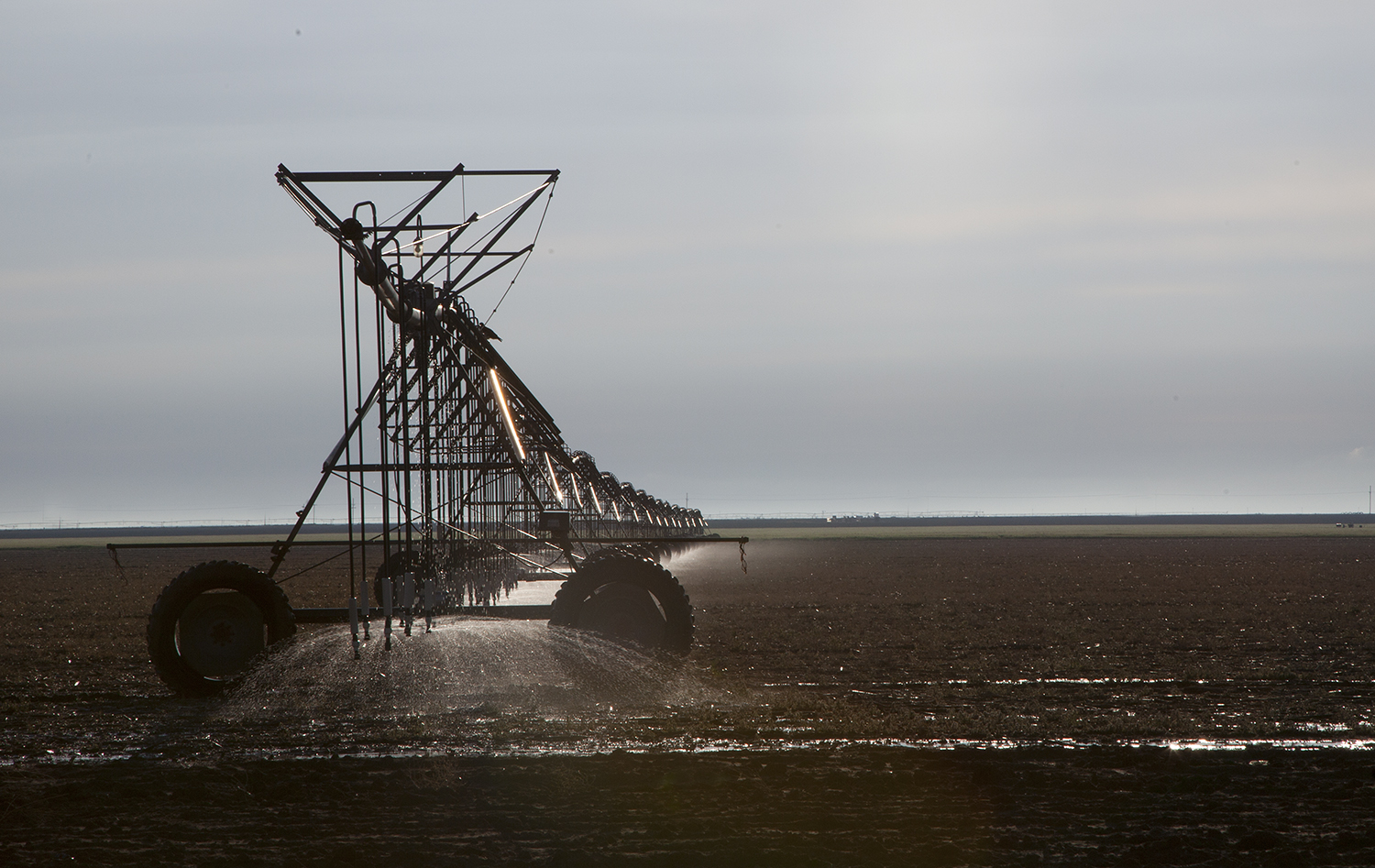
Center pivot irrigation system, Texas panhandle. (Photo copyright 2015, Chris Madson, all rights reserved)
Irrigation expanded our sense of control and eventually led to the first great cities, places where specialists in various trades could divorce themselves almost entirely from the daily demands of producing food. The world’s first written epic, “Gilgamesh,” arose from some of the earliest of those hydraulic cultures. It includes the wild man Enkidu, immensely powerful, drawing his strength from the wild world outside the control of the empire. Eventually, the emperor finds a way to domesticate the wild man and reduces him to the status of a slave, albeit, a valued slave, who assists the monarch in a series of adventures. Enkidu’s story reads remarkably like the biblical expulsion from Eden or the life of a modern office worker, set down in cuneiform 2,500 years before the birth of Christ.
As far as I can tell, these are the roots of the notion that the human animal stands somehow outside of nature— an idea that, in western culture at least, has complicated our thinking about our relationship with the earth ever since.
In its most extreme form, this concept has led to expressions of open hostility toward the unruly places that are seen to resist domestication. In the classic history of early colonial life in New England, Of Plimoth Plantation, the Puritan cleric William Bradford had this to say about the land he and his companions had chosen as their new home:
“What could they see but a hideous & desolate wilderness, full of wild beasts & wild men? And what multitudes there might be of them, they knew not Neither could they, as it were, go up to the top of Pisgah, to view from this wilderness a more goodly country to feed their hopes; for which way soever they turned their eyes (save upward to the heavens) they could have little solace or content in respect of any outward objects. For summer being done, all things stand upon them with a weatherbeaten face; and the whole country, full of woods & thickets, represented a wild & savage hue. If they looked behind them, there was the mighty ocean which they had passed, and was now as a main bar & gulf to separate them from all the civil parts of the world.” It was a view many Americans would take over the coming centuries.
One of the most succinct modern expressions of this attitude I’ve ever seen is literally cast in concrete on the University of Wyoming campus. Construction on the building that first housed the UW engineering department began in the early 1920s. In 1926, as the building neared completion, someone asked Earl D. Hay, dean of the college of engineering at the time, to compose a motto to be enshrined over the main entrance. After some thought, he came up with this: “Strive on; the control of nature is won, not given.”
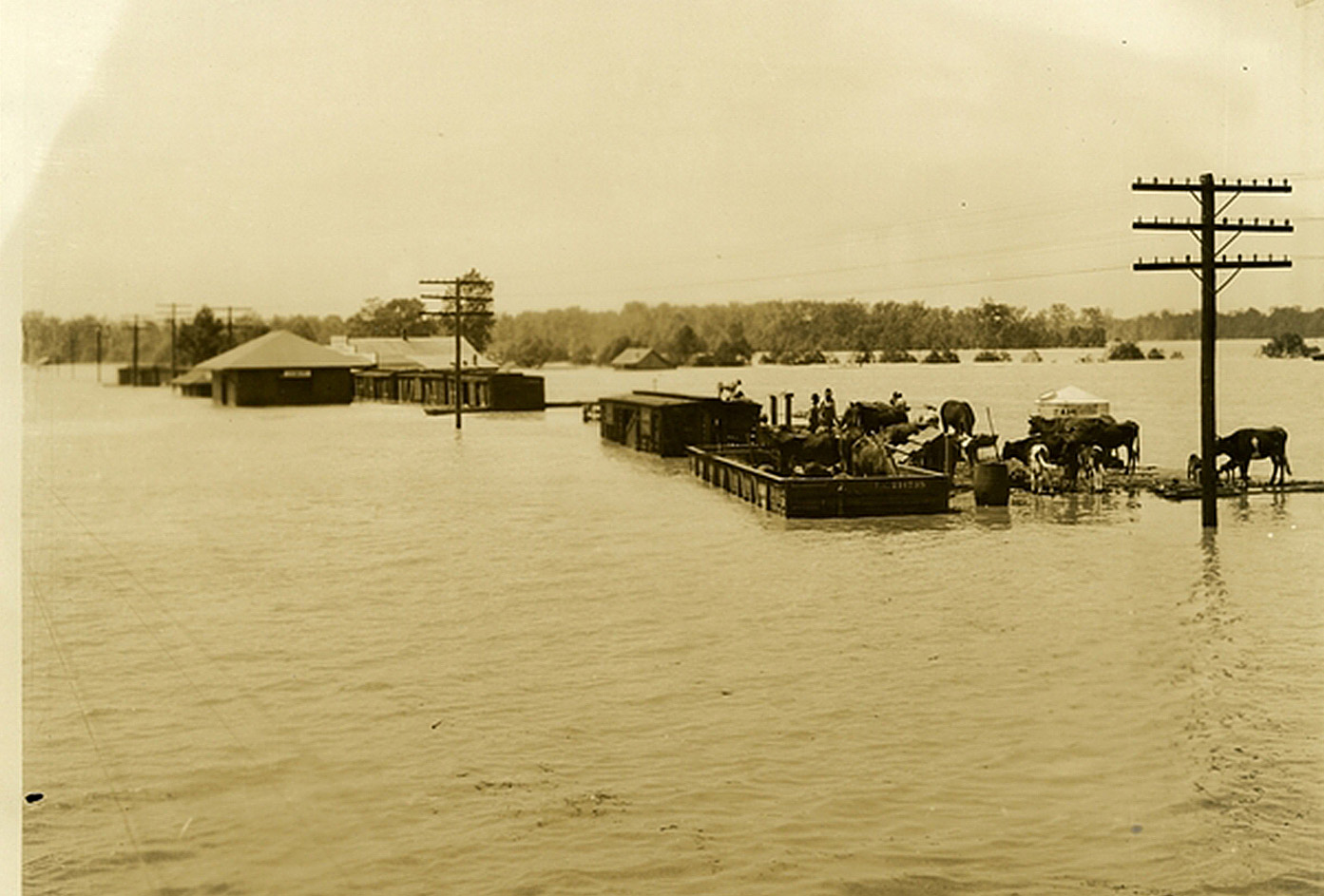
Photo of the Great Mississippi River Flood taken from the Y and M. V. Railroad station, Onward, Mississippi, May 5, 1927. Courtesy of the Mississippi Department of Archives and History.
I find it more than a little ironic that, in the spring of 1927, as Dr. Hay and his students were moving into the new building, the Mississippi River contested his notion that nature is susceptible to control. Always an unruly watercourse, the Mississippi had already been contained behind an extensive network of levees, but rain and snowfall across the heartland were unusually intense from August 1926 to the following April. Driven by nine months of exceptional runoff, the river ruptured the levees, flooded 127,000 square miles of bottomland, drove 700,000 people from their homes, and killed 250. And this rain-soaked winter immediately preceded the catastrophic ten-year drought of the Dust Bowl. Strive on. …
I’d like to think we’ve learned a few things since Dr. Hay issued his challenge to engineers and the implacable opponent he identified only as “nature”— although I have to say that some of our activities in the last decades shake my faith more than a little. However, for the sake of argument, I’ll concede that we may be beginning to think more in terms of cooperating with the land rather than dominating it.
Having said that, I still find us struggling with the fundamental question: Are we a part of nature or apart from it? The conservation and environmental communities are not immune. At one extreme is a specific group of hunters the sociologist Stephen Kellert has labeled “dominionistic” because they view wildlife and the rest of the planet as property to be disposed of as people see fit. The human species, in this view, stands clearly apart from, and somehow above, the rest of the natural world.
But many of these hunters speak movingly of their outdoor experiences— it’s why they take the time and trouble, go to the expense, involved in hunting. They feel involved in natural processes when they’re in the field, and often, they place a high value on the meat they bring home. It gives them a sense of connection. They see themselves as apart from the natural world in the authority they have over it but very much a part of the natural processes and landscapes they enjoy.
Animal rights activists represent another extreme. They’re passionate about the kinship between people and the rest of life on earth. We are a part of nature, they argue— animals are our brothers. But they are morally repulsed by the idea that humans would participate in some of the most basic processes in the natural world, like eating meat and killing other animals to get it. They see humans as unique moral beings— a part of the natural world in our genes, but apart from the natural world in our moral responsibility.
Somewhere in the middle, there is the well-meaning phrase in that organizational mission statement: “a world where human needs do not come at the expense of nature.” It’s a mainstream sentiment, one that would fit nearly any conservation group, but it implies a sharp division between “human” and “nature.”
From a strictly ecological point of view, that’s sheer fantasy. Every physical need we have is filled “at the expense of nature,” as the drafters of this language know as well as I do, but when challenged with expressing an overarching mission, they struggle to acknowledge our dependence and leave the impression that billions of people could somehow find a way to live and prosper without making any demands on the planet that supports us all.
The roots of the conservation movement reach back much further than most history books recognize. Alarmed by the disappearance of their deer, the residents of the town of Portsmouth, Rhode Island, outlawed spring deer hunting in 1647. And the notion of providing some protection for wildlife was not new in the New World. It stretches back through the game preserves of kings and nobles to the Fertile Crescent and the reign of the Assyrian emperor Ashiburnipal.
Through all those centuries down to the first effective conservation efforts in America, we approached the task much as we approached our backyard gardens. We admired some things for their beauty, some for the way they tasted. We set aside a corner out back, cultivated it, built a fence, and chose the varieties we wanted to grow.
Early in the development of wildlife management, its advocates used the metaphor of the garden to explain how they thought about the process. There were stocks of wildlife that needed our attention, and if we watered and weeded with sufficient care, we would eventually have a crop to harvest. A good gardener was careful not to overharvest his perennials so they would yield another crop next year, and with the annuals, he made sure not to eat all the seed so he had something to plant the following spring. A little prudent thinning down the row helped production. So did a little manure. It was a useful metaphor, as far as it went, emphasizing the renewable nature of the “resources” we managed in a way that an agrarian population could readily appreciate.
But it had its limits. There was a casual chauvinism in the distinctions we made between crops and weeds that often failed to recognize the interdependence of the organisms we were managing or the processes that supported them. With a certainty bred of ignorance, we did things that seemed like a good idea at the time, only to discover years or decades later that we had failed to account for some key variables.
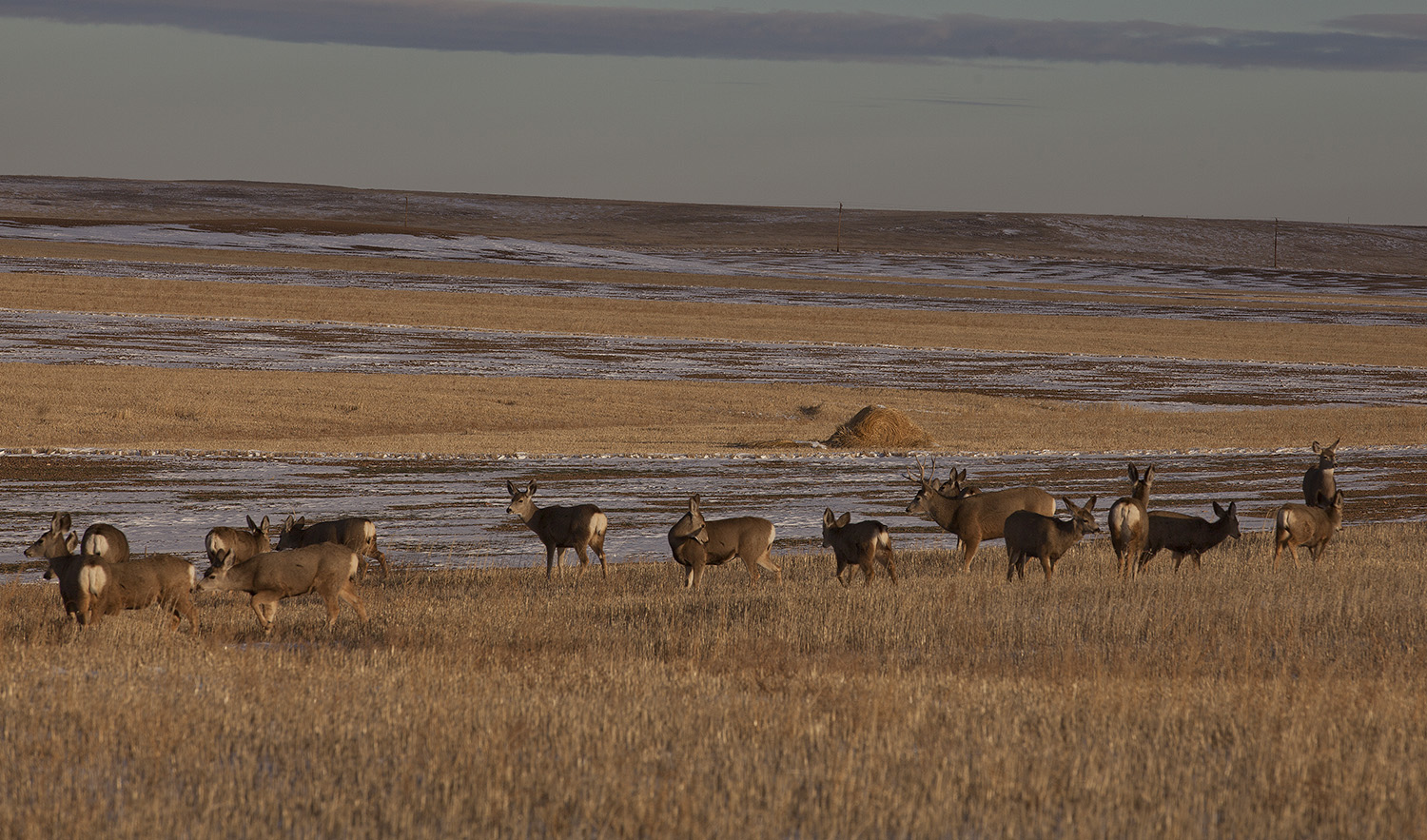
Mule deer on wheat stubble north of Burns, Wyoming. (Photo copyright, 2018, Chris Madson, all rights reserved)
The collapse of the mule deer herd on Arizona’s Kaibab Plateau was among our first lessons in America. Massive predator control and highly restricted hunting allowed the population to grow from 4,000 animals to between 50,000 and 100,000 in a matter of eighteen years between 1906 and 1924. Conservationists celebrated until the herd finished chewing the last of its forage down to the roots and collapsed from its own too-much.
In the early years of the twentieth century, the people of Wyoming began feeding elk to keep them off private stocks of hay. Eventually, there were more elk than private citizens could afford to feed, so state and federal governments took over the program. It seemed like a durable compromise, an expensive but effective way to have elk in the mountains while avoiding conflicts with ranchers on winter range in the valleys. Until brucellosis came along. And the possibility of chronic wasting disease.
We thought common carp would be a welcome addition to the nation’s fisheries, and in spite of a hundred years of bad experience with that introduction, we subsequently decided to import grass carp. And black carp. And silver carp. We weren’t satisfied with the interior West’s native trout, the cutthroat, so we brought in brookies and rainbows, and German browns and mackinaw and walleye and broadcast them over the landscape without considering the
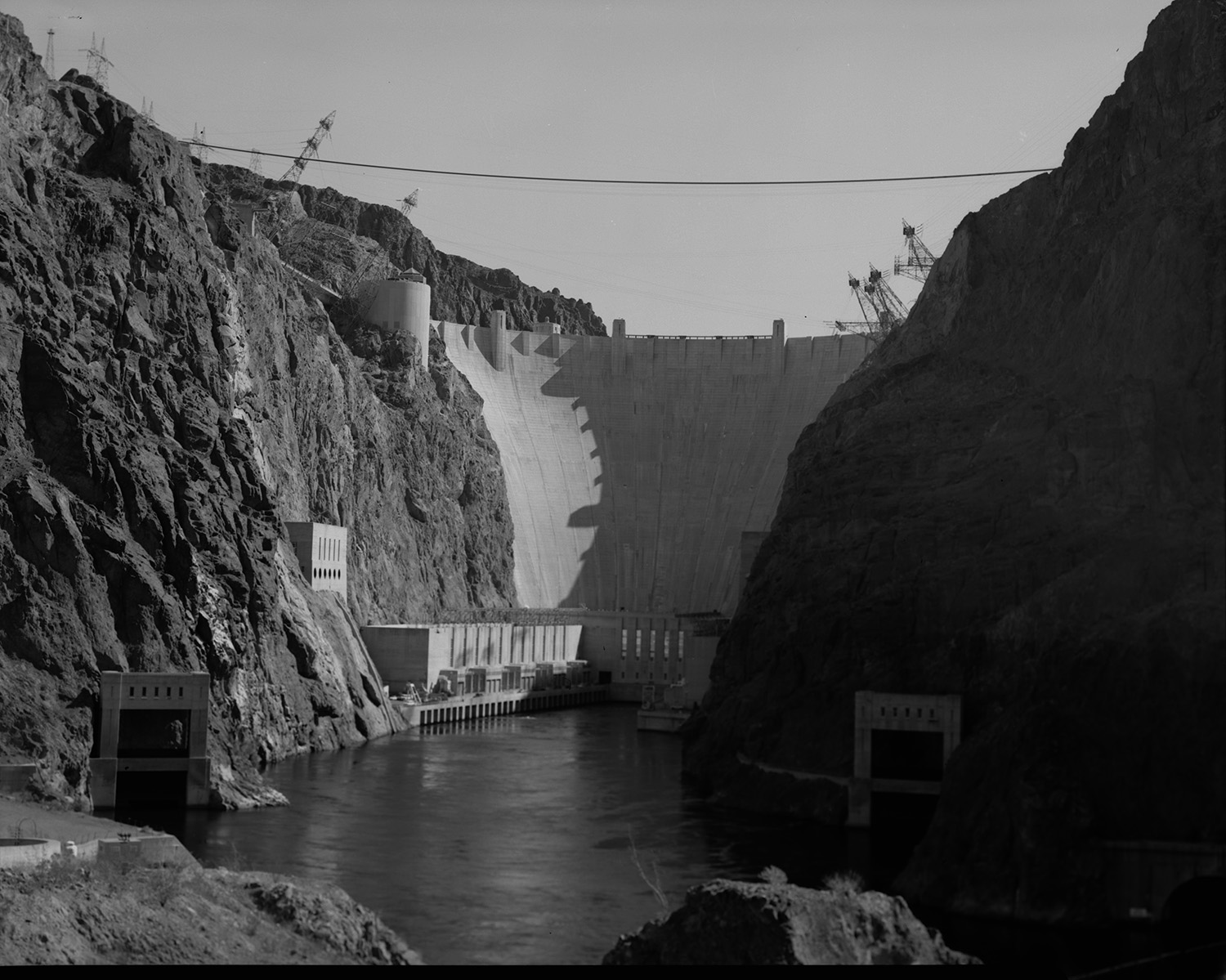
Hoover Dam on the Colorado River. Bureau of Reclamation, courtesy of the Library of Congress.
possibility that some or all of them might not coexist comfortably. We dammed nearly every river in the region without bothering to think about how a wall across a river might affect the movements of salmon, sauger, sturgeon, humpback and razorback chubs, Colorado pikeminnows, and the host of lower-profile wild things that must move up and down a watercourse to survive the floods and droughts that shape it.
Sometimes, visualizing a garden isn’t the best way to think about the world.
The garden metaphor carried another message, too. Was that subtext accidental or intentional?— I can never decide. Either way, it was easy to jump to the conclusion that we owned the garden. We could decide how big it should be. If we suddenly decided that we needed another wing on the house or a new shed, we could move the beds or cut them in half, and if the crops and ornamentals were more trouble than they were worth, we could lay down some weed barrier, cover it with rocks, and give up the whole exercise. The garden, while often useful and sometimes entertaining, was something we could do without. We were apart from it.
I’m the first to concede that our willingness to provide for natural systems has grown with time. Here in Wyoming, we have the world’s first national park and first national forest, both monuments to our changing perspective. In the last forty years, we’ve made a commitment, however uneasy, to preserve native biodiversity by protecting rare species, whether they are charismatic or not, and we’ve begun to appreciate that an organism can’t survive without the wild places that shelter it, a perception of habitat that demonstrates a growing ecological sophistication.
But we still struggle to come to grips with our place in it all. Do we exist on some higher plane, out of reach of “the thousand natural shocks that flesh is heir to”? Are we overseers, partners, or just participants, feeling our way toward survival like every other living thing on the planet? Is the impulse to protect wildlife and wild places an act of selfless charity or self-preservation?
Conservation is defined as “wise use.” There are many paths to that wisdom. Science reveals the unimaginable complexity of natural systems and helps clarify the way human actions ripple through them. If we spent more on research, we would have a better grasp of the challenges we face and the often unintended effects our decisions have.
But a technical grasp of the situation isn’t enough. We need to come to terms with the emotional and ethical ties that bind us, not only to each other, but to every other living thing.
So here’s how I see it. It’s time to return to a reality the artists in Chauvet Caverns understood and that we, in our technological hubris, have long abandoned: The human animal is a part of the natural world. Skin and bone, flesh and blood, right down to the last strand of DNA, we are creatures of the earth. We depend on it for food, water, shelter, raw materials, the very air we breathe. It shapes our conscious and unconscious, our minds and souls. It defines us.
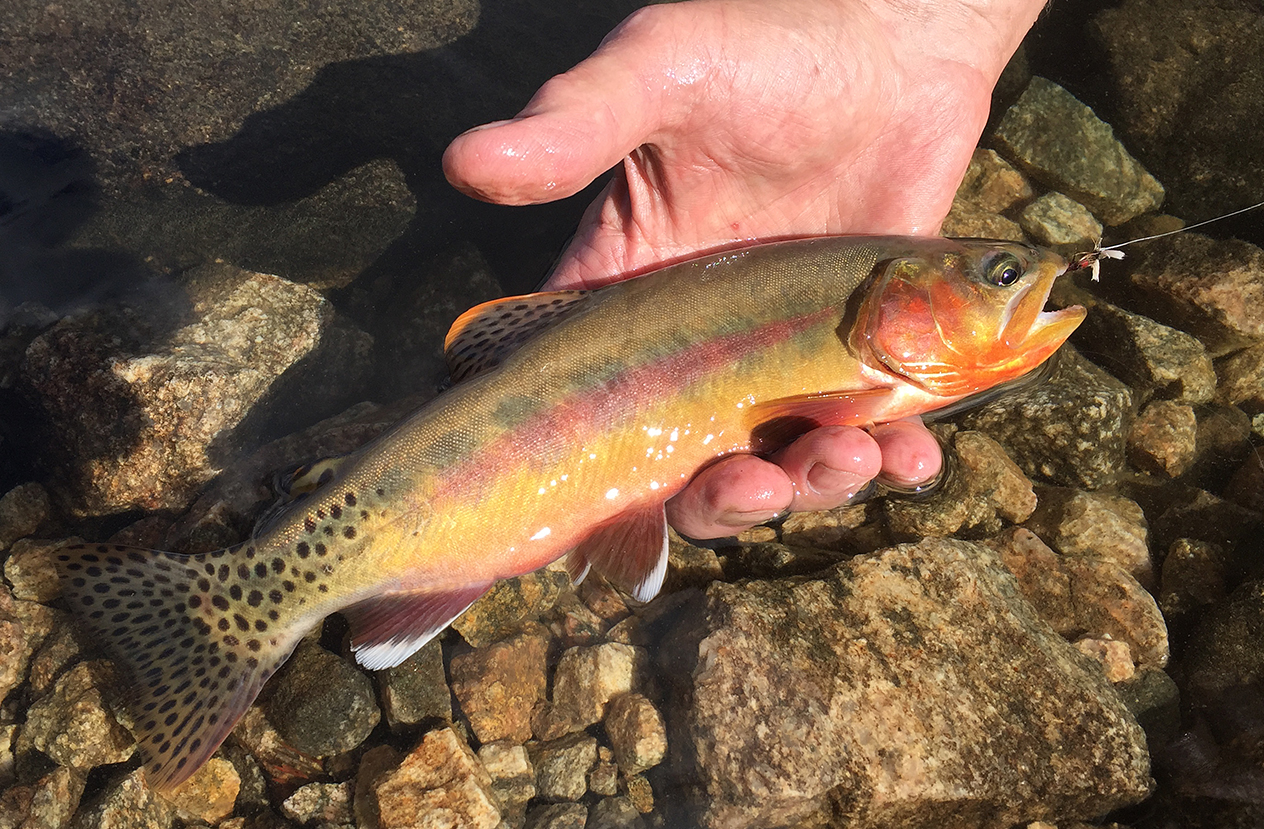
Golden trout in Montana’s Beartooth Mountains. (Photo copyright 2016, Chris Madson, all rights reserved)
We should return to the idea that all living things are interdependent. Diversity yields stability, an ecological truth that is, at once, practical and esthetic. As Aldo Leopold so wisely observed: “to keep every wheel and cog is the first precaution of intelligent tinkering.” At the same time, we need to come to grips with the fact that many of the natural processes on which the living world is based are violent and cruel. Predation, parasitism, catastrophic loss of habitat, the killer winter, the grinding drought, the endless competition for resources and even space, as savage as they may seem to a human wrapped in a cocoon of his own making, are facts of life, inextricable parts of the whole. They are sources of great suffering and, at the same time, the forces that produce what we most admire in ourselves and the rest of the natural world— grace, beauty, strength, ingenuity, courage, commitment to family and social unit. Even now, at the pinnacle of our technological power, we are not free of these primal forces, nor of our need for the sustenance the earth provides. We can’t suspend our impacts, direct and indirect, on other living things; the best we can do is to make sure our demands are sustainable. Other species have found ways to restrain their demands to match the supply their environment provides. We must find our own path to that way of living, or the inevitable forces of the planet will intervene to find it for us.
We are a part of nature. Nature is a part of us. From the simplest viruses to the most complex life on earth, we’re all in this together. I don’t know that accepting this will make our decisions concerning the land any easier, but there’s a good chance it will make them better.
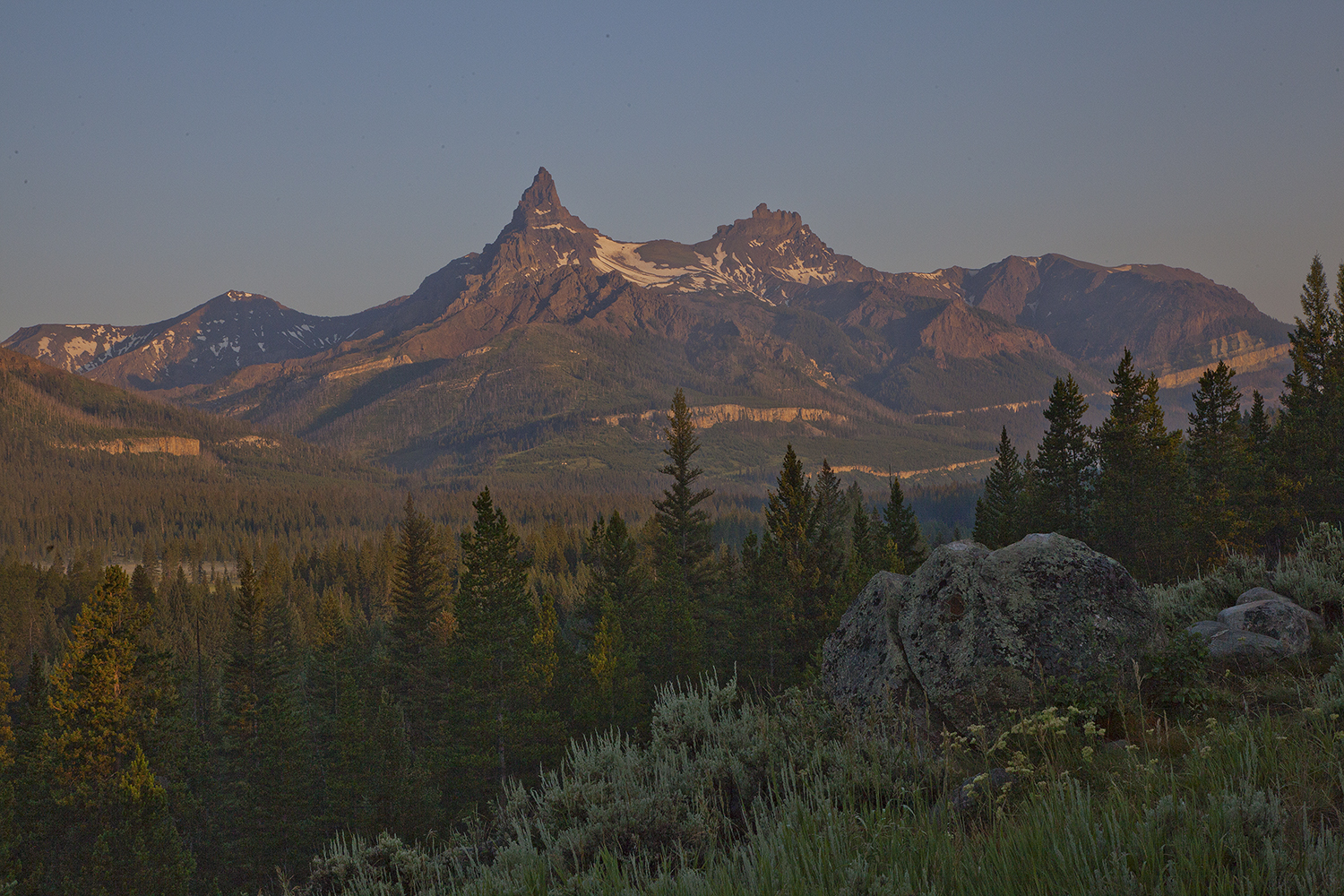
Pilot and Index peaks in the Absaroka Wilderness in northwestern Wyoming. (Photo copyright 2018 by Chris Madson, all rights reserved)
AT ITS HEART, COMMUNICATION REQUIRES TWO THINGS: SOMEONE TALKING AND SOMEONE WILLING TO LISTEN.APARTICULARLY artful communicator may beguile a few more passersby to join the audience in the tent, but in the end, a message won’t catch fire until a large audience is ready to embrace it.
This has certainly been true of the messages that have transformed the American view of some of the most important ethical debates of the last century. Progress toward a higher moral ground hasn’t proceeded in steady linear fashion; instead, it has languished while a tiny minority of messengers strove to convert the majority, largely without success, until one day, the public finally decided to listen, and the nation changed its mind about values as profound and intensely held as whether a woman should have the right to vote, whether a black person has a right to equal treatment in society, whether homosexual couples should be allowed to marry, whether a factory should be allowed to poison its neighbors.
Sometime in the last forty years, Americans decided to stop listening to warnings of environmental deterioration. While I think they were mistaken in much of their analysis, Shellenberger and Nordhaus may have laid their finger on one factor that contributed to this retreat. With the advent of federal agencies like the EPA and a panoply of laws to protect the environment, the public may have felt justified in turning over the details of environmental protection to the professionals in government and the private sector.
It’s also possible that we’ve been fortunate enough to enjoy a respite of sorts— in the last forty or fifty years, we’ve been largely spared the kind of environmental catastrophes that reminded past generations of Americans that what happens in the natural world has a direct effect on people. To the casual observer, the state of our continent at the end of the twentieth century was reasonably good: There were deer in most suburban backyards,
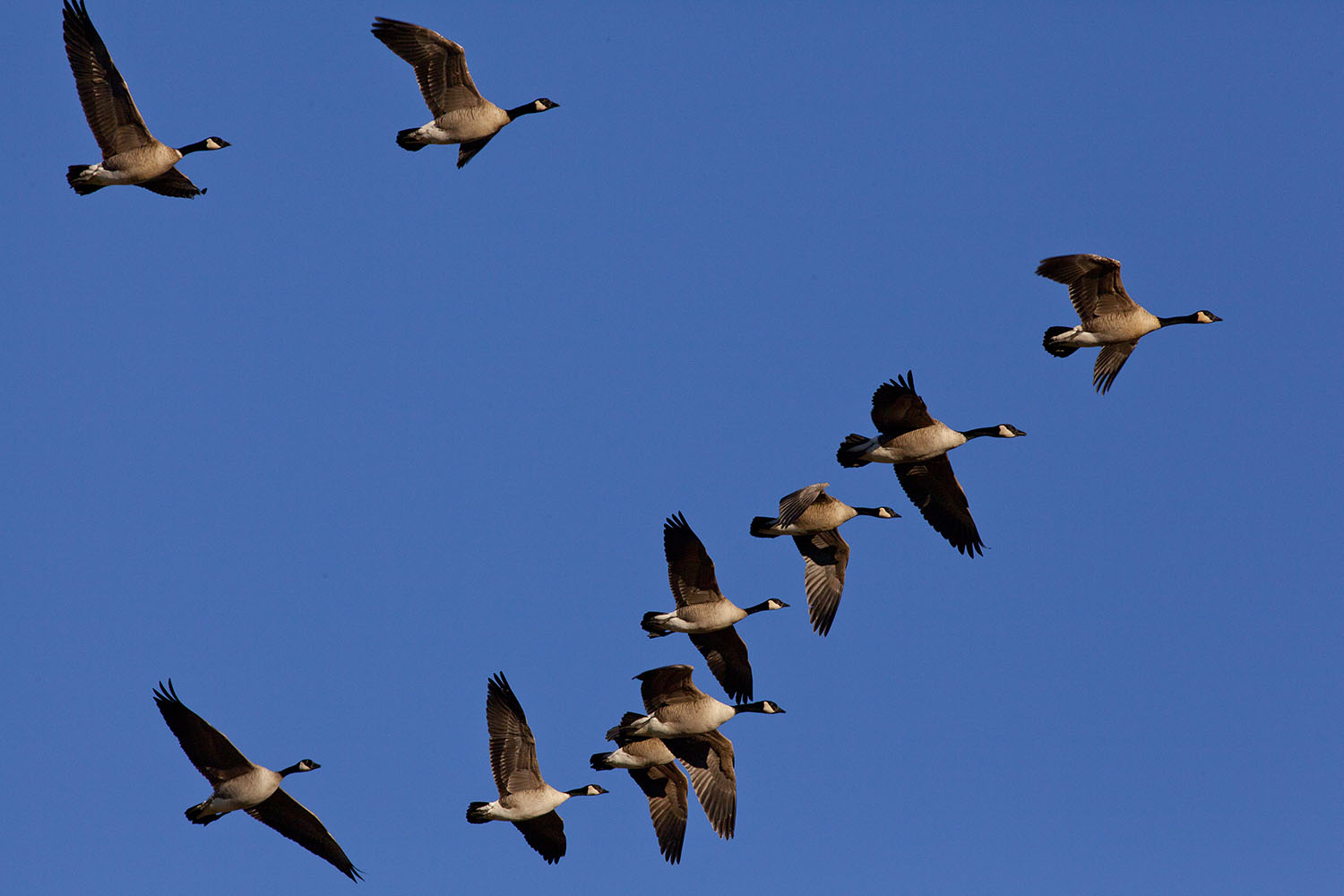
Canada geese in flight. (Photo copyright 2018, Chris Madson, all rights reserved)
geese on the golf courses, wild turkeys in the woodlots, trees on the hillsides, fish in the lakes. The brown clouds that had hung over most urban centers through the 1950s and 1960s had largely dissipated; the alarm over the effects of DDT and other organochlorine pesticides had subsided, and out in wheat country, the nightmare memory of the Dirty Thirties had faded away with the generation that caused it and lived through the aftermath. It was easy to believe that, if the war between Americans and the environment wasn’t over, then it had at least reached some sort of détente.
So it seems to me that the general public declared victory and went home. That left two small interest groups— the heirs of the robber barons and the heirs of Aldo Leopold— locked in battle while ninety percent of Americans were otherwise occupied. It’s a measure of the moral power of the environmental message that more hasn’t been lost in the resulting vacuum.
It’s certainly legitimate to insist, as Shellenberger and Nordhaus have insisted, that the supporters of a sustainable human relationship with the environment do everything they can to perfect their message and deliver it to the greatest possible number of people. However, the audience has to be ready to hear that message before it will take effect. And here, I find the tiniest cause for optimism.
The conservation/environmental movement of the nineteenth and early twentieth centuries was largely a response to a succession of catastrophes. Then— and now— we’re at our best when our backs are against the wall, and when it comes to the state of our environment, we’re cozying up to the wall again.
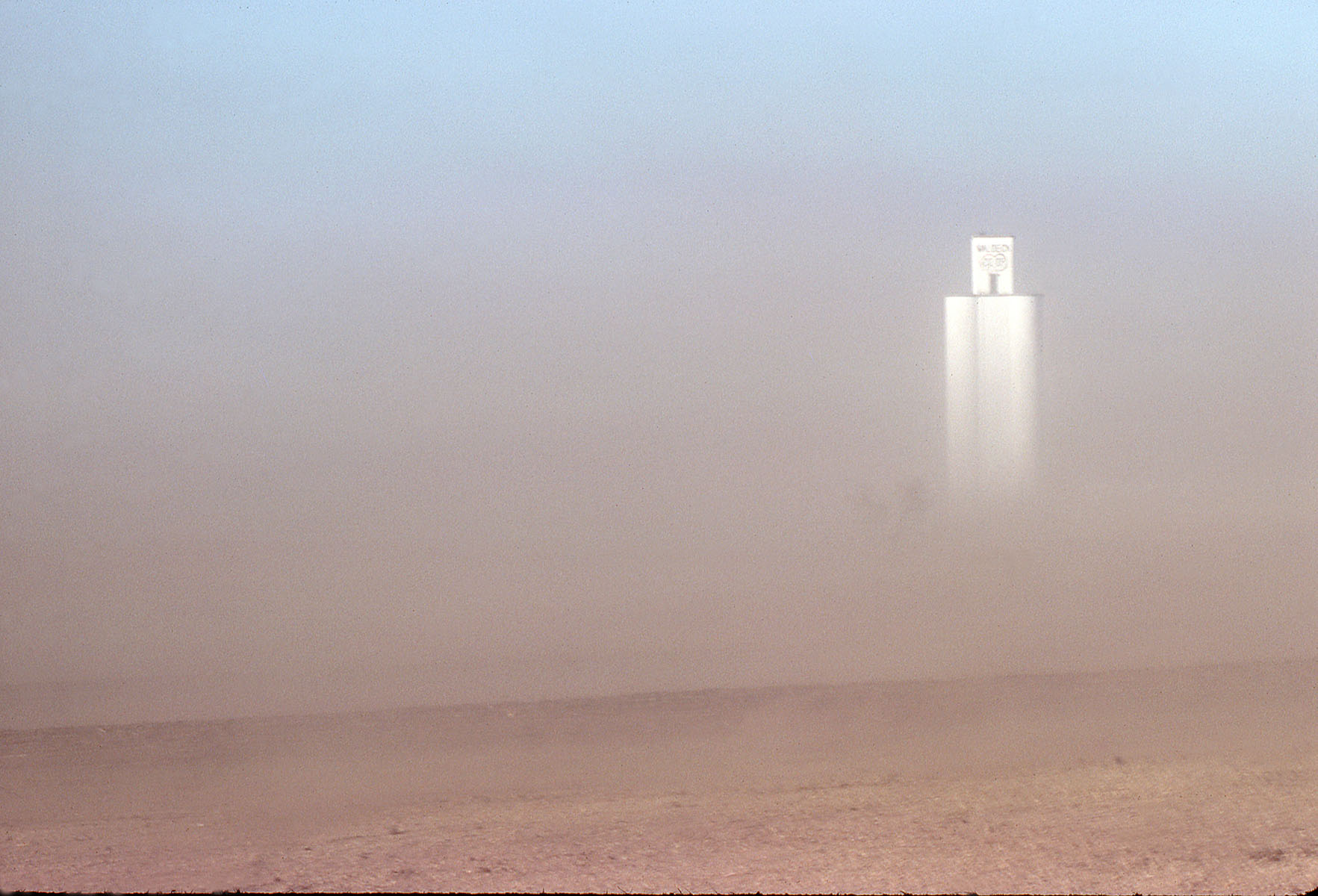
A modern dust storm on the High Plains of Kansas. (Photo copyright 1995, Chris Madson, ell rights reserved)
Consider 2017— hurricanes, huge wild fires, a punishing drought, devastating hailstorms. In the contiguous forty-eight states alone, extreme weather did $387 billion in damage and claimed 283 lives. And, while it can be argued that there is no incontrovertible proof that any one of these weather events was caused or made worse by the climate change we’ve created, nearly any expert will tell you that they are exactly what he expects as the planet gets warmer.[i]
In 2018, the southwestern quarter of the nation continued to suffer through an epic drought, a dry spell so severe that the federal Bureau of Reclamation warned that it is “one of the worst drought cycles over the past 1,200 plus years” in the Colorado River basin, source of water for millions of people and some of the nation’s most productive cropland.[ii] Authorities are expecting yet another “above normal” wildfire season in the West[iii], a prediction that has come to pass in California, and south Texas is up to its chin in floodwater— again.[iv]
Where’s the good news in all this? In an especially perceptive article for the Annual Review of Political Science last year, Stanford sociologist Doug McAdam took a hard look at the anemic American response to climate change and pointed out that stimulating real action will require more than instilling an understanding of the problem; it will require an emotional response. “The relevant mobilizing emotions are anger at a perceived injustice, or fear at a perceived threat, and hope that the injustice or threat can be redressed through collective action. . . . The combination of anger and hope has proven to be a powerful motivator in many successful movements.”[v]
Whooping crane among sandhill cranes on Nebraska’s Platte River. (Photo copyright 2017, Chris Madson, all rights reserved)
I think we’re beginning to see that combination— the litany of loss of life and property to extreme weather; the continuing problems with air and water pollution; a spreading shortage of fresh water; the ongoing decline in numbers of economically important fish like Pacific salmon[vi] and Atlantic cod,[vii] blue marlin[viii] and bluefin tuna[ix]; loss of crucial pollinators; dwindling numbers of popular game animals, from bighorn sheep to bobwhite quail; and even the scarcity of well-loved songbirds are beginning to generate a wide-reaching feeling of anxiety and anger. The evidence continues to accumulate, and it is as disturbing as it is compelling. We haven’t really solved several of the major environmental problems that have haunted us for generations, and we’re facing a new problem in climate change that may be the most profound threat to humanity in our history as species. The cost, inconvenience, and ultimately suffering these problems produce will spiral upward steadily until we respond effectively.
In short, I think the environment will demand America’s attention even more emphatically than it did a century ago. And we will act as our grandparents and great grandparents acted to preserve what we need . . . and what we love.
We’ve already lost many things that might have been of use to us or given us pleasure, and the hard ecological truth is that we’ll lose many more, no matter how quickly we respond to the circumstances we face. That’s the price we pay for waiting until the crisis to act.
But I think the condition of our environment is about to reclaim its place near the center of our political and social discourse. With some luck and an outpouring of innovation, technology should help ease our way forward, but technology alone won’t be enough. We’ll need a renewed commitment to an ethical code, a part of our shared heritage that has been neglected in recent decades. For that, we could do worse than turn back to Leopold: “A thing is right when it tends toward the integrity, stability, and beauty of the biotic community.” Words for our future . . .
[v] McAdam, Doug, 2017. Social movement theory and the prospects for climate change activism in the United States. Annual Review of Political Science 20: 189-208.
[viii] Collette, B. et al, 2015. Makaira nigricans, Blue Marlin. The IUCN Red List of Threatened Species 2011.
[ix] Pacific Bluefin Tuna Working Group, 2016. 2016 Pacific Bluefin Tuna Stock Assessment. International Scientific Committee for Tuna and Tuna-like Species in the North Pacific Ocean. July 2016.
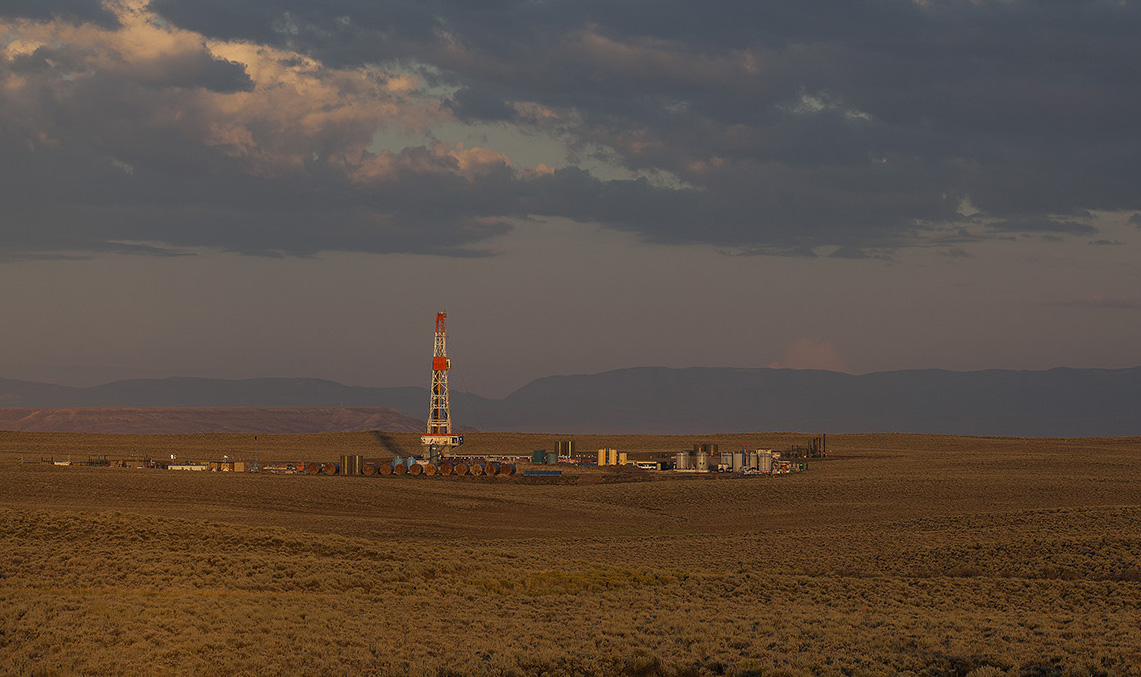
Drilling rig in the Green River basin, Wyoming. (Photo copyright 2015, Chris Madson, all rights reserved)
AS THE CURRENT ADMINISTRATION DOES EVERYTHING IT CAN TO VITIATE THE NATION’S ENVIRONMENTAL LAWS, GUT FEDERAL agencies like theEnvironmental Protection Agency, roll back regulations intended to protect our air and water, accelerate leasing of federally managed lands for mining and drilling, prevent adequate management of rare wildlife, and block any response to the growing problem of climate change, professionals in the field wonder: What happened? How can the political winds have shifted so profoundly in little more than a generation?
If you ask, most Americans will tell you they are environmentalists. A general survey administered by the Pew Research Center over the last twenty years has asked for response to the statement: “This country should do whatever it takes to protect the environment.” In July of 1994, 78 percent of Americans surveyed said they agreed with that statement; in March of 2016, 74 percent still agreed.[i]
In the spring of 2018, Pew asked Americans what they thought about federal efforts on a variety of environmental issues. Sixty-four percent said the government was doing too little to “protect air quality;” 69 percent said it was doing too little to “protect water quality in lakes, rivers, and streams;” 63 percent said too little to “protect animals and their habitats;” 57 percent said too little to “protect open lands in national parks and nature preserves;” and 67 percent said too little to “reduce the effects of global climate change.”[ii]
Angler on the Clark’s Fork of the Yellowstone, northwestern Wyoming. (Photo copyright 2018, Chris Madson, all rights reserved)
According to the U.S. Fish and Wildlife Service, more than 100 million Americans over the age of sixteen fished, hunted, and/or watched wildlife in 2016, spending nearly $157 billion in the process.[iii] Broaden the scope of the inquiry to all outdoor recreation, and the statistics become even more startling. Nearly 150 million Americans pursue some kind of outdoor recreation. They spend $887 billion each year, which generates $65 billion in federal tax revenue. The outdoor industry creates 7.6 million jobs.[iv]
The environment hasn’t faded from American consciousness. The breakdown seems to have come somewhere between attitude and action. The pool of American interest in the environment is a mile wide . . . and an inch deep.
Why is that? It’s worth considering the possibility that the carefully designed public relations and political action generated by anti-environment business interests over the last forty years may be to blame. In their superb book, Merchants of Doubt, Naomi Oreskes and Erik Conway analyze the techniques that business interests developed to protect tobacco from increasing regulations. The combination of denial that there was any problem with tobacco, attacks on the veracity of research findings and the discipline of science itself, support of pseudo-scientific “studies,” and delay of actions to control tobacco use turned out to be powerful tools in maintaining the revenue stream from products that had clearly been shown to be dangerous to human health. Oreskes and Conway go on to show how the same techniques have been applied to undermine support for action to reduce acid rain, protect the ozone layer, regulate pesticides, and, most important, control the release of the greenhouse gases.
It’s been argued in some quarters that environmentalists are their own worst enemies. In 2004, Michael Shellenberger and Ted Nordhaus published an incendiary essay they called “The death of environmentalism,” in which they focused on the issue of climate change and argued that the environmental movement was largely responsible for its own failure to influence climate policy. The traditional groups are locked into outmoded tactics from the 1960s and 1970s, the authors argued; they depend on technical “fixes” and fail to articulate a vision, a set of values, for their movement that engages the general public; they refuse to court new allies like labor unions, and they haven’t widened their view of “environmental” issues to include matters like economic growth, adequate health care, poverty, and war. According to Shellenberger and Nordhaus, they’ve become just one more special interest.[v]
Other analysts have argued that, as the environmental movement has grown, it has fractured into camps that all too often work at cross-purposes.[vi] Some point to the aftermath of the first Earth Day when new-wave activists indignantly claimed that they had entirely different— and much more enlightened— attitudes than the old conservation crowd. As the influence of the environmental/conservation community has continued to slip, some observers have identified other fault lines in the movement— “mainstream environmentalism” versus “environmental justice;”[vii] “eco-pragmatism” versus “preservationism;” advocates of “working landscapes” versus champions of “wilderness.”
A few observers with an economics bent have speculated that environmentalism is a luxury only a wealthy people can afford, that even in a nation as prosperous as the United States, support for environmental causes waxes and wanes with the stock market. Following that economic argument into the realm of class, a handful of theorists have offered the view that the decline in the environmental movement’s effectiveness has been driven by the growing inequity in American income that has developed over the last thirty years.
There’s an element of truth in all these arguments, but, I wonder: If these are, in fact, the forces that have stopped the environmental movement in the last forty years, how did the movement gain momentum in the beginning?
J.P. Morgan, banker, financier, and owner of 25 of America’s leading newspapers, in 1915. (Bain News Service, courtesy of the Library of Congress)
If the media effort to undermine environmental reform has had such success at the turn of this century, why didn’t it have greater effect at the turn of the last? It certainly wasn’t for lack of trying. The robber barons of the Gilded Age and their successors wielded powerful influence over news coverage of the day. Some, like the financial magnates Jay Gould and J.P. Morgan simply owned newspapers in major cities; many others, like the Civil War financier and railroad magnate Jay Cooke, went out of their way to court journalists with everything from entertainments to stock options and loans. As the muckrakers of the Progressive Era sharpened their pens against the tycoons, the multi-millionaires responded with bribes, threats, and increasingly sophisticated public relations campaigns.
The magnates of the Gilded Age had a degree of control over the political system of the time that’s hard to imagine today. Until 1913, U.S. senators were selected by state legislatures, not by popular vote; bribery commonly affected the appointment process as well as subsequent deliberations by the chosen senators. Nearly every major city had its political machine, controlled with merciless tactics by a political boss and his backers. It’s hard to imagine a system less susceptible to the rise of grassroots movements, but some of the nation’s most important grassroots movements rose in this era nonetheless.
If comfortable middle-class income is really necessary to generate an environmental groundswell, it’s more than a little surprising that, in 1900, the average household income in America was $438 a year or about $8,000 in modern spending power. At the peak of the Gilded Age, ten percent of Americans controlled 80 percent of the nation’s wealth. That proportion declined significantly in the 1930s, but by 2010, it had crept back up to 70 percent.[viii] The notion that income or relative equality of income somehow drives support for the environment isn’t borne out by history.
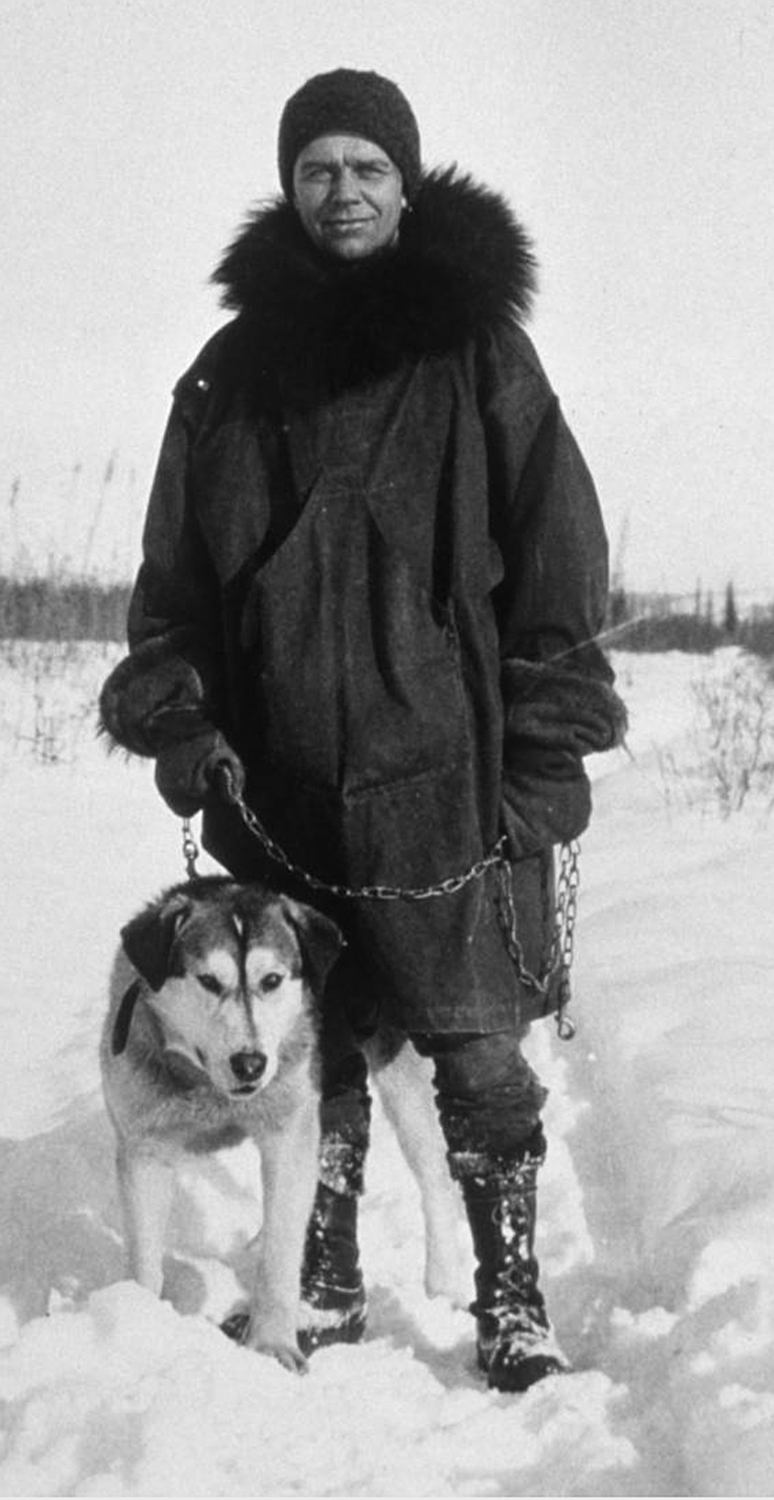
Olaus Murie, son of Norwegian immigrants and a leader in American wildlife research and wilderness protection.
Nor is the idea that race and national origin are somehow driving a decline in support for environmental issues. A century ago, the great American melting pot had barely begun its work—large minorities occupied urban enclaves where Old World attitudes still had a powerful presence. Many of these newcomers couldn’t even speak English and were often the focus of brutal discrimination, but these ethnic tensions didn’t seem to undermine the broad American impulse to reduce pollution, preserve natural areas, and protect wildlife; in fact, several immigrants and children of immigrants became leaders in the movement.
The proliferation of environmental organizations in the United States over the last forty years has allowed specific interest groups to focus more closely on issues they care about, and there’s no doubt that some of these goals conflict. However, conflict is nothing new in the environmental movement. The most notorious fight in the movement during the late nineteenth century was the vituperative confrontation between the Sierra Club’s John Muir and Teddy Roosevelt’s secretary of the interior, Gifford Pinchot, but there were many other passionate confrontations over issues as fundamental as the constitutional underpinnings of the federal effort to protect migratory birds; as procedural as the management of national forests, parks, and wildlife refuges; and as ethically motivated as the preservation of wilderness areas and wild rivers.
These days, most of the nation’s major environmental groups belong to cooperative associations to coordinate their efforts on major issues. Messaging and lobbying are carried out at a high level of sophistication. If there is still disagreement across the spectrum of environmental activism, it’s hard to believe it’s any more disruptive now than it was a century or more ago.
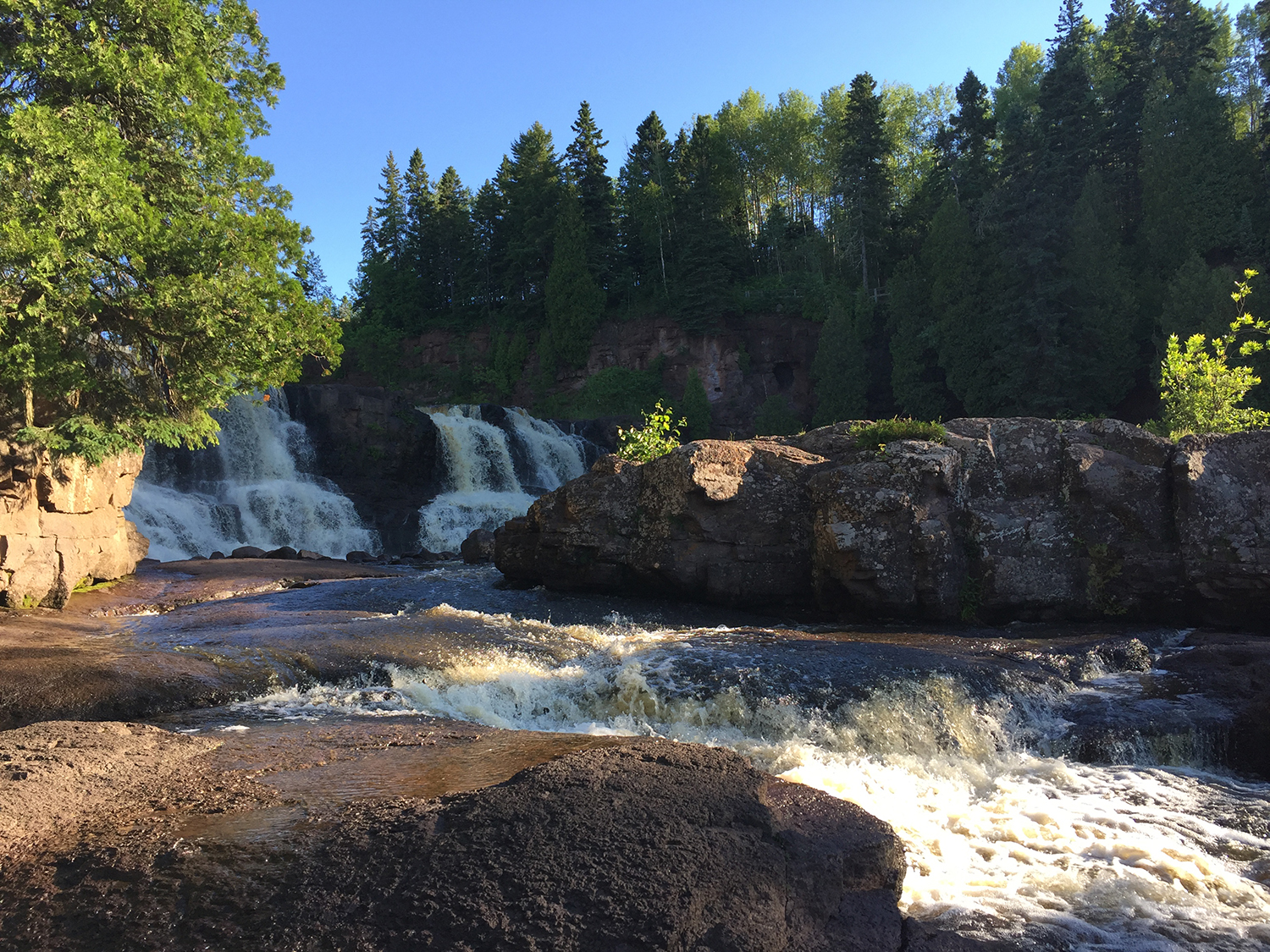
Environmental issues like water quality touch every American, regardless of income, vocation, race, city dweller or country cousin. (Gooseberry Falls, Minnesota, photo copyright, 2018, Chris Madson, all rights reserved)
Shellenberger and Nordhaus accuse environmental groups of failing to relate environmental issues to other concerns American have— employment, health care, national security— and ignoring politically powerful groups like labor unions. Early in 2005, Carl Pope, then the executive director of the Sierra Club, published a scathing analysis of the Shellenberger/Nordhaus accusations, pointing out that the Sierra Club has long made common cause with organized labor on broad issues of environmental quality, job creation, and the ongoing viability of major industries.
Pope also argued that, if Shellenberger and Nordhaus had been looking for a more compelling, less technical approach to the broad issues of people and their relation with the planet, they should have spoken with influential thinkers like Wendell Berry, Paul Shepherd, and Terry Tempest Williams, among many others. S&N failed to contact any such leaders in the area of philosophy or art.[ix]
To that, I can only add that the conservation/environmental community has always reached out to a spectrum of Americans with a message that combines practical recommendations with ethical considerations and a vision of a better future. Such elements can be found in the combined work of men like George Perkins Marsh, Frank Forester, and Henry David Thoreau well before the Civil War. Nor have such efforts diminished since the glory days of the early 1970s. They’ve migrated into new media and focused on a host of urban issues as well as the matters of wilderness and wildlife that some detractors have argued are the primary “elitist” interests of the modern environmental movement. Contrary to the argument Shellenberger and Nordhaus make, the outreach may be better than it’s ever been before. I think something else is responsible for the fading American effort to maintain our environment, and I think that “something” is about to change.
NEXT: REBIRTH
[i] Pew Research Center, March 2016 Political Survey. p.14.
[ii] Pew Research Center, May 2018. Majorities see government efforts to protect the environment as insufficient.” May 14, 2018. p.2.
[iii] U.S. Department of the Interior, USFWS, and U.S. Commerce Department, U.S. Census Bureau, 2018. 2016 National Survey of Fishing, Hunting, and Wildlife-Associated Recreation. FHW/16-NAT. p.4.
[iv] Outdoor Industry Association, 2017. The Outdoor Recreation Economy. Boulder, CO.
[v] Shellenberger, Michael and Ted Nordhaus, 2004. The death of environmentalism. The Breakthrough Institute, Oakland, CA.
[vi] Kloor, Keith, 2012. The great schism in the environmental movement. Slate, December 12, 2012.
[vii] Purdy, Jedediah, 2016. Environmentalism was once a social-justice movement. The Atlantic, December 7, 2016.
[viii] Picketty, Thomas, 2014. Capital in the Twenty-first Century. Belknap Press of Harvard University Press, Cambridge, MA. p.348.
THAT WAS THE WAY THINGS STOOD WHEN A NEW GENERATION OF ENVIRONMENTAL PROFESSIONALS EMERGED FROM THEIR TRAINING TO DO what they could to sustain the “integrity, stability, and beauty of the biotic community.” I was one of that cohort. I ‘d done my graduate work in the department Leopold established at the University of Wisconsin-Madison, advised by Leopold’s last graduate student, Robert McCabe. My colleagues and I studied late into the night in the department’s well-stocked library, looking up occasionally at a bow of osage orange and a quiver of arrows Leopold had made himself, the bow and its arrows hanging in a locked glass case over the original manuscripts of A Sand County.
I think I can speak for many of the professionals of that generation, nearly all of whom are now retired and more or less bitter about the situation as it stands. They— we— expected to lead a charge into the future; instead, we’ve been in a fighting retreat for thirty years or more, which is to say, most of our professional lives.
The momentum of the environmental movement carried the nation for another decade or so after the great surge in public interest and legislative action of the 1960s and 1970s. After bans on their use, concentrations of DDT and PCBs declined in America. Levels of lead in the environment dropped considerably after the ban on lead additives in gasoline. The hole in the ozone layer was repaired. Sulfates and nitrates responsible for acid rain were reduced by forty percent. No rivers have caught fire since the last time Ohio’s Cuyahoga River burst into flames in 1969. The average fuel efficiency of American cars and trucks has improved— ever so slightly—[i] as mileage requirements for new vehicles were raised. Organic farming has managed to get a foothold in the nation’s supermarkets.
Trumpeter swans on Loess Bluffs National Wildlife Refuge, northwest Missouri. (Photo copyright, Chris Madson, 2017, all rights reserved)
Iconic species like the bald eagle, whooping crane, peregrine falcon, trumpeter swan, and black-footed ferret were rescued from the brink of extinction. The gray wolf was successfully reintroduced to Yellowstone National Park and the northern forests of Wisconsin and Minnesota. The rate of destruction of important habitats like freshwater wetlands and native grasslands slowed, kindling some hope among specialists that we would eventually regain some of what had been lost.
But somewhere in the 1980s, the environmental tide turned, and it’s been headed out ever since.
The Clean Water Act of 1972 promised in ringing language “to restore the chemical, physical, and biological integrity of the Nation’s waters.” In the first decade after its adoption, pollution from many “point sources,” the effluent pipes from factories and sewage treatment plants, dropped, and there was reason to believe that America’s waters would soon return to “swimmable, fishable” condition.
Unfortunately, the problem of “nonpoint sources” of pollution, the chemicals and dissolved solids that wash off farmland, suburban lawns, and city streets, was left largely unaddressed. As a result, huge quantities of nutrients like nitrogen and phosphorus, herbicides and insecticides, and loads of sediment continued to find their way into the nation’s streams. As we head toward the fiftieth anniversary of the Clean Water Act, the levels of nitrates in our water are about the same as they were when the act was passed; pesticides continue to float downstream; and an entirely new class of pollutants, endocrine disruptors, are beginning to cause significant physiological problems for a growing list of animals from snails to humans.
Duckweed on the upper Mississippi River in southeastern Minnesota. (Copyright 2017, Chris Madson, all rights reserved)
The “death” of Lake Erie was one of the most influential parables of the 1960s environmental movement. In that era, a massive overdose of phosphorus from “nonpoint sources” around the lake had triggered gigantic algal blooms. When the algae died and began to decompose, the process consumed most of the oxygen in parts of the lake, creating “dead zones” devoid of any aquatic life. Cooperation between Canada and the United States led to a drastic reduction in particulate phosphorus and a rebound in the lake’s biota, but recent trends in farming have once again boosted the level of dissolved phosphorus, which nourishes huge blooms of blue-green “algae,” actually a form of bacteria that can be highly toxic. The blue-greens have an advantage over true algae in the lake because nothing eats them, not even the exotic zebra mussels that are rapidly displacing native shellfish. The blue-green blooms threaten, not only the wildlife in and on the lake, but people who drink the water.[ii]
On Chesapeake Bay, another of the famous examples of environmental stress in the Sixties, the situation is only marginally better. Thanks to gargantuan efforts and sustained cooperation among several states and the federal government, the bay has shown some improvement in its ecological health over more than forty years, although scientists at the University of Maryland still give its condition no better than a “C” grade overall.[iii] Whether efforts to reduce runoff of sediment and nutrients can be sustained in the face of a steadily growing human population and intensifying farming around the bay is yet to be seen.
The situation on the delta of the Mississippi River is a variation on the same general theme: nutrients have created an oxygen-depleted dead zone off the coast of Louisiana that covered an area the size of New Jersey last summer.[iv]
Then there is the case of the Everglades. Disruption of the historic flow of water and nutrient pollution from massive farming operations and a growing human population have threatened the integrity of America’s most famous wetland for more than a century, but the situation has gotten significantly worse in the last decade. The International Union for Conservation of Nature now includes the Everglades on its list of critically threatened natural areas.[v]
In its most recent assessments of water quality, the EPA found that only twenty-eight percent of the nation’s streams are in “good” biological condition.[vi] Forty percent of the nation’s lakes have “excessive levels” of phosphorus; thirty-five percent have “excessive levels” of total nitrogen; a third of all lakes show problems with invertebrate populations.[vii]
Against this backdrop, the U.S. Supreme Court, in 2001, decided to drastically restrict the scope of one of the Clean Water Act’s most critical terms: “waters of the United States.” The problem of regulating “nonpoint sources” of pollution was difficult enough when it could be addressed at a national level. Now that the smaller tributaries and isolated wetlands are left to the tender mercies of special interests in the states, runoff of nutrients and other pollutants from wide areas will have no control at all and many ephemeral marshes will face the threat of being filled in entirely. Water quality, on the surface and underground, will suffer, along with hundreds of species of wildlife, especially the migratory birds that depend on the continent’s wetlands.
My copy of the state of Wyoming’s fishing regulations is open on my desk. On page 12, it warns me to limit my consumption of the fish I catch from some of the waters here to “2 meals per week (8 ounces per meal before cooking).”[viii] This, in a state with only 560,000 people, a region known for its pristine wilderness. These days, most state fishing regulations carry a similar warning, just one more reminder, if another reminder were needed, that the Clean Water Act is far from achieving the laudable goals it set for itself.
The Clean Air Act has generally done better. Since 1980, the average concentration of carbon monoxide at U.S. sampling stations has dropped eight-five percent; lead levels have dropped ninety-nine percent; nitrogen dioxide levels have dropped sixty-one percent; ozone, by thirty-one percent; sulfur dioxide, by eighty-seven percent.[ix] All of these pollutants are now below standards set under the act. So are particulate emissions. In fact, there’s only one major challenge left in the struggle, but it’s turned out to be the most dangerous of all.
Dust storm in northwestern Kansas, May 2014. (Photo copyright 2017, Chris Madson, all rights reserved)
Greenhouse gases. In the mid-1950s, a young chemistry student, Dave Keeling, wondered whether our rapidly increasing use of coal and oil might be affecting the composition of the atmosphere and increasing the amount of solar radiation trapped on earth. By the middle of the twentieth century, many scientists were considering the same possibility. It wasn’t a new idea. The Swedish chemist Svante Arrhenius proposed the notion that the burning of massive amounts of coal might raise world temperature in 1896, and in 1938, British engineer Guy Callender reported preliminary data that supported Arrhenius’ view.
Keeling’s contribution to studying the relationship was an improved instrument to measure CO2 and a better place to take samples— Hawaii, a site that could be easily reached but was thousands of miles from local sources of CO2, natural or human, that might distort results. He began measuring the concentration of carbon dioxide at the Mauna Loa Observatory in March of 1958. That month, the average CO2 level was 315.71 parts per million. In April of 2018, it averaged 410.26.[x]
In 1965, the members of the President’s Environmental Pollution Panel were concerned enough about climate change to give it an entire chapter in their annual report, Restoring the Quality of Our Environment. They concluded that, “by the year 2000 the increase in atmospheric CO2 will be close to 25%. This may be sufficient to produce measurable and perhaps marked changes in climate, and will almost certainly cause significant changes in the temperature and other properties of the stratosphere.”[xi]
Now, we have the benefit of fifty more years of data collected in a wide-ranging array of climate studies, from the analysis of ancient ice and fossil pollen to the prediction of the future by hyper-sophisticated computer models. The message from all that information and analysis is the same as it was when Keeling first started his CO2 measurements: We’re heating the planet. So is our response: The problem is more than we want to tackle.
While these overarching indicators of American environmental quality have followed their depressing tracks, similar trends have haunted my world, the world of wildlife and wildlife habitat, over the last forty years.
Up until the 1960s, the nation dealt with rare species of wildlife one at a time. High-profile animals like the bison and trumpeter swan captured national attention and were given some support as a result. Rare species with less notoriety were generally neglected.
The nation’s commitment to rare wildlife broadened with the endangered species conservation acts of 1966 and 1969,[xii] and when those laws proved largely ineffective, Congress passed the Endangered Species Act of 1973, a law that established “a program for the conservation of such endangered species” in order to safeguard “the Nation’s heritage in fish, wildlife, and plants.”[xiii] ESA passed in the House of Representatives by a vote of 390 to 12;[xiv] in the Senate, by a vote of 92 to 0,[xv] but, within a decade, it was under attack and has remained one of the nation’s most controversial environmental laws ever since.
An amendment to the law in 1982 is just one example— it created a mind-bending new classification for species that have been proposed for listing as “threatened” or “endangered”: the idea that a listing is “warranted but precluded.” It’s an admission that, although scientific analysis supports a listing, federal wildlife officials are not going to list it. One of the most recent wrinkles in the ongoing assault is a provision in the last four federal budgets that prohibits the U.S. Fish and Wildlife Service from spending any money on processes that might lead to the listing of the greater sage grouse in the interior West.
The act has had its share of successes: Species like the grizzly, gray wolf, whooping crane, California condor, and trumpeter swan, needed more protection from a variety of human activities. When we gave them that protection, they also began to recover. A few, like the black-footed ferret, were specialists that required a specific habitat in order to survive. When we provided that habitat or protected what was left and found ways to produce animals in captivity so they could be reintroduced to the wild, they began to recover, at least to the limit of the habitat they had left. Many of these specialists were probably never abundant or widely distributed— they occupied a relatively small niche on the landscape and could survive nowhere else.
We’ve succeeded where the challenges were relatively straightforward and where there was general public support for the species in need. Where the challenges are more complex, we’ve struggled, partly because of the limits of our scientific understanding of ecology of rare and declining species but mostly because the agency charged with executing ESA has been hamstrung by attacks on its funding and authority.
In the forty-year span of my professional life, three North American birds— the Bachman’s warbler, Eskimo curlew, and ivory-billed woodpecker— probably disappeared from the world. The warbler nested in the swamps of the southeastern United States; the woodpecker was a year-round resident in pristine bottomland forests of the Southeast; the curlew swept across the prairies in America’s heartlands between its tropical wintering areas and its nesting grounds on the northern tundra. In addition, four Hawaiian birds have been extirpated since 1965.
A male Attwater’s prairie chicken displaying on one of the species’ last breeding grounds in southern Texas. Copyright 2015 Chris Madson, all rights reserved.
The Attwater’s prairie chicken of the Texas Gulf coast continues to teeter on the ragged edge of extinction in the wild, and the Gunnison’s sage grouse clings to a precarious existence in the mountain valleys of central Colorado.
As depressing as the ongoing decline of rare birds has been, I’m even more dismayed by the trajectories in populations of common birds I grew up with, species like the eastern meadowlark, once a presence on every other fencepost in the Midwest, a species that has been declining at the rate of more than three percent a year, a drop of nearly ninety percent, since surveys began in 1966.[xvi] Or the northern bobwhite quail— since 1966, bobwhite populations have declined by eighty-eight percent.[xvii]
According to recent research, about a third of the 551 bird species wintering in the United States “have declined over the last five decades, some of them quite dramatically.”[xviii] Some groups are at particular risk. More than half of the fifty-four bird species that live on the oceans around North America are at “high risk,” according to the North American Bird Conservation Initiative. Same proportion applies to the 478 species in America’s tropical and subtropical forests.[xix]
There have been surprising and disheartening declines in the populations of other kinds of wildlife as well. Populations of the mule deer, one of the icons of the American West, have been slipping for nearly forty years across most of the species’ range for reasons researchers and wildlife managers still don’t fully understand. North American bats are reeling under the attack of new diseases. Shocking numbers of amphibians are beset by their own special illnesses and are losing ground as a result. Bees, both our native species and the imported honeybee, are under stress, a trend that threatens the businesses of many farmers who depend on pollinators to fertilize the flowers that eventually become almonds, apples, and other fruit. Numbers of the monarch butterfly, the bug that must surely hold the record among arthropods for greatest human fan base, have dropped by eighty-four percent in the last twenty years.[xx]
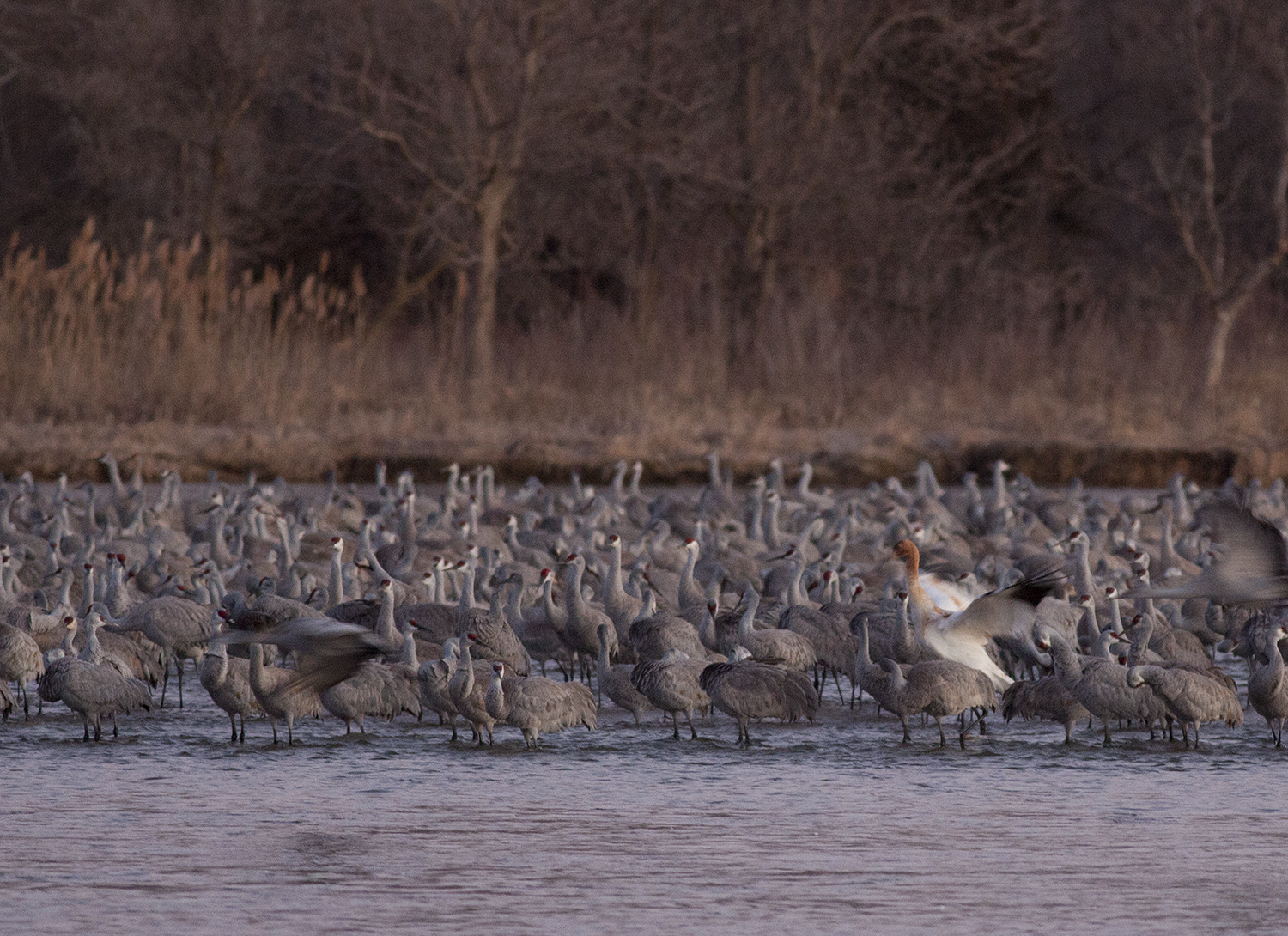
Parched federal wetland in the Dakotas. (Photo copyright, 2000, Chris Madson, all rights reserved)
No small part of this downward spiral among wild things is due to a loss of key habitats. Two-thirds of the original marshes in the prairie pothole region of the northern prairie have been drained and are now farmed.[xxi][xxii] The tallgrass prairie system that once surrounded these wetlands is in even greater distress— somewhere between eighty-six percent and ninety-nine percent of it has gone under the plow.[xxiii] Farther south, the bottomland forests of the Southeast’s great river systems have been reduced to scattered fragments. Louisiana’s experience is probably typical— one report states that the loss “is estimated to be 50 to 75% of the original presettlement acreage, statewide. Old-growth examples of this habitat type are very rare.” The strange thickets of native bamboo that frontiersmen called “the canebrake” have been reduced to about two percent of their original area and are considered a “critically endangered ecosystem.”[xxiv]
Much of this damage occurred before the environmental movement peaked in the early 1970s. There’s a lag time between the destruction of a habitat type and the disappearance of the animals that depend on it, so the extinction of animals that depended on these systems is, to a marked degree, the legacy of land-use decisions that were made and executed before I was born. The ongoing declines in populations of more common wildlife since the 1970s are, in part, a reflection of outright loss of habitat, but they’re also a frightening indicator of the poor health of the wild places we have left.
Some of the wild species in decline are specialists whose limited niches are under special stress. Many more are generalists, capable of exploiting a wide variety of food and cover, often traveling over vast areas of the hemisphere. Their struggle may be the most accurate assessment we have of the ecological condition of the continent, and that picture is far from encouraging. Leopold described the view of many wildlife specialists of this generation when he wrote that “one of the penalties of an ecological education is that one lives alone in a world of wounds.”[xxv]
[vi] U.S. Environmental Protection Agency, 2016. National Rivers and Streams Assessment 2008-2009: A Collaborative Survey. EPA/841/R-16/007, Washington, D.C. p.xiii.
[vii] U.S. Environmental Protection Agency, 2016. National Lakes Assessment 2012: A Collaborative Survey of Lakes in the United States. EPA 841-R-16-113, Washington, D.C. p.1.
[viii] Wyoming Game and Fish Department, 2018. Wyoming fishing regulations. Wyoming Game and Fish Department, Cheyenne, WY. P.12.
[xviii] Sykan, Canadan U., et al, 2016. Population trends for North American winter birds based on heirachical models. Ecosphere 7(5):12.
[xix] North American Bird Conservation Initiative, 2016. The state of North American birds. Environment and Climate Change Canada, Ottawa, Ont.
[xx] Throgmartin, Wayne, E., et al, 2017. Monarch butterfly population decline in North America: identifying the threatening processes. Royal Society Open Science 4: 170760. http://dx.doi.org/10.1098/rsos.170760.
[xxi] Dahl, Thomas E., 1990. Wetland losses in the United States, 1780s to 1980s. U.S. Department of the Interior, Fish and Wildlife Service, Washington, D.C. p.6.
[xxii] Dahl, Thomas E., 2014. Status and trends of prairie wetlands in the United States 1997 to 2009. U.S. Department of the Interior; Fish and Wildlife Service, Ecological Services, Washington, D.C. p.18.
[xxiii] Samson, Fred B., Fritz L. Knopf, and Wayne R. Ostlie, 2004. Great Plains ecosystems: past, present, and future. Wildlife Society Bulletin 32(1): 6-15.
[xxiv] Platt, Steven G. and Christopher G. Brantley, 1997. Canebrakes: An ecological and historical perspective. Castanea 62(1): 8-21.
[xxv] Leopold, Aldo, 1953. Round River. Oxford University Press, New York, NY. p.165.
THE SUMMER OF 1947 WAS QUIETER FOR ALDO LEOPOLD THAN HE’D EXPECTED.
He was at the peak of a remarkable career: founder and chair of the world’s first department of wildlife management at the University of Wisconsin; a sought-after essayist and public speaker; one of the founders of the Wilderness Society; honorary vice president of the American Forestry Association; and president of the Ecological Society of America, elected even though he seldom attended the ESA’s annual conference and did not consider himself an active member.[i]
He was also wrestling with a manuscript for a nature book he’d promised the editors at Alfred A. Knopf. It was a project he’d been considering for six years and had discussed with Knopf for at least three.[ii] The book project had proven to be unexpectedly challenging — the wordsmiths at Knopf struggled with the eclectic nature of the essays he submitted, some intensely personal and descriptive, others expansive and deeply philosophical.[iii] And Leopold couldn’t find the time to give the work his undivided attention.
It took a doctor’s order to slow him down. Sometime in late 1945, he had begun suffering occasional spasms of extreme pain on the left side of his face. At some point, he sought medical attention and was given a name for the problem— trigeminal neuralgia— and few options for treatment. By early 1947, the attacks had become frequent and temporarily debilitating. In May, he submitted to an “alcohol block,” an injection his doctors hoped would deaden the trigeminal nerve. The specialists weren’t sure how precise the injection would be, how much it would relieve the pain, or how long the effect would last, but, short of surgery, it was the only palliative they could offer. They cautioned their patient to step back from his hectic schedule and rest over the summer.[iv]
With those directions in mind, Leopold scheduled just a single June trip to Minnesota where he attended the Wilderness Society’s annual council meeting and stopped in Minneapolis on the way back to address the conservation committee of the Garden Club of America, a speech he called “The Ecological Conscience.” With those commitments fulfilled, he settled down to prepare his essays for publication.[v]
Sometime in late July, as the painful spasms in his face returned and he reflected on a lifetime spent in defense of wildlife and wild land, his thoughts turned back to something he’d said to the Garden Club. It reflected a broadening of the precepts he’d been taught as a student in Gifford Pinchot’s School of Forestry at Yale; in the subsequent thirty-eight years, he had reached beyond purely technical analysis and Pinchot’s utilitarian “wise use” of natural resources to a philosophical whole that combined ecological reality with human morality.
“Examine each question in terms of what is ethically and esthetically right, as well as what is economically expedient,” he wrote. “A thing is right when it tends to preserve the integrity, stability, and beauty of the biotic community; it is wrong when it tends otherwise.”[vi] He called this “the land ethic.”
It was— and remains— one of the great ideas in American thought, and, like most great ideas, it wasn’t entirely original. Its roots reached back across the generations to the experiences of the first generation of Europeans to settle in the New World.
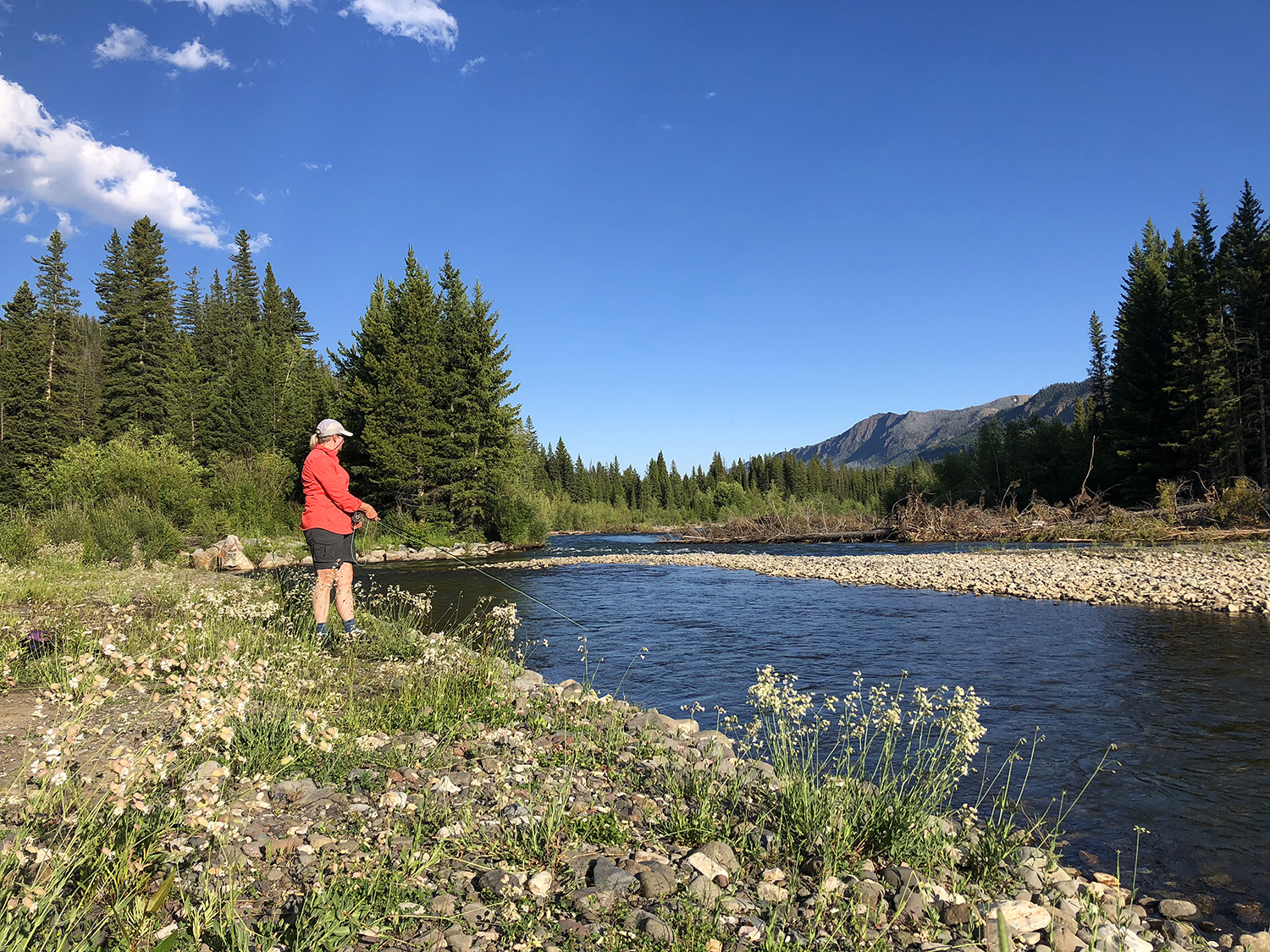
As early as 1626, the residents of New Plymouth, Massachusetts, adopted a local ordinance to protect the colony from the “inconveniences as do and may befall the plantation by the want of timber.” Before a colonist cut down a tree, he was required to seek “the consent approbation and liking of the Governour and council.”[vii] And the colonial concern over impending scarcity wasn’t limited to lumber. In the winter of 1646, the council of the settlement of Portsmouth, Rhode Island, ordered “that there shalbe noe shootinge of deere from the first of May tell the first of November and if any shall shoote a deere with in that tyme he shall forfitt 5 pounds.”[viii]
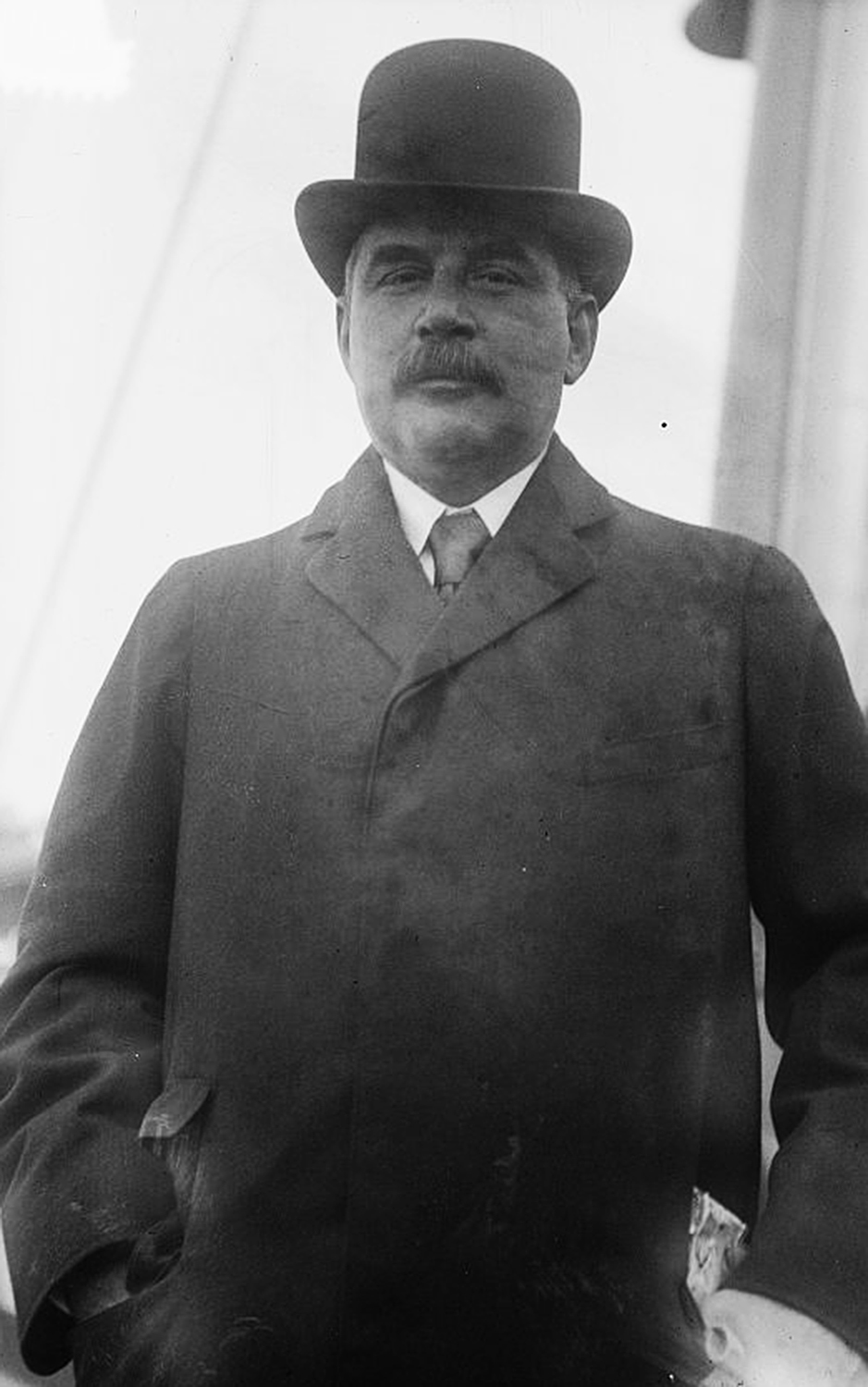
The discovery was repeated again and again as each generation of emigrants ventured into territory they considered to be unsettled, built their cabins, and lived off the fat of the land while they labored to transform it. As stands of old-growth white pine, chestnut, and oak melted away under the onslaught of the timber barons, as populations of bison and elk disappeared at the edge of the frontier and the passenger pigeon and Carolina parakeet began their free fall toward extinction, the idea of a more judicious approach to the management of natural resources steadily gained public support.
And so Americans began to organize. The trend began among zoologists and enthusiasts of natural history: the American Fisheries Society in 1870;[ix] the American Forestry Association in 1875;[x] the Nuttall Ornithologists’ Club in 1873, which became the American Ornithologists’ Union in 1883;[xi] the Boone and Crockett Club, a gathering of influential patrician sportsmen and scientists, in 1887.[xii]
George Bird Grinnell, pioneer conservationist and founder of the Audubon Society
In February of 1886, George Bird Grinnell, editor and publisher of Forest & Stream magazine, called for “an association for the protection of wild birds and their eggs, which shall be called the Audubon Society.”[xiii] Within three years, membership in the society had grown to more than 50,000.[xiv]
In response to a groundswell of public concern, the federal government began to act. Congress created a division of fisheries management in 1871, a division of forestry in 1881, and a division of economic ornithology to research the practical benefits of songbirds in 1885. The first national forest was established in 1891; the first national wildlife refuge, in 1892. In 1890, it became illegal to “throw rubbish, filth, refuse, or waste of any kind into the navigable rivers of the United States.”[xv] By the time Teddy Roosevelt moved into the White House a decade later, the electorate had clearly demonstrated its support for practical conservation, and the government’s role in advancing the doctrine had already become a prominent part of the nation’s political dialogue.
As the currents of pragmatic management of natural resources gathered force, another school of thought also developed. While Pinchot stressed the importance of use in his approach, his contemporary, John Muir, championed a less utilitarian relationship between humans and wild places: “Everybody needs beauty as well as bread, places to play in and pray in, where nature may heal and give strength to body and soul,” he wrote in 1912[xvi]
The antecedents of Muir’s view stretch back as far the origins of practical conservation. Its origins can be traced through the popular writings of John Burroughs; through the work of artist-naturalists like Audubon, Alexander Wilson, and Mark Catesby; into the musings of Henry David Thoreau— “In wildness is the preservation of the world”;[xvii]— and even earlier in the journals of men who are now largely forgotten, pioneers like John Lawson— “. . . the loftiest Timbers . . . proper Habitations for the Sweet-singing Birds . . .”[xviii] and Thomas Morton— “’Twas Nature’s Masterpiece . . . If this land be not rich, then is the whole world poore.”[xix]
This less pragmatic ideal found its way into federal policies even before the more practical approaches to conservation were adopted. As the Civil War raged to its conclusion in 1864, President Lincoln took time to sign a grant of land to the state of California, a parcel “known as the Yo-semite valley . . . with the stipulation . . . that the premises shall be held for public use, resort, and recreation . . . for all time.”[xx] Eight years later, Congress voted to set aside a much larger tract of land “lying near the Head-waters of the Yellowstone River . . . as a public park or pleasuring-ground for the benefit and enjoyment of the people.”[xxi] Just what constitutes a “pleasuring-ground” remains the subject of heated debate in some circles even today, but by the time the National Park Service was formed in 1916, it was clear that at least part of Yellowstone’s purpose was to serve as a refuge for wildlife as well as people.
Esthetic and even spiritual sentiments had drifted in and out of the developing canons of practical conservation for generations before Leopold was even born, and the trendrils of such perceptions reached back across the Atlantic, disappearing at last into the mists of prehistory in the Old World. What Leopold added was a stiff shot of ecology. Along with other scientific pioneers like Charles Elton and Herbert Stoddard, Leopold had stepped back from the disciplines of zoology and natural history to consider the processes and interactions that drive natural systems. His land ethic combined the scientific, practical, and esthetic elements of the conservation imperative and did it with a grace and poetic economy that was unprecedented.
It was a lucky thing for those of us who came after that he found the respite to finish his work that summer. By August, the neuralgia had intensified to the point that Leopold scheduled surgery to have the trigeminal nerve severed. The surgeons at the Mayo Clinic declared the procedure a success, but it left him with partial paralysis on the left side of his face, difficulty speaking, a chronically dry left eye, and, most disturbing, problems with his memory. While he recovered slowly, finally resuming his normal lecture schedule and contributing to a few technical conferences the following spring,[xxii] he managed to write only two more short essays for the book before his death on April 21, 1948, at the age of sixty-one.[xxiii]
Knopf dropped the book before Leopold’s death, but thanks to Leopold’s son, Starker, Oxford University Press picked it up,[xxiv] and after the family and several of his close friends finished the final editing, the collection appeared under the title, A Sand County Almanac and Sketches Here and There, in 1949.[xxv]
It’s an interesting footnote to history that several editors were uncomfortable with the philosophical essays Leopold had included in Sand County. They saw more market value in the nature vignettes that made up the almanac itself. In retrospect, it was precisely the philosophy that led to its initial success and has accounted for its ongoing popularity. Even more than Silent Spring, Sand County’s “Sketches Here and There” and “The Upshot” were the new testament of environmental stewardship in America. They crystallized the sentiment that had shaped almost a century of action by the government, the scientific community, a host of organizations, and millions of Americans.
Whenever energy began to flag, people were goaded by another in a succession of sobering natural catastrophes: Wisconsin’s Peshtigo fire in 1871, a hurricane of flame that claimed the lives of at least 1,500 people; the “Big Burn” of 1910, another inferno that laid waste to an area the size of New Jersey and killed 85 people in just two days; the Galveston hurricane in 1900 that erased a city and killed between 6,000 and 12,000 people; the Mississippi Flood of 1927; the Dust Bowl; rivers catching fire in major urban areas; high-profile animals like the bald eagle and whooping crane leading scores of other species on the way toward extinction, all of them reminders of the consequences of a failure to understand and respect the land and the processes it supports.
Dust storm in Baca County, Colorado, 1936. (D.L. Kernodle, courtesy of the Library of Congress)
The momentum that had driven the growing environmental movement through the last third of the nineteenth century and the first half of the twentieth reached some sort of peak in the decades following the appearance of Sand County. A groundswell of support led to federal laws that promised to control air and water pollution, imposed limits on pesticide use, protected endangered species, reduced erosion on vulnerable cropland, established wildlife habitat there, and mandated a thorough review of the consequences of any major federal development project before it could begin. The Land and Water Conservation Fund was established in 1964,[xxvi] a program that diverted billions of dollars of income from offshore oil leases to projects as diverse as improving water treatment plants and expanding national parks and wildlife refuges, and the Environmental Protection Agency was created in 1970.
Other programs emerged in the same era, arguably less pragmatic but solidly in the tradition of the esthetic and spiritual concerns captured in Leopold’s land ethic: the Wilderness Act of 1964, the Wild and Scenic Rivers Act of 1968, the Marine Mammals Protection Act of 1972, the creation of the Arctic National Wildlife Refuge in 1960, and the passage of the Alaska National Interest Lands Conservation Act in 1980, legislation that added nearly 44 million acres to the national park system, almost 10 million acres to the nation’s wildlife refuges, and more than 9 million acres to the area of federally protected wilderness. There was every reason to believe that Americans were unalterably committed to a sustainable relationship with the land they called home.
NEXT INSTALLMENT: THE TIDE GOES OUT
[i] p. 493. Meine, Curt, 1988. Aldo Leopold: His Life and Work. University of Wisconsin Press, Madison, WI.
[vii] p.28. The Compact with the Charter and Laws of the Colony of New Plymouth: Together with the Charter of the Council at Plymouth and an Appendix. Dutton and Wentworth, Printers to the State, Boston, MA, 1836. From Laws of the Colony of New Plymouth
[viii] Brigham, Clarence, S., ed., 1901. Early Records of the Town of Portsmouth. E.I. Freeman & Sons, State Printers, Providence, RI. p.34.
[x] Steen, Harold K., 2004. The U.S. Forest Service: A History. Forest History Society in association with the University of Washington Press, Seattle, WA. p.9.
[xi] Orr, Oliver H. Jr., 1992. Saving American Birds: T. Gilbert Pearson and the Founding of the Audubon Movement. University of Florida Press, Gainesville, FL. p.22.
[xii] Reiger, John F., 2001. American Sportsmen and the Origins of Conservation. Oregon State University Press, Corvallis, OR. p.4.
[xiii] Grinnell, George Bird, 1886. “The Audubon Society” in Forest and Stream: A Weekly Journal of the Rod and Gun, Vol. 26:3, p.41, Feb. 11, 1886.
[xiv] Trefethen, James B., 1975. An American Crusade for Wildlife. Winchester Press, New York, NY. p.130.
[xv] Statutes at Large of the United States of America, Volume XXVI. Fifty-first Congress, Session I, Chapter 907, 1890. p.453.
[xvii] p. 239. Henry David Thoreau: Collected Essays and Poems. The Library of America, Literary Classics of the United States, New York, NY.
[xviii] p. 63. Lawson, John, 1709. A Voyage to Carolina; Containing the Exact Description and Natural History of that Country: Together with the Present State Thereof and a Journal of a Thousand Miles Travel’d thro’ Several Nations of Indians Giving a particular Account of their Customs, Manners, Etc. London, UK.
[xix] P. 54. Morton, Thomas, 2000. New English Canaan. Digital Scanning, Inc., Scituate, MA. Originally published 1637 in Amsterdam.
[xx] Statutes at Large, Thirty-Eighth Congress, Session I, Ch. 184, 1864. p.325.
[xxi] Statutes at Large, Forty-second Congress, Session II, Chapter XXIV. p.32.
THIS PLACE IS CLOSE TO THE CENTER OF THE BIG EMPTY IN WYOMING. THE RIDGE TO THE SOUTH IS KNOWN TO A HANDFUL OF LOCALS AS PINE HILL. THE mountain range just out of this picture to the west is too small to be a part of any national forest. It’s held and mostly neglected by the Bureau of Land Management. The local population of residents consists primarily of sage grouse, pronghorns, a handful of black-footed ferrets, and a herd of elk that drifts back and forth from the high country to the prairie as the season and the whims of its members dictate. As I went out last week to pursue a few of those elk, I found half a dozen of these flimsy antennae scattered across the area. They’re called “met” towers— “met” short for meteorological— and they’re the first step in installing yet another series of 400-foot-tall wind generators.
At a recent public meeting on the new “development,” a man who cowboyed on a local ranch as a youth and has hunted here all his life asked the representative of the energy corporation why he would build in such a place.
“It’s some of the very last of the very best,” he said. “What you want to do would destroy it.”
The rep listened perfunctorily and replied, “Tough.”
I believe in alternative energy. My wife and I are reaching into our life savings to install solar panels on our roof this fall. But wind and solar energy development at an industrial scale causes many of the same problems that industry in other forms has caused across the continent. It seems the goal of the big wind energy firms is the same as any other big company’s— maximize return on investment, nothing else. And for those of us who think that some places are too precious to scar, even in the name of clean energy, their message is clear:
IT’S THE BUSIEST INTERSECTION IN WYOMING, A CROSSING I MAKE, AT somerisk of life and limb, nearly every morning on my way back from running my Brittanies. As I wait for the light to change, my gaze settles on the ground at the curb. Heaven only knows how many times this dirt has been turned over as the roads have been built and widened, sidewalks and bike paths laid, Little League fields developed, big box stores and fast-food drive-throughs added. If there was ever any topsoil here, it’s long since been buried or scraped off and moved elsewhere. What’s left is mostly clay with a scattering of gravel, a substrate that is nearly as impervious to living things as the concrete and macadam pavement nearby.
Still, a few plants manage to take root here. Some, like the crested wheatgrass, brome, and fescue, were planted on purpose to hold the ground in place. Others, like the occasional stem of toadflax and sweetclover, are outlanders, tough enough to shoulder their way into the bare spots where other plants can’t survive. And right next to the curb, a tiny holdover from what once was— a patch of blue grama and buffalograss claiming a square yard among the exotics.
How these natives have survived the decades of abuse is beyond understanding. But here they are, a reminder of the history of this place, a history that has been otherwise erased.
A few years back, I picked up a copy of John C. Fremont’s journals. Captain Fremont set out from St. Louis in the spring of 1842 with a small detachment to explore the route across the plains to South Pass. According to Fremont’s journal, the group spent the night of July 12 about five miles south of what is now this corner. There was no timber to provide firewood, so they cooked over buffalo chips. The next morning, they headed north and crossed “a small creek in which there was water, and where several herds of buffalo were scattered about among the ravines, which always afford good pasturage.”
The bones of Fremont and his men have long since returned to the dust, along with the buffalo that fed them and the Sioux and Cheyenne that called this corner of the plains home. And here at my feet is the grass that supported them all— “good pasturage,” indeed.
For a moment, the roar of the road fades, and there is nothing but the weight of the sun on my shoulders, and the cool, prairie breeze whispers in my ears, just as it did for them. I find myself looking out over the creek, remembering something I never saw. All of them gone now. But the grass remains. Something important there, if I could just grasp it. The blare of a horn. Light’s green. Time to cross back over . . .